How to Improve Self-Esteem: Six Steps That Last
Self-esteem is not something you talk yourself into. How to improve self-esteem in six steps, with ten exercises, the research, and a worked example.

Contents
- 01What self-esteem is, and what it isn't
- 02Self-esteem vs. self-worth vs. confidence
- 03Where low self-esteem comes from, and how to spot it
- 04Why affirmations can backfire: the most common mistake
- 05How to improve self-esteem in six steps
- 0610 things you can do to boost self-esteem this month
- 07Priya's six months in numbers
- 08Self-esteem in the goal chain: from year to day
- 09Frequently asked questions about self-esteem
Knowing how to improve self-esteem starts with one idea: you change the evidence your mind uses to judge you: small promises kept, boundaries held, risks taken, and a kinder voice when things go wrong. Self-esteem is not something you can talk yourself into. It works more like a ledger than a mood. Anyone who keeps a few small promises to themselves every week is making deposits, and over months the balance shifts.
That takes three things: an honest starting number, two or three exercises that fit your actual week, and enough time for the ledger to move. This guide works it through with Priya, 29, a graphic designer at a small agency in Austin. Clients ask for her by name. She still opens every presentation with “this is probably not what you wanted,” redoes work nobody asked her to redo, and has not asked for a raise in three years because she is sure the others deserve it more.
What self-esteem is, and what it isn't
Self-esteem is your overall judgment of your own worth: whether, on balance, you see yourself as a person of value. Sociologist Morris Rosenberg defined it that way in 1965 and built a ten-item scale that is still the most widely used measure in research. You rate statements in the spirit of “on the whole, I am satisfied with myself” on a four-point scale. The total runs from 0 to 30.
Self-esteem moves during the day. A compliment nudges it up, a sharp email pulls it down. Underneath that movement sits a baseline it keeps returning to. Mark Leary and colleagues proposed in 1995 that self-esteem works like a sociometer, an internal gauge of how accepted we feel by other people. That explains why one offhand comment can color a whole afternoon. The gauge reacts before your reasoning gets a chance to check whether the comment was even fair.
What self-esteem is not: feeling superior. Michael Kernis distinguished in 2003 between secure and fragile high self-esteem. Fragile self-esteem can score high, but it needs constant defending. Secure self-esteem holds when something goes wrong. That means: the goal is not a high number. It is a stable one.
Self-esteem vs. self-worth vs. confidence
The three words get used as if they meant the same thing. Each one answers a different question, and separating them tells you what you are actually trying to build.
| Term | The question behind it | Where you notice it |
|---|---|---|
| Self-esteem | How do I rate myself overall? | How you talk to yourself after a mistake |
| Self-worth | Do I deserve respect and care, regardless of results? | Whether you accept being treated badly |
| Confidence | Can I handle what is coming? | Whether you start new things or put them off |
| Self-efficacy | Can I do this specific task? | How much effort you put into one concrete challenge |
Self-worth is the floor under self-esteem. It is the belief that you deserve decent treatment simply because you are a person, not because you performed well this week. Priya has plenty of self-efficacy: she knows she can rebuild a brand identity in two weeks. Her self-esteem is low anyway, because the verdict “I'm not enough” is about her as a person, not about her work. How belief in a specific task grows is covered in the guide to self-efficacy. This guide is about the level underneath. Anyone who only collects skills will not automatically become kinder to themselves.
Where low self-esteem comes from, and how to spot it
Low self-esteem usually starts early and gets confirmed later by experiences you quietly help select. Psychologist Melanie Fennell described the pattern in a cognitive model in 1997. It begins with experiences, often in childhood or adolescence: a lot of criticism, little warmth, bullying, being compared with a sibling, or a family where affection depended on performance. Those experiences harden into a bottom line, a core belief such as “I'm not good enough” or “I matter less than other people.”
The bottom line produces rules for staying safe. “If I do everything perfectly, nobody will notice I'm not enough.” “If I never say no, people will still like me.” As long as the rules work, life feels manageable. The moment a situation threatens them, a review, a deadline, a conversation about money, the core belief lights up. Then comes the thing that keeps it alive: avoidance. Anyone who never asks for the raise never collects the evidence that they could have gotten it.
Priya's rule was: “If I lower expectations first, nobody can be disappointed in me.” It protected her reliably. It also stopped her from ever finding out that her work was usually exactly what the client wanted. That is how the loop closes. The safety rule prevents the very experience that could disprove the core belief.
Can a pattern that old still change? The research says yes. Ulrich Orth and colleagues showed in a large 2018 meta-analysis of longitudinal studies that self-esteem, on average, rises from adolescence until around age 60. It is not a fixed trait. Julia Sowislo and Ulrich Orth also found in 2013 that low self-esteem predicts later depressive symptoms more strongly than the other way around. That makes the topic serious, and it makes the work worth doing.
When self-help is not enough
Exercises help when low self-esteem gets in the way of daily life. They do not replace treatment. If low self-esteem comes with lasting hopelessness, anxiety, or thoughts of harming yourself, talk to a doctor or therapist, and in the US you can call or text 988 at any time to reach the Suicide and Crisis Lifeline. If you are already in therapy, bring the steps in this guide to your next session.
Signs you've lost self-respect
There is no official checklist. Five signs show up again and again, and each one points back to a safety rule:
- You apologize before anything has happened. Priya counted 19 pre-apologies in her first week of tracking.
- You deflect praise and keep criticism. A compliment bounces off in a second, a critical comment stays for a week.
- You agree to things you resent. Extra work, favors, plans you did not want, all to avoid a moment of disappointment on someone else's face.
- You break promises to yourself without noticing. The gym, the side project, the early night. Each broken promise teaches you that your own word does not count.
- You always compare upward. Your worst day against someone else's highlight reel, every time.
Whoever recognizes three of the five has a useful starting point. Not for a verdict, but for a count.
Why affirmations can backfire: the most common mistake
Positive statements about yourself are an understandable idea. If you talk yourself down, why not talk yourself up? For people who already like themselves, there is nothing wrong with it. The research suggests it can backfire for the people who need it most.
In 2009, Joanne Wood and colleagues asked participants to repeat the statement “I am a lovable person.” People with high self-esteem felt slightly better afterward. People with low self-esteem felt worse. The researchers' explanation: a statement far from what you believe reminds you how far away you are. The inner critic answers back, and it gets the last word. If you still want to work with sentences, choose affirmations you can believe, such as “I am practicing speaking up” instead of “I am amazing.”
The most common mistake: claiming self-esteem instead of proving it
Saying something kind in the mirror feels like a start. With low self-esteem, though, a voice that has been “right” for years argues back. Evidence persuades it better than claims do: a promise kept, a no said out loud, an email you were afraid to send. The test is simple: can you name three pieces of evidence from last week for the sentence you want to believe? If not, collect the evidence first.
A second misunderstanding runs deeper. Roy Baumeister and colleagues reviewed the self-esteem research in 2003 and reached a sobering conclusion: high self-esteem does not, by itself, cause better performance or better relationships. The link with happiness is clear. The link with success is weak. So the goal is not to push the number up at any price.
How to build self-worth that doesn't depend on approval
Jennifer Crocker and Connie Wolfe described in 2001 how people base their self-worth on different contingencies, such as approval, appearance, or academic and work performance. The more your worth hangs on a single source, the harder it swings when that source wobbles. Priya's hung almost entirely on client feedback. One lukewarm email could undo a good month.
Kristin Neff offered a different foundation in 2003: self-compassion, which means speaking to yourself the way you would speak to a good friend who just failed. In a 2009 study by Neff and Roos Vonk, self-compassion was linked to steadier feelings of self-worth and less social comparison than global self-esteem. Self-compassion does not ask you to claim that everything is fine. It only asks for a kinder tone. That means: to build self-worth that survives a bad review, spread it across several sources and treat your own mistakes as a friend would.

How to improve self-esteem in six steps
How to improve self-esteem is a question of months, not days. Six months is a good window: long enough for the ledger to move, short enough to stay with it. You need a notebook or an app, a calendar, and the patience to only count for one week. Here is the plan:
Take a baseline
Answer the ten items of the Rosenberg Self-Esteem Scale, which is freely available, and write down your score. Then count one behavior that holds you back for seven days. Priya: 11 out of 30, and 19 apologies before anything had happened.
Write down the inner critic, word for word
Whenever you put yourself down, write the exact sentence. Next to it, write what you would say to a friend in the same spot. The goal is not to silence the critic but to hear it clearly. Priya filled 27 lines in three weeks.
Make small promises and keep them
Three promises to yourself per week, small enough to keep on a bad day: ten minutes of sketching for yourself, a walk without your phone, one question in a meeting without a disclaimer. On Friday, count how many you kept.
Hold one boundary a week
Once a week, say no to something you would normally take on out of guilt. Keep it kind and short. Priya started with one no a month and moved to one a week in April.
Take one avoided risk
Pick the thing your safety rule has been protecting you from and give it a date. For Priya, that was asking for a raise by the end of March. The outcome matters less than the fact that you did it.
Keep an evidence log and review it monthly
Every evening, one line: something you did, kept, or got through. Once a month, read the log, retake the Rosenberg scale, and adjust your promises. Whoever reviews only by feeling will see the worst week most clearly.
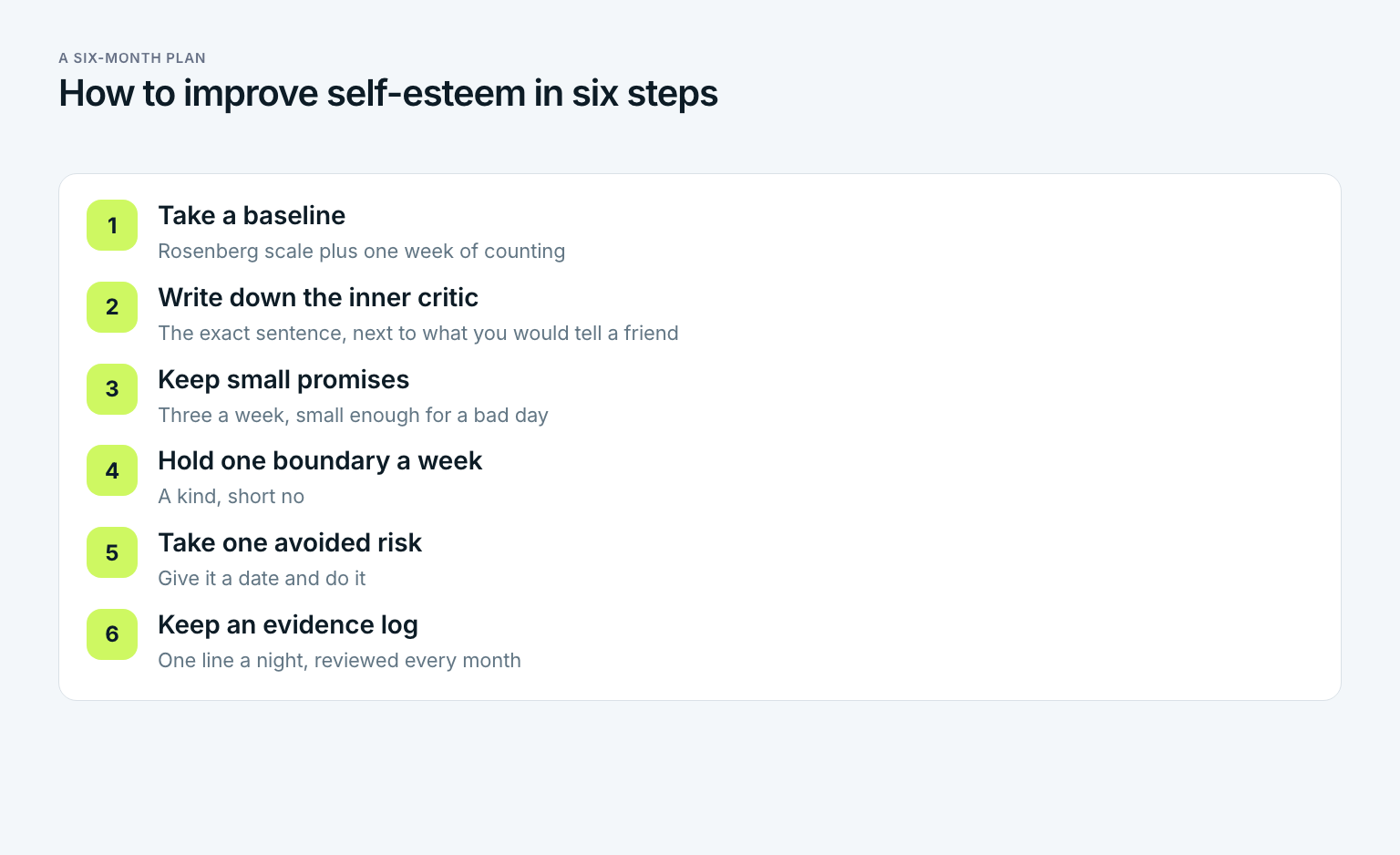
The plan takes little time. Five minutes in the evening for the count and the critic's sentence, ten minutes on Friday for your promises, half an hour once a month. If you want the evening notes to stay useful instead of sliding into rumination, the method in the guide to self-reflection helps. What matters most is the order: count first, change second. Without a baseline, every improvement is a claim, and claims are exactly what the inner critic takes apart most easily.
10 things you can do to boost self-esteem this month
The six steps are the frame. These ten exercises fill it. None takes more than ten minutes, and you do not need all ten. Pick two that match your safety rule:
- The friend test. When you put yourself down, ask whether you would say that to a friend in the same situation. Then write what you would actually tell them.
- The evidence log. One line each night about something you did, kept, or got through. After 30 days you have 30 pieces of evidence against “I never get anything done.”
- Take the compliment. When someone praises you, say thank you and stop. No “oh, it was nothing.” Priya found this the hardest and the most useful.
- One question, no disclaimer. Ask one question a day without apologizing first. Notice that nobody misses the apology.
- The weekly no. Turn down one request you would usually accept out of guilt. One sentence is enough: “I can't take that on this time.”
- The comparison break. For one week, limit the apps where you compare yourself most to a fixed fifteen minutes a day. Write down how often you still think everyone else is ahead.
- Spread your sources. Write down what your self-worth depends on right now. Then choose one area that has nothing to do with performance and give it an hour a week.
- Keep the smallest promise. Pick a promise so small it feels silly, such as filling a water bottle before work, and keep it every day for two weeks.
- Finish one thing you have been avoiding. Not the biggest one. The one that has sat on your list longest and would take under an hour.
- Move your body on purpose. A walk, a run, a class, at a time you set in advance. It is one more promise you can watch yourself keep, and it rarely depends on anyone else.
Why exercises instead of insights? Because self-esteem grows from repeated action. A thought can lift it for an afternoon, a repeated behavior moves the baseline. If you want an exercise to stick, the mechanics are in the guide on how to build good habits. In short: two exercises done for three months beat ten exercises tried for a week.
Priya's six months in numbers
Priya started in January. Her goal for the half year: ask for a raise by the end of March, and cut pre-apologies to five or fewer per week. Here is how the six months went:
| Month | Focus | Rosenberg score | Pre-apologies per week | Promises kept |
|---|---|---|---|---|
| January | Count, write down the critic | 11 of 30 | 19 | 5 of 12 |
| February | Three small promises a week, evidence log | 12 of 30 | 15 | 7 of 12 |
| March | Ask for the raise, first no | 14 of 30 | 12 | 9 of 12 |
| April | One no a week, take the compliment | 16 of 30 | 9 | 10 of 12 |
| May | Comparison break, spread sources | 17 of 30 | 6 | 11 of 12 |
| June | Hold steady, grow promises slightly | 19 of 30 | 4 | 11 of 12 |
Priya asked for the raise on March 26. She got half of what she asked for, with a review promised for September. Under the old rule, that would have been proof she had asked for too much. This time her evidence log read: wrote the case, booked the meeting, asked, negotiated. Her score went up in April, not down.
Two things in the table matter more than the numbers. First, self-esteem did not jump. It climbed one or two points a month. Whoever quits after three weeks mistakes a slow process for a useless one. Second, the promises kept went up before the Rosenberg score did. The evidence came first, the feeling followed. Anyone waiting for it the other way around waits a long time.
Priya's monthly and weekly goal in March
This is how small the half-year goal gets at the bottom. Monthly goal for March: ask for a raise by the 31st. Weekly goal for the second week: write one page with three projects, their results, and two market salary figures, and send it to a friend to read. Daily goal for Tuesday: twenty minutes after lunch on the first project. Small enough for a tired day, and one more line in the evidence log on Friday.
Self-esteem in the goal chain: from year to day
You cannot schedule self-esteem directly. You can schedule the actions it grows from. A goal chain turns a large intention into five levels, and each level answers a different question. The general method is in turning yearly goals into daily steps. For self-esteem, Priya's chain looks like this:
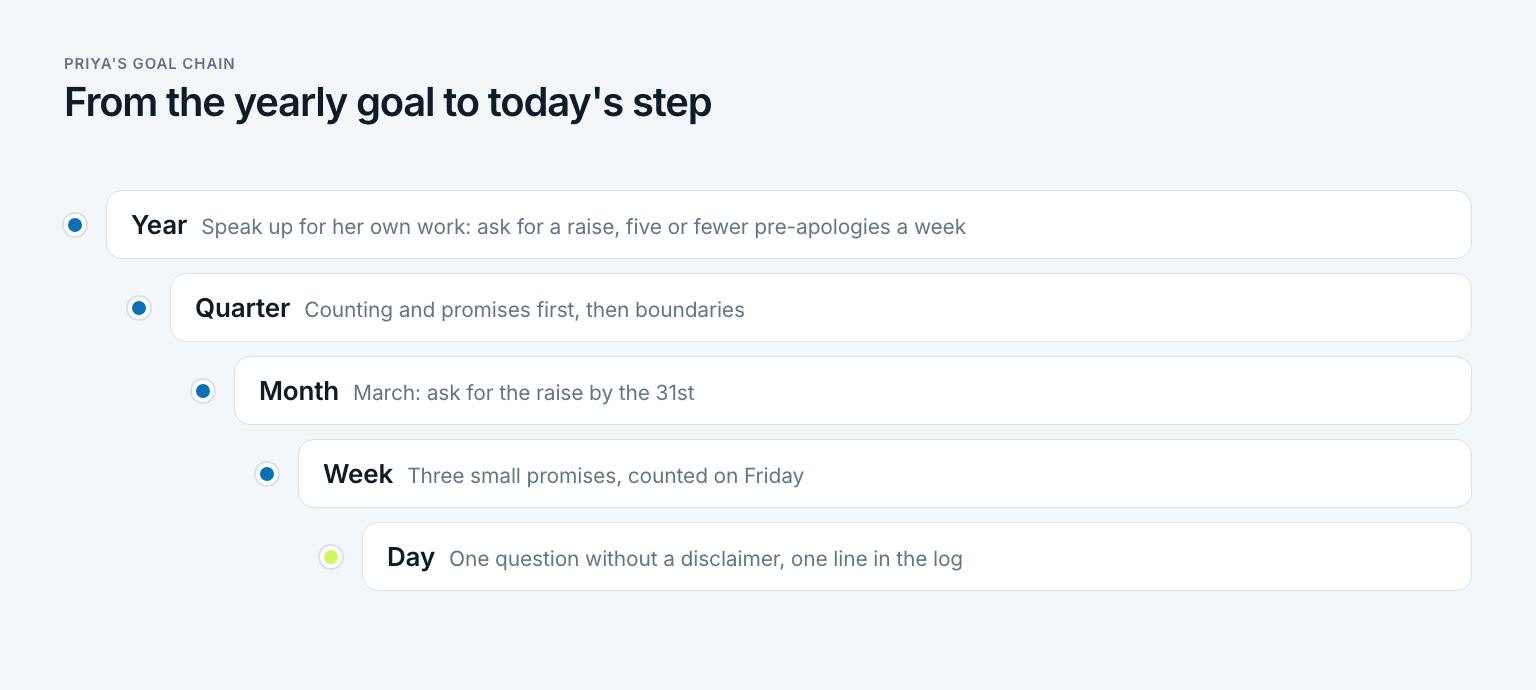
- Year: Who do you want to be in the moments that count? Priya: someone who speaks up for her own work. Made measurable as asking for a raise and five or fewer pre-apologies per week.
- Quarter: Which skill comes first? Counting and keeping promises in the first quarter, boundaries in the second. Each quarter gets a target.
- Month: Which exercise carries the month? In March, the raise. In April, the weekly no.
- Week: Which three promises do you make yourself? Small, specific, and countable on Friday.
- Day: What is the one step today? One question without a disclaimer, one line in the evidence log.
Progress at each level is the share of goals completed, and that share is exactly what makes the chain so useful for self-esteem. It is evidence the inner critic cannot argue away. In May, Priya kept 11 of 12 weekly promises, 92 percent, up from 42 percent in January. In Gaapp, this chain is the core: five levels from year to day, and every kept promise visibly counts toward the yearly goal.
For couples and families, the same chain works as a shared practice: every Sunday, each person names one thing the other did well that week, and the compliment can only be answered with thank you. For coaches, it is the record between sessions. The client counts, the coach reads the number, and the session starts with evidence instead of the mood of the day.
Three questions before you start
Three questions, answered honestly:
- Do you know, word for word, the sentence your inner critic says most often?
- Which promise to yourself did you keep in the last seven days, and was it small enough for a bad day?
- Does your self-worth hang on a single source right now, and what could be a second one?
Anyone who cannot answer one of these does not need a new resolution. They need one week of counting. That is how Priya started, with a tally mark for every apology, and it is how most people start. In short: improving self-esteem is not about thinking better of yourself. It is about handing yourself enough evidence that, eventually, you do.
Frequently asked questions about self-esteem
What are 5 ways to improve self-esteem?
Track one behavior that holds you back for a week, write down your inner critic word for word, keep three small promises to yourself each week, hold one boundary a week, and keep a nightly evidence log. All five build proof instead of claims. Pick two to start and add the others over a few months.
What are 10 things I can do to improve my self-esteem?
Use the friend test, keep an evidence log, accept compliments with a simple thank you, ask one question a day without apologizing, say one no a week, take a comparison break from social apps, spread your self-worth across several areas, keep one tiny daily promise, finish one task you have been avoiding, and exercise regularly. You do not need all ten. Two done for three months beat ten tried for a week.
What are some signs that I've lost self-respect?
Common signs are apologizing before anything has happened, deflecting praise while holding on to criticism, agreeing to things you resent, breaking promises to yourself without noticing, and always comparing yourself upward. Each one is a way of staying safe that also keeps you from collecting evidence of your own worth. Counting how often they happen is a good first step.
What are some ways to combat low self-esteem?
Work on evidence rather than slogans: small kept promises, boundaries, and one avoided risk with a date. Treat yourself with self-compassion, which Kristin Neff's research links to steadier self-worth. Positive affirmations alone can make people with low self-esteem feel worse, as Joanne Wood's 2009 study showed.
How long does it take to raise self-esteem?
Think in months, not days. In the example in this guide, the Rosenberg score rose one or two points a month, and kept promises rose before the feeling did. Research by Ulrich Orth shows that self-esteem can change throughout adult life.
Can you fix low self-esteem on your own?
When low self-esteem gets in the way of daily life, structured exercises and a clear plan often help. If it comes with lasting hopelessness, anxiety, or thoughts of harming yourself, a doctor or therapist is the right place to start. In the US you can call or text 988 at any time.
Last updated: 22 October 2026
Read next
 Personal Growth
Maslow's Hierarchy of Needs: The 5 Levels Explained
Maslow's hierarchy of needs sorts motivation into five levels. What each level means, what research says today and a needs audit you can run yourself.
14 min read
 Personal Growth
Mindfulness Exercises: 12 for Everyday Life
Mindfulness exercises are not about emptying your mind. 12 techniques for stress and focus, what research shows, and a four-week plan to practice daily.
16 min read
 Personal Growth
Positive Affirmations: 50 Examples You Can Believe
Positive affirmations are not magic words. What research shows, 50 daily affirmations you can believe, and a five-step method with a worked example.
16 min read