How to Manifest: What Science Says Actually Works
Manifesting is not magic. Learn how to manifest something with a method that holds up: what research says, 369 and 777, and a template on paper.

Contents
- 01What manifesting means and where the idea comes from
- 02Does manifesting work? What the research says
- 03How to manifest something in six steps
- 04How to manifest something on paper: a one-page template
- 05The 369 method, the 777 rule and 11:11, checked
- 06Love, money, a new job: what you can manifest
- 07How to manifest in a goal chain: year, quarter, month, week, day
- 08When manifesting backfires
- 09Three questions before you manifest again
- 10FAQ: how to manifest
Manifesting is not magic, and it is not pure nonsense either. To manifest something means to think, write or say a wish so clearly and so often that it comes true. That is the promise of the law of attraction, and there is no evidence for the mechanism behind it. There is solid evidence, though, for what careful manifesting does along the way: it sharpens the goal, directs your attention and, done right, leads to a first step. Learning how to manifest is mostly learning which half to keep.
Take Marcus. He is 34, a shift supervisor at a distribution center outside Columbus, Ohio, and he is tired of living paycheck to paycheck. Since March he has followed the 369 method he found on TikTok: three lines in the morning, six at lunch, nine at night, always the same sentence. “I am financially free and money flows to me easily.” That is 18 lines a day and close to 4,000 lines in seven months. He also tried the 777 rule for a week and set an alarm for 11:11. His savings account held $400 in March. Today it holds $380. What went wrong, and what is worth keeping?
What manifesting means and where the idea comes from
Manifesting, in today’s sense, means bringing something into your life by focusing your thoughts on it. The older meaning was plainer. To manifest something was to show it or make it visible, and doctors still say a disease manifests itself in a symptom. The new meaning has spread so fast that Cambridge Dictionary named “manifest” its Word of the Year for 2024, after a spike in people looking up exactly this sense of the word.
The idea itself is more than a century old. It grew out of New Thought, a movement that took shape in the United States in the 19th century and held that the mind shapes reality. William Walker Atkinson put the phrase law of attraction into a book title in 1906. Wallace D. Wattles tied it to wealth in The Science of Getting Rich in 1910, and Napoleon Hill tied it to career success in Think and Grow Rich in 1937. Neville Goddard’s lectures, including his 1944 booklet Feeling Is the Secret, added the instruction to feel as if the wish were already fulfilled. Rhonda Byrne turned all of it into a global bestseller with The Secret in 2006. The number rituals came last, mostly from social media.
Every version carries the same promise: whoever believes firmly enough will receive. The promise is understandable. It replaces helplessness with a sense of control. It was simply built for something other than reaching a goal. It soothes, and soothing is not a plan.
Does manifesting work? What the research says
As a law of nature, no. Physics has no law under which thoughts attract events or people. When books invoke quantum physics to explain manifesting, they borrow words from a field that describes particles, not wishes. As a mindset, the picture is more mixed. Some of what happens when people manifest does work. It just works for different reasons than the method claims.
What the evidence says about believing in manifestation
In 2023 Lucas Dixon, Matthew Hornsey and Nicole Hartley at the University of Queensland built a scale that measures belief in manifestation and used it in several surveys. People who scored high saw themselves as more successful and expected to reach success faster. The same people were more drawn to risky investments and were more likely to report having gone bankrupt. Their belief was not linked to actual success.
Gabriele Oettingen’s work points the same way. In a 1991 study with Thomas Wadden, women in a weight loss program who pictured their results most glowingly lost less weight than those who did not. In 2011 Heather Barry Kappes and Oettingen showed that positive fantasies about the future measurably lower blood pressure, a sign of lower energy. The body relaxes as if the goal were already reached. How to picture a goal without falling into that trap is covered in depth in the guide on how to visualize goals. In short: a beautiful picture of the finish line does not give you energy. It spends it.
What actually works inside manifesting
Three things that happen along the way when you manifest are well supported. None of them has anything to do with attraction:
- A clear goal. Edwin Locke and Gary Latham spent decades showing that specific, challenging goals lead to better performance than a vague promise to do your best. Their summary appeared in 2002. Anyone who states a wish precisely has already taken the first step of setting a goal.
- Directed attention. You notice more of what matters to you. Psychologist Richard Wiseman handed volunteers a newspaper and asked them to count the photographs. On page two a large message told them to stop counting because there were 43 photos. People who described themselves as lucky were more likely to spot it. That is not the universe delivering. It is a mind that is searching.
- Belief in your own ability. Albert Bandura described self-efficacy in 1977 as the conviction that you can handle a task through your own actions. It predicts persistence well. But it grows mostly from your own small wins, hardly from sentences about them. The article on self-efficacy shows how to build it on purpose.
That means: manifesting helps where it leads to a clear goal, alert attention and small wins. It hurts where it delivers the good feeling without anything having happened. Marcus got the second version for seven months.
| Claim | What holds up | What to do instead |
|---|---|---|
| Like attracts like, so thoughts pull in matching events | No evidence, quantum physics included | Treat the thought as a starting point, not a cause |
| Your brain filters for opportunities once you set an intention | Selective attention is real, but it only finds what you know to look for | Make the wish concrete enough to recognize a fitting chance |
| Doubt blocks your manifestation | Doubt is normal. Naming the obstacle leads to better plans | Write the doubt down and make an if-then plan for it |
| The more often you write it, the faster it comes | Repetition strengthens memory, not results | Point the sentence at an action that is due today |
| Feel as if you already have it | Studies link positive fantasies to less energy for action | Picture the result once, then picture the path |
The most common mistake: mistaking the good feeling for progress
Manifesting feels like working on your goal. Anyone who writes a wish nine times every night feels committed. Measured against the goal, nothing has moved. The test is simple: what would a stranger see in your week that brings you closer to the wish? If the answer is nothing, it was a ritual, not a step.
How to manifest something in six steps
How can you start manifesting in a way that holds up? Keep what works and add what is missing. The six steps take about an hour the first time. After that you need five minutes a day and fifteen minutes on Sunday.
Put the wish into one sentence with a number and a date
A wish without a date never ends, and a wish without a number has no score. Marcus writes: I will have a $6,000 emergency fund by October 31, 2027. It sounds less exciting than financial freedom. It can be checked.
Picture the why once
Take 20 minutes and write about one good day after the wish has come true. Marcus writes about a Saturday next fall when the transmission on his truck fails and he pays the repair from savings instead of a credit card. Reread this text at the start of each quarter, not every night.
Name the obstacle inside you
Ask what in you stands between you and the wish. For Marcus it is two things: ordering takeout after long night shifts, and avoiding his banking app when money feels tight. Leave out outside reasons such as prices or his boss. You cannot change those today.
Write an if-then plan
One sentence per obstacle: if the situation happens, then I do this. Marcus writes: If I want to order food after a night shift, then I heat up one of the meals I cooked on Sunday. Peter Gollwitzer and Paschal Sheeran reviewed 94 studies in 2006 and found that plans like this clearly improve goal attainment.
Turn the daily line into an action
If the daily writing ritual feels good, keep it. Change only the content. Instead of financial freedom, Marcus now writes one line each morning: Today at 7 a.m. I check that $110 moved to savings and log the number. The line no longer reminds him of the dream. It reminds him of the appointment.
Collect evidence every Sunday
Write down what you did this week that a stranger could see: transfers, hours, emails sent, meals cooked. This replaces waiting for signs. You read signs into things. Evidence you can count.
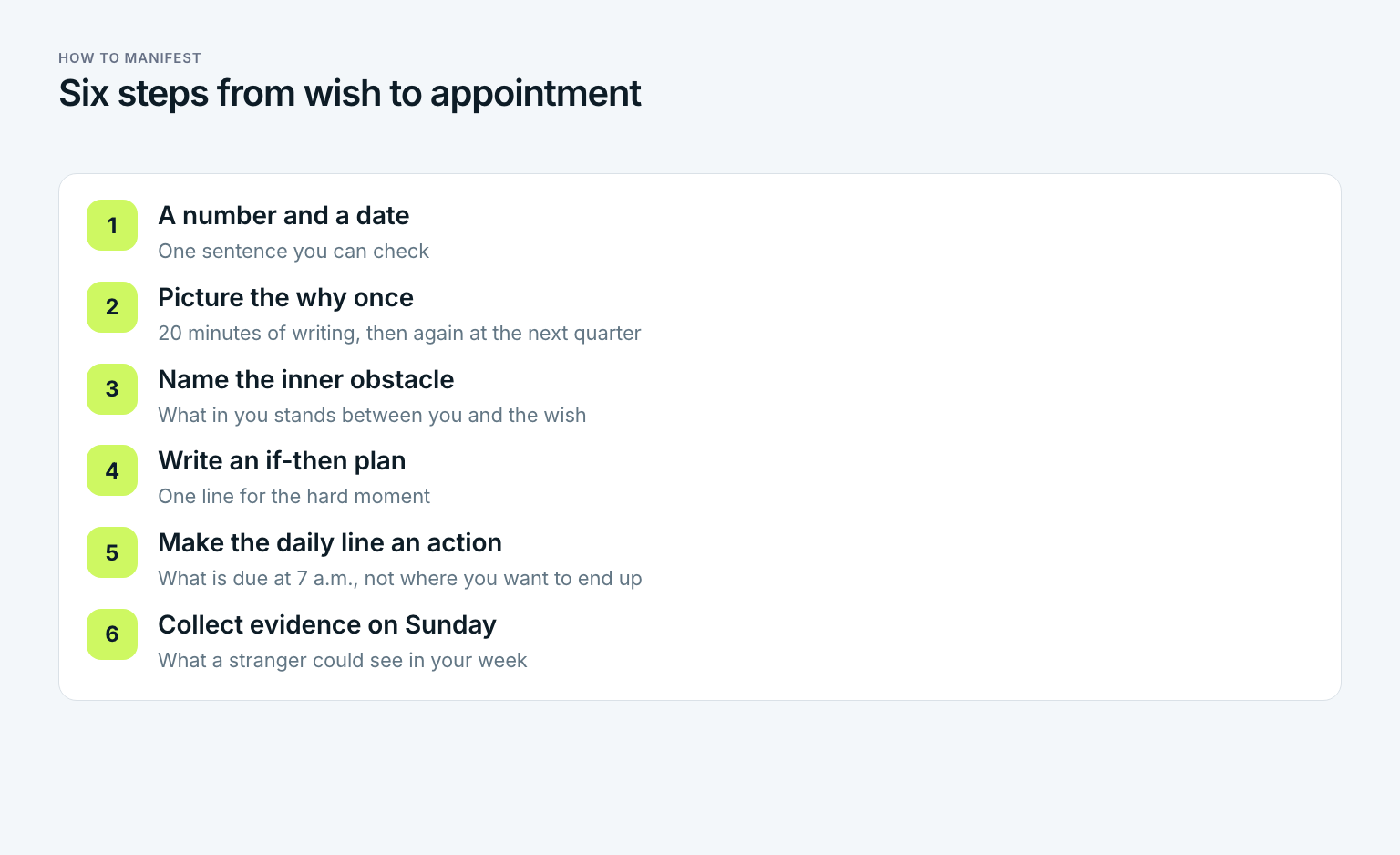
Steps three and four are missing from almost every manifesting guide. Many of them even warn you not to think about obstacles because doubt would block your energy. Research shows the opposite. Anyone who knows the obstacle handles the hard moment better, because they have already rehearsed it once.

How to manifest something on paper: a one-page template
If you want to know how to manifest something on paper, give each wish its own page. A wish on a long list stays a wish. A wish on its own page gets a path. The template has six fields, and each answers one question. The right column shows what Marcus wrote.
| Field | Question | Marcus’s entry |
|---|---|---|
| Wish | What exactly, by when, measured how? | $6,000 emergency fund by October 31, 2027 |
| Why | What does one good day look like? | Truck repair paid from savings, no credit card, no call to his brother |
| Inner obstacle | What in me gets in the way? | Takeout after night shifts, avoiding the banking app |
| If-then plan | What do I do in the hard moment? | If I want to order food after a shift, I heat up a meal cooked on Sunday |
| First action | What will I do in the next 48 hours? | Open a separate savings account, set up a $110 transfer every Friday |
| Evidence this week | What has visibly moved? | Account opened, first $110 transferred, two takeout orders instead of five |
The page fits in any notebook. Whoever has several wishes should run no more than three of these pages at the same time. Few people can sustain more next to a job and a household, and three half-tended wishes bring less than one that actually moves. If you want the research on why writing goals down helps at all, the article on writing down goals covers it.
The 369 method, the 777 rule and 11:11, checked
Most manifesting techniques share one core: write or say a wish, repeat it often, and generate a good feeling while you do. What differs are the numbers. None of them has been tested as a method in a scientific study. Each has a part worth keeping.
| Method | How it works | What helps | What is missing |
|---|---|---|---|
| 369 method | Write the wish three times in the morning, six times at midday and nine times at night. Often credited to Nikola Tesla, with no source to back that up | A daily reminder of the goal | An action. The sentence describes a state, not a step |
| 777 rule | Usually: write the wish seven times in the morning and seven times at night for seven days. Versions differ | A short, focused trial run | Anything after day seven |
| 11:11 | When the clock shows 11:11, make a wish or write an intention, based on number symbolism | A fixed moment to pause | Any link between the time and the result |
| 55x5 | Write one sentence 55 times a day for five days | Focus on a single wish | The method ends after five days, the goal does not |
| Scripting | Write a journal entry from the future as if the wish came true | Clarity about what you actually want | The obstacle. The story jumps to the end and skips the path |
| Vision board | Collect images and words for your wishes on one board | An overview across life areas | Numbers and dates |
Two related practices deserve a second look. Joanne Wood, Elaine Perunovic and John Lee found in 2009 that people with low self-esteem felt worse, not better, after repeating the affirmation “I am a lovable person.” The sentence clashed too much with how they saw themselves. What works better are positive affirmations you can believe, small sentences that stay close to your daily life. And scripting has a close cousin that is well studied. Laura King had students write about their best possible future self for 20 minutes on four days in 2001. They reported better mood afterward and visited the campus health center less often in the following months. The difference from scripting is small but real: King used writing to clarify goals, not to summon them.
A vision board comes closest to a plan if you build it right. The guide to the vision board shows how pictures turn into goals with dates. Marcus did not do the 369 method wrong, by the way. He did it exactly as it is taught. The problem sits in the sentence itself. It describes where he wants to arrive and says nothing about what he does today. Whoever repeats a state is waiting for it.
Love, money, a new job: what you can manifest
Love, money and a new job are the three things people most often try to manifest. The same limit applies to all three: you can plan your own behavior, not other people’s. Anyone who separates the two gets a workable plan. Anyone who mixes them up waits.
- Love. You cannot manifest a specific person, and that is a good thing. What you can shape is opportunity and your own openness: how many evenings you spend around people, whether you share a hobby with others, whether you start the conversation. A goal like two new group activities a month sounds smaller than finding the one. It is the part that is in your hands.
- Money. A balance does not grow from thoughts. It grows from income, spending and time. Whoever wants to manifest money writes down an amount, a date and a monthly savings figure. Be careful with promises of fast wealth: in the study by Dixon and colleagues, strong believers in manifestation found risky investments especially appealing.
- A new job. Here the gap between wish and action is smallest. Applications, a portfolio, conversations and courses can all be counted. If this is your wish, you are in a good position the moment you start counting.
Notice what the three have in common? The wish stays the same. Only the sentence moves from the result to the part you can do yourself. That is not giving up on dreaming. It is translating the dream into your calendar.
How to manifest in a goal chain: year, quarter, month, week, day
A manifested wish is a yearly goal with nothing underneath it. Only when you translate it into a quarter, a month, a week and a day do you know what is due on Friday morning. The guide on how to achieve goals explains how the chain works in general. For Marcus it looks like this:
| Level | Marcus’s goal | How he can tell |
|---|---|---|
| Year | $6,000 emergency fund by October 31, 2027 | Balance in the separate savings account |
| Quarter | $1,450 in the account by December 31 and every expense logged for ten weeks | Account balance, spending log |
| Month | November: $440 moved on four Fridays, takeout cut to two orders a week | Four Friday transfers, receipts |
| Week | $110 moved every Friday, two meals cooked on Sunday | Transfer confirmation, two containers in the freezer |
| Day | Friday at 7 a.m., before the shift: check the transfer and log the number | One line in the notebook |

The table shows where Marcus’s old sentence belongs. Financial freedom is the top row, at most. It was never wrong. It was alone. Four levels were missing underneath, and that is where the work happens. The math is plain: $5,620 to go in a little over a year means 53 Fridays at $110, with a small cushion left over.
Anyone who sets up a wish this way in Gaapp sees progress on every level next to the time that has passed. Marcus uses that view mostly on Sunday. When he checks off the week, he can see whether the quarter is still on track. He traded waiting for signs for a number.
When manifesting backfires
Manifesting is mostly harmless. In three cases it can do real damage, and those cases are hard to notice from the inside.
- Blame instead of causes. If thoughts attract events, then anyone who suffers something bad brought it on themselves. That conclusion is built into the logic of the method, and it hits sick, unemployed and grieving people hardest. It is wrong. Chance, circumstances and bad luck exist.
- Avoiding instead of acting. Whoever is told to avoid negative thoughts eventually stops looking at real problems too. Bank statements stay unopened and warning signs get smiled away. An honest look at the obstacle is the start of every plan.
- Risk instead of patience. Believing the universe will deliver makes big bets look tempting. The findings by Dixon and colleagues on risky investments and bankruptcy show this is not a theoretical problem.
If you are in a mental health crisis right now, you need a conversation, not a method: in the US you can call or text 988 any time, free of charge. Manifesting does not replace therapy or medical advice, and no serious guide should claim it does.
Three questions before you manifest again
- Does my sentence contain a number and a date, or only a feeling?
- Do I know the obstacle inside me, and do I have an if-then line for it?
- What did I do this week that a stranger could see?
After six weeks Marcus can answer yes to all three. His savings account shows $1,040, six Friday transfers on top of the $380 he started with. Takeout went from five orders a week to two. He still writes every morning, but only one line now: what is due at 7 a.m. He has not missed the 369 list.
Manifesting does not work because the universe is listening. It starts working the moment you turn the wish into an appointment.
FAQ: how to manifest
How can I start manifesting?
Write your wish as one sentence with a number and a date, then picture the result once to get clear on why it matters. Next, name the obstacle inside you and write an if-then plan for it. Finish by putting the first action in your calendar for the next 48 hours.
What is the 3 6 9 method manifestation?
In the 369 method you write a wish three times in the morning, six times at midday and nine times at night. The link to Nikola Tesla that is often cited has no reliable source, and the method has not been studied. If the ritual helps you, write the action you will take that day instead of the wish.
What is the 777 rule manifesting?
The 777 rule usually means writing a wish or affirmation seven times in the morning and seven times at night for seven days, though versions differ. There is no research on it. It can work as a short trial to test whether a wish still matters to you after a week.
How to do an 11 11 manifestation?
Followers pause when the clock shows 11:11 and make a wish or write down an intention, based on number symbolism. Nothing links the time to the result. If you like the habit, use the moment to check whether today’s action toward your goal is done.
Does manifesting actually work?
Not as a force that pulls events toward your thoughts, and there is no evidence for that. What works are the side effects of careful manifesting: a clear goal, directed attention and confidence that grows from small wins. Simply fantasizing about the outcome can even lower your energy to act, according to Gabriele Oettingen’s studies.
How long does it take to manifest something?
There is no set time, because writing does not fulfill the wish, action does. How long it takes depends on the goal, like any other goal. Put a date into the wish itself and check your progress at the end of each quarter.
Last updated: 22 October 2026
Read next
 Personal Growth
Maslow's Hierarchy of Needs: The 5 Levels Explained
Maslow's hierarchy of needs sorts motivation into five levels. What each level means, what research says today and a needs audit you can run yourself.
14 min read
 Personal Growth
Mindfulness Exercises: 12 for Everyday Life
Mindfulness exercises are not about emptying your mind. 12 techniques for stress and focus, what research shows, and a four-week plan to practice daily.
16 min read
 Personal Growth
Positive Affirmations: 50 Examples You Can Believe
Positive affirmations are not magic words. What research shows, 50 daily affirmations you can believe, and a five-step method with a worked example.
16 min read