Stress Management: Three Pillars and One Plan
Stress management is not a relaxation exercise. The Lazarus model, three pillars, stress management techniques and a five-step plan with an example.

Contents
- 01What stress management is and what it is not
- 02How stress starts: the transactional model of Lazarus
- 03The three pillars of stress management
- 04Stress management techniques compared
- 05Planning as a stress lever: why a plan quiets your head
- 06How to manage stress in five steps
- 07Stress management in your goal chain: from year to Thursday
- 08Common symptoms of stress and when to get help
- 09Three mistakes that quietly undo stress management
- 10Stress management FAQ
Stress management is not a relaxation exercise. It is the deliberate handling of pressure on three levels: the situations that trigger it, the way you appraise them, and how your body recovers afterward. A breathing exercise belongs in the toolkit. It just does not answer why every Tuesday falls apart the same way. Whoever only relaxes treats the aftermath. Whoever manages stress also changes the setup that keeps producing it.
This guide rests on two models that are widely used in psychology and workplace health programs: Richard Lazarus's transactional model of stress and the three pillars of stress management described by the German psychologist Gert Kaluza. Both are worked through on six weeks in the life of Dana, a high school chemistry teacher, mother of two, and volunteer coach of the school's robotics team. Along the way you get stress management techniques sorted by what they actually fix, five steps to copy, the three mistakes that quietly undo good intentions, and a clear line on when self-help is no longer enough.
What stress management is and what it is not
Stress management is everything you do on purpose to reduce pressure, see it differently, or recover from it. Three parts are fixed: you know your triggers, you know the patterns in your head, and you have set times when your body gets to come down. Psychologists use the broader word coping for anything people do in response to stress, planned or not. Stress management is the planned version.
So what does it not include? Three ideas tend to get lumped together. None of them is wrong. Each is built for something else:
- Relaxation. A technique such as slow breathing, progressive muscle relaxation, or a walk. It is a valuable piece of recovery. It does not move a deadline or lower an expectation.
- Resilience. The capacity to get through hard times and adapt. It grows over years and draws on many sources, including relationships, experience, and outlook. Stress management can feed it, but the two are not the same thing.
- Treatment. Care for a health condition by a doctor or a licensed therapist. Stress management is prevention for everyday life. Where that line sits is covered further down.
Dana knows all three. She has a meditation app, a yoga mat in the corner of the bedroom, and two self-help books on her nightstand. Still, she rates her stress on school days at 7 out of 10. That means: knowledge is not the problem. What is missing is a system that puts each tool where it belongs.
How stress starts: the transactional model of Lazarus
Stress does not live in a situation. It lives in how you appraise the situation. That is the core of the transactional model, which psychologist Richard Lazarus developed from the 1960s on and laid out with Susan Folkman in 1984 in Stress, Appraisal, and Coping. Transactional means that person and environment act on each other. The same email can flatten one person and barely register with another.
Lazarus describes three appraisals that usually happen in seconds, without much conscious thought:
- Primary appraisal. Does this matter to me, and if so, is it harm, a threat, or a challenge? Anything irrelevant or pleasant does not produce stress.
- Secondary appraisal. Do I have what it takes to deal with it? That covers time, skill, support, money, and the belief that you can handle the task yourself.
- Reappraisal. Once you start dealing with the situation, you judge it again. What looked threatening a minute ago may now look doable, or the other way around.
In this model, stress shows up when the demand from the primary appraisal looks bigger than the resources from the secondary one. What follows is coping. Lazarus and Folkman describe two directions: problem-focused coping changes the situation, and emotion-focused coping changes how you handle the feeling. Both are legitimate. Anyone who can change the situation usually does better starting there. Anyone who cannot needs the second kind.
Here is how it looks for Dana. On Monday at 9:40 p.m., a parent emails to ask why their son got a C on the lab report and wants an answer before school. Primary appraisal: threat, because the email reads like a complaint to the principal in waiting. Secondary appraisal: she has 64 unread lab reports, no free period until 1 p.m., and her own kids still need lunches packed. Result: stress, and a late night. If Dana had a set window for parent emails and a rubric she could point to, the secondary appraisal would have come out differently. The email would have been the same.
Appraisal is not positive thinking
The Lazarus model often gets boiled down to the idea that stress is all in your head. That is not what it says. The secondary appraisal asks about real resources: time, help, skill. When you add resources, your appraisal changes for a good reason, not because you talked yourself into calm. This is exactly where self-efficacy comes in, the belief that you can handle a task through your own effort.
Good stress, bad stress, and how long it lasts
There is no single official list of stress types. A distinction you will often see goes back to the physician Hans Selye: eustress, which feels energizing, and distress, which feels draining. Some sources also separate acute stress, a short spike around an event, from chronic stress, which keeps running for weeks or months. That second split matters more in daily life. Short stress followed by recovery is part of being alive. The trouble starts when the recovery never comes.
The three pillars of stress management
The three pillars of stress management are instrumental, mental, and regenerative stress management. The framework comes from Gert Kaluza, whose training program has been used for years in German health promotion. Kaluza links each pillar to one part of what he calls the stress chain. The chain has three links: the stressor, which is the outside demand, the personal stress amplifier in your head, and the stress response in your body and behavior.
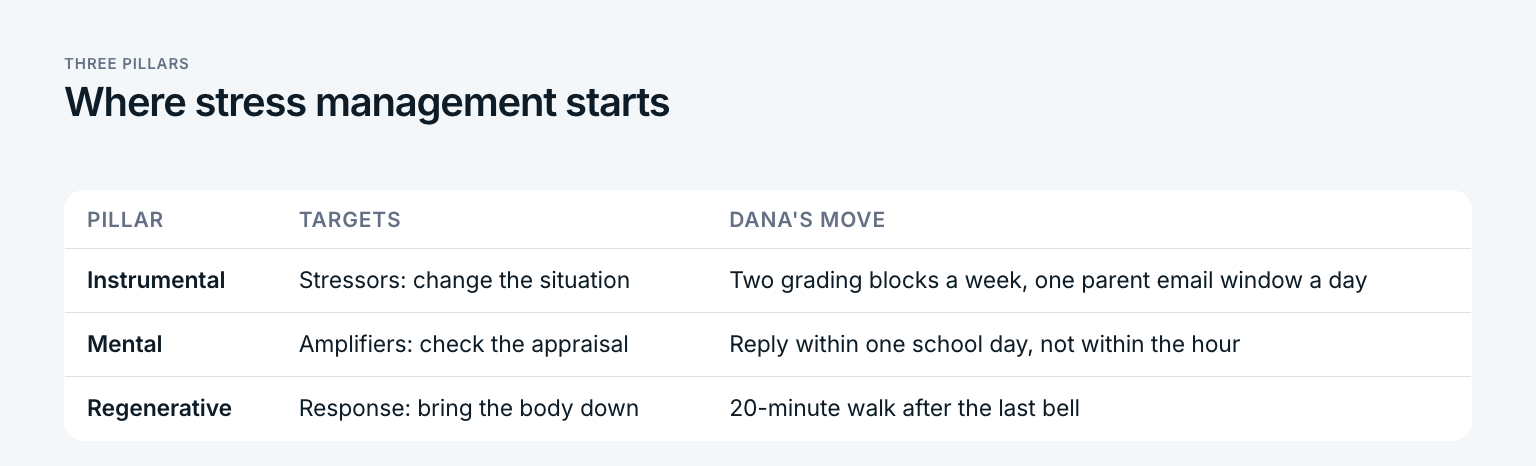
Kaluza turns the three links into three sentence starters you can finish yourself: “I get stressed when …”, “I put myself under pressure by …”, and “When I am stressed, I …”. Whoever completes all three honestly has a first map of their stress in about ten minutes. The table shows the pillars in Dana's week.
| Pillar | Targets | Guiding question | Dana's move |
|---|---|---|---|
| Instrumental | stressors, the outside demands | What about the situation can I change? | Two grading blocks a week, one parent email window a day, robotics logistics handed to a parent volunteer |
| Mental | personal stress amplifiers, your standards and appraisals | Which expectation of myself is driving the pressure? | Reply to parents within one school day instead of within the hour |
| Regenerative | the stress response in body and behavior | How do I come down, and when exactly? | A 20-minute walk after the last bell, screens off at 10:30 p.m. |
Instrumental stress management: change the situation
Instrumental stress management changes the demands themselves. It covers planning and time management, delegating, saying no, fixing workflows, addressing conflicts, and building skills that make a task easier. This pillar is strongest when a stressor keeps coming back. It is weakest when the stressor cannot be changed, such as a family member's illness.
After two weeks of a stress log, eight of Dana's 26 entries land in the same place: grading that piles up until Sunday night. That is not a character flaw. It is a scheduling problem. So the fix is instrumental. Dana books two grading blocks a week, Tuesday and Thursday from 3:30 to 5 p.m., in an empty classroom with her phone in her bag.
Mental stress management: check the appraisal
Mental stress management works on your own thinking. Kaluza names five common stress amplifiers, phrased as inner drivers: be perfect, be liked, be strong, be careful, and I can't. Each has a true core. Care is a strength, and so is being responsive. A driver turns into an amplifier only when it becomes absolute and allows no exceptions.
Dana recognizes the second one. She answers every parent email within the hour, at 9:40 p.m. if that is when it arrives. The mental work is not about caring less. It is about dosing the standard. Does a parent really need an answer tonight, or do they need a clear, fair answer by tomorrow afternoon? Whoever asks that before opening the laptop wins back most evenings.
Three questions help test a stressful thought: Is this definitely true? What is the worst, the most likely, and the best thing that could happen? What would I tell a colleague in the same spot? Questions like these come from cognitive behavioral therapy, and many stress management programs use them in some form.
Regenerative stress management: bring the body down
Regenerative stress management calms the stress response and makes room for recovery. In the short term that means breaks, movement, and slower breathing. In the long term it means sleep, exercise, hobbies, and time with people who are good for you. Relaxation methods such as progressive muscle relaxation, developed by the physician Edmund Jacobson, belong here too. They do not work on command. Like any training, they need repetition before they are available under pressure.
Dana already had the meditation app. She never had a time slot for it. Recovery without a place on the calendar loses to every email. So it gets an appointment: a 20-minute walk after the last bell and screens off at 10:30 p.m. What an evening looks like when your head actually switches off is laid out in the evening routine guide. In short: recovery is not a reward for finished work. It is part of the plan.

Stress management techniques compared
Which stress management techniques work best? Most of them have a place. The table sorts the common ones by pillar and effort. No technique beats the others across the board. What matters is whether it fits the link in the stress chain where your stress actually starts.
| Technique | Pillar | Effort | Fits when |
|---|---|---|---|
| Stress log for 14 days | all three, as diagnosis | 5 minutes each evening | you are not sure where the stress comes from |
| Weekly and daily planning | instrumental | 20 minutes a week | tasks and appointments keep piling up |
| Eisenhower matrix | instrumental | 10 minutes | everything feels equally urgent |
| Delegating and saying no | instrumental | one conversation | work lands on you that someone else could do |
| Three-question thought check | mental | 5 minutes | one sentence in your head raises the pressure |
| Acceptance | mental | ongoing | the stressor cannot be changed |
| Progressive muscle relaxation | regenerative | 15 to 20 minutes, several times a week | you notice tension in your body |
| Exercise and walking | regenerative | 20 minutes and up | you cannot switch off at night |
| Fixed breaks and a hard stop | regenerative | one calendar entry | recovery is always the first thing to go |
| Social support | mental and regenerative | one phone call | you feel you have to carry everything alone |
Two techniques from the table have their own guides. The Eisenhower matrix separates important from urgent and is the fastest tool when the list overflows. The guide on how to plan your day shows when and in what order to plan so the day does not break by 9 a.m. Both belong to the instrumental pillar. Why planning in particular absorbs so much stress is the subject of the next section.
Planning as a stress lever: why a plan quiets your head
Planning is not extra work when you are stressed. It is one of the strongest levers against stress. The reason is unfinished tasks. Anything that is neither done nor scheduled keeps resurfacing, in the shower, at dinner, at 3 a.m. In a series of experiments published in 2011, psychologists E. J. Masicampo and Roy Baumeister found that making a specific plan for an unfinished goal reduced those intrusive thoughts, even though the goal itself was not yet reached.
That means: your mind does not need everything to be done. It needs to know when it will be done. A plan with a day and a time answers that question. A loose list does not.
Open loops
In the 1920s, the psychologist Bluma Zeigarnik described how interrupted tasks stay in memory more readily than finished ones. Later research has confirmed the effect with mixed strength. For daily life, the addition from Masicampo and Baumeister is enough: an open task stops nagging once it has a plan. For stress management, that means writing a task down is not enough. Scheduling it is.
Planning helps at all three links of the stress chain at once. On the instrumental side, it spreads the load before it piles up. On the mental side, it improves your secondary appraisal in the Lazarus sense, because you can see that the time exists, or notice early that it does not. On the regenerative side, it protects recovery, because the break has an appointment. Whoever plans the week manages stress before it starts.
For Dana, the change shows up on Sunday evening. Sunday used to end at midnight with a stack of ungraded labs and a week spinning in her head. Now she sits down at 6 p.m. for 20 minutes. She blocks the two grading sessions, the parent email window at 4 p.m., the robotics meeting, and her walks, and she writes one daily goal for each school day. After that, the evening is free. Not because the week got lighter, but because it now has a shape.
How to manage stress in five steps
How to manage stress in daily life comes down to this: understand it first, pick one move per pillar, then schedule it. The five steps take about six weeks the first time, because the stress log needs two weeks and the changes need four. After that, a short check each week is enough.
Keep a stress log for two weeks
Each evening, spend five minutes noting the moments you felt tense: time, trigger, thought, what your body did, and intensity from 0 to 10. Dana logs 26 entries in 14 days with an average of 7.1. Precision matters less than writing every night.
Sort the entries by pillar
Assign each entry to the link of the stress chain that drove it most: the trigger, the thought, or missing recovery. For Dana that gives eight entries on grading, seven on late parent emails, six on robotics logistics, and five on the morning rush. Behind six of the seven email entries sits the same thought: they will think I don't care.
Pick one move per pillar
Not ten resolutions. Three moves, one per pillar, each with a number so you can check it later. Dana picks two grading blocks a week, parent replies within one school day, and a 20-minute walk every school day.
Put the moves on your weekly plan
Anything without a time slot does not happen. Enter the grading blocks, the email window, and the walks as fixed appointments before other commitments fill the week. The guide to [weekly planning](/en/blog/weekly-planning) shows how to fit it all on one page in about 20 minutes.
Measure after four weeks
In week six, keep the stress log again for seven days. Compare the number and intensity of entries with where you started. Dana logs 11 entries that week with an average of 5.0. The morning rush is still tight, so that becomes her next project.
Whoever sees no change after four weeks has not failed. They have learned something. Either the move does not fit the pillar, or it never actually happened. The log shows which one it was. How do you tell the difference? Check the calendar. A move that never made it onto the calendar never existed. Which format suits a stress log is covered in the guide to types of journaling.
Stress management in your goal chain: from year to Thursday
Stress management works best when it is built into your goals instead of running beside them. Whoever sets a yearly goal that only works with 60-hour weeks can meditate as much as they like. The stressor is baked into the goal. That is why the question of load belongs in your yearly plan, not just in your evenings.
Dana translates her three moves into the five levels of the goal chain:
- Year, through October 2027. Robotics logistics run by a parent committee, no schoolwork after 8 p.m. on at least four weeknights.
- Quarter, Q4 2026. Parent committee formed, two grading blocks a week agreed with the department head.
- Month, November. All three moves running, auto-reply on school email after 5 p.m.
- Week 46. Grading blocks Tuesday and Thursday from 3:30 to 5 p.m., parent email window at 4 p.m., walks after the last bell.
- Day, Thursday. Grade 32 lab reports in the block, walk at 5:15 p.m.
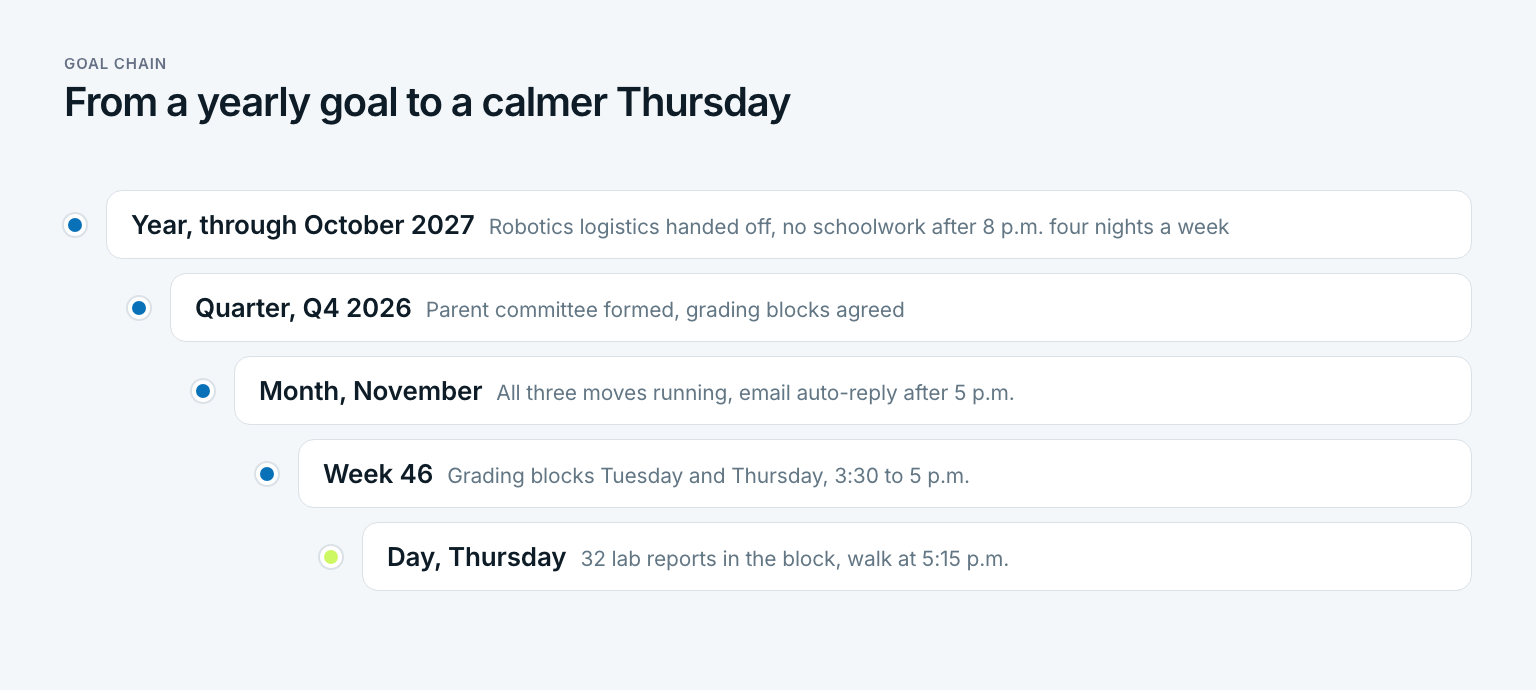
The goal chain prevents two things. First, stress management does not stay a good intention, because each move is broken down to a week and a day. Second, your yearly goals do not quietly build the next stressor, because the load is planned at every level. In Gaapp, you see that chain from today's task up to the yearly goal on one screen.
One boundary belongs here. How work, family, and your own time fit together overall is a bigger question than the stress of a single week. That is the territory of work-life balance, and it deserves its own look. Stress management is the tool for the weeks when that balance comes under pressure.
Common symptoms of stress and when to get help
Stress shows up in the body, the mind, and behavior. Commonly reported signs include headaches, muscle tension, trouble sleeping, irritability, difficulty concentrating, changes in appetite, and pulling away from people. Short bursts of these after a tough week are common. What deserves attention is a pattern that does not fade once the pressure eases.
Stress management is built for everyday life. It does not replace a diagnosis or treatment. If symptoms such as poor sleep, exhaustion that survives a weekend off, low mood, or a racing heart last for several weeks, talk to your doctor or a licensed mental health professional. In a crisis in the US, you can call or text 988 at any hour. In Germany, the TelefonSeelsorge is free and available around the clock at 0800 111 0 111.
Three mistakes that quietly undo stress management
The most common mistake: working only on the response
Most people start with recovery: an app, a class, a spa weekend. That is good, and it often helps. But whoever faces the same overload every Monday is recovering on the weekend only to drive back into the same traffic jam. Recovery without a look at the stressors treats the aftermath and leaves the cause in place. So ask the instrumental question first: what about the situation can I change?
The second mistake is doing too much at once. Whoever decides on Sunday to meditate, run, sleep earlier, and stop checking email after 6 p.m. has just signed up for four new obligations. Four new obligations are a new stressor. One move per pillar is plenty to start.
The third mistake is not measuring. Without a log at the start and at the end, all you have is a feeling, and the feeling mostly remembers the last bad day. Anyone who measures also sees small progress. Small progress is what keeps people going.
Three questions before you start
Before you open your stress log, answer three questions in writing:
- Which stressor shows up every single week, and who besides me could change something about it?
- Which sentence in my head makes a task bigger than it is?
- When in the last seven days did I have an hour with nothing I had to do, and is the next one already on my calendar?
Dana spent two minutes on the third question and came up empty. That is exactly where she started. In short: stress management is not a technique against bad days. It is a plan that makes good days more likely.
Stress management FAQ
What are 5 ways to manage stress?
Five widely recommended ways are planning your week so demands do not pile up, setting boundaries such as a fixed time to answer messages, checking stressful thoughts against the facts, moving your body every day, and protecting sleep. Together they cover all three pillars: the situation, your appraisal, and recovery. Start with one per pillar rather than all five at once.
How do you reset your nervous system?
There is no single reset button. Many stress programs teach slow breathing with a longer exhale, a short walk, or a few minutes of progressive muscle relaxation to help the body shift out of the alarm state. Over the longer term, regular sleep, exercise, and fewer recurring stressors do most of the work.
What are some common symptoms of stress?
Commonly reported symptoms include headaches, muscle tension, trouble sleeping, irritability, difficulty concentrating, and changes in appetite. Short bursts after a hard week are normal. If symptoms last for several weeks or interfere with daily life, talk to a doctor or a licensed mental health professional.
What is the 3-3-3 rule for stress?
The 3-3-3 rule is a grounding exercise that circulates widely online: name three things you see, three sounds you hear, and move three parts of your body. It is meant to pull attention back to the present during a spike of stress or anxiety. It is a quick self-help tool, not a treatment, and research on this exact version is limited.
What are the three pillars of stress management?
In Gert Kaluza's framework, the three pillars are instrumental, mental, and regenerative stress management. The first changes the situation, the second changes your standards and appraisals, and the third helps your body recover. The model works best when you have at least one concrete move in each pillar.
How long does stress management take to work?
It varies from person to person. Instrumental changes such as fixed focus blocks often bring relief in the first week, while relaxation methods usually take several weeks of practice. A stress log at the start and again after four to six weeks shows you what has actually changed.
Last updated: 19 October 2026
Read next
 Personal Growth
Maslow's Hierarchy of Needs: The 5 Levels Explained
Maslow's hierarchy of needs sorts motivation into five levels. What each level means, what research says today and a needs audit you can run yourself.
14 min read
 Personal Growth
Mindfulness Exercises: 12 for Everyday Life
Mindfulness exercises are not about emptying your mind. 12 techniques for stress and focus, what research shows, and a four-week plan to practice daily.
16 min read
 Personal Growth
Positive Affirmations: 50 Examples You Can Believe
Positive affirmations are not magic words. What research shows, 50 daily affirmations you can believe, and a five-step method with a worked example.
16 min read