Micromanagement: Signs, Causes and How to Stop It
Micromanagement is not attention to detail: nine signs, real examples, causes, effects and five steps out, for managers and the people they manage.

Contents
- 01What micromanagement is, and what it is not
- 02Signs of micromanagement in the workplace
- 03Why managers micromanage
- 04What happens when employees are micromanaged
- 05Micromanagement vs. hands-off leadership vs. managing by goals
- 06How to stop micromanagement in five steps
- 07Being micromanaged at work: how to get out of it
- 08Turn control into a goal chain, from year to day
- 09Self-audit: are you a micromanager?
- 10Frequently asked questions about micromanagement
Micromanagement is not attention to detail. Micromanagement is a management style in which a manager hands off work but keeps steering it in small ways: dictating the method, checking every step and holding on to decisions the team could make on its own. Knowing the details is a strength. Micromanagement turns that strength into a bottleneck.
Anyone who has led a team that waits for sign-off on everything knows the result. The manager works late, the team feels watched, and nothing moves faster. This guide walks through it with Dana, 37, who was the top producer at a regional insurance broker for eight years and now leads seven account managers. You get nine signs, six examples of micromanagement at work, the causes and effects, five steps to stop, and a section for anyone being micromanaged at work right now.
What micromanagement is, and what it is not
Merriam-Webster defines micromanaging as managing with excessive control or attention to details. The key word is excessive. How closely someone looks is not the issue. The issue is who decides in the end. A manager who prescribes the method after the outcome has already been agreed takes that decision away from the person doing the work. That is the core of it.
Three things are therefore not micromanagement. First, close guidance during onboarding. Anyone who is new needs direction, and a manager who checks a lot in the first weeks is doing the job. Second, control in high-risk areas. In payroll, in a hospital pharmacy or in safety inspections, a second pair of eyes belongs to the process. Third, interest. Asking how a project is going is not managing in miniature.
That means: micromanagement is not a question of how much control, but of fit. Control that does not match the person's experience and the task's risk is too much. The same review can be right for a new hire and insulting to a ten-year veteran.
Micromanager versus micromanagement
A micromanager is a person. Micromanagement is a behavior. The distinction sounds picky, but it helps. Most managers do not micromanage all the time. They do it on certain tasks, under pressure or with certain people. Whoever ties the behavior to a situation can change it. Whoever labels themselves a type can only regret it.
Signs of micromanagement in the workplace
Micromanagement in the workplace rarely shows up in one big moment. It shows up in many small habits that each look reasonable on their own. Only together do they form a pattern. These nine signs are the most common:
- Approval for everything. Even routine calls, like a $15 goodwill credit, need the manager's okay.
- The method is dictated. Instead of agreeing on the outcome, the manager decides how, in what order and with which tool the work gets done.
- Copied on every email. The manager wants to be on every thread, including ones that have nothing to do with them.
- Constant status checks. "Where are we on this?" arrives several times a day, not at agreed times.
- Edits to style, not substance. Documents and slides come back with changes that improve nothing but the manager's taste.
- Work gets redone. The manager quietly redoes tasks or takes them back the moment they get hard.
- No decisions in the team. People ask instead of deciding, because the result will be changed anyway.
- The manager is the bottleneck. Work queues up behind their feedback, and approvals pile up before every vacation.
- Overtime at the top, idle time below. The manager works the longest hours and complains that nobody takes ownership.
No single sign proves anything. Anyone who recognizes three or more in their own week should look more closely. This works in both directions. Managers often recognize themselves faster than they admit. Their teams recognize it right away.
Examples of micromanagement at work
What does an example of micromanagement look like in practice? The cases below come from ordinary situations in offices, sales, the trades and customer service. Each row shows what the micromanager does and which alternative covers the same risk.
| Situation | Micromanagement | What works instead |
|---|---|---|
| Proposal to a new client | The sales director rewrites every sentence and sends the proposal herself. | Agree up front on the three points the proposal must contain, then check only those. |
| Deck for the executive team | The boss changes fonts, colors and slide order the night before. | Agree on the main message and the numbers together, leave the design to the author. |
| Job site in the trades | The foreman calls the crew lead four times a day about each step. | Agree on the goal and the inspection standard in the morning, get a photo of progress at the end of the day. |
| Software project | The tech lead rewrites a junior developer's code instead of reviewing it. | Review with comments, the author makes the changes. |
| Remote work | The manager watches online status in the chat tool and pings after ten minutes of inactivity. | Agree on a weekly goal and look at the result together on Friday. |
| Customer service | Every reply to a customer goes through the team lead before it is sent. | Set reply templates and approval limits, read a weekly sample. |
All of these examples share one thing: the worry behind them is fair. A weak proposal loses a client, a bug costs a night. Micromanagement answers the right worry with the wrong tool. It checks the method where it should check the result.
Why managers micromanage
Nobody sets out to become a micromanager. It is usually a mix of background, pressure and missing clarity. Five causes come up again and again:
- The expert trap. Whoever gets promoted for being the best at the work tends to see that work as their real value. Letting go feels like losing importance. Learning how to delegate tasks well moves that value to the team's results.
- Fear of mistakes. Anyone who has to answer for the result wants to see every risk. Pressure from above makes this worse, not better.
- Unclear goals. When nobody has defined how a result will be judged, the method is the only standard left. So the method gets controlled.
- Untested distrust. Sometimes distrust is earned. Often it has simply never been tested. Whoever never lets go never finds out what the team can do.
- No time to manage. It sounds backwards, but it is common. A manager with no time for one-on-ones gets information through control instead, and that costs more time than any conversation.
Andrew Grove, the longtime head of Intel, offers a useful yardstick in High Output Management, published in 1983: task-relevant maturity. It belongs to the task, not just the person. The same employee can be highly experienced in day-to-day work and brand new on a first major account. Grove's conclusion: the lower the maturity for a task, the closer the supervision. The higher it is, the more room. By that logic, micromanagement is supervision that stays as tight at high maturity as it would be at low maturity.
What Dana's calendar actually shows
Dana was promoted in February. Her team handles about 400 commercial insurance renewals a quarter. In October her VP raises two problems. Quotes now take four business days to reach clients instead of two, and her strongest account manager mentioned in a one-on-one that she is looking around. Dana herself is at her desk until 7 p.m. most days. For one week she writes down where her hours go.
| What Dana did in week 41 | Time | Management work? |
|---|---|---|
| Reviewed every renewal quote before it went to the client | 10 h | No, checking the method |
| Answered "quick question" pings in the team chat | 5 h | No, approvals |
| Took over difficult client calls herself | 7 h | No, individual work |
| Checked in on the status of open renewals | 4 h | No, status checks |
| One-on-ones with the team | 1 h | Yes |
| Planning, goals, alignment with her VP | 2 h | Yes |
| Team meetings, reports, other meetings | 14 h | Partly |
| Total | 43 h | 3 h clearly managing, 26 h checking and doing |
The picture is clear. 26 of 43 hours went into control and into work the team can do itself. One hour went to one-on-ones, for seven people. The slower quotes have the same cause: each one sits in Dana's inbox for more than a day on average before she gets to it. Dana is not lazy and she is not paranoid. She is the bottleneck of her own team.
In short: whoever checks everything has no time left for what matters most. For Dana, what mattered most was preparing seven people to handle most renewals on their own.
What happens when employees are micromanaged
The effects are well studied, even though researchers rarely use the word micromanagement. Three findings carry the most weight.
The first comes from Robert Karasek. His job demand-control model from 1979 shows that strain is highest when high demands meet low decision latitude. Anyone who has to deliver a lot while deciding very little faces the most pressure. Micromanagement shrinks exactly that latitude without lowering the demands.
The second comes from self-determination theory by Edward Deci and Richard Ryan, summarized in their review article from 2000. Autonomy is one of three basic psychological needs, along with competence and relatedness. A controlling environment weakens the motivation that comes from the work itself. Whoever is told every step eventually works to rule. What drives teams instead is covered in the guide on how to motivate employees.
The third is a survey. Harry Chambers reports in his 2004 book My Way or the Highway that 79 percent of respondents had been micromanaged at some point. 69 percent had considered changing jobs because of it, and 36 percent actually had. The survey is not representative. The direction is still hard to miss.
On top of that come effects you can watch in almost any affected team. People stop suggesting ideas because their work will be changed anyway. The best people leave first because they have the easiest time finding more freedom elsewhere. Knowledge stays with one person, and every vacation becomes a risk. The manager does two jobs at once and makes real progress on neither. That means: micromanagement does not just cost morale. It costs speed, knowledge and, in the end, people.

Micromanagement vs. hands-off leadership vs. managing by goals
The opposite of micromanagement is not looking away. Some advice simply tells managers to step back and stay out of the details. That is a good instinct. It breaks down when stepping back turns into being absent. Kurt Lewin, Ronald Lippitt and Ralph White described that hands-off style as laissez-faire in their 1939 experiments with youth groups, and those groups were the least focused on getting work done. Comparing Lewin's three leadership styles shows the same thing: freedom needs a frame, or it turns into absence.
The workable middle is managing by goals. Peter Drucker described it in 1954 in The Practice of Management as management by objectives: goal and standard are agreed together, the method belongs to the employee, and the manager checks the result at set times. The table puts the three styles side by side.
| Question | Micromanagement | Managing by goals | Laissez-faire |
|---|---|---|---|
| Who sets the goal? | The manager, often unspoken | Both, in writing | Nobody explicitly |
| Who decides how? | The manager | The employee | The employee, with no frame |
| When is work checked? | Constantly, at every step | At agreed check-in dates | Rarely or never |
| What is checked? | Method, style, details | The result against a standard | Nothing in particular |
| What the team feels | Waiting for sign-off | Clarity and room to act | Uncertainty and duplicate work |
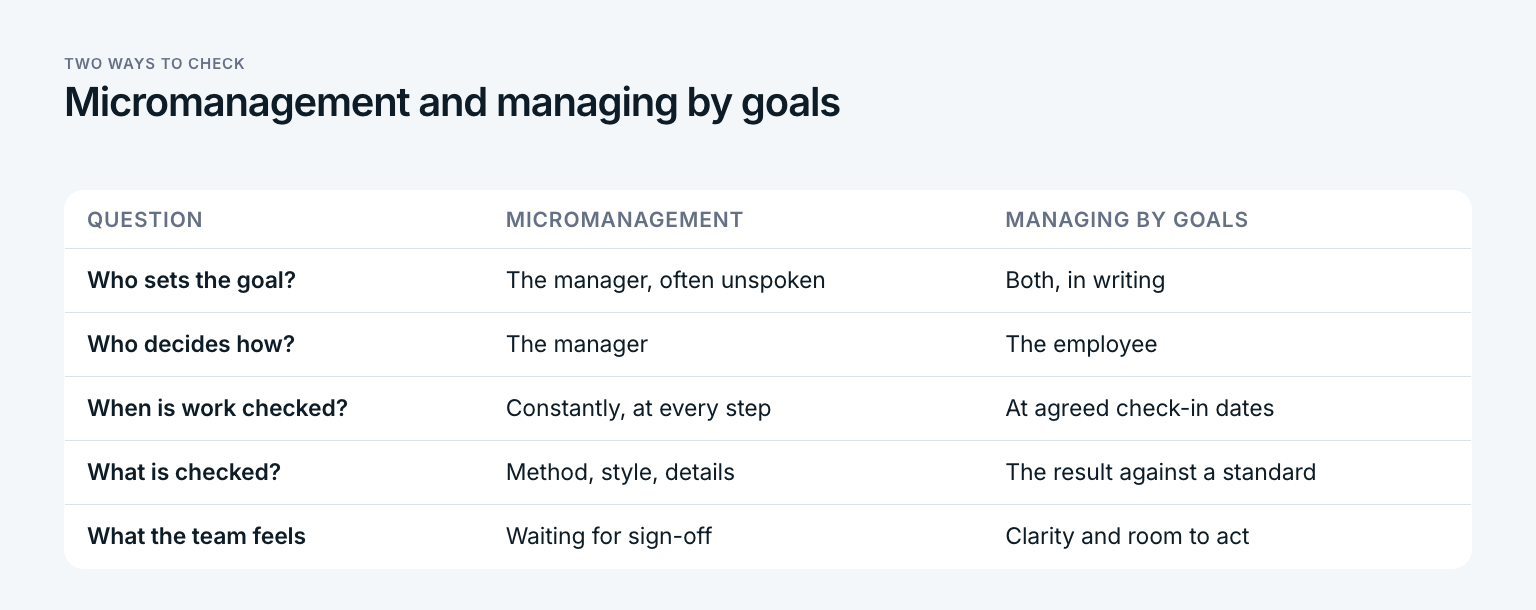
Managing by goals does not mean less control. It means control in a different place. Whoever agrees on how a result will be judged no longer needs to watch the method. The guide on team goals shows how to set those goals with the whole team.
How to stop micromanagement in five steps
Good intentions do not get you far here. "I will let go more" lasts until the first client complaint. What works is rebuilding control: away from the method, toward the result. Five steps hold up in practice, and Dana went through them in six weeks.
List your checkpoints, one week
For one week, write down every point where work waits for you: approvals, reviews, follow-ups, questions. Next to each one, note the risk you are trying to cover. Dana found eleven checkpoints. Only three of them covered a real risk, such as quotes above $25,000 in annual premium.
Rate maturity per task, 30 minutes
Go through the main tasks of each person on your team and ask: how often has this person done this well? Following Grove, the tightness of supervision depends on that maturity, not on your gut. Dana realized that five of her seven reps had handled standard renewals reliably for years.
Agree on results and limits, 30 minutes per person
For every task, agree on what the finished result must contain and at what point you want to be asked. Dana stopped reviewing quotes below $25,000 and set a four-point checklist for every quote: coverage, limits, premium, renewal date.
Fixed times instead of drive-bys
Replace status checks with a fixed rhythm: a weekly one-on-one of 30 minutes, plus two set windows a day for questions. Everything else waits for those times unless something is truly urgent. The guide on the [one-on-one meeting](/en/blog/one-on-one-meeting) has an agenda and questions for that slot.
Sample instead of checking everything
Check results by sampling, not item by item. Grove compares this to quality control in manufacturing: the more experienced the person, the smaller the sample can be. Dana now reads five quotes per rep each week and discusses them in the one-on-one.
Six weeks later, Dana's week looked different. Reviewing quotes takes 2 hours instead of 10, and one-on-ones take three and a half hours instead of one. Quotes reach clients in two business days again, and Dana leaves at 5:30 p.m. Not everything went smoothly. In week two, a quote went out with the wrong renewal date. Dana did not take back the limit. She added the renewal date to the checklist.
The most common mistake: letting go of everything at once
Managers who realize they micromanage often swing to the other extreme and pull back overnight. The intent is good, and it is still risky. The team gets freedom without a frame, the first mistake comes quickly, and control returns twice as hard. Hand off one task at a time, each with an agreed result and a fixed check-in date.
One point gets lost easily in the rebuild: feedback on the result replaces corrections to the method. Whoever gives it clearly and soon does not need control on the side. The guide on how to give feedback to employees shows what that sounds like in a real conversation.
Being micromanaged at work: how to get out of it
Anyone being micromanaged at work has fewer levers than the manager. That does not make them powerless. Marcus, one of Dana's account managers, spent the spring asking before every quote, because she rewrote them anyway. What helped him? Five moves, in this order:
- Watch the pattern, not the person. For two weeks, note when the control shows up: on which tasks, at what time, after which event. Often a trigger appears, such as pressure from above before the monthly numbers are due.
- Report before you are asked. Whoever shares status before anyone asks removes the reason to check. Marcus sent Dana three lines every afternoon: done, open, where he needed help.
- Ask about results and limits. In your next one-on-one, ask: how will you know I did this well? Above what limit do you want me to check with you? That moves the conversation from method to result.
- Earn trust in small pieces. Offer to own one task on your own for four weeks, with a fixed review date. A small area that runs well persuades more than any debate about principles.
- Raise it calmly, with an example. If nothing changes, bring it up in a one-on-one. Describe one specific situation and its effect, for example: the quote waited a day for approval and the client called twice. Comments about character lead nowhere.
And if none of that works? The next step is a conversation with your manager's manager or with HR, calm and backed by the notes from step one. If the situation keeps weighing on you, costs you sleep or makes you ill, take that seriously and talk to your doctor or an employee assistance program. If you are in crisis, you can call or text 988 to reach the 988 Suicide and Crisis Lifeline at any hour.
In short: you cannot change your manager. You can supply the information they have been getting through control. For Marcus, that was enough. Now that he knows Dana's limits, he only asks on quotes above $25,000.
Turn control into a goal chain, from year to day
Micromanagement often grows where goals stop halfway down. The yearly goal sits in a review form, but there is no checkpoint between January and December. So the manager checks everything, every day. The fix is a goal chain in which every level has its own check-in date. Dana's chain looks like this:
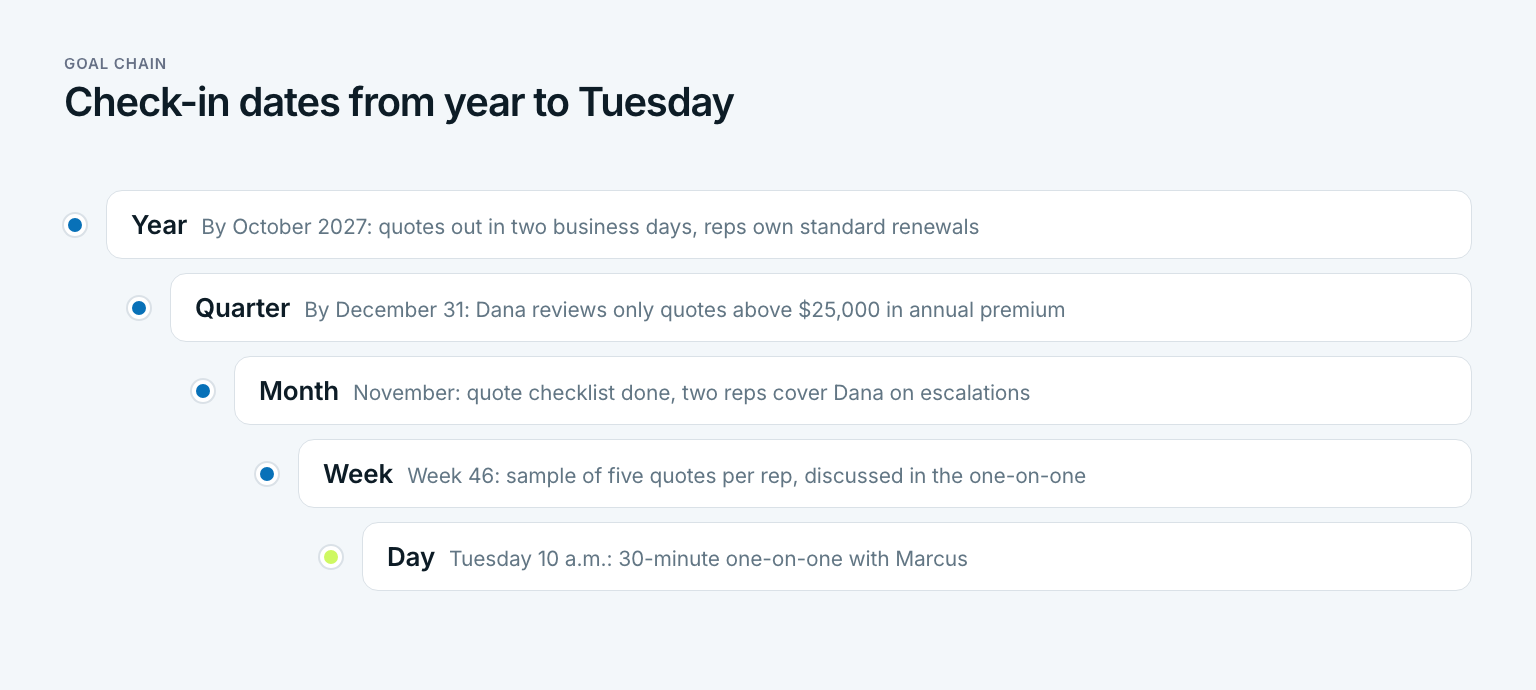
At every level it is clear what gets checked and when. Dana sets the yearly and quarterly goals with her VP. She agrees on monthly and weekly goals with the team. The day belongs to the team. Dana no longer checks what her reps are doing today. She checks on Friday whether the week moved the monthly goal.
Her own leadership goal sits in the chain as well: through the end of March, 30 minutes of one-on-one time with each rep every week instead of control on the side. The guide on goals for managers shows how to write goals like that for yourself. Whoever keeps the chain in one shared place sees progress without having to ask. That is what Gaapp is built for.
Self-audit: are you a micromanager?
Before you change anything, take an honest look. Answer these six questions with yes or no:
- Does work from your team regularly wait for your approval?
- Did you rewrite something last week that was already correct in substance?
- Are important tasks missing an agreed standard for judging the result?
- Do you ask for updates more often than you agreed to?
- Do you take over hard cases instead of preparing someone to handle them?
- Would your team stall if you took a week of vacation?
Anyone who answers yes three times or more has a clear starting point: the first of the five steps, one week of writing down checkpoints. Micromanagement is not a character flaw. It is a habit that agreed goals can replace.
Frequently asked questions about micromanagement
What should you do when someone tries to micromanage you?
Start by noticing when the control shows up and send updates before you are asked. Then ask in a one-on-one how the result will be judged and at what point you should check in. If nothing changes, raise one specific situation calmly and focus on its effect, not on your manager's character.
What are some good books on micromanagement?
My Way or the Highway by Harry Chambers from 2004 is written about micromanagement itself. High Output Management by Andrew Grove from 1983 explains task-relevant maturity, a clear test for how much supervision a task needs. The Coaching Habit by Michael Bungay Stanier from 2016 and Radical Candor by Kim Scott from 2017 help managers ask more and correct less.
How do you get out of being micromanaged?
Supply the information your manager is getting through control: short daily status notes, agreed results and clear limits for when to check in. Offer to own one task on your own for four weeks with a fixed review date. If that fails, talk to your manager's manager or HR with notes on specific situations.
What happens when employees are micromanaged?
Employees who are micromanaged lose decision latitude, which research by Robert Karasek links to higher strain, and autonomy, which Deci and Ryan count as a basic psychological need. In practice people stop suggesting ideas, wait for approval and start looking for other jobs. In a 2004 survey reported by Harry Chambers, 36 percent of micromanaged respondents had changed jobs because of it.
What is an example of micromanagement?
A team lead who reads every customer reply before it goes out is a classic example of micromanagement. Others include a boss who changes fonts in a deck the night before a meeting or a manager who pings remote staff after ten minutes offline. In each case the method gets checked instead of the result.
Is micromanagement ever a good thing?
Close supervision makes sense when someone is new to a task or when a mistake could cause serious harm, as in safety inspections. In those cases it is fitting guidance, not micromanagement. It becomes a problem when it stays in place after the person has long since mastered the task.
Last updated: 22 October 2026
Read next
 Leadership & Teams
Leadership Styles: Which One Fits Which Situation
Leadership styles are not personality types: 11 types compared, Lewin, Goleman, situational leadership and five steps to find the style that fits you.
14 min read
 Leadership & Teams
Retrospective: How Teams Learn From Every Sprint
A retrospective is not a blame session: what the word means, five phases, seven retrospective examples and action items that stick, shown on one team.
16 min read
 Leadership & Teams
How to Delegate Tasks: Hand Off Work, Keep Results
Delegation is not dumping work: five levels of delegation, seven steps, a handoff script and what to keep, shown on one marketing team.
15 min read