Work-Life Balance: How to Plan It Week by Week
Work-life balance is not a 50/50 split. Its meaning, the 8-8-8 rule, three boundaries, six steps and a worked 168-hour week with real numbers.

Contents
- 01What work-life balance means
- 02Work-life balance vs. work-life integration: two ways to draw the line
- 03Why work-life balance is a planning problem, not a mood
- 04Three boundaries that keep work from leaking
- 05How to improve work-life balance in six steps
- 06Goals in several areas of life at once: three, not eight
- 07Work-life balance in the goal chain: from the year to 5:30 pm
- 08What an unhealthy work-life balance looks like
- 09Work-life balance tips: the three mistakes nobody notices
- 10Jasmine after twelve weeks: what moved and what it cost
- 11Frequently asked questions about work-life balance
Work-life balance is not a 50/50 split between your job and everything else. It is the way your time and energy are divided between paid work and the rest of your life: family, health, friends, and the goals that belong to you rather than to your employer. A good work-life balance does not mean equal halves. It means a split that fits what you want from this year, and one you chose on purpose instead of inheriting it from your calendar.
Three things make it work: boundaries where the workday actually ends, an hour budget for each area of life, and no more than three goals outside work that go on the calendar before the week starts. All of it is worked through on the week of Jasmine, a 34-year-old product marketing manager in Denver who is paid for 40 hours and logged 51. Along the way you get the meaning of the term, the 8-8-8 rule, how balance differs from work-life integration, six steps you can copy, the signs of an unhealthy balance, and the three mistakes that quietly undo a good plan by November.
What work-life balance means
Work-life balance means having enough time and energy left after work for the parts of life that matter to you. The phrase puts work on one side of a scale and life on the other. The picture is catchy and a little off, because work is part of life, not its opposite. Still, the idea underneath is concrete. Your week has a fixed number of hours, and every hour that goes to the job is an hour that does not go somewhere else.
The term took hold in the 1980s in the United States and the United Kingdom, in debates about flexible hours and childcare. That is why most articles on it speak to employers: remote days, flexible schedules, paid leave. Those levers matter. They just do not tell you what to do with the hour you got back.
Anyone who wants to improve work-life balance has two levers. The first sits with the employer: hours, location, and how reachable you have to be. The second sits with you: planning where the hours outside work go. This article is about the second lever. In short: balance is not a mood. It is a distribution.
The 8-8-8 rule, and why your week does not split that cleanly
The 8-8-8 rule says a day should hold eight hours of work, eight hours of rest, and eight hours for yourself. It goes back to the Welsh reformer Robert Owen, who in 1817 called for eight hours of labour, eight hours of recreation, and eight hours of rest. The labor movement later turned that line into the fight for the eight-hour day.
The rule is a good floor. As a plan, it falls short. The eight hours for yourself also have to cover the commute, dinner, laundry, and homework help. For most working parents, that block is spoken for before it starts. That means: the 8-8-8 rule tells you the size of the box, not what goes in it.
Exempt from overtime, not from the clock
Under the Fair Labor Standards Act of 1938, non-exempt employees earn overtime for every hour past 40 in a workweek. Most salaried professionals are exempt, which means the 41st hour costs the employer nothing and shows up on no pay stub. That is why hours creep in salaried jobs without anyone deciding they should. Whoever has no overtime line on their pay stub needs one in their own notes instead.
Work-life balance vs. work-life integration: two ways to draw the line
Work-life integration is the main alternative to balance, and it comes from the remote and hybrid work debate. Its argument: the line between work and life is gone anyway, so blend the two on purpose instead of fighting to keep them apart. Some call it blending or harmony. The question underneath stays the same: where does work stop?
Integration is a good idea for anyone whose work can be cut into pieces. If you leave at 3 pm for a school pickup and write for an hour at 8 pm, you gain an afternoon. The cost is rarely mentioned: without a fixed edge, work seeps into every open gap. The laptop lives on the kitchen counter, and Slack pings during dinner.
| Work-life balance | Work-life integration | Work-life blending | |
|---|---|---|---|
| Core idea | Keep work and life in separate blocks | Move work and life around each other flexibly | Let work and life run at the same time |
| Where the line sits | A fixed end time and a fixed place | A fixed number of weekly hours, flexible timing | Barely anywhere, almost always reachable |
| Fits best | Shift work, on-site roles, people who want to switch off | Hybrid roles, parents, freelancers who plan | Launch phases and short projects |
| Main risk | Rigid hours clash with family logistics | Work fills every gap | Recovery stops happening |
| What you have to plan | Quitting time and weekends | A weekly hour budget and quiet windows | An end date for the phase |
That means: integration is not the successor to balance. It is a version of it with a different line. The line moves from the clock to the weekly budget. Anyone who integrates has to count more carefully than someone who shuts the laptop at 5 pm, not less. Blending is built for phases. Whoever has been in launch mode for three years is no longer in a phase.
Why work-life balance is a planning problem, not a mood
A week has 168 hours. That number is the same for a CEO and an intern, and it cannot be negotiated. Everything anyone says about work-life balance is, in the end, a claim about how those 168 hours are divided. Whoever never counts them still divides them. Just not on purpose.
Most work-life balance tips start with feelings: mindfulness, breaks, a hobby. Those are good habits. They do not explain why the evening starts at 7:30 pm. The answer is in the calendar, and the calendar usually says the same thing: work has fixed appointments, everything else has none.
That is the whole mechanism. Work arrives with times, deadlines, and people waiting on you. A run, dinner with your kid, and coffee with a friend arrive with none of that. So the run loses every conflict, not because it matters less, but because it has no slot. When did you last defend an evening the way you defend a client deadline? Anyone who wants to improve work-life balance has to give life the same tools work already has: a start time, a duration, and a number that shows whether it happened.
Jasmine's 168-hour week, in numbers
Jasmine tracked one week in September, five minutes every night, in a spreadsheet with eleven rows. She is 34, runs product marketing for a software company, and works hybrid: Tuesday to Thursday in the office, Monday and Friday at home. Her husband Chris teaches high school chemistry, and their daughter Maya is seven. Her offer letter says 40 hours. Her calendar disagreed.
| Area | Tracked week in September | Budget from October |
|---|---|---|
| Sleep | 45 hours | 52 hours |
| Paid work | 51 hours | 44 hours |
| Commute, three office days | 4 hours | 4 hours |
| Email and Slack after hours | 7 hours | 1 hour |
| Household and errands | 12 hours | 12 hours |
| Maya: school run, dinner, homework, bedtime | 16 hours | 19 hours |
| Time with Chris | 3 hours | 5 hours |
| Running | 0 hours | 4 hours |
| Friends | 1 hour | 3 hours |
| Meals, getting ready, getting around | 13 hours | 13 hours |
| Unplanned time | 16 hours | 11 hours |
| Total | 168 hours | 168 hours |
Three numbers stand out. The 51 hours of paid work are eleven more than the offer letter, spread across small extensions: fifteen minutes here, a call that ran over there. The seven hours of email and Slack after hours appear in no timesheet, yet they eat the stretch between Maya's bedtime and her own. And running sits at zero, even though Jasmine ran two half marathons before Maya was born.
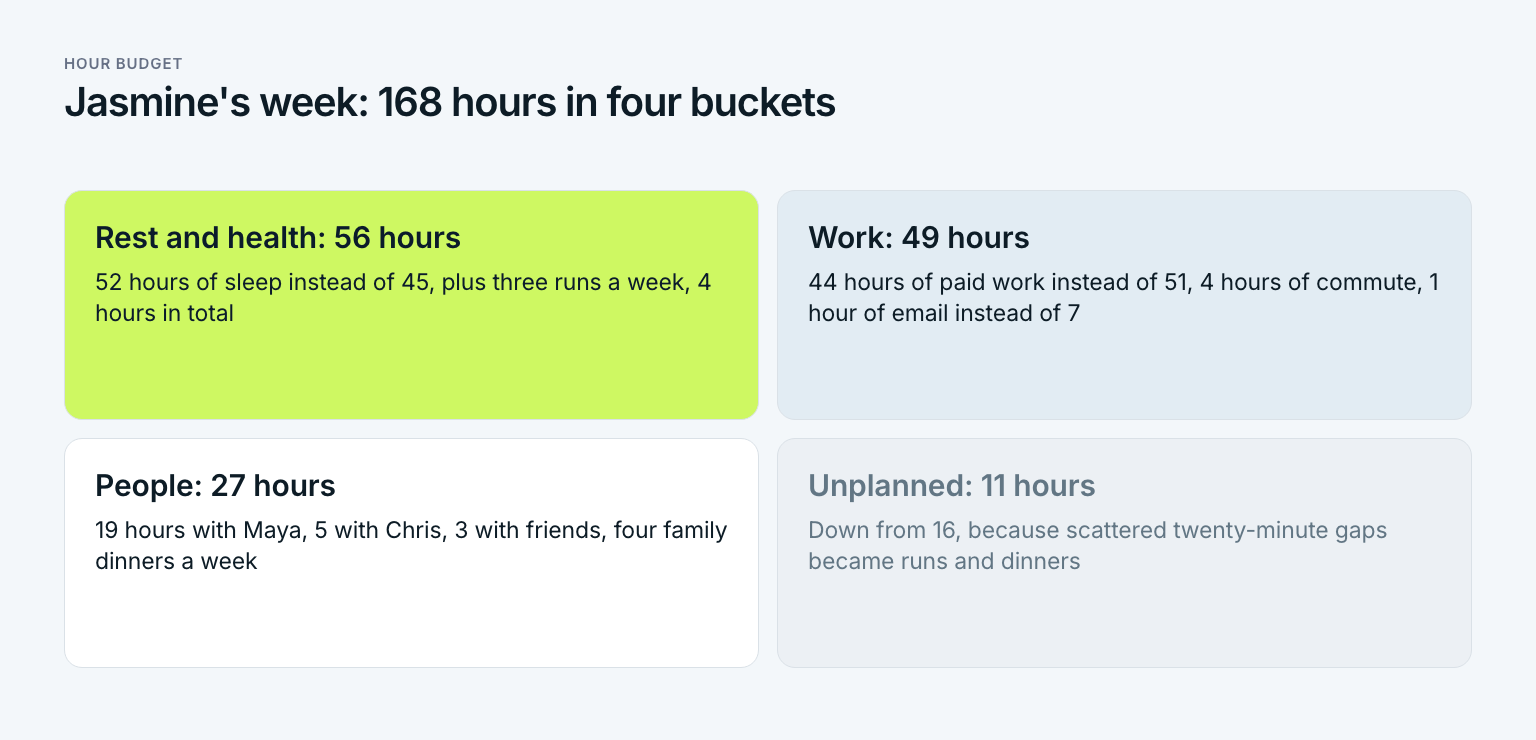
The table also shows something it never says out loud. Jasmine had sixteen hours of unplanned time, enough for three runs and a dinner with friends. It was just scattered in twenty-minute pieces, too short for anything and long enough to answer one more message. The time is rarely missing. The block is.
The October budget has less free time than September, not more. That surprises most people. For Jasmine, work-life balance does not mean more leisure. It means the hours land where she decided they should. Seven fewer hours of work, six fewer hours of after-hours email, five fewer unplanned hours. In return, seven more hours of sleep, four for running, three more for Maya, and two more each for Chris and for friends.
Three boundaries that keep work from leaking
An hour budget without boundaries lasts until the first urgent project. Boundaries are the points where work stops, even when it is not finished. Three are enough. Nobody remembers more than three:
- The time boundary. A fixed time when the workday ends, the same on office days and at home. For Jasmine it is 5:30 pm. Whoever has no end time stops when they are tired, and that is always too late. The boundary needs a small ritual: at 5:20 pm Jasmine writes the three tasks for tomorrow on a sticky note, then closes the laptop.
- The place boundary. One spot where work happens, and places where it does not. At home, Jasmine works at the desk in the spare room, never at the kitchen counter. After 5:30 pm the laptop goes into a drawer. Whoever can see it thinks about it.
- The reach boundary. A window when email and Slack are silent. Jasmine set her work phone to pause notifications from 7 pm and told her team how to reach her in a real emergency: call. In twelve weeks, nobody called.
Boundaries only hold when other people know them. Jasmine announced hers in one sentence at a team meeting and put her working hours in her Slack status. It sounds minor. Yet every reply at 9 pm is an invitation for the next one.
Freelancers and managers face the same problem with less cover. Anyone who answers to nobody has to put the boundary on the calendar as an appointment, as binding as a client call.
The most common mistake: planning life from the leftovers
Most people plan the week from the work side. Meetings first, then tasks, and whatever remains counts as free time. Life always gets the leftovers, and the leftovers shrink every week. The British historian C. Northcote Parkinson described why in 1955: work expands to fill the time available for its completion. So reverse the order. Sleep, runs, family dinners, and time with friends go on the calendar first, and work gets planned into the frame that is left. That is not laziness. It is the same logic that gives every project a deadline.

How to improve work-life balance in six steps
The six steps take about two hours the first time, spread across one week of tracking and one Sunday evening. After that, keeping them up costs ten minutes a week.
Track one real week
For seven days, spend five minutes each night writing down where the hours went, in whole or half hours. Count after-hours email, the commute, and errands. Without this week, you plan against a week that does not exist.
Sort the hours into four buckets
Assign every row to rest and health, work, people, or yourself, and add them up. Mark the bucket that has been running empty for months. For Jasmine it was rest and health: 45 hours of sleep and zero minutes of running.
Set an hour budget for each row
Write a target number next to each row so the total comes to 168. Every hour you add in one place has to come from another. Anyone who skips this step ends up planning a 180-hour week and wonders why Friday feels like a failure.
Draw three boundaries
Pick an end time for the workday, one place where work happens, and a window when you are not reachable. Tell the people who would otherwise reach you, in one sentence.
Choose up to three goals outside work
One goal for each bucket that needs it, with a number and a date. Jasmine picks three: run three times a week toward a half marathon in May, be at the dinner table by 6 pm four nights a week, and see a friend in person every week.
Plan the week from the life side and review it on Sunday
Put the slots for your three goals on the calendar first, then the work. On Sunday, take ten minutes to check whether the week hit the budget, and change one thing for the next one.
Step three is the uncomfortable one. It forces a decision the calendar would otherwise make for you. Whoever wants seven more hours of sleep has to say which seven hours they give up. Jasmine gave up the late-night scroll. To get the blocks onto the calendar, time blocking helps, because it puts work blocks and life blocks into the same calendar so neither one stays invisible.
Goals in several areas of life at once: three, not eight
Work-life balance rarely fails for lack of goals. It fails because of too many. Whoever notices in the fall that life feels lopsided wants to fix everything at once: exercise, friends, marriage, reading, volunteering. Five projects need five fixed slots a week. Those slots do not exist, so after three weeks everything drops.
Three goals outside work are the limit a full week can carry, and only if they occupy different times. The reasoning behind that number, and how to park the rest without guilt, is in why three goals are enough. If you want a scored picture of all eight areas before you choose, the wheel of life gives you one in twenty minutes. Here a second rule matters: every goal needs a fixed place in the hour budget. A goal without hours is a wish.
Three questions help you choose:
- Which bucket has been empty for months? The one your tracked week gave the fewest hours. For Jasmine: running, zero.
- Which goal pulls others along? A Tuesday evening run means Jasmine has to stop at 5:30 pm. The health goal enforces the work boundary. Goals like that count twice.
- Which goal already has a slot? Dinner with Maya happens every night, just often without Jasmine. A goal that docks onto an existing routine costs less effort.
Jasmine's three goals, written with a number and a date:
- Health: Run the Colfax Half Marathon in May 2027, with three runs a week from October on and no break longer than one week.
- Family: From October, be at the dinner table by 6 pm at least four nights a week.
- Friends: See one friend in person every week, for at least an hour, through March 2027.
None of these goals is about working less. Work-life balance is not about shrinking your career. It is about making sure the goals outside work get hours that are not stolen from sleep.
Work-life balance in the goal chain: from the year to 5:30 pm
A yearly goal like running a half marathon in May is clear in January and forgotten by March if nothing sits in between. The goal chain translates it into five levels: year, quarter, month, week, day. Each level holds something you can count, and each one feeds the level above it.
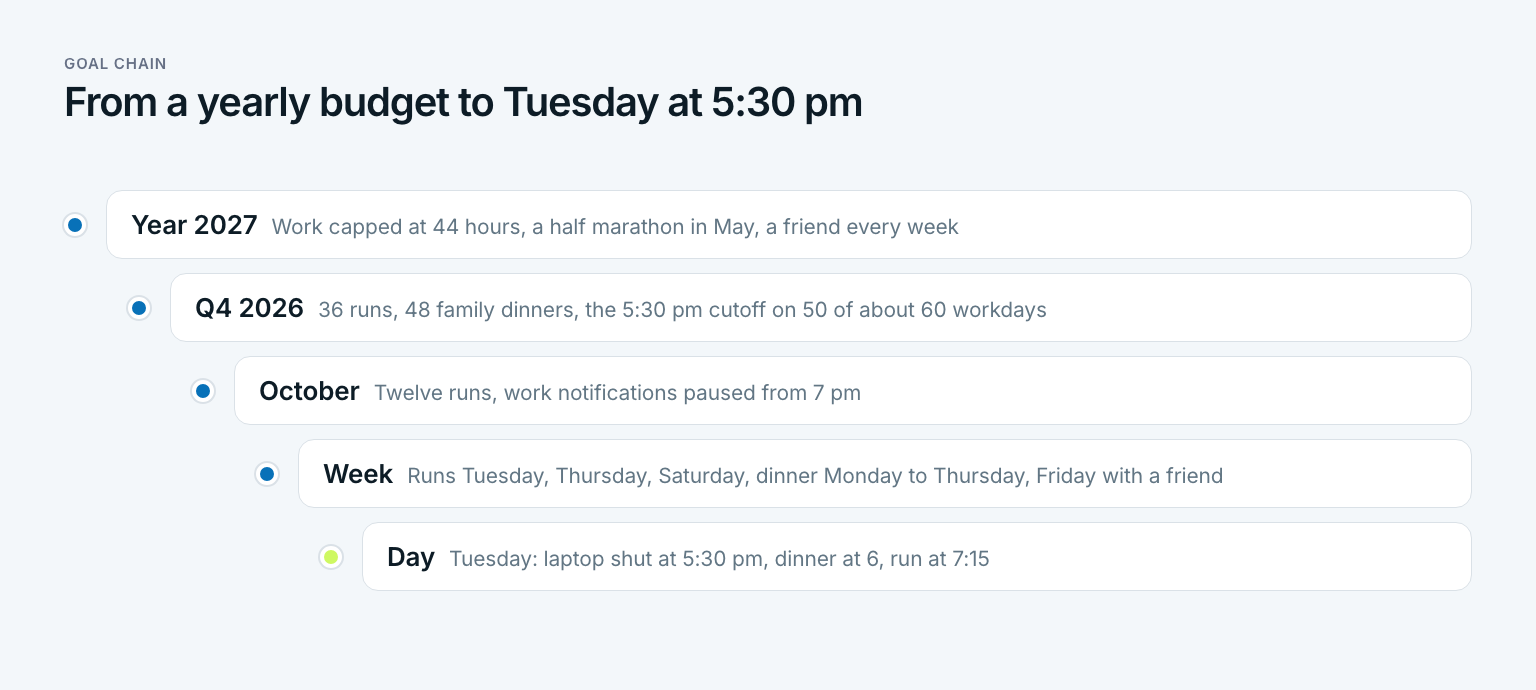
For Jasmine, the top level is not a single goal but the budget itself: work capped at 44 hours a week and three goals outside it. The quarter turns that into numbers she can tick off: 36 runs by Christmas, 48 family dinners, the 5:30 pm cutoff on at least 50 of roughly 60 workdays. October holds twelve runs and the new notification pause. The week fixes the evenings: runs on Tuesday, Thursday, and Saturday morning, dinner Monday through Thursday, Friday night with a friend. And the day is one sentence: Tuesday, laptop shut at 5:30 pm, dinner at 6, run at 7:15.
The day is where balance gets decided. At 5:25 pm an email arrives that looks like a quick reply. Anyone who only has the intention of better balance answers it. Anyone who knows that Tuesday is one of three runs this week, and that the quarter needs 36 of them, answers at 8 am tomorrow. The chain turns an attitude into arithmetic.
In Gaapp, the whole chain sits in one view: the yearly budget at the top, quarters, months, and weeks below it, and on each day the one checkmark that counts. A notebook with one page per level works too, as long as every level carries a number.
Balance as a couple and as a family
Jasmine's week depends on Chris's schedule. Whoever shares a home does not have a private work-life balance. They have a shared one. Her Thursday run only works if Chris is home by 6:30 pm, and during parent conference weeks he is not. So the two of them sit down every Sunday at 7 pm for twenty minutes, put his school calendar next to her three goals, and hand out the evenings. The format they use is the family weekly planner.
What an unhealthy work-life balance looks like
An unhealthy work-life balance is one where work keeps taking hours you had promised to something else, week after week, without anyone deciding it should. It rarely announces itself. It shows up as a pattern in the numbers long before it shows up as a feeling. How can you tell if you are overworking yourself? Check four signals in your own calendar:
- Your actual hours have been above your budget for three weeks in a row, and each week had a reason.
- Every goal outside work has missed its slot at least twice this month.
- You cannot name the time your workday ends tomorrow.
- You answer messages during the hours you set aside for sleep, family, or friends, and nobody asked you to.
Two or more of these mean the plan has stopped working and needs a new budget, not more willpower. The World Health Organization describes burnout in its ICD-11 classification as an occupational phenomenon that results from chronic workplace stress that has not been successfully managed. Anyone who has felt exhausted for weeks, sleeps badly, or no longer enjoys things that used to matter should talk to a doctor, because a weekly plan is not a treatment.
Work-life balance tips: the three mistakes nobody notices
Most work-life balance tips are correct. Take breaks, put the phone away, learn to say no. They do not fail because of their content. They fail because of three mistakes that feel like common sense in the moment. Which one is yours?
- Saving balance for vacation. Two weeks off in August are a good thing, they break up the year. They do not make up for fifty weeks at 51 hours. Balance that only happens on vacation is compensation, not balance. Whoever postpones recovery to August is planning eleven months of tilt.
- Not counting the exceptions. The most common sentence in a full calendar is that this week is different. A launch, a conference, a quarter close. Anyone who counts their exceptions over a quarter often finds seven out of twelve weeks. At that point the exception is the rule, and the budget has to change, not the hope.
- Only shrinking the work side. Working less is a good goal, but an incomplete one. Whoever leaves two hours earlier without knowing what for fills those hours with screens and errands. Every hour you take back from work needs a goal on the other side, or work reclaims it the next week.
That means: good work-life balance tips are not a list of feel-good rules. They are rules for the calendar. A fixed end time, fixed slots for life, and a count of the exceptions. Everything else is decoration.
Jasmine after twelve weeks: what moved and what it cost
The week before Christmas, Jasmine tracks one more week and lays it next to the budget, together with twelve weeks of checkmarks. Paid work averages 45.5 hours, down from 51 but above the 44 she planned. The 5:30 pm cutoff held on 46 of 59 workdays, four short of the quarter goal. Runs: 31 of 36, with the missing five falling in a launch week and a cold. Family dinners: 42 of 48. Friends: eleven of twelve weeks.
None of the numbers is perfect. All of them are better than September, and more importantly, they exist. In September Jasmine would have called her balance fine, mostly. In December she can say: 31 runs, an hour and a half a week over budget, and the two weeks it slipped, by date.
It also cost something. A campaign brief went out two days later, because Jasmine no longer finished it at night. A weekly report she had owned for three years now belongs to a junior colleague. That is not a step back. It is the price, and now it is written down instead of being quietly taken out of her sleep.
Three questions to close, for your own week:
- Do you know how many hours you worked last week if you count email after hours?
- Does each of your goals outside work have a fixed slot this week?
- Can you name the time your workday ends tomorrow?
Anyone who answers no to one of the three does not have an attitude problem. They have a planning problem. The Sunday check is laid out step by step in the ten-minute weekly review. In short: work-life balance is not a feeling you find. It is a budget you hand out again every week.
Frequently asked questions about work-life balance
What is a good work-life balance?
A good work-life balance is one where the areas that matter to you get fixed hours every week, and work stays inside a limit you set. It does not require equal halves. Many people with a good balance work 45 hours, but they know when the day ends and their goals outside work have their own slots.
What is the 8 8 8 rule for work-life balance?
The 8-8-8 rule splits a day into eight hours of work, eight hours of rest, and eight hours for yourself. It goes back to Robert Owen, who called for it in 1817, and it shaped the push for the eight-hour workday. It works as a floor, but the third block also has to cover commuting, chores, and family logistics, so it needs its own plan.
What is an unhealthy work-life balance?
An unhealthy work-life balance is one where work keeps taking hours you had set aside for sleep, family, friends, or your own goals, week after week. Typical signs are working above your planned hours for several weeks in a row, missing every goal outside work, and answering messages late at night without being asked. If exhaustion lasts for weeks or sleep suffers, talk to a doctor.
How can I tell if I'm overworking myself?
Track one week and compare it to the hours you are paid for and the hours you planned. If your actual hours have been above your budget for three weeks in a row, if you cannot name tomorrow's end time, or if your goals outside work keep missing their slots, you are overworking. Persistent exhaustion, poor sleep, or losing interest in things you used to enjoy are reasons to see a doctor.
What is the difference between work-life balance and work-life integration?
Work-life balance separates work and personal life with fixed times and places. Work-life integration lets the two move around each other flexibly and shifts the line from the clock to a weekly hour budget. Integration fits hybrid roles well, but it requires more careful tracking, because otherwise work fills every gap.
Is work-life balance my employer's job or mine?
Both. Your employer sets hours, location, and expectations about being reachable, and those are often the biggest levers. What you do with the hours outside work, and whether your own goals get a place there, is up to you. Neither lever works well without the other.
Last updated: 6 October 2026
Read next
 Personal Growth
Maslow's Hierarchy of Needs: The 5 Levels Explained
Maslow's hierarchy of needs sorts motivation into five levels. What each level means, what research says today and a needs audit you can run yourself.
14 min read
 Personal Growth
Mindfulness Exercises: 12 for Everyday Life
Mindfulness exercises are not about emptying your mind. 12 techniques for stress and focus, what research shows, and a four-week plan to practice daily.
16 min read
 Personal Growth
Positive Affirmations: 50 Examples You Can Believe
Positive affirmations are not magic words. What research shows, 50 daily affirmations you can believe, and a five-step method with a worked example.
16 min read