Goal Setting Theory: What Locke and Latham Found
Locke and Latham's goal setting theory explained: five principles, limits and criticism, SMART and OKR compared, five steps, and one worked example.

Contents
- 01Locke and Latham goal setting theory: where it came from
- 02The five principles of goal setting theory
- 03What goal setting theory does not say: limits and criticism
- 04How to apply goal setting theory in five steps
- 05Goal setting theory vs. SMART goals and OKRs
- 06Goal setting theory at work: assigned or agreed goals
- 07Goal setting theory in a goal chain: year, quarter, month, week, day
- 08Three questions before you set your next goal
- 09Frequently asked questions about goal setting theory
Goal setting theory is not a motivational poster. It is one of the most thoroughly tested ideas in work psychology, and it says one thing clearly: specific, difficult goals lead to higher performance than vague goals like “do your best” or no goals at all. The theory was built by Edwin A. Locke and Gary P. Latham and laid out in full in their 1990 book A Theory of Goal Setting and Task Performance. Anyone who names a clear target, sets it high enough, commits to it, and gets regular feedback will outperform someone who simply means to try hard.
Most summaries stop at the five principles: clarity, challenge, commitment, feedback, and task complexity. What they skip is how to use them on a real goal. So this article works through one: Dev, 39, a shift manager at a distribution center in Columbus, Ohio, who wants to play piano for his daughter's spring choir concert. You get where the theory came from, the five principles applied line by line, its limits and the best-known criticism, a comparison with SMART goals and OKRs, five steps you can copy, and the whole thing translated into a chain from year to day.
Locke and Latham goal setting theory: where it came from
The core finding fits in one sentence: a specific, hard goal beats good intentions. That sounds obvious. It gets interesting when you see what Locke and Latham tested it against. They did not compare a goal with no goal. They compared a clear, high goal with the instruction to just do your best. And that instruction is how most people approach most things.
The research started in 1968. Edwin Locke, then at the University of Maryland, published a paper arguing that conscious goals directly drive how well people perform a task. Starting in the 1970s, Gary Latham tested the idea outside the lab, including field studies with crews in the logging and timber industry. He later taught at the University of Toronto. The two lines of work became one theory.
Three publications mark the path. In 1990 came the book A Theory of Goal Setting and Task Performance, the first complete statement of the theory. In 2002, Locke and Latham published a review in the American Psychologist that pulled together 35 years of research. In 2013 they edited New Developments in Goal Setting and Task Performance, which collects later work on learning goals, team goals, and goals people pursue without being aware of them. That means: goal setting theory is not a hunch. It rests on hundreds of studies across more than four decades.
What “do your best” means in this research
In Locke and Latham's studies, “do your best” is the comparison condition: people are told to try hard but get no number to aim for. It feels motivating, yet it lets any result count as success. With no standard to measure against, effort tends to stop sooner. That is exactly why it loses to a specific, challenging goal.
Four ways a goal changes performance
Why does a goal work at all? Locke and Latham describe four mechanisms. They explain what happens between writing a goal down and getting a result.
- Direction. A goal pulls attention toward what matters for it and away from everything else.
- Effort. A higher goal produces more effort. A lower goal produces less.
- Persistence. Whoever has a clear goal stays with a task longer instead of quitting at the first obstacle.
- Strategy. A goal forces you to think about the route. Anyone who cannot reach it on effort alone starts looking for a better method.
In short: a goal does not work through enthusiasm. It works because it points attention, effort, persistence, and planning in one direction.
The five principles of goal setting theory
Textbooks and guides usually condense goal setting theory into five principles. The first two, clarity and challenge, are the core of the theory. The other three describe the conditions under which the core works. Locke and Latham call them moderators: commitment, feedback, and the complexity of the task.
Dev starts January with a typical intention: “This year I'm finally going to practice piano more.” The choir director has asked whether a parent could accompany three songs at the spring concert on May 15. With his intention as the only plan, Dev sat down at the keyboard four times in January. Here is how each principle changes his sentence:
| Principle | What it requires | Check question | Dev's goal after |
|---|---|---|---|
| Clarity | A state with a number and a date, not a direction | Can I answer yes or no on the deadline? | Play all three choir songs through without stopping, at the choir's tempo, on May 15 |
| Challenge | Hard, but within reach of your ability | Do I have to stretch, and is it still doable? | Five 30-minute sessions a week instead of four sessions a month |
| Commitment | The goal matters to you and you believe you can reach it | Why does it matter, and who knows about it? | His daughter asked him, and the choir director has his name on the program |
| Feedback | Regular information about where you stand | How will I see each week where I am? | A phone recording every Sunday, metronome tempo logged |
| Task complexity | For new, complex tasks, learning goals first, then performance goals | Do I already know how to do this? | February as a learning month: try three practice methods, keep one |
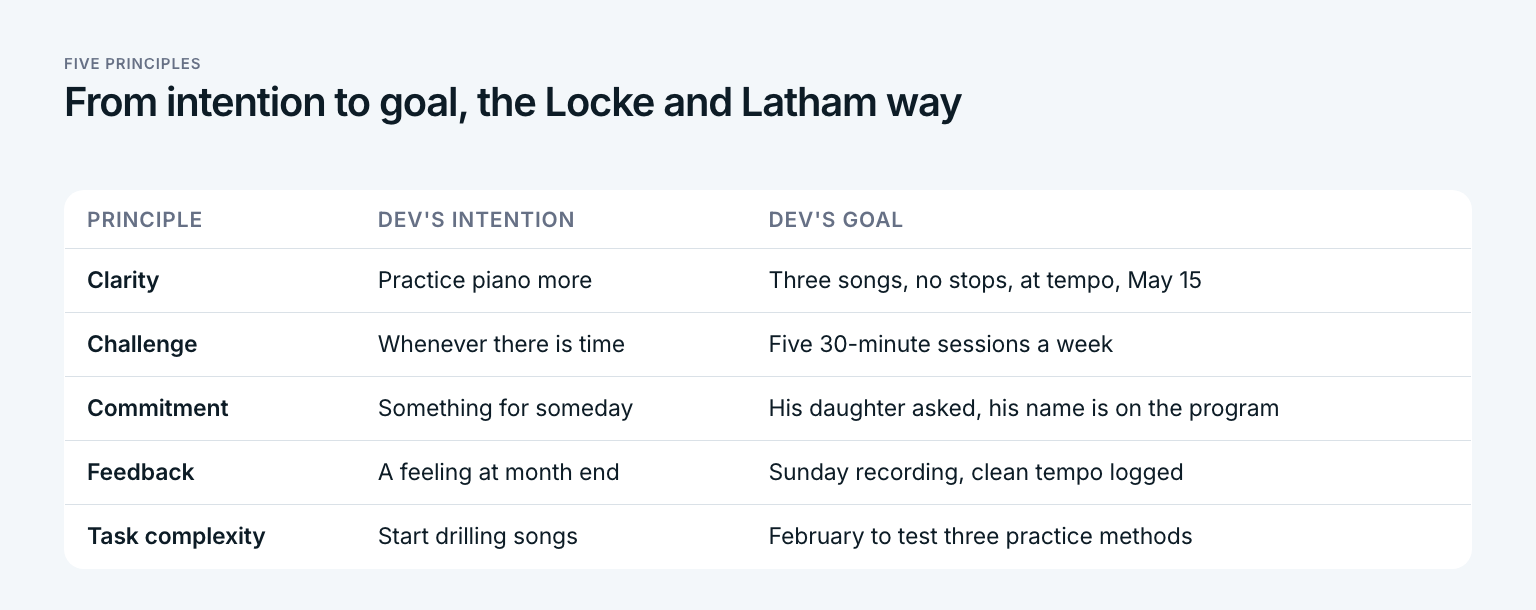
Clarity: a finish line someone else could check
Clarity does not mean a goal sounds good. It means there is nothing left to argue about on the deadline. “Practice more” is met by any week in which Dev touched the keys once. “All three songs through without stopping, at tempo, on May 15” is either true that evening or it is not. Whoever writes a goal so that another person could verify it has clarity. The step by step version of that sentence is in the guide to goal setting.
Challenge: high, but not impossible
The second principle is the surprising one. Locke and Latham found that performance rises with goal difficulty, as long as ability holds and commitment stays. An easy goal gets reached and then not exceeded. A hard goal pulls performance up, even when it is narrowly missed in the end.
Dev's January pace was four sessions a month. A goal of six would have been comfortable. A goal of an hour every day would have collapsed in week two, because his shifts start at 6 a.m. He picks five sessions of 30 minutes a week, a little over five times what he did in January. It is demanding, and it still fits between dinner and his kids' bedtime. That means: the right height is where you have to stretch without breaking the plan.
Commitment: important and believable
A hard goal only works if you actually want it. In Locke and Latham's account, commitment comes from two sources: the goal matters to you, and you believe you can reach it. Psychologists call the second one self-efficacy, and it sits close to the center of goal setting theory. How to build it is covered in the article on self-efficacy.
Dev strengthens both. His daughter Maya, who is nine, asked him to play. That makes it matter. The choir director printed his name in the concert program. That makes it public. And he starts with a week he is certain to complete, five sessions on the easiest of the three songs. That makes it believable.
Feedback: no number, no course correction
A goal without feedback is flying blind. Locke and Latham report that goals and feedback together work better than either one alone. The goal says where to go. The feedback says where you are. Only the gap between the two raises the question that matters: do you need more effort or a different strategy?
Dev's feedback is simple. Every Sunday he records each song on his phone and notes the fastest metronome tempo at which he plays it cleanly. The choir sings at 96 beats per minute. At the end of March, his first song stands at 88, the second at 60, and the third has not been started. That gap is not a crisis, but it is visible.
Task complexity: learn first, then perform
The fifth principle is the one most people skip. On simple tasks, a high performance goal raises performance directly. On new, complex tasks, it can backfire, because energy goes into more effort instead of a better method. For those tasks, Locke and Latham recommend starting with a learning goal, such as finding or trying a set number of strategies. The same split between learning and performance goals shows up in research on what makes people goal oriented: learners read a mistake as information, people out to prove themselves read it as a verdict.
Dev has not played since he was twelve. Had he demanded songs at tempo in February, he would likely have drilled bad fingering into his hands. So his February goal is a learning goal: try three practice methods for two weeks each, a learning app, a video course, and four lessons with a local teacher, then keep the one that moves his tempo fastest. Only in March does he start measuring beats per minute.
What goal setting theory does not say: limits and criticism
Goal setting theory is well supported. That is exactly why it pays to look at what it does not promise. Locke and Latham name several limits themselves, and other researchers have added more. None of them overturns the core. Each one shows where a hard goal can backfire.
- Higher goals, less satisfaction. Anyone who sets a high goal is less satisfied with the same result than someone with a low goal. The goal is the standard you judge yourself by. High goals bring more performance and less comfort along the way.
- Too many goals. The theory describes one goal and its effect. Whoever sets five hard goals at once splits attention, effort, and persistence five ways, and the mechanisms start to cancel each other out.
- Tunnel vision and shortcuts. In 2009, Lisa Ordóñez and colleagues published a widely discussed critique titled Goals Gone Wild. It warns that narrow, aggressive goals can crowd out other things that matter and tempt people into unethical shortcuts. Locke and Latham replied the same year that these risks were already known and avoidable with careful goal setting.
For Dev, this means a tempo number cannot be the only measure. Hitting 96 beats per minute with wrong notes would meet the number and miss the point. So the choir director listens to one recording in April. And the concert is his only big personal goal this spring.
The most common mistake: set the goal high, then leave it alone
Most people know one line of goal setting theory: hard goals lead to better performance. So the goal gets set high and never looked at again. Without feedback, nobody notices when the gap grows too wide. Without commitment, the goal is quietly dropped at the first setback. That means: challenge is one principle out of five. Anyone who applies it without the other four does not get more performance, just earlier frustration.
How to apply goal setting theory in five steps
The theory was described for organizations, but it works the same way on a personal goal. The order matters, because each step builds on the one before it. Plan on about 45 minutes once, then ten minutes a week.
Turn the intention into a finish line, ten minutes
Write your intention down and ask: what would another person see on the deadline that tells them it is done? The answer is your goal, with a number and a date. Dev's “practice more” becomes “all three songs through without stopping, at 96 beats per minute, on May 15.”
Set the height, ten minutes
First measure what you do without a goal, then set the goal clearly above it. Check it against your calendar: how many hours do you really have each week? Dev did four sessions in January and has evenings after 7:30 p.m. Five sessions of 30 minutes is a stretch that still fits.
Check complexity and add a learning goal if needed, ten minutes
Ask honestly whether you already know how to do this. If not, the plan opens with a learning goal that settles the method. For Dev, that is February and its three practice methods.
Lock in commitment, ten minutes
Write the reason next to the goal in one sentence, and tell one person who will ask about it. Plan the first week so it is certain to succeed. Dev tapes a note to the keyboard: “For Maya, May 15.”
Set up feedback, five minutes, then weekly
Decide which number you record, when, and where, and compare it with the plan. Dev records every Sunday and logs the clean tempo per song. If a song stalls for two weeks in a row, he changes the strategy, not the goal.
Dev's March in numbers: feedback that forces a decision
Here is the Sunday log Dev keeps in March for his first song. The decision column is the reason the log exists. A number without a decision is a statistic. A number with a decision is feedback.
| Week | Sessions | Clean tempo, song one | Target | Decision |
|---|---|---|---|---|
| Week 1 | 5 | 70 | 96 by April 30 | No change |
| Week 2 | 5 | 76 | 96 by April 30 | No change, on pace |
| Week 3 | 3 | 77 | 96 by April 30 | Two late shifts, note the cause |
| Week 4 | 4 | 78 | 96 by April 30 | Strategy change: practice the hard bars at half speed first |
| Week 5 | 5 | 88 | 96 by April 30 | Back on pace, start song two at 60 |
Two things stand out. After the first weak week, Dev changes nothing, because one week is noise, not a pattern. After the second flat week, he does not lower the goal. He changes the method. Whoever lowers the goal at every setback loses the effect of challenge. Whoever never changes anything loses the effect of feedback. Is that overthinking a hobby? No. It is exactly the gap between plan and result that the theory runs on.
Goal setting theory vs. SMART goals and OKRs
SMART goals and OKRs sit close to goal setting theory, but they are built for something else. The theory explains why goals work. SMART is a checklist for wording a goal, introduced by George T. Doran in 1981 in the journal Management Review. OKRs are a management system that Andy Grove developed at Intel and that John Doerr later made widely known. Both belong to a wider family of goal setting frameworks, each built to close a different gap.
| Goal setting theory | SMART goals | OKRs | |
|---|---|---|---|
| What it is | A psychological theory of goals and performance | A checklist for how to word one goal | A method for steering goals across teams and companies |
| Origin | Locke and Latham, book 1990, review 2002 | George T. Doran, 1981 | Andy Grove at Intel, popularized by John Doerr |
| Strength | Explains why and when goals work | Makes a goal checkable | Links a qualitative objective to measurable results |
| What is missing | No ready-made template for daily use | Nothing on commitment, feedback, or learning goals | Without the theory, often too many key results |
| Link to the five principles | It is the source | Mostly covers clarity | Covers clarity, challenge, and feedback |
That means: anyone who writes SMART goals applies mainly the first principle. Challenge, commitment, feedback, and complexity are left open. The full set of criteria is in the article on SMART goals. If you work with OKRs, the OKR framework shows how they connect to teams and quarters.
Goal setting theory at work: assigned or agreed goals
Most of Locke and Latham's studies come from workplaces and labs. For managers, one question matters more than most: does a goal have to be agreed on together to work? The answer is more nuanced than many expect. Locke and Latham report that assigned goals can work about as well as participatively set ones, as long as the manager explains the reason behind them.
Participation still has value. It brings more knowledge into the goal, because the people doing the work often know which strategy will succeed. That helps most on complex tasks. Whoever sets goals for a team checks the same five principles: is the goal clear, high and doable, is the reason known, is there feedback, and is there something to learn first?
Dev uses this on his shift. “Fewer picking errors” becomes a number on the board by the time clock, with a weekly count and a reason everyone has heard: every wrong order costs a customer a second delivery. In February, before chasing the number, the team spends two weeks testing two ways of labeling bins. How to turn this into goals your people actually own is covered in goal setting for employees.
Goal setting theory in a goal chain: year, quarter, month, week, day
A goal for May 15 is clear, but in January it is far away. Far goals lose their pull without milestones in between. A goal chain carries the five principles into every time frame, and every level gets its own feedback. How short-term and long-term goals carry each other decides whether the near goal gives the far one feedback or just keeps you busy.
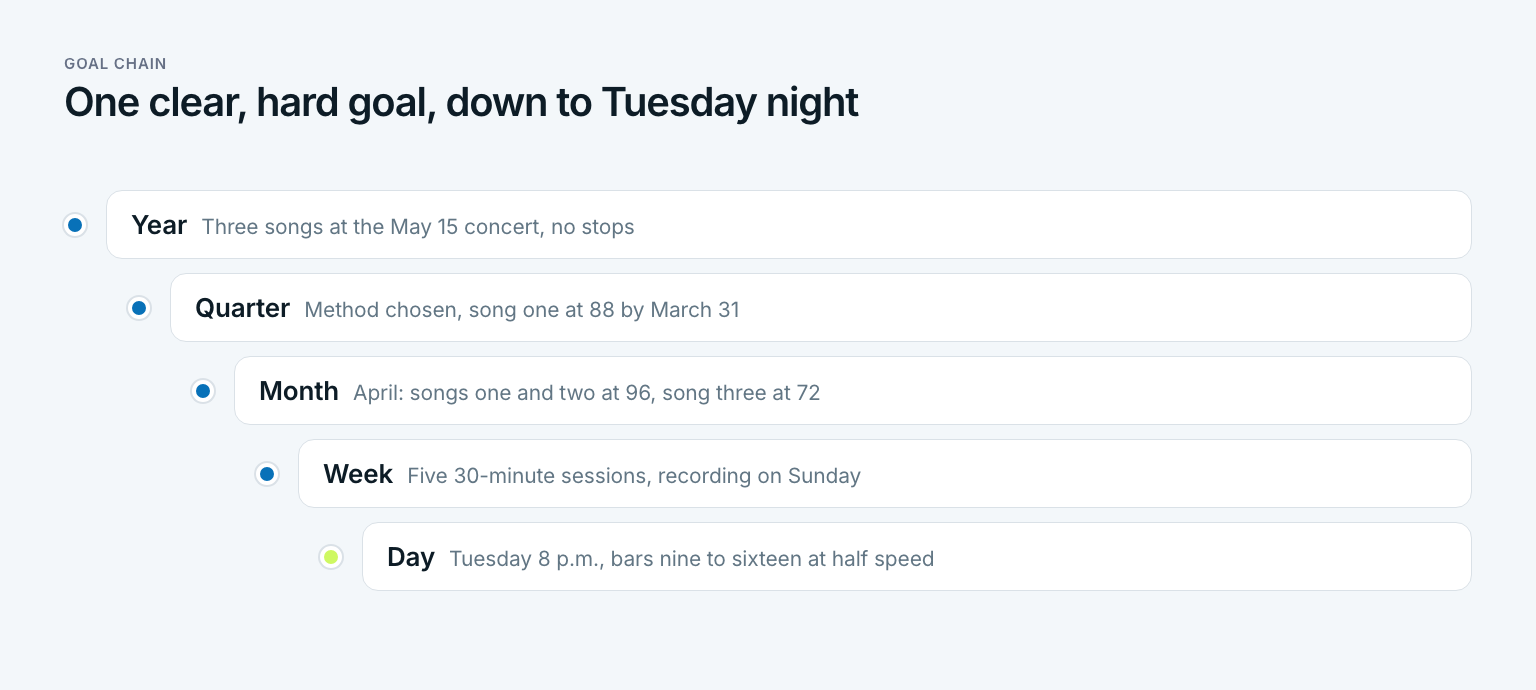
- Year: Accompany the spring concert on May 15, all three songs without stopping. Clarity and commitment live here.
- Quarter: By March 31, one practice method chosen and song one at 88 beats per minute. The February learning goal sits here.
- Month: In April, songs one and two at 96 and song three at 72. This is where challenge becomes a number.
- Week: Five sessions of 30 minutes, a recording every Sunday. This is where feedback happens.
- Day: Tuesday 8 p.m., 30 minutes, bars nine to sixteen of song two at half speed. This is where the goal becomes an action.
In Gaapp, every goal hangs on a bigger one, and progress at each level sits next to elapsed time. On April 30, Dev sees two of three April goals done while the month is fully gone. That is feedback in exactly the form Locke and Latham describe: a gap between plan and result that asks for a decision, here to spend the first two weeks of May on song three alone.
Three questions before you set your next goal
Goal setting theory comes down to three checks. Run them on the goal that matters most to you right now.
- Could someone else say yes or no on your deadline about whether you reached it?
- Is your goal clearly above what you would do without one, and does it still fit into your week?
- Do you know which day you will next see where you stand?
Anyone who answers no to one of these is not short on willpower. They are short on one of the five principles. In short: goal setting theory is not a call to want more. It is a way to build goals so that wanting is enough.
Frequently asked questions about goal setting theory
What are the 5 principles of goal-setting theory?
Clarity, challenge, commitment, feedback, and task complexity. Clarity and challenge are the core of Locke and Latham's theory: specific, difficult goals lead to higher performance. Commitment, feedback, and task complexity decide whether that core actually works.
What is Edwin Locke's theory of goal setting?
Edwin Locke proposed in 1968 that conscious goals directly drive performance, and that specific, hard goals beat vague instructions to do your best. Together with Gary Latham, he developed this into goal setting theory, set out in their 1990 book and their 2002 review in the American Psychologist. The theory also explains how goals work, through direction, effort, persistence, and strategy.
What are the 5 C's of goal setting?
There is no single official list under that name, and Locke and Latham did not publish one. Most versions relabel the five principles, for example clarity, challenge, commitment, check-ins for feedback, and complexity. If you see a different set of C's, check whether it still covers those five ideas.
What are the 7 steps of goal setting?
Seven-step lists come from guides, not from the theory itself. A practical version built on Locke and Latham looks like this: write the intention, turn it into a finish line, measure your current level, set the goal above it, add a learning goal if the task is new, lock in commitment, and schedule weekly feedback. The five steps above combine some of these.
Is goal setting theory still valid today?
Yes, the core findings have held up across many studies and settings, which is why the theory is still taught in management and psychology. The main criticism, Goals Gone Wild from 2009, does not dispute that goals raise performance. It warns about side effects of narrow or excessive goals, which the theory's own limits already point to.
Does goal setting theory work for personal goals?
Yes, the mechanisms of direction, effort, persistence, and strategy work whether a goal sits at work or at home. Most studies come from workplaces and labs, but the principles carry over directly to a fitness goal, a savings goal, or learning an instrument. The same caution applies: keep the number of hard goals small.
Last updated: 19 October 2026
Read next
 Goal Setting
Intrinsic Motivation: What Drives You From the Inside
Intrinsic motivation is not a personality trait. Meaning, 12 examples, the three needs behind it and five steps to build it, with a worked example.
17 min read
 Goal Setting
Financial Goals: How to Turn Wishes Into a Plan
Financial goals are not wishes with a dollar sign. Short and long term examples, SMART savings goals and a five step plan, worked through one year.
17 min read
 Goal Setting
WOOP Method: Four Steps From Wish to If-Then Plan
The WOOP method is not positive thinking. What WOOP stands for, the research, if-then plans, eight goal examples and a five-minute guide.
18 min read