Mid-Year Review: How to Check In on Your Goals
A mid-year review is not a report card: three numbers per goal, four decisions, six steps, a one-page template and what to say to your manager.

Contents
- 01What a mid-year review means, at work and for your own goals
- 02Why the halfway point is the best time to change course
- 03The mid-year goals review: three numbers for every goal
- 04Keep, sharpen, shrink, drop: four decisions for the second half
- 05How to do a mid-year review in six steps
- 06Mid-year review template: one page, twelve fields
- 07What to say in your mid-year review with your manager
- 08Three mistakes that turn a mid-year check in into a status report
- 09From mid-year review to next Tuesday: the goal chain
- 10Frequently asked questions about the mid-year review
A mid-year review is not a report card. It is a checkpoint at the halfway mark of the year where you compare the progress on each goal with the time that has passed, then decide what to keep, sharpen, shrink or drop for the second half. At work, it is the mid-year check in with your manager. For your own goals, it is the same conversation with yourself, and it works best when you have it first.
You need two hours and three numbers per goal: where you planned to be, where you are, and what you have to deliver every week from now on. The worked example is Priya, 36, a senior account manager at a software company in Columbus, Ohio, with a mid-year check in on July 14 and four goals she wrote down in January. You also get a six-step process, a mid-year review template on one page, the words to use with your manager, and the three mistakes that turn a review into a status report.
What a mid-year review means, at work and for your own goals
Search for mid-year review and most results are written for HR teams. That makes sense. Many companies run a formal review in June or July, with a self-assessment, a rating and a conversation about pay or promotion. Those reviews do a real job. They document performance and keep managers honest. They are just built for the company, not for the goals you set for yourself.
Five formats get mixed up all the time. None of them is wrong. Each one is built for something different:
| Format | When | What it is built for | What it cannot do |
|---|---|---|---|
| Annual performance review | December or January | Rate a full year of work, often tied to pay | Comes too late to change this year |
| Mid-year performance review | June or July | A formal halfway rating with HR forms | Rarely asks if the goals still make sense |
| Mid-year check in | June or July | A shorter talk with your manager about progress and support | Only as good as the numbers you bring |
| Personal mid-year review | Last week of June | Measure every goal, decide, and replan the second half | Does not replace the year in review in December |
| Year in review | Between Christmas and New Year | Look back on twelve months and set up the next year | Cannot rescue the year it describes |
This article is about the personal mid-year review, the one you run for your own goals. It also happens to be the best preparation for the formal one. Anyone who walks into a mid-year check in with three numbers per goal has a different conversation than someone who walks in with a feeling. If your company asks for a written form, the performance review template covers how managers score it. The year in review covers the December side of the same idea.
That means: January designs the year, July steers it, December grades it. Skip the middle and December becomes the moment you find out, not the moment you decide.
Why the halfway point is the best time to change course
By the end of June, half the year is gone. That sounds like halftime, but it works more like a turning point. In January every goal is still an intention. By October, a gap is often too big to close. At the end of June, neither is true. You have enough data to measure honestly, and enough time left to change something.
There is a practical reason too. July is when vacations, summer camps and the Fourth of July break up the routine anyway. Whoever plans the second half before the break comes back to a finished plan. Whoever plans it after the break tends to lose August to the question of where things actually stood. So why wait for September to make the decisions for you?
And your life has changed since January. Maybe a new role, a move, a sick parent, a project nobody saw coming. The goals you wrote in January were written for the person you were in January. A mid-year review checks whether they still fit the person you are in July.
The second half of the year has 26 weeks. That is two blocks of twelve weeks plus two weeks of buffer for the holidays, the same rhythm behind the 12 week year. In short: a mid-year review turns the rest of the year into two short sprints with a clear starting line.
The mid-year goals review: three numbers for every goal
A mid-year goals review is not a mood check. Ask anyone how the first half went and you will hear pretty good or kind of busy. Neither one tells you what to do next. It gets precise with three numbers per goal:
- Target at midyear. Where did you plan to be on June 30? For goals that build evenly, that is half. For goals with a fixed date, it is the point your plan expected by now.
- Actual at midyear. Where are you really? Count only what is finished and measurable, not what is started.
- Required pace. What do you have to deliver every week or month from now on to still reach the goal? Put that number right next to the pace you actually had.
The third number matters most, and almost every template online leaves it out. A gap of 15 percent sounds small. What it means for the next six months only shows up in the pace.
Term: the pace ratio
The pace ratio is the required pace divided by the pace you had in the first half. A ratio of 1.0 means keep going as you are. A ratio of 1.3 means you need 30 percent more than before. Above 2.0, the goal will not happen without a real change in your week, and that is a decision, not a pep talk.
Here is how that looks for Priya. On Saturday, June 27, she sits at her kitchen table from 8 to 10 a.m., while her husband takes their son to swim practice, and fills in one line per goal:
| Goal for 2026 | Target June 30 | Actual June 30 | Progress | Pace so far | Required pace |
|---|---|---|---|---|---|
| Close $1.2 million in new business by Dec 31 | $600,000 | $510,000 | 85% | $85,000 a month | $115,000 a month |
| $9,000 emergency fund by Dec 31 | $4,500 | $3,000 | 67% | $500 a month | $1,000 a month |
| Finish an eight-course data analytics certificate by Dec 31 | four courses | two courses | 50% | one course per quarter | one course a month |
| Run 600 miles in 2026 | 300 miles | 320 miles | 107% | 53 miles a month | 47 miles a month |
Read only the progress column and three goals look roughly similar. The pace column tells a different story. The sales goal needs 35 percent more per month than the first half delivered. That is real work, but her pipeline has deals in it that slipped from May, so it is doable. The emergency fund needs twice the saving rate, because a $1,500 vet bill in April came out of it. Her budget gives $750 a month, not $1,000.
The certificate is the hardest. Priya would have to finish six courses in six months after finishing two in six months, a pace ratio of three. The reason is not laziness. In April she was handed the company's largest renewal, and the evenings she had planned for coursework went into it. Running, on the other hand, is ahead. Anyone who sees a goal running ahead learns something too: it needs no attention right now, and that attention can go somewhere else.
That means: the same progress number can hide a small problem or an impossible one. Only the pace tells them apart.
Keep, sharpen, shrink, drop: four decisions for the second half
Every mid-year review ends with exactly one of four decisions per goal. Two questions are enough to make them: Does this goal still matter? And is the required pace realistic for the life you have now?
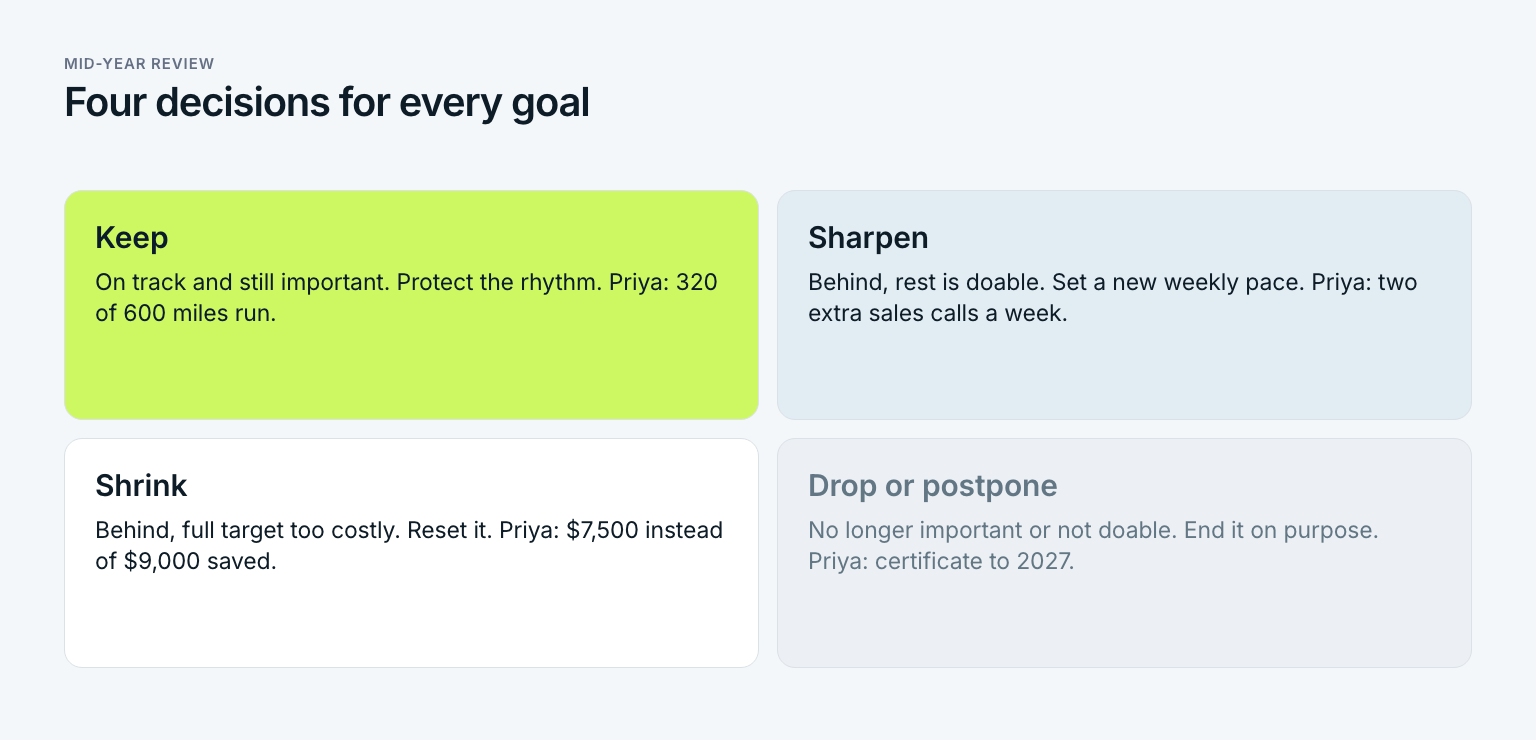
- Keep. On track and still important. Change nothing and protect the rhythm that works. For Priya, that is running.
- Sharpen. Behind, but the rest is doable. Set a new weekly pace and give it a fixed slot in your calendar. For Priya, that is the sales goal, with two extra discovery calls a week.
- Shrink. Behind, and the full target costs more than you have. Reset the goal honestly, with a number and a date. For Priya, that is $7,500 instead of $9,000, with an automatic transfer of $750 on the first of each month.
- Drop or postpone. No longer important, or not possible this year. End it on purpose and write down why. For Priya, that is the full certificate, moved to June 2027.
Dropping a goal feels like failing. That is understandable, because in January it was a real intention. But a goal that has sat on your list for months without moving is no longer a goal. It is a guilty conscience. Whoever postpones it on purpose wins back time for the goals that are still alive. Whoever lets it quietly rot loses both the goal and the time.
For Priya, the certificate does not disappear. She finishes courses three and four by December, one every three months, which is the pace she can actually hold during the renewal. The last four courses move to the first half of 2027. A goal that disappointed her every week since April becomes a small second-half goal she can hit.
There is a fifth option besides the four decisions: adding a new goal. It is allowed, with one condition. For every goal that comes in, an old one has to shrink or go. Priya adds nothing this year. The renewal is her new goal, and it already lives in her sales number.
How to do a mid-year review in six steps
The whole process fits into two hours. It works best in the last week of June, but you can use it for any six-month stretch, like a fiscal half year that starts in October or a school year that turns in January.
Book the slot, once
Two hours in the last week of June or the first week of July, before vacation and alone. Priya blocks Saturday, June 27, from 8 to 10 a.m. Whoever schedules it on vacation plans between the beach and dinner and quits after 20 minutes.
Gather the numbers, 10 minutes
Your January goal list, your calendar, your weekly reviews, and the sources behind your numbers: CRM report, bank app, running app, course dashboard. Without numbers the review turns into memory, and memory flatters.
Fill in target, actual and progress, 25 minutes
One line per goal. Count only what is finished. Priya needs about 20 minutes for four goals, most of it spent pulling the closed deals out of the CRM.
Calculate the required pace, 15 minutes
Divide what is left by the weeks or months that are left, then put the pace you actually had next to it. If the required pace is more than double, the goal will not happen without a real change in your week.
Decide, 30 minutes
Keep, sharpen, shrink or drop for every goal. At most one new goal, and only if an old one makes room. Write one sentence of reasoning for every decision so you still understand it in December.
Plan the second half, 30 minutes
For every goal that stays, set a quarterly goal through September, a monthly goal for July and a weekly goal for the first week of July. The first step gets a fixed time in your calendar, no later than Tuesday.
That is 110 minutes of work and ten minutes of buffer. Steps three and four are the ones people skip, because math is less fun than planning. Whoever skips them decides on gut feeling. Whoever skips step six has a new plan on Monday and the old routine by Friday.
Mid-year review template: one page, twelve fields
The template has two parts: the review on top, the plan for the second half below. Twelve fields per goal are enough. More fields make the review longer, not clearer. Here is the template filled in with Priya's sales goal, which also answers the common question of what a mid-year review form looks like:
| Field | Question | Priya's entry |
|---|---|---|
| Goal | What did you want by the end of the year? | Close $1.2 million in new business by Dec 31 |
| Target at midyear | Where did you plan to be on June 30? | $600,000 |
| Actual at midyear | What is finished and measurable? | $510,000 closed and signed |
| Progress | Actual divided by target | 85% |
| Pace so far | How fast did you move? | $85,000 a month |
| Required pace | How fast do you need to move now? | $115,000 a month, ratio 1.35 |
| What changed | What is new since January? | Largest renewal in the company since April |
| Decision | Keep, sharpen, shrink or drop? | Sharpen: two extra discovery calls a week |
| Q3 goal | What is done by September 30? | $345,000 closed, including the two May deals |
| July goal | What is done by July 31? | $115,000 closed, twelve discovery calls |
| Goal for the first week of July | What is done by the end of the week? | Three discovery calls, two proposals sent |
| First appointment | When does the first step happen? | Tuesday, June 30, 9:00 a.m., call list of eight dormant accounts |
Fill in these twelve fields once for every goal. With four goals, it fits on one landscape page with a column per goal. If you prefer digital, build it as a spreadsheet. The only field that must never stay empty is what changed. In December it explains why the numbers look the way they do.
The template doubles as a checklist. Every field filled means the mid-year review is done. If one of the bottom five is missing, all you have is a status report.
What to say in your mid-year review with your manager
Your personal review is the best preparation for the formal one. Most people walk into a mid-year check in and describe how busy they were. Managers hear that all day. What they rarely hear is a short, numbered account of each goal with a decision attached.
Use three sentences per goal. The first gives the number. The second gives the reason. The third gives the decision and what you need. For Priya's sales goal, that sounds like this: I am at $510,000 of $600,000, so 85 percent at midyear. The gap comes from two deals that slipped from May to July, and both are still active. I am adding two discovery calls a week to get to $115,000 a month, and I would like your help getting the renewal team to take over the weekly status call.
For the certificate she says: I finished two of eight courses, and at the current pace I will not finish this year. The renewal took the time I had planned for it. I am moving the last four courses to 2027 and will finish two more by December. That sentence does something most self-assessments avoid. It names a shortfall and turns it into a plan before anyone else has to.
Whoever brings a decision to a mid-year check in gets a conversation about support. Whoever brings only a feeling gets a conversation about effort. For more wording on the written part, the self evaluation examples show how to phrase strengths and gaps without sounding defensive.
Three mistakes that turn a mid-year check in into a status report
Three mistakes come up again and again at midyear. None of them comes from laziness. All three come from good intentions. The first is the most common:
The most common mistake: piling the gap on top
Whoever is behind at midyear wants to catch up and plans the second half at the old pace plus the shortfall. That is a plan the first half already disproved. For Priya it would mean finishing six courses in six months during the biggest renewal of her career. Do the honest math from step four instead, then pick one of the four decisions.
Mistake two: measuring without deciding
Many mid-year reviews end with a list of percentages and a sigh. The numbers are right, but nothing follows from them. Without a decision per goal, the review is a bank statement. It shows the balance and does not change it. In short: every line ends with one of the four verbs, or it is not finished.
Mistake three: adding new goals without dropping old ones
Midyear brings new ideas, and summer makes a fresh start feel tempting. Anyone who adds three new goals in July and drops none starts the second half with seven goals and finishes none of them properly. The rule is simple: one in, one out. Why three to five is the ceiling for a year is covered in the guide to yearly goals.
From mid-year review to next Tuesday: the goal chain
A mid-year review is only done when its first step has a time slot. To get there, break every remaining goal down through all levels: year, second half, quarter, month, week, day. Every level holds a result with a number and a date, not an activity. What does that look like for Priya's sales goal?
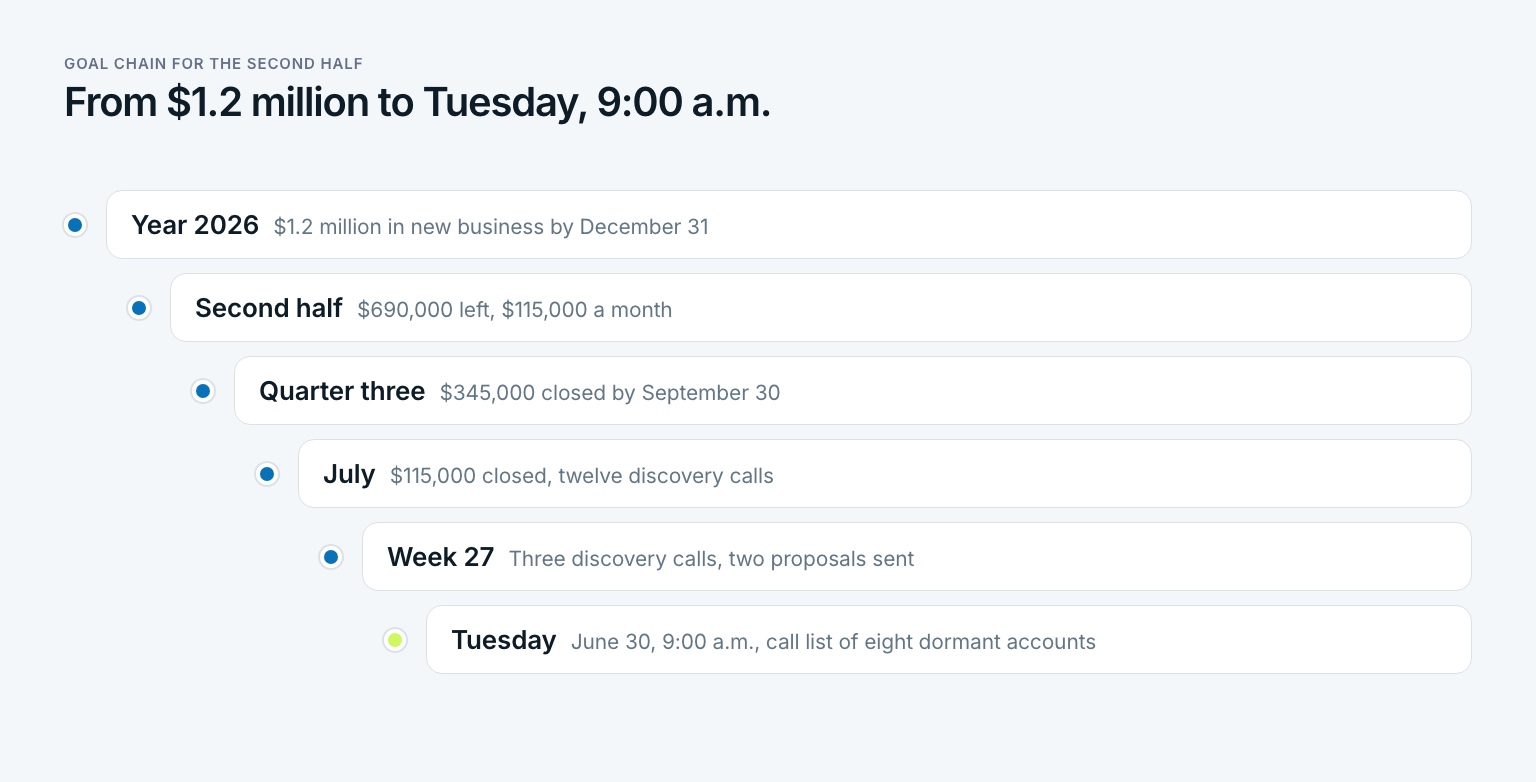
At the top sits the goal that has been there since January. Below it is what the mid-year review made of it: a new monthly pace for the second half, a third-quarter goal that includes the two slipped deals, a July goal with twelve discovery calls, and a Tuesday at 9:00 a.m. when the call list is already open. Week 27 is short because of the July 3 holiday, so the weekly goal is smaller on purpose.
In Gaapp you set up your yearly goals once and hang quarterly, monthly and weekly goals underneath. At midyear the target and the actual already sit side by side, and the review starts with the decision instead of the adding up.
To keep the chain from going quiet until December, give it a small rhythm: a ten-minute weekly review on Fridays, a look at your monthly goals at month end, and a quarterly check at the end of September. Anyone who works this way gets no surprises in December. That means: the mid-year review is the big appointment, the week is the small one, and neither works without the other.
Three questions before the second half starts
Before you put the template away, test it with three questions. They take two minutes and catch most gaps:
- Does every goal have exactly one decision and one sentence of reasoning?
- Is every required pace less than double your old pace, or did you adjust the goal?
- Does the first step of every goal have a time slot this week or next?
Whoever answers yes three times walks into July with a plan that fits the life they have in July. Priya leaves her kitchen table after two hours with four decisions, a script for July 14 and a call list for Tuesday morning. Her second half is smaller than her January plan, and that is exactly why it will hold. In short: a mid-year review does not rescue the old plan, it builds the one that lasts until December.
Frequently asked questions about the mid-year review
What should I say in my mid-year review?
Use three sentences per goal: the number, the reason, and the decision with what you need. For example: I am at 85 percent of my midyear target because two deals slipped, I am adding two calls a week, and I need help with one recurring meeting. Managers remember a clear decision far longer than a list of activities.
What does mid-year review mean?
A mid-year review is a check in at the halfway point of the year. At work it is a formal or informal conversation with your manager about progress and support. For personal goals it means comparing progress with the time that has passed and deciding what to keep, sharpen, shrink or drop.
What are the 5 levels of performance rating?
Many companies use a five-point scale that runs roughly from outstanding through exceeds expectations, meets expectations and needs improvement to unsatisfactory. The exact labels differ from company to company. A rating describes the past, so it helps to bring your own numbers and decisions for the second half to the same meeting.
Can you provide an example of a mid-year review form?
A useful form has twelve fields per goal: goal, target at midyear, actual, progress, pace so far, required pace, what changed, decision, Q3 goal, July goal, goal for the first week, and first appointment. The template section above shows all twelve filled in for a sales goal. Six fields measure, one records context and five plan the second half.
When should you do a mid-year review?
In the last week of June or the first week of July, ideally before summer vacation. You then have six months of data and six months to act. If your company runs on a different fiscal year, use the middle of that year instead.
What is the difference between a mid-year review and a mid-year check in?
A mid-year review is usually the more formal format, often with a written self-assessment and sometimes a rating. A mid-year check in is a shorter conversation about progress, obstacles and support. Both go better when you have run your own review of your goals beforehand.
Last updated: 19 October 2026
Read next
 Planning
Cleaning Schedule: Daily, Weekly and Monthly Tasks
A cleaning schedule is not a Saturday to-do list: daily, weekly and monthly tasks, a printable template and a fair split for families.
15 min read
 Planning
Study Plan: How to Make One You Can Actually Follow
A study plan is not a schedule. Make one in six steps: inventory, hours math, buffer, a sample study schedule and a template, with a worked example.
17 min read
 Planning
Bullet Journal: How to Start One You'll Actually Keep
A bullet journal is not an art project. Learn the bullets, four core modules, migration and a six-step setup, with an example, 12 ideas and a goal chain.
15 min read