Year in Review: How to Measure 2026 Before You Plan 2027
A year in review is not a highlight reel: measure 2026 against your goals in three hours, with 30 questions, a one-page template and an example.

Contents
- 01What a year in review is, and what it is not
- 02Why your memory is a bad yardstick for your year
- 03How to write a year in review in six steps
- 04The three questions every year in review answers
- 05Year in review questions: 30 prompts for a personal review
- 06Year in review ideas: seven formats beyond the list
- 07Annual review template: one page, twelve fields
- 08Three mistakes that turn a year in review into a scrapbook
- 09From year in review to your 2027 goal chain
- 10Frequently asked questions about the year in review
A year in review is not a highlight reel. It is a three-hour appointment in the last week of December where you measure your year against the goals you set in January and make three decisions: what to keep, what to let go, and what to start. A highlight reel shows what happened. A personal year in review shows what changed, and it turns that into the first page of next year.
Three things make it work: material, a yardstick, and a consequence. The material is your calendar, your photos, and whatever list of goals you wrote in January. The yardstick is those goals, or, if you never wrote any, what you hoped for when the year started. The consequence is no more than three goals for 2027. Everything below runs through one worked example, a teacher named Leah, along with six steps, 30 year in review questions, seven ideas for other formats, and a one-page annual review template.
What a year in review is, and what it is not
A year in review is a structured look back at the past twelve months that ends with decisions for the next twelve. In December the phrase is everywhere. Companies publish reports full of milestones, and Spotify sends you Wrapped, a list of what you played most. These are good formats. They remind you of moments, and moments are what a year leaves behind. None of them tells you whether your year went where you wanted it to go.
A personal year in review is built for something else. It looks at your year, not the world's, and ends with a decision. Five formats get mixed up, and each has a different job:
| Format | Built for | What it does not do |
|---|---|---|
| Company year in review | Showing customers and staff the milestones of the year | Says nothing about your own year |
| Highlight reel or Wrapped | Collecting the best moments, songs, and photos | Measures nothing against a goal |
| Journal | Sorting through what happened and clearing your head | Rarely judges and rarely changes anything |
| Personal year in review | Measuring your year against your goals and making three decisions | Does not plan weeks and days yet |
| Annual planning | Turning those decisions into yearly, quarterly, and monthly goals | Plans in the dark without a review first |
Year in review or year-end review?
Both phrases are correct, and they usually mean different things. A year in review looks back on a whole year, and it is the phrase most people use for their own life. A year-end review usually means the performance review at work, where you and your manager go over results and next year's targets. That means: for the meeting with your boss you need a year-end review, for your own next year a year in review. Anyone who does the second one first walks into the first with better answers.
Why your memory is a bad yardstick for your year
Your memory keeps peaks and endings, not averages. A brutal November overwrites a calm spring. One great vacation covers three months in which nothing moved. Anyone who grades their year from memory on December 28 is mostly grading the fall.
The peak-end rule: why December rewrites your year
In a 1993 study, Daniel Kahneman and colleagues had people hold a hand in cold water for 60 seconds, and in a second trial for 90 seconds, with the water warming slightly at the end. Most chose to repeat the longer trial because it ended better. In his 2011 book “Thinking, Fast and Slow” he calls this the peak-end rule: we judge an experience by its peak and its ending. Without a calendar and a few numbers, you are grading December, not the year.
Take Leah, 36, a high school chemistry teacher in Columbus, Ohio, married, with a seven-year-old son. From memory, she would sum up 2026 in one line: busy, broke, never ran the race. In January she had written three goals on an index card. On December 28 she puts the card next to her calendar and counts:
| 2026 goal | Plan | Result | Done |
|---|---|---|---|
| Pay off the $7,200 credit card balance | $600 a month, paid off by December | $6,000 paid, $1,200 left | 83% |
| Read 24 books | two a month | 11 books, six of them in June and July | 46% |
| Run the half marathon on October 18 | train from June | 10K in May, calf strain in August, did not start | no |
One goal nearly done, two missed. That sounds like the line from memory. It gets interesting once Leah maps the numbers to the months. Six of her eleven books fall in June and July, the two months without grading. From February to April she read one book in total. Those were the three months she spent on the school's spring auction committee, a job she agreed to in a hallway in January. Her year did not have a reading problem. It had a calendar without a single empty evening in it.
That means: a year in review starts with counting, not with feeling. The feeling gets a vote afterward. Only the number shows where it is wrong. How much of your own year do you know only from the way it ended?
How to write a year in review in six steps
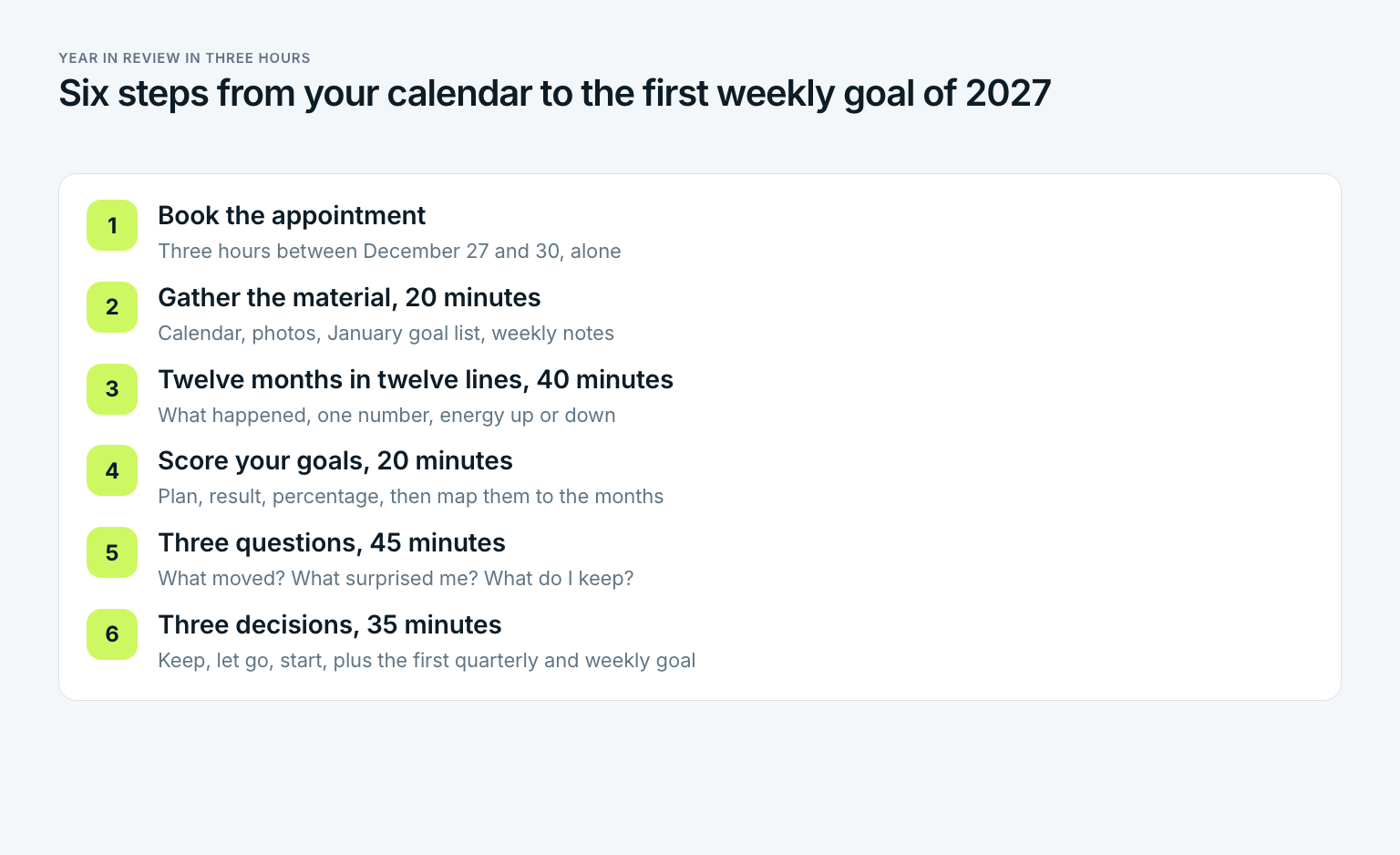
Three hours is not an estimate. It is a budget. Less is not enough for twelve months, and more means you will not find the time again next December. The six steps add up to 160 minutes. The rest is buffer for coffee and for the month that takes longer than it should.
Book the appointment, once
Three hours between December 27 and 30, alone, phone in another room. Leah blocks Monday, December 28, from 8 to 11 a.m., while her husband takes their son sledding. Whoever schedules it for New Year's Eve writes between grocery runs and quits after an hour.
Gather the material, 20 minutes
Calendar, photos, goal list, notes. Do not read anything yet, just put it all in one place. For Leah that is two calendars, about 2,100 photos, and 26 short Friday notes.
Twelve months in twelve lines, 40 minutes
One line per month with three fields: what happened, one number, energy up or down. Flip through calendar and photos one month at a time, three minutes each, or you are writing a diary again.
Score your goals, 20 minutes
Every January goal gets a plan, a result, and a percentage. No goals? Score against what you hoped for. Then map the numbers to the months, where the pattern shows up.
Answer the three questions, 45 minutes
What moved, measured against my goals? What surprised me, good and bad? What do I keep, what do I let go, and what do I start? In writing, about half a page each. For more depth, add three prompts from the list below.
Make three decisions and set the first quarterly goal, 35 minutes
Keep one thing, drop one thing, start one thing. Turn those into no more than three goals for 2027, each with a number and a date. Finish with the first quarterly goal and the first January weekly goal for the most important one.
Leah's twelve months in twelve lines
Here is step three for Leah, done in 35 minutes. The energy column only allows up or down, so she does not start handing out grades.
| Month | What happened | Number | Energy |
|---|---|---|---|
| January | Three goals written, half marathon booked | 1 book, $600 paid | up |
| February | Joined the spring auction committee | 0 books, $600 paid | down |
| March | Auction planning, parent conferences | 0 books, $600 paid | down |
| April | Auction night, committee wrap-up | 1 book, $600 paid | down |
| May | First 10K race, final exams | 0 books, $600 paid | up |
| June | Summer break, road trip to Michigan | 3 books, $600 paid | up |
| July | Half marathon training, long runs up to 10 miles | 3 books, $600 paid | up |
| August | Back to school, calf strain, car repair | 0 books, $0 paid | down |
| September | Started helping with Science Olympiad | 1 book, $600 paid | up |
| October | Missed the half marathon, end of the grading period | 0 books, $600 paid | down |
| November | First invitational tournament with the team | 1 book, $600 paid | up |
| December | Holidays, year in review on December 28 | 1 book, $0 paid | up |
Seven months up, five down, and three of the five down months are auction months. Two things only show up once Leah reads the lines in order. The auction committee took about 45 hours by her calendar count and was never on any list. And the Science Olympiad practices she agreed to as a favor in September were the hours she talked about most all fall. Neither insight would have come from memory.
The three questions every year in review answers
The twelve lines give you material. Three questions turn that material into a reflection. They are deliberately plain, because only the same questions give answers you can compare from one December to the next.
The three core questions
What moved, measured against my goals? What surprised me, good and bad? What do I keep, what do I let go, and what do I start? The first question measures, the second finds what no plan predicted, the third decides. Without the third, a year in review is just a report.
Leah's answers, cut to the essentials:
- What moved? The card balance dropped from $7,200 to $1,200. Reading stalled at eleven books, mostly in summer. The half marathon did not happen, because of the calf, not the plan.
- What surprised me? Good: coaching Science Olympiad gave me more energy than anything else this year. Bad: 45 hours on an auction committee I never really decided to join.
- What do I keep, let go, and start? Keep: the $600 a month, first to finish the card, then into savings. Let go: the auction committee, and I told the principal before the break. Start: I will ask to become the official head coach of the Science Olympiad team.
Those answers become Leah's three goals for 2027. The card at zero by February 28, then $600 a month into an emergency fund, $6,000 by December 31. Reading as a habit, not a count: 20 minutes before bed, five nights a week. And the team at regionals on March 6, with the head coach role confirmed by May 31. In short: none of the new goals is bigger than the old ones. Two are just built better.
Anyone who started 2026 without written goals scores the year against what they hoped for. The guide on how to achieve goals shows how a wish becomes a goal with a number and a date. And whoever finds seven problems in the review still sets three goals at most, for reasons the article on why three goals are enough explains.
Year in review questions: 30 prompts for a personal review
The three core questions work for any year. Some years ask for more: a move, a breakup, a new job, a new baby. That is when these 30 year in review questions in six groups help. Pick three to six that hit home, not all of them. Anyone who answers all 30 is still writing at dinner and will not open the list again next December.
Goals and progress
- Which January goal could I still name in June without looking it up?
- Which goal did I reach, and what exactly made the difference?
- Which goal did I quietly abandon without ever crossing it off?
- If I repeat this exact year, where will I be next December?
- Where did most of my time go, and was it on any list?
Work and money
- Which part of my work gave me energy instead of taking it?
- What can I do now that I could not do in January?
- Which project would I turn down if it came back today?
- Did my income move in the direction I wanted?
- Which purchase was worth it, looking back, and which one was not?
Health and energy
- In which month did I feel best physically, and what was different?
- In how many weeks did I move my body at least three times?
- What cost me more energy than it was worth?
- When did I last have a week with no evening commitments?
- Which habit crept in without a plan, good or bad?
People
- Who did I spend the most time with, and did I choose that?
- Who did I lose touch with, and do I want to change that?
- What was the best day I spent with family or friends?
- Who helped me this year, and do they know it?
- Which conversation have I been putting off for months?
Growth
- Which mistake did I make more than once?
- Which decision took courage, even if it did not work out?
- Which book, conversation, or experience changed how I see something?
- What am I proud of that nobody else saw?
- Which song, photo, and sentence belong to this year?
Letting go and looking ahead
- Which commitment did I take on without ever deciding to?
- What do I still do only because I did it last year?
- Which worry from January is still here, and did it come true?
- What do I want the first line of next year's review to say?
- Which single goal would make 2027 a good year?
Leah picked two extras: the commitment she never decided on and the work that gave her energy. The first exposed the auction, the second pointed at Science Olympiad. Which question on this list would you most like to skip? That is usually the one worth answering.
Year in review ideas: seven formats beyond the list
Not everyone likes tables. A year in review can include photos, music, or a letter, as long as it ends with the three questions:
- One photo per month. Pick a single picture from each month. Twelve photos side by side show which months stayed empty, often the same ones that look weak in the numbers.
- The number of the year. One number that sums up your year: $6,000 paid off, eleven books, 300 miles run. It forces you to decide what the year was really about.
- The song of the year. Not the one Wrapped puts on top, but the one that takes you back to a moment. The reason it is that song often says more than a full list.
- Three top-three lists. Your three best books, places, and conversations. Nine entries in five minutes.
- A letter to next December. Write down what you plan for 2027 and what you are afraid of. Seal it and open it on the day of your next review.
- A year in review for couples. Each of you answers the three questions alone, then you swap. Shared goals for 2027 come from where your years overlapped.
- A family year in review at dinner. Three questions for the kids between the holidays: What was your best day? What can you do now that you could not do in January? What are you looking forward to? Leah's son picked the day he rode without training wheels.
The format is a matter of taste. The order is not: format first, questions second. Anyone who stops after twelve photos has an album. Anyone who answers the three questions afterward has a year in review.
Annual review template: one page, twelve fields
Writer Chris Guillebeau has published his own annual review every December for well over a decade, built on two plain questions: What went well this year? What did not go well? This template keeps that simplicity and adds a number for each goal and a decision at the end.
It fits on one page. The third column shows Leah's entries, so you can see how short an answer may be. The twelve month lines go on the back.
| Field | Question | Example: Leah, 2026 |
|---|---|---|
| Date | When am I looking back? | Monday, December 28, 2026, 8 to 11 a.m. |
| 2026 goals | What did I set out to do? | Pay off $7,200, read 24 books, run a half marathon |
| Results | How much of it happened, in percent? | 83%, 46%, and no |
| Best month | When did it work, and why? | June: summer break, three books, $600 paid |
| Worst month | When did it not work, and why? | August: calf strain, car repair, no books, no payment |
| Pattern | What keeps repeating? | Goals die in months without empty evenings |
| What moved | What moved, measured against my goals? | Card balance down from $7,200 to $1,200 |
| Surprise | What surprised me? | Energy from coaching, 45 hours on the auction |
| Keep | What do I keep? | $600 a month, into savings once the card is paid |
| Let go | What do I let go of? | The auction committee, principal told before the break |
| Start | What do I start? | Head coach role for Science Olympiad, confirmed by May 31 |
| First weekly goal | What do I do in the first full week of January? | Final roster of 15, two practices, event pairs sent to parents |
Anyone who fills in this page every December has three comparable pages after three years. When the same sentence lands in the pattern field three times, it is no longer a coincidence. It is the first line of your next plan.
Three mistakes that turn a year in review into a scrapbook
Most reviews do not fail for lack of motivation. They fail from one of three mistakes that never feel like mistakes at the time. Which one would be yours?
The most common mistake: a review with no consequence
Three hours of remembering, a nice page, and in January everything runs like before, because the review stopped after the second question. The fix is not a longer review but one last step: three decisions and a first weekly goal with a date. Whoever leaves the appointment without knowing what they will do in the second week of January has looked back, but has not closed the year.
- A diary instead of a measurement. Retelling every month feels thorough, and it does sort things out. It also takes a whole day and measures nothing. Limit each month to one line and one number.
- A verdict instead of an adjustment. “Failed again” is not a result, it is a grade. Leah could have beaten herself up over eleven books. Instead she asked when the books went missing and rebuilt the goal. A missed goal is a data point, not a judgment.
- Changing everything at once. An honest review finds more than three problems. Anyone who turns them into seven goals for 2027 is back to a full list with no progress by March. Three decisions, three goals at most, and the rest waits for next December.
From year in review to your 2027 goal chain
The review ends with three decisions. Annual planning turns them into goals on five levels: year, quarter, month, week, and day. What good is a decision in December if it has no slot in January? Without the chain, “I will ask to be head coach” becomes a sentence Leah remembers in May, after the role is filled.
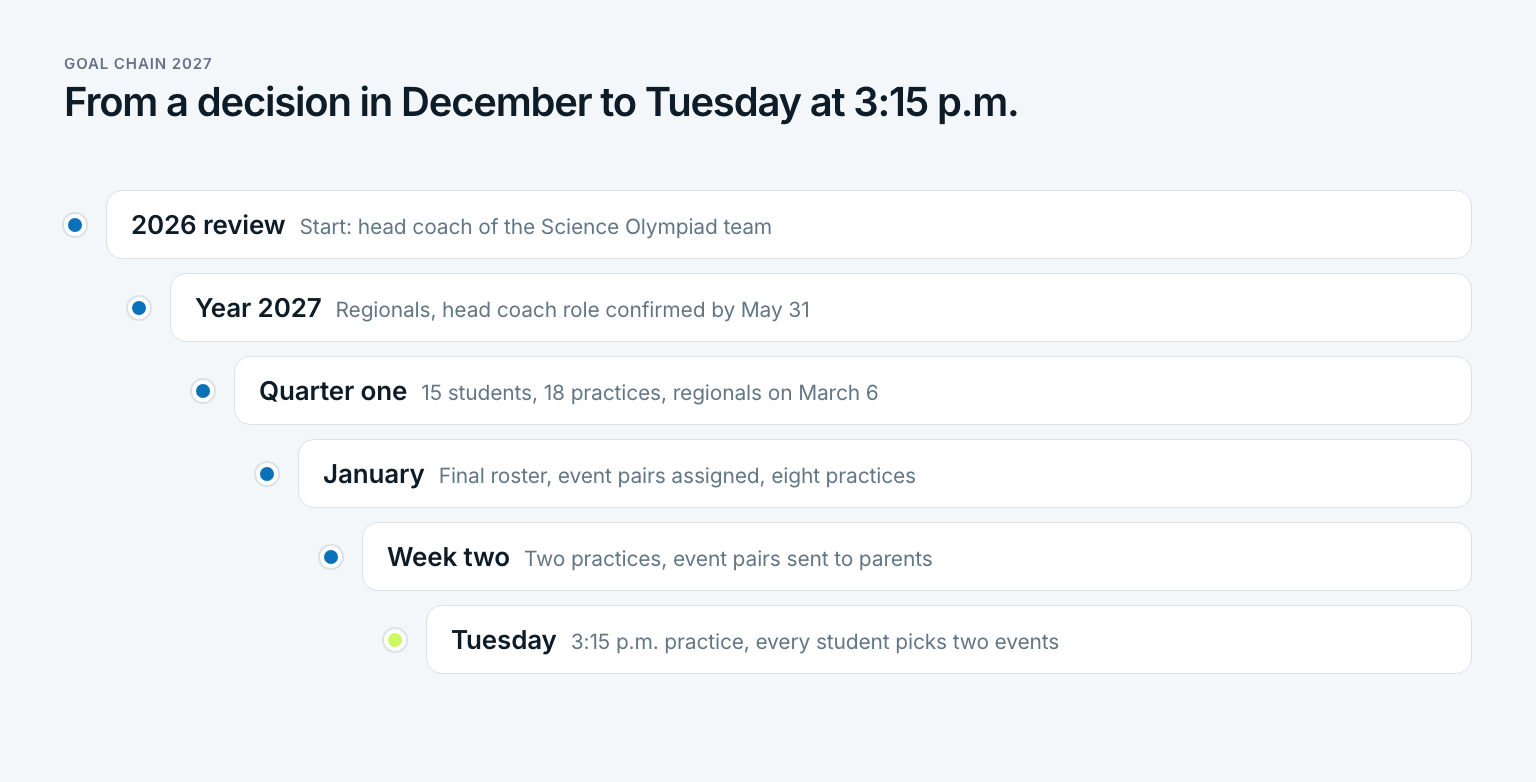
| Level | Leah's goal | How she checks it |
|---|---|---|
| Year 2027 | Team competes at regionals, head coach role confirmed for next school year by May 31 | Tournament entry, confirmation from the principal |
| Quarter one | 15 students registered, 18 practices held, regional tournament on March 6 | Roster, practice log, results sheet |
| January | Final roster of 15, event pairs assigned, eight practices held | Roster sent, eight checkmarks |
| Week two | Two practices held, event pairs sent to parents by Friday | Email sent |
| Tuesday, January 12 | 3:15 p.m. practice, every student picks two events | List complete by 4:30 p.m. |
Each level asks its own question. The year asks where, the quarter what has to be true by March, the week what is done by Friday. The guide to annual planning shows how to break a yearly goal into quarters and months. The session that sets each quarter is covered in quarterly planning step by step. The article on how to turn yearly goals into daily steps takes it down to a single day.
In Gaapp this chain is the core: every goal hangs on a bigger one, and progress for each period is the share of goals completed. Leah will not have to count in December 2027. The percentages will be there, month by month, and the three hours belong to the questions.
The year in review is the biggest look back, but not the only one. Leah's 26 Friday notes gave her the numbers on December 28. Anyone who looks back for ten minutes every week has dozens of small reviews by December, and the big one almost writes itself. The ten-minute weekly review shows how. Between the weekly and the yearly look back sits the mid-year review, a check on every goal at the halfway mark.
Three questions before you put the appointment in your calendar:
- Can you name your 2026 goals without looking them up?
- Do you know which month of your year went best, as a number and not as a feeling?
- Is there already a three-hour block in your calendar between December 27 and 30?
Anyone who answers no to one of them does not need a longer review. They need one with a yardstick. In short: a year in review is not a memory of the old year. It is the first appointment of the new one.
Frequently asked questions about the year in review
What is a year in review?
A year in review is a structured look back at the past twelve months that ends with decisions for the next twelve. Companies use the term for reports on their milestones. In a personal year in review, you measure your year against your goals, answer three questions, and set no more than three goals for the coming year.
How do you write a year in review?
Block three hours between December 27 and 30 and gather your calendar, photos, and goal list. Then work through six steps: book the time, gather material, write one line per month, score your goals, answer three questions, and make three decisions. You finish with a first weekly goal for January that has a date on it.
Is year in review hyphenated?
Not when it stands on its own as a noun: my year in review, a personal year in review. When the phrase works as an adjective in front of a noun, most style guides hyphenate it: a year-in-review post, a year-in-review video. The same logic gives you year-end review with a hyphen.
Is it better to say "year in review" or "year end review"?
Neither is wrong, but they usually mean different things. A year in review looks back on a whole year, often your own life or a company's milestones. A year-end review usually means the performance review at work with your manager. For a personal reflection, year in review is the more common phrase.
What questions should I ask in a year in review?
Three are enough for most years: What moved, measured against my goals? What surprised me, good and bad? What do I keep, what do I let go, and what do I start? For bigger years, add three to six prompts from the 30 year in review questions above, for example from the group on letting go.
Can I do a year in review if I never set goals?
Yes. Score the year against what you hoped for in January and against the months that felt good. The review will be less precise, but it still gives you what you need to set your first real goals, each with a number and a date.
Last updated: 14 October 2026
Read next
 Planning
Cleaning Schedule: Daily, Weekly and Monthly Tasks
A cleaning schedule is not a Saturday to-do list: daily, weekly and monthly tasks, a printable template and a fair split for families.
15 min read
 Planning
Study Plan: How to Make One You Can Actually Follow
A study plan is not a schedule. Make one in six steps: inventory, hours math, buffer, a sample study schedule and a template, with a worked example.
17 min read
 Planning
Bullet Journal: How to Start One You'll Actually Keep
A bullet journal is not an art project. Learn the bullets, four core modules, migration and a six-step setup, with an example, 12 ideas and a goal chain.
15 min read