Miracle Morning: What SAVERS Gets Right, and a Short Version
The Miracle Morning is not a 5 a.m. contest. Hal Elrod's SAVERS reviewed: what holds up, what doesn't, and a short version for parents and shift work.

Contents
- 01What the Miracle Morning is and what it is not
- 02The Miracle Morning book summary: five ideas that matter
- 03The SAVERS Miracle Morning practices: what holds up and what needs a fix
- 04Dana's mornings: the hour that was not there
- 05The six-minute Miracle Morning routine for parents and shift workers
- 06Three mistakes that end the Miracle Morning by week two
- 07The Miracle Morning in a goal chain: from yearly goal to one minute
- 08Three questions for your next 14 mornings
- 09Frequently asked questions about the Miracle Morning
The Miracle Morning is not a contest to see who can get up earliest. It is the morning routine from Hal Elrod's 2012 book The Miracle Morning: six practices you do before your day starts, remembered by the acronym SAVERS for Silence, Affirmations, Visualization, Exercise, Reading and Scribing. The full version takes an hour. The shortest takes six minutes.
The idea is sound. The trouble is that most readers do not own the hour the book assumes. Anyone who wakes up to a toddler, starts a shift at 7 a.m. or drives home from a night in the ER has a morning that belongs to someone else. So everything below is worked through with Dana, a nurse on 12-hour shifts and a mother of two: what holds up in SAVERS, what does not, and what a short version looks like on a morning that starts at 5:15 a.m.
What the Miracle Morning is and what it is not
The Miracle Morning is a fixed sequence of six habits done right after waking. Hal Elrod, an American speaker and coach, built it out of his own crisis. At 20 he barely survived a head-on car crash. Years later, the 2008 recession pushed him to a financial and personal low point. He started getting up earlier, looked at what successful people did with their mornings and combined six of those habits. He self-published the result in 2012, and the book became one of the best-known titles on morning routines.
The core claim is simple. How you spend the first hour after waking sets the tone for the rest of the day. Whoever starts with the phone spends the first minute reacting to other people. Whoever starts with something of their own has already done one thing before the demands arrive. That is plausible, and it is why the book still sells.
Three things the Miracle Morning is not. It is not a rule to wake up at 5 a.m., even though Elrod encourages getting up earlier than you do now. It is not a goal system, because none of the six practices asks what you are working on. And it is not a general morning routine with breakfast, shower and coffee. If you want to build a whole routine around a goal from scratch, the guide to a morning routine covers that. This article sticks to Elrod's method and what survives of it in a real week.
SAVERS in one line per letter
Silence: a few quiet minutes, such as meditation, prayer or slow breathing. Affirmations: statements about who you are and what you intend, spoken out loud. Visualization: picturing the result you want. Exercise: movement, from a walk to a workout. Reading: a few pages of a book that helps you grow. Scribing: writing, usually as a journal. The acronym is a memory aid, not a ranking. That is exactly why each letter deserves its own look.
The Miracle Morning book summary: five ideas that matter
If you do not want to read the whole book, five ideas carry it. SAVERS is only one of them, and not the most useful one.
- The first hour is yours. Elrod argues that many people fall short of what they could do because they start every day in reactive mode. His answer is an hour for personal growth before work, family and the news begin.
- Waking up is decided the night before. Against the snooze button he suggests small moves: decide before bed why you are getting up, put the alarm out of reach, drink a glass of water first thing. It is the most practical part of the book and the part most readers skim.
- Six practices as one package. SAVERS is meant to work together: silence calms, affirmations and visualization set direction, exercise wakes the body, reading and scribing go deeper.
- Thirty days as a trial. Elrod proposes a 30-day challenge in three phases. The first ten days feel unbearable, the next ten uncomfortable, the last ten unstoppable.
- Six minutes still count. For crowded days there is a short version with one minute per practice. For parents, shift workers and anyone with a small window, this is the part worth keeping.
Thirty days is a good frame to start with. It is not proof that a habit is finished. In a 2009 study led by Phillippa Lally, participants took a median of 66 days before a new behavior felt automatic, with a wide range between people and behaviors. That means: anyone still struggling on day 30 has not failed. They are right on schedule. The article on how long it takes to form a habit goes into the numbers.
The SAVERS Miracle Morning practices: what holds up and what needs a fix
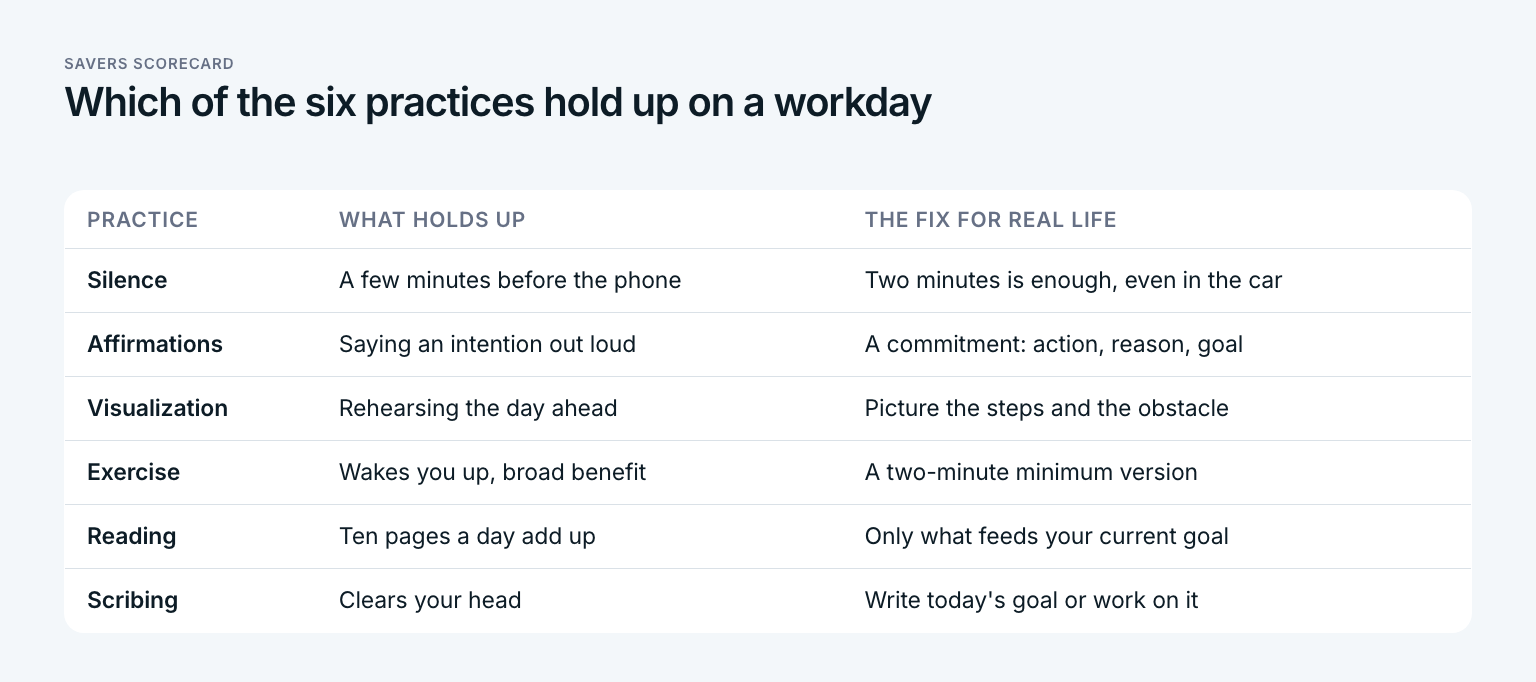
Every one of the six practices is built for something. Some hold up in almost any life, some only after a small rebuild. The test here is plain: does the practice help on a full workday, and does it move something you actually want to reach?
Silence: worth it, as long as it stays short
A few minutes without input before the first notifications arrive is the easiest win in the whole package. Breathe, pray, look out the window: the form does not matter. The catch is the setting. Anyone with small kids knows that 6:30 a.m. is rarely quiet. Silence is also built for calm, not for progress. In short: two minutes are enough, and they can happen in the bathroom or in a parked car.
Affirmations: from wishes to commitments
Saying sentences about yourself out loud feels odd to a lot of people. To be fair, an intention you speak is sharper than one you only think. The research on classic affirmations is mixed, though. In 2009, Joanne Wood and colleagues reported in Psychological Science that repeating a broad positive statement about yourself left people with low self-esteem feeling worse, not better. The sentence clashed with what they already believed about themselves.
What holds up is a commitment instead of a wish. Not “I am a successful nurse leader,” but “Today I write 300 words of my capstone because I want my degree by December.” The sentence names an action, a reason and a goal. You can check it, and by evening you know whether it came true.
Visualization: picture the path, not just the finish line
Imagining the result feels motivating. That is the problem. Psychologist Gabriele Oettingen describes in Rethinking Positive Thinking, published in 2014, how simply fantasizing about a wish can drain the energy you need to pursue it. The mind enjoys the outcome in advance. What worked better in her studies was mental contrasting: the wish, the best outcome, the inner obstacle and a plan for that obstacle. Along the same lines, Lien Pham and Shelley Taylor found in 1999 that students who pictured themselves studying did better than students who only pictured the good grade.
For your morning, that means one minute to walk through the next step and the most likely obstacle. When do I sit down today, what will get in the way, what do I do then? Whoever sees the obstacle coming trips over it less often.
Exercise: the strongest letter
Movement has the broadest benefit of the six and needs no defense. A few minutes are enough to wake you up. The catch is size. Anyone who puts a 20-minute workout into the morning needs those 20 minutes every single day, and that is exactly what a 5:15 a.m. start does not have. The fix is a minimum version: two minutes of squats and stretching count, and the run can move to a day off.
Reading: ten pages, but the right ones
Ten pages a day sounds small. Over a year it adds up to 3,650 pages, about 14 books of 250 pages each. That pays off when the book serves your goal. Plenty of Miracle Morning fans read self-help every morning, one book after another, and never apply any of it. In short: read what you need right now. For Dana, that is the course reading for her degree, not the next book about habits.
Scribing: writing with a yardstick
Writing clears your head. Elrod uses it as morning journaling for gratitude, insights and plans. That is a good habit. It just does not measure anything. The fix is small: one line is today's goal, worded so you can check it off at night. And if your goal is itself a piece of writing, scribing becomes work time. Dana spends these minutes on her capstone paper.
That means: four letters hold up almost unchanged, namely silence, exercise, reading and scribing, as long as reading and scribing are tied to a goal. Two need a rebuild. Affirmations turn into a commitment, visualization turns into a look at the path and the obstacle. And none of the six needs more than a few minutes on a busy day.
Dana's mornings: the hour that was not there
Dana is 34 and works as an ER nurse. She works three 12-hour shifts a week, mostly days from 7 a.m. to 7:30 p.m., plus a night shift now and then. Her kids are three and eight, and her husband Marcus leaves for work at 7 a.m. On top of that she is finishing an online RN to BSN program. Her goal for this year: complete the degree, which means a capstone paper of 4,000 words and one last course, all due by December 11.
In September she reads the book and follows it to the letter. Before a day shift she sets the alarm for 4:15 a.m. so the full hour fits before she leaves at 6:15. On other days she plans the hour before the kids wake up, starting at 5 a.m. After two weeks she counts:
| Type of morning in two weeks | Mornings | Full hour done | What got in the way |
|---|---|---|---|
| Day shift | 4 | 1 | Snoozed through the 4:15 a.m. alarm from the second shift on |
| Before a night shift | 2 | 1 | Once the toddler was up at 5:20 a.m. |
| After a night shift | 2 | 0 | Home at 8 a.m., sleep comes first |
| Day off | 6 | 2 | Kids awake at 5:30 a.m., routine dropped in the chaos |
| Total | 14 | 4 | 29 percent of mornings |
Four out of 14 mornings. Without counting, Dana would have called herself undisciplined. With the count in front of her, she sees something else: the method assumes a morning that starts at the same time every day and belongs to her alone. How many parents on rotating shifts have a morning like that? Her capstone grew by about 200 words in those two weeks. None of the six practices touched it.
In short: Dana does not need to fit the method. The method needs to fit Dana's schedule. Elrod himself provides the starting point, with the six-minute version.
The six-minute Miracle Morning routine for parents and shift workers
In the book, the short version is meant for crowded days. For many people it is the real routine. One minute per letter, in whatever order suits your morning. Two rules make it work in real life. It is tied to waking up, not to a time on the clock. And one letter works on your goal. Here is Dana's version:
Silence, one minute
Before the phone: sit, breathe, look out the window. Dana does it on the edge of the bed before she turns on the light.
Commitment, one minute
One sentence with an action, a reason and a goal, out loud or under your breath. Dana's: “Today I write 300 words of the review because I want my degree by December.”
Path and obstacle, one minute
When does the action happen today, what will interrupt it, what do you do then? On a day off: 8:30 a.m. at the kitchen table, the obstacle is laundry, the answer is laundry after 9:15.
Movement, one minute
Ten squats, shoulder rolls, one trip up the stairs. The point is to be awake, not to train.
Reading, one minute
One page from the book that feeds your goal. For Dana it is a journal article she needs for the literature review.
Scribing, one minute
Write today's goal in one sentence, small enough to finish today. If there is more time, this minute grows into a work block on the goal.
Six minutes is the floor. On days with more room the routine grows in exactly one place: the letter that works on the goal. For Dana that is scribing, which turns into writing time on her capstone. The other five stay short.
On shift work: tie it to waking up, not to the clock
Anyone who works rotating shifts does not have one morning. They have several. So the routine starts after waking, whenever that is. Dana has a fixed version for each kind of day, and she never decides in the morning which one applies. Her schedule already says so. The same idea carries over to the whole day, and the daily routine examples for three kinds of days show what that looks like on paper.
| Kind of day | Wake up | Window | Version | Time on the goal |
|---|---|---|---|---|
| Day shift | 5:15 a.m. | 5:20 to 5:30 a.m. | six minutes plus buffer | one minute: write today's goal |
| Day off | 6:00 a.m. with the kids | 8:30 to 9:30 a.m., after school drop-off | full version, 60 minutes | 40 minutes of writing |
| Before a night shift | 6:00 a.m. with the kids | 8:30 to 8:50 a.m. | 20 minutes | 15 minutes of reading for the course |
| After a night shift | after sleep, around 2 p.m. | no morning window | none | sleep comes first |
The full hour still exists, but only on days off, and it comes after the school run instead of before sunrise. Before a day shift Dana now wakes at 5:15 instead of 4:15 and gets an extra hour of sleep. After a night shift there is no routine at all. Whoever meditates and reads at 8 a.m. after twelve hours in the ER is only delaying the sleep the body needs most. A week with a night shift simply has a morning without the Miracle Morning. That is planned, not a failure.
With small kids: use the minutes you have
Parents of small kids rarely get an uninterrupted hour, no matter how early the alarm goes off. Anyone who gets up at 5 a.m. to have the house to themselves often finds a three-year-old in the doorway at 5:15. Three adjustments help. First, spread the minutes out: silence in the bathroom, movement with the kids, reading with the first coffee. Second, bring the kids in where it fits: ten jumping jacks with a three-year-old count as exercise. Third, move scribing to the night before, so today's goal is already written when the morning falls apart. The guide to an evening routine shows how the night before carries the morning.
Elrod co-wrote a whole edition for this situation, The Miracle Morning for Parents and Families. To start, the six-minute version is enough. The deciding question is which letter survives a morning where everything goes wrong. For Dana it is the goal on a sticky note. Everything else is a bonus.
After two weeks on the new plan, Dana counts again. Two of the 14 mornings followed a night shift and had no routine by design. On eleven of the remaining twelve, her version happened, including the six minutes on all four day shifts. Her capstone grew by 1,900 words, almost all of it from the mornings on her days off. Less method, more result.
Three mistakes that end the Miracle Morning by week two
The method rarely fails because of its content. It fails because of how people start it. All three of these mistakes feel like ambition at the time. Which one is yours?
The most common mistake: trading sleep for the hour
Elrod encourages getting up earlier, and many readers move the alarm back an hour without going to bed any earlier. Since 2015, the American Academy of Sleep Medicine has recommended at least seven hours of sleep a night for adults. Whoever cuts an hour to make room pays for it with an afternoon slump and usually quits in the second week. The morning hour starts the night before.
- All six, every day, right away. Anyone who starts with the full hour on day one needs the same willpower on day five as on day one. Better: the six-minute version as the rule and the full hour as an option on good days.
- A routine with no goal. SAVERS is maintenance: calmer, more awake, better read. None of it asks what you are working on. Whoever is more balanced after three months but no closer to their yearly goal got exactly what the method is built for.
- One missed morning ends it. After a miss, the next day is a six-minute day, not a make-up hour. Missing twice in a row is the warning sign. Missing once is just life.
The Miracle Morning in a goal chain: from yearly goal to one minute
The method gets strong the moment one letter is tied to a goal. For that, the morning needs an answer to a simple question: what is today's piece? The goal chain provides it. A yearly goal becomes a quarterly goal, the quarter becomes a monthly goal, then a weekly goal and a daily goal. The daily goal is what goes on the page in the scribing minute.
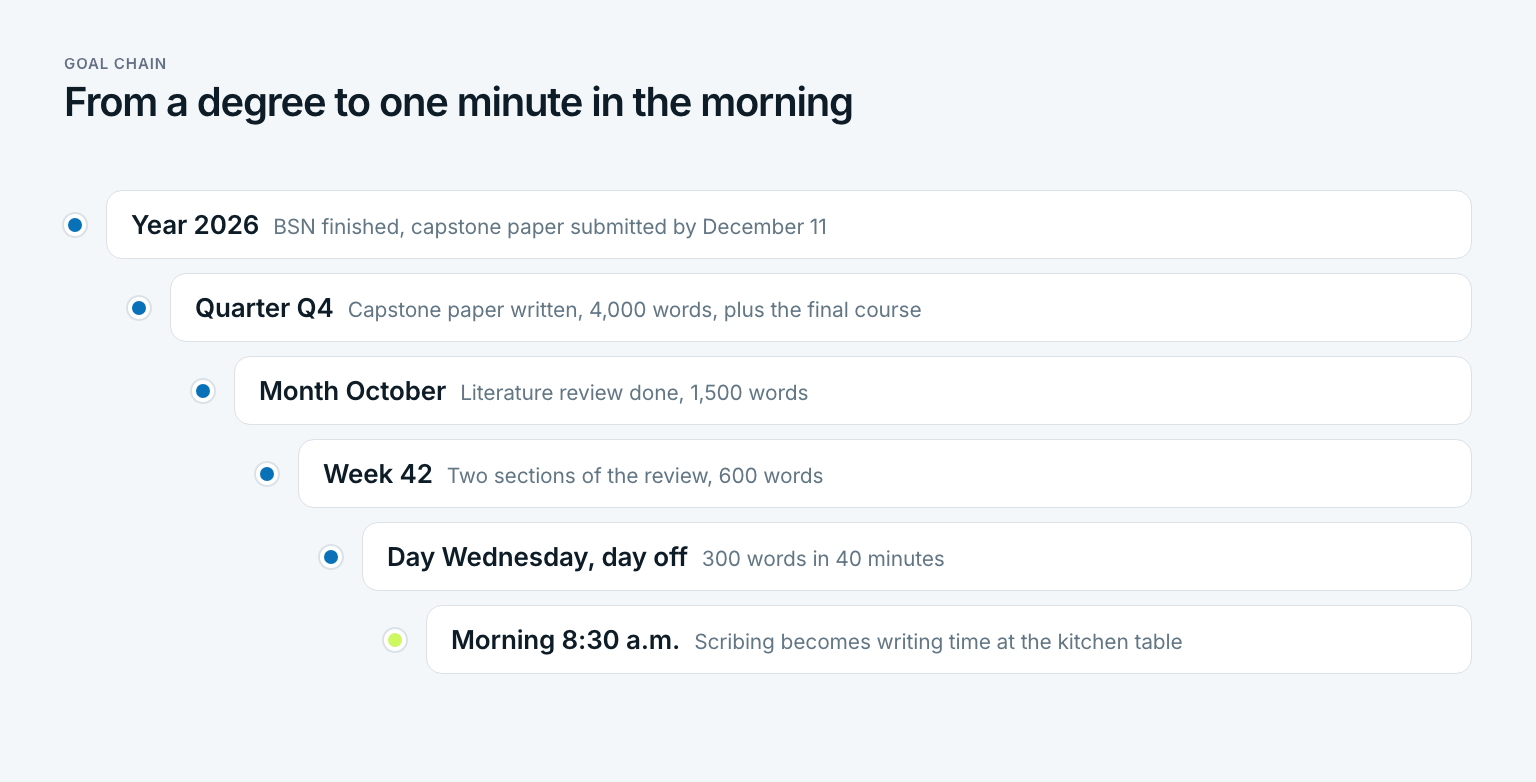
Here is how it looks for Dana. Year 2026: BSN finished, capstone submitted by December 11. Quarter Q4: capstone written, 4,000 words, plus the final course. Month October: literature review done, 1,500 words. Week 42: two sections of the review, 600 words. Wednesday, a day off: 300 words in 40 minutes. The block at 8:30 a.m. is not self-improvement for its own sake. It is the smallest piece of a plan that ends in December.
In Gaapp, every daily goal hangs on a weekly goal and every weekly goal on a monthly goal. Progress for any period is the share of goals you finished. For Dana, that means on Friday she does not see how many mornings she meditated. She sees whether her mornings moved the literature review. If you are not sure how to break a yearly goal into steps that small, read how to turn yearly goals into daily steps.
Without a yearly goal you can still do the Miracle Morning. You get a calmer start to the day, and that is worth a lot. Anyone who does have a goal should give it one letter. Otherwise the routine and the goal run side by side and never meet.
Three questions for your next 14 mornings
Before you buy the book or move your alarm, answer three questions:
- How many of your next 14 mornings start at the same time, and how many of those belong to you alone?
- Which of the six letters works on a goal you want to reach this year?
- What time do you need to be in bed so that the earlier alarm does not cost you sleep?
Whoever answers the first question honestly knows whether they need the full hour or the short version. Anyone who cannot answer the second will get a calm routine but no progress. And if the third question makes you pause, start with your evening, not your morning. In short: the Miracle Morning is not a miracle. It is a menu of six habits, and you take the minutes your life can spare.
Frequently asked questions about the Miracle Morning
What are the 6 practices of Miracle Morning?
The six practices are Silence, Affirmations, Visualization, Exercise, Reading and Scribing, remembered as SAVERS. Hal Elrod describes them in his 2012 book The Miracle Morning. The full routine takes about an hour, the short version one minute per practice.
What is The Miracle Morning routine?
It is a fixed sequence of the six SAVERS practices done right after waking, before work and family take over the day. Elrod recommends about an hour and offers a six-minute version for busy days. Many readers adapt the order and the length to their own schedule.
How much does The Miracle Morning app cost?
Several apps in the App Store and on Google Play use the Miracle Morning name, and their prices and subscription terms differ and change. Check the current store listing before you subscribe. The method itself needs no app: a timer and a notebook cover all six practices.
What are the six habits of The Miracle Morning, and which matter most?
The six habits are the SAVERS practices. In a busy week, exercise and scribing tend to carry the most weight, especially when scribing is used to write down or work on a daily goal. Affirmations and visualization work better when they name a concrete action and an obstacle instead of a wish.
Do you have to wake up at 5 a.m. for the Miracle Morning?
No. Elrod encourages getting up earlier than you do now, but the method does not require a set time. What matters is that the routine comes right after waking and does not cost you sleep. On rotating shifts, tie it to waking up rather than to the clock.
Is The Miracle Morning worth reading?
Yes, as a toolkit rather than a rulebook. The snooze-proof tips and the six-minute version are the most useful parts for busy people. Read it with one question in mind: which of the six letters will work on a goal you already have?
Last updated: 19 October 2026
Read next
 Habits
75 Hard: Rules, Risks and a Version You Can Finish
75 Hard is not a fitness program. The full rules, four health risks, 75 Soft compared and a custom version built around a real goal.
15 min read
 Habits
Digital Detox: A 7-Day Plan to Reduce Screen Time
A digital detox isn't a weekend offline. What the research shows, how to measure and reduce screen time, plus a 7-day plan with a worked example.
15 min read
 Habits
Delayed Gratification: Meaning, Examples, How to Build It
Delayed gratification isn't self-denial, it's a trade: what the marshmallow test really showed, everyday examples, five proven strategies and a plan.
15 min read