Daily Routine: How to Give Your Whole Day a Shape
A daily routine is not a schedule. Five anchors, six steps to write yours, the top 10 daily routines, and a worked example for three kinds of days.

Contents
- 01What a daily routine is and what it is not
- 02The six routines inside a good daily routine
- 03Marcus's Tuesday without a routine, measured
- 04The five anchors of a daily routine for success
- 05How to write your daily routine in six steps
- 06Daily routine examples: Marcus's template for three kinds of days
- 07Daily routine ideas: the top 10 daily routines worth keeping
- 08The three mistakes that end a daily routine by week three
- 09Your daily routine in the goal chain: from a yearly goal to 12:15 p.m.
- 10Frequently asked questions about daily routines
A daily routine is not a schedule. It is the handful of fixed points your day passes through in the same order, with a short sequence of actions attached to each one, so the important things happen without being decided again every morning. A schedule assigns every half hour and breaks the first time a meeting runs long. A daily routine fixes only the anchors and leaves the rest of the day open.
That is why the best daily routines look almost boring on paper. Five anchors, three small actions at each, and one block reserved for the goal that matters most this year. This guide works through it on a real week: Marcus, 36, a hybrid logistics coordinator with a five-year-old, who is studying for a certification exam and had not opened his prep course in nine days. You get the six steps to write your own routine, his routine for three kinds of days as a template, the top 10 daily routines worth keeping, and the three mistakes that end most routines in week three.
What a daily routine is and what it is not
A routine is a sequence of actions you repeat at the same trigger, in the same order, until it stops needing a decision. The word comes from the French “route”, a path, and that is exactly how it works. You walk the same path so often that you stop thinking about which way to turn. Anyone who studies at 12:15 because 12:15 is when studying happens skips the daily negotiation with themselves.
Routine has a bad reputation. At work it sounds like boredom, at home it sounds like a rut. Both are fair when the routine repeats the wrong things. A routine is built for repetition, not for variety, and it repeats whatever you give it with complete loyalty. That means: the question is never whether you have a daily routine. You already do. The question is whether it repeats anything you care about.
How much of your day is already routine
In 2002 the psychologist Wendy Wood and two colleagues asked students to write down, every hour for several days, what they were doing and thinking. About 43 percent of their actions were repeated almost daily in the same setting, often while they were thinking about something else. Wood summarized the research in her 2019 book “Good Habits, Bad Habits”. For your day, it means that nearly half of it already runs on autopilot. You only decide where the autopilot is headed.
Routine, habit, ritual: what each is built for
The three words get used as if they were the same. None of them is wrong, but each is built for a different job, and knowing which one is failing tells you what to fix.
| Term | What it is | What starts it | Marcus's example |
|---|---|---|---|
| Habit | One action that runs on its own | A cue, not a decision | He fills a water glass as soon as the coffee maker starts |
| Routine | A fixed sequence of actions with one purpose | An anchor in the day, usually an event or a time | Eat, phone in the hallway, 40 minutes of exam prep, back to work |
| Ritual | A sequence that carries meaning, done with attention | An occasion that matters to you | Saturday pancakes with Lily and one question: what was fun this week? |
| Daily routine | The frame that holds several routines across one day | Five anchors from waking up to lights out | His remote day from 6:30 a.m. to 10:45 p.m. |
A habit is the brick, a routine is the wall, and the daily routine is the frame of the house. How a single habit forms, and why it takes closer to 66 days than 21, is covered in how to build good habits. This guide works one level up: how several routines carry an entire day. In short: habits make single actions easy, a daily routine makes whole days reliable.
The six routines inside a good daily routine
What is the daily routine made of? Look at any working day and you find six smaller routines, each with its own job. You do not need all six on day one. Whoever knows the jobs, though, can see quickly which one is missing:
- Morning routine. The first 30 to 60 minutes after you wake up. Its job is a calm start and, ideally, a block for your main goal before the day makes its own plans. Steps, formulas and ideas are in our guide to the morning routine. One well-known version for the full hour is the Miracle Morning, built on six practices.
- Startup routine. The ten minutes that open your workday: check the calendar, open the one task that matters, keep email closed. Its job is that work starts on purpose and not with the first notification.
- Transition routines. Short sequences at the seams of the day: after school drop-off, after lunch, after the commute. They are the most underrated kind, because the seams are where most of the time leaks out.
- Shutdown routine. A deliberate end of work: write down open loops, set tomorrow's goal, close the laptop. Its job is to keep work from running into your evening.
- Evening routine. The last 30 to 60 minutes before bed. Its job is good sleep and a prepared morning, and the three parts are laid out in the guide to the evening routine.
- Weekly routine. Things that happen every week but not every day: groceries, workouts on fixed days, a short review on Friday. It takes pressure off the daily routine because not everything has to fit into every day.
Anyone who starts with only one routine usually picks the morning, because it is the most visible. That is a fine start. The trouble is that days rarely break in the morning. They break in between: after drop-off, at lunch, at a workday with no clear end. That means: a good daily routine is designed around the seams, not only around sunrise and bedtime.
Marcus's Tuesday without a routine, measured
Marcus is 36 and works as a logistics coordinator for a regional distributor in Columbus, Ohio. He is in the office Monday, Wednesday and Friday, a 25-minute drive away, and works from home on Tuesday and Thursday. His daughter Lily is five and in pre-K, and daycare closes at 6 p.m. Since September he has been preparing for the PMP certification exam, which he wants to pass by the end of March 2027. His plan was five 40-minute study sessions a week, “in the evening, once Lily is asleep”.
In week 39 he logged one remote Tuesday without changing anything. This is what it looked like:
| Time | What actually happened | Planned? |
|---|---|---|
| 6:45 a.m. | Alarm, snoozed twice, up at 7:05 | No |
| 7:05 to 7:40 | Breakfast, Lily's shoes, a search for her library book | Partly |
| 7:40 to 8:00 | Daycare drop-off | Yes |
| 8:00 to 11:50 | Email first for 50 minutes, then a carrier escalation | Partly |
| 11:50 to 12:45 | Lunch at the desk, sports news on the phone | No |
| 12:45 to 5:30 | Calls, route planning, no clear stopping point | Partly |
| 5:30 to 8:15 | Daycare pickup, dinner, bath, two books, bedtime | Yes |
| 8:15 to 9:00 | Dishes, then work chat on the phone | No |
| 9:00 to 11:30 | Prep course open on the laptop, a game on TV instead | No |
| 11:45 | Bed, phone until 12:20 | No |
Nothing in this day is wrong. The escalation needed handling, the game was a fair reward, and anyone who tries to study project risk management at 9 p.m. after a full day and a five-year-old's bedtime needs more than good intentions. The problem is elsewhere. The day had exactly two fixed points, drop-off and bedtime, and Lily set both of them. Everything in between sorted itself, and it sorted itself by whatever was loudest.
Across the whole week, five study sessions were planned and one happened, on Sunday afternoon. Meanwhile, the lunch hour on his two remote days went to the desk and the phone, and on office days it went to the break room. That is five lunch breaks of 45 to 55 minutes, close to four hours in total, while the four missing sessions would have needed 160 minutes. Does Marcus lack time? No. He has time in the wrong place. That means: a day without a routine is not a free day. It is a day that other things plan for you.
The five anchors of a daily routine for success
A daily routine for success does not need more items. It needs fewer, better placed. Instead of a to-do list for every hour, it fixes five moments the day reliably passes through and attaches a short sequence to each. The space between anchors stays flexible, and that is exactly what makes it last.
Anchor
An anchor is a moment that already happens every day: waking up, the coffee, opening the laptop, the end of work, brushing your teeth. BJ Fogg calls it the anchor moment in “Tiny Habits”, published in 2019, the existing event you attach a new behavior to. Whoever hangs a new routine on an anchor instead of on willpower does not have to remember it. The anchor does the remembering. The formula for turning an anchor into a one-sentence plan is in the guide to habit stacking.
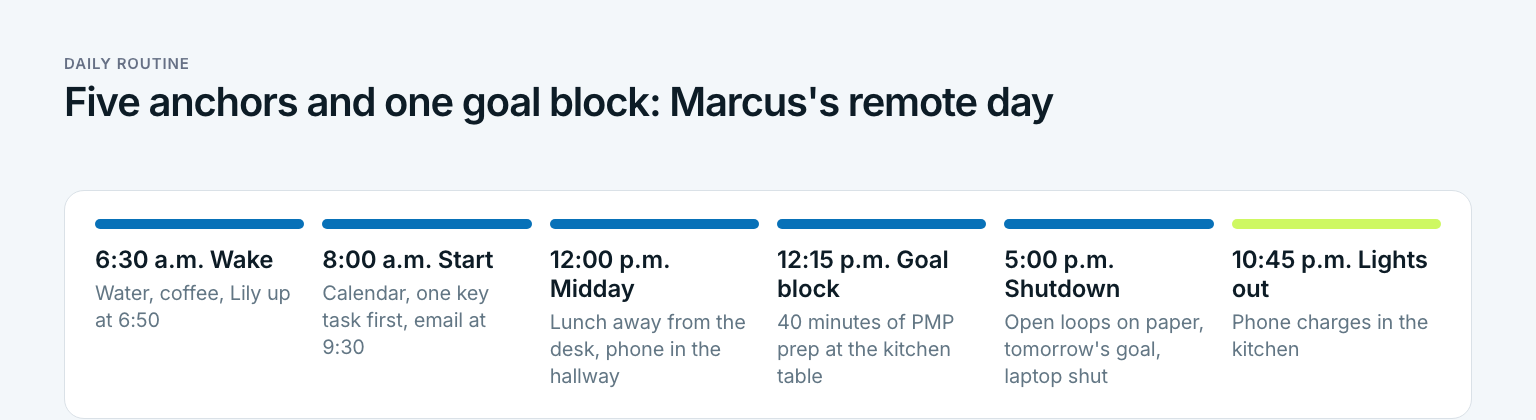
The five anchors are the same in almost every life, only the times differ:
- Wake up. A fixed time on workdays, no more than an hour later on weekends. It decides how much morning you have.
- Start work. The moment the day starts belonging to other people. Your best window for your own goals is often right before or right after it.
- Midday. The seam in the middle. A real break here decides whether the afternoon still has focus in it.
- Shut down. A clear end of work with a five to ten-minute closing sequence.
- Lights out. The anchor that carries all the others. Whoever moves it moves the next morning with it.
Attach no more than three actions to each anchor. Five anchors times three actions is 15 fixed actions a day, not 30 or 40. Almost nobody keeps more than that through the first weeks, and that is not a character flaw but arithmetic: every extra item is one more place where the chain can break.
One of the five anchors also gets your goal block, the time when something happens for your most important goal every single day. For Marcus, that block is not in the evening where he had planned it. It sits at the midday anchor. Why lunch? His mornings belong to Lily, his evenings are flat, and the lunch hour is the one hour in his day that nobody else has claimed, at home or in the office. In short: the goal block belongs at the anchor with the most energy and the least competition, not at the one with the most free time on paper.
How to write your daily routine in six steps
Writing a daily routine means turning a decision into something you no longer have to decide. The six steps take about 45 minutes the first time, then two weeks of running it without changes. Have your calendar, a sheet of paper and the one goal your days should carry for the next few months in front of you.
Name the purpose, ten minutes
Which goal should your days carry for the next three months? One goal, not five. Turn it into a daily block with a length: 40 minutes of study, a 30-minute run, 500 words. For Marcus it is one session of PMP prep, 40 minutes. Whoever skips this step builds a routine that looks tidy and moves nothing.
Write down your five anchors with real times, five minutes
Note when you actually wake up, start work, take lunch, stop working and turn off the light on a normal workday. Not the times you would like, the times that really happen. Marcus's honest list for Tuesday: 7:05, 8:00, 11:50, no clear end, 12:20 a.m.
Hang the goal block on your strongest anchor, ten minutes
Test each anchor with two questions: do I have energy here, and does anyone want something from me here? The anchor with the most energy and the fewest demands gets the goal block. For Marcus it is midday: eat for 15 minutes away from the screen, then study from 12:15 to 12:55.
Give each anchor three actions, ten minutes
Write no more than three actions for each anchor, in a fixed order. At shutdown, for example: write down open loops, set tomorrow's goal, close the laptop. Anything that does not fit into three actions belongs in your weekly routine, not in your day.
Write the short version for bad days, five minutes
For every day with a sick kid, a late shift or a bad night, define a minimum. The goal block shrinks to ten minutes, the anchors stay where they are. For Marcus that means ten practice questions on his phone. The short version keeps one bad day from ending the whole routine.
Count for two weeks, then change one thing
Change nothing for two weeks. Only count how many days the goal block happened and at which anchor the chain broke. Then change exactly one thing, ideally during a short weekly review on Friday, when you are looking at the week anyway.
After two weeks, Marcus's count looked like this: ten sessions planned, seven done. All four remote days had their block. On office days it worked three times out of six, because the small conference room he used was booked twice and a lunch meeting took the third slot. His one change: a recurring 12:15 calendar hold for that room, set up like any other meeting. In the next two weeks he logged nine sessions out of ten, one of them as the short version on a day Lily stayed home sick.
That means: a routine is not right on day one, it gets right in week three or four. Anyone who rewrites everything after three days is not testing anything. Whoever counts for two weeks knows which anchor holds. And whoever changes only one thing afterward also knows whether the change worked.
Daily routine examples: Marcus's template for three kinds of days
A daily routine is not one template for every day. The anchors stay the same, but times and actions shift with the kind of day. Marcus has three versions, and each fits on a card on the fridge. Use the table as a template: swap in your times and the actions your anchors need.
| Anchor | Remote day, Tue Thu | Office day, Mon Wed Fri | Saturday |
|---|---|---|---|
| Wake up | 6:30 a.m.: water, coffee, Lily up at 6:50 | 6:15 a.m.: water, clothes from the night before, Lily's bag by the door | 7:30 a.m.: pancakes with Lily |
| Start work | 8:00 a.m.: calendar, one key task first, email at 9:30 | 8:15 a.m.: the same sequence at the office | none |
| Midday and goal block | 12:00 lunch away from the desk, 12:15 to 12:55 study at the kitchen table | 12:00 lunch in the break room, 12:15 to 12:55 study in the small conference room | no block, Saturday is the backup slot |
| Shut down | 5:00 p.m.: open loops on paper, tomorrow's goal, laptop in the drawer | 5:00 p.m.: same sequence, then drive to daycare | none |
| Lights out | 10:30 p.m.: lunch packed, phone to the kitchen, lights out at 10:45 | 10:30 p.m.: the same, study notes on the table | 11:30 p.m., a little slack |
Two things stand out. First, the goal block sits at the same anchor five days a week, which is rare and worth looking for. Most people have one anchor that nobody else owns, and for many it is lunch. Second, the evening is free. The study session Marcus never managed at 9 p.m. now happens at noon, and his evenings belong to Lily, the game and sleep again. Saturday stays empty on purpose, as the slot for a session that a weekday lost.
How you fill a single day with tasks is a different question. The daily planner template shows seven fields for planning tomorrow tonight: what gets done, by when, in which order. The daily routine is the frame that stays the same every day. The daily plan is the content that changes every day. Whoever mixes the two ends up writing the same 15 routine actions on tomorrow's plan every night and wonders why planning takes so long.
Daily routine ideas: the top 10 daily routines worth keeping
What are the best daily routines? The best daily routines share three traits: they hang on an anchor you hit every day, they have a minimum for bad days, and they feed something you care about. Here are ten, sorted by anchor. Pick two to start, not ten.
| Anchor | Routine | Minimum on bad days | What it does |
|---|---|---|---|
| Wake up | A glass of water and five minutes of daylight by a window or outside | The glass of water | Wakes you up without a screen |
| Wake up | Make the bed right after you get up | Pull the covers straight | The first finished thing of the day |
| Before or after work starts | A goal block for your main goal, 30 to 60 minutes | Ten minutes | Progress before anyone else asks for your time |
| Start work | Open the one important task before you open email | Open the file, write the first line | The workday starts on purpose |
| Midday | A ten-minute walk after lunch | Once around the block | Focus in the afternoon |
| Midday | Eat with the phone in another room | Screen face down | A break that is actually a break |
| Transitions | Two minutes after every meeting to write what follows from it | One sentence | Nothing gets lost between meetings |
| Shut down | Write open loops down and set tomorrow's one goal | Tomorrow's goal only | Work stays at work |
| Evening | Lay out clothes, bag and what the goal block needs | Put the material on the table | The morning starts without searching |
| Lights out | The phone charges outside the bedroom, lights out at a fixed time | The phone out of the bed | Enough sleep for the next anchor |
Good daily routine ideas are boring, and that is their strength. None of these ten needs motivation, because none takes longer than the argument with yourself about whether to do it today. Whoever finds their routines exciting has usually not had them very long.
For parents this counts twice. Anyone with kids already has anchors that never move: drop-off, pickup, dinner, bedtime. Those anchors are more reliable than any alarm, because they do not depend on how you feel that day. Instead of planning against them, hang your routines on them. Marcus did exactly that: his shutdown is timed backward from the daycare door at 6 p.m., and once Lily is asleep, nothing else is asked of the evening.
The three mistakes that end a daily routine by week three
Most routines do not fail in the first week. Week one runs on excitement, week two on novelty. They fail in week three, quietly, at one of these three mistakes. Which one is yours?
The most common mistake: a routine written like a timetable
Whoever splits the day into half-hour blocks from 6 a.m. to 10 p.m. feels great on day one and has a plan that no longer fits by day three. One call from daycare, one meeting that runs long, and the rest of the day slides. Because everything was fixed, every slide feels like failure, and by week three the plan is in a drawer. A daily routine fixes five anchors, not 32 blocks. What happens between them is allowed to move.
Mistake two: everything at once
New routines feel best when they all start together: early workouts, study, meditation, meal prep, an earlier bedtime. That is understandable, because a fresh start should feel like one. But five new routines compete for the same attention, and when one breaks, the others go with it. Anyone who adds one routine every two weeks has six after three months. Anyone who adds all of them on the same Monday usually has none.
Mistake three: no short version
The routine works on normal days and disappears on every unusual one: a sick kid, a late shift, a trip, a bad night. After the second miss in a week comes the feeling that it is not working anyway, and then it is gone for good. The short version from step five is the fix: ten minutes instead of 40, ten questions instead of a lesson. That means: a routine is not measured on good days. It is measured by the number of days it does not disappear completely.
Your daily routine in the goal chain: from a yearly goal to 12:15 p.m.
A routine without a goal is order. That is not nothing, but it does not move anything. Only when the goal block hangs on a bigger goal do you know each day what belongs in those 40 minutes, and at the end of the week whether they were enough. To get there, you translate the yearly goal one level at a time until it lands on an anchor in your day.
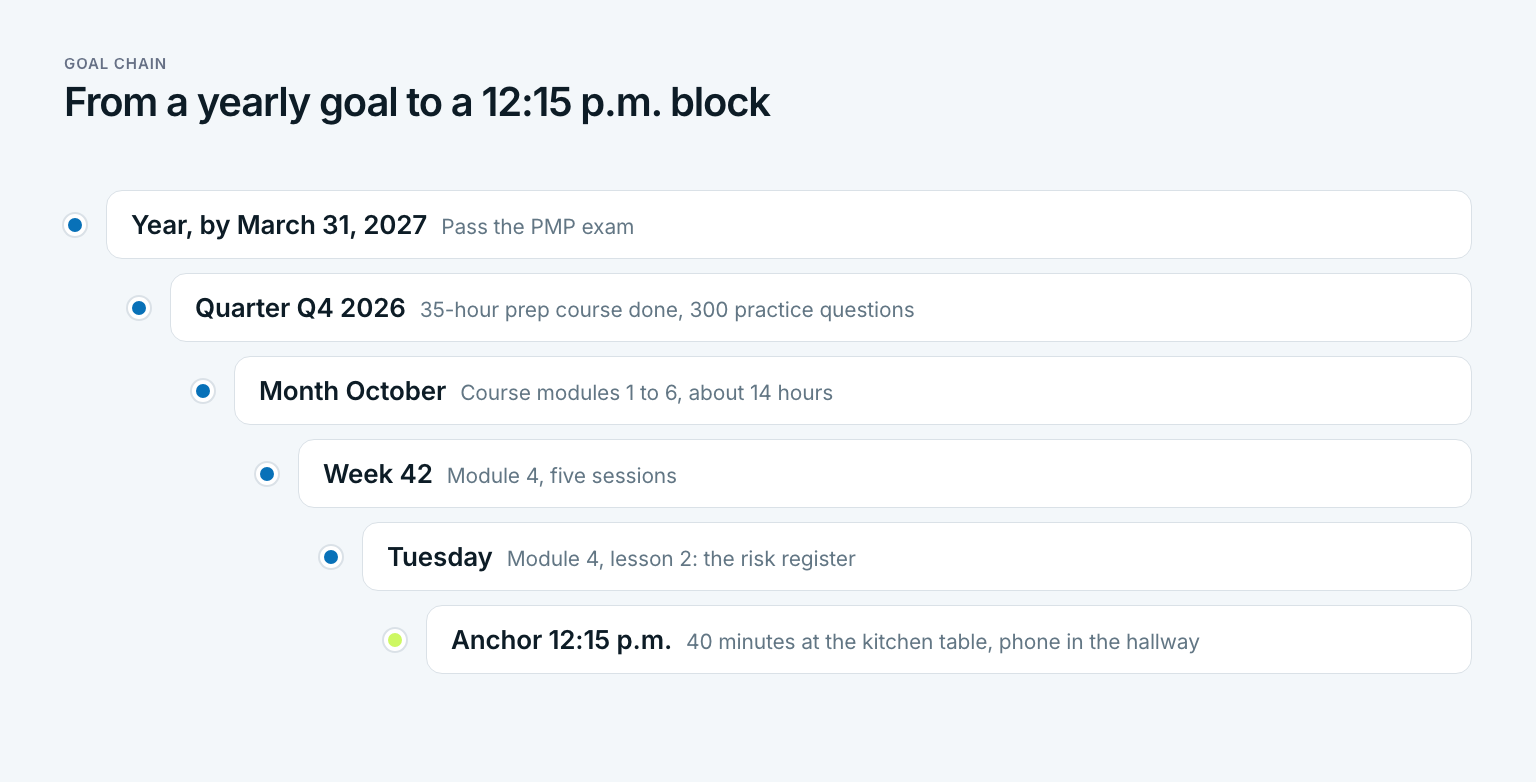
The chain is planned from the top down and measured from the bottom up. Five sessions of 40 minutes a week add up to about 14 hours in October, which is what modules 1 to 6 need. If one week only gets three sessions, October ends 80 minutes short. Marcus sees that on Friday of that week, not in March, a few weeks before the exam. That means: the routine supplies the time, the goal chain says what goes into it and whether it is enough.
In Gaapp, this chain is the core: five levels from year to day, every goal hanging on a bigger one, and progress for each period shown as the share of goals done next to the share of time gone. Marcus's Tuesday goal is a single checkmark there that feeds the week, the month and the quarter. How to write a daily goal small enough for one 40-minute block is covered in daily goals.
Three questions about yesterday
Before you change anything tomorrow, look at yesterday:
- Can you name the five anchors of yesterday with times, without checking?
- Was there a block yesterday in which something happened for your most important goal, and which anchor did it hang on?
- Where did the minutes between two anchors go that you no longer remember today?
Whoever hesitates on any of these does not lack discipline. They lack an anchor. In short: a daily routine does not make your day smaller, it decides where your free time goes.
Frequently asked questions about daily routines
What are the best daily routines?
The best daily routines hang on an anchor you hit every day, have a minimum for bad days and feed a goal you care about. Strong examples are a goal block of 30 to 60 minutes, opening your key task before email, a short walk after lunch and setting tomorrow's goal at shutdown. Two routines that last beat ten that are gone by week three.
What are the top 10 daily routines?
A practical top 10: water and daylight after waking, making the bed, a daily goal block, the key task before email, a walk after lunch, a phone-free meal, two minutes of notes after meetings, a shutdown with tomorrow's goal, laying things out in the evening, and the phone charging outside the bedroom. Each one has a fixed anchor and a minimum for bad days. Start with two of them, not all ten.
How do I write my daily routine?
Name the one goal your days should carry, then write down your five anchors with real times: wake up, start work, midday, shutdown and lights out. Put your goal block at the anchor with the most energy and the fewest demands, and give each anchor no more than three actions. Run it unchanged for two weeks and count where it breaks.
What is the daily routine?
A daily routine is the set of fixed points your day passes through in the same order, each with a short sequence of actions attached. It is not an hour-by-hour schedule, because the time between the anchors stays flexible. Its job is that the important things happen without being decided again every day.
What is a good daily routine for success?
A daily routine for success is one in which a fixed block for your most important goal happens every day, attached to an anchor that nobody else claims. Everything else in the routine, sleep, breaks and shutdown, exists to protect that block. Success then shows up as a count: how many blocks happened this week, and is that enough for this month's goal?
How long does it take for a routine to stick?
For single habits, the psychologist Phillippa Lally found in 2009 that automaticity took 66 days on average, with a wide range depending on the person and the behavior. A full daily routine has several parts and usually takes longer, which is why you add it piece by piece. After two weeks you know whether it holds, and after about three months it mostly runs without thinking.
Last updated: 14 October 2026
Read next
 Habits
75 Hard: Rules, Risks and a Version You Can Finish
75 Hard is not a fitness program. The full rules, four health risks, 75 Soft compared and a custom version built around a real goal.
15 min read
 Habits
Digital Detox: A 7-Day Plan to Reduce Screen Time
A digital detox isn't a weekend offline. What the research shows, how to measure and reduce screen time, plus a 7-day plan with a worked example.
15 min read
 Habits
Delayed Gratification: Meaning, Examples, How to Build It
Delayed gratification isn't self-denial, it's a trade: what the marshmallow test really showed, everyday examples, five proven strategies and a plan.
15 min read