One on One Meeting Questions: 50 for Managers and Reports
One on one meeting questions are not a script: 30 for managers by purpose, 10 for hard moments, 10 for reports, plus 5 for every 1:1 and the bad signs.

Contents
- 01What good one on one questions do, and what they do not
- 02Why the first answer is rarely the real one
- 03One on one meeting questions by purpose: 30 for managers
- 041:1 questions for two situations every manager meets
- 05Questions to ask in a one on one with your manager: ten for reports
- 06Five good questions to ask in every 1:1
- 07Signs of a bad 1 on 1 meeting, and the three mistakes behind them
- 08How to pick next week's questions in four steps
- 09One on one questions along the goal chain: year, quarter, month, week, day
- 10Questions about one on one meeting questions
Good one on one meeting questions are not a script. They are open questions you ask one direct report, one at a time, to find out what a status update never shows you: what is in the way, what is wearing them down, where they want to grow, and what you should do differently. A script gets every box ticked and nothing said. A good question asks one thing, waits for the whole answer, and then asks what else.
Below are 50 one on one questions sorted by purpose: 30 for managers in five groups, ten for two situations every manager meets, and ten for reports to ask their manager. Each group says what the questions are for and which follow-up they need. You will also see the signs of a bad 1:1 and how Marcus, eight months into his first management job, rebuilt his weekly 1:1s around five questions instead of one.
What good one on one questions do, and what they do not
A question in a 1:1 has one job. It brings something to the table that you would not have learned otherwise. That can be a number, an obstacle, a wish, or a criticism of you. Anything you already know, you do not need to ask. You can simply say it.
Question lists get a bad reputation, and unfairly so. They keep you from skipping a whole area, such as workload, which almost nobody raises unprompted. They are just built for preparation, not for the conversation itself. Anyone who reads a list top to bottom in the meeting is running an interview, not a 1:1.
Three traits turn a question into a good one:
- Open. It cannot be answered with yes or no. Are you happy here ends after one word. What would have to change for you to enjoy this job more opens a topic.
- Specific. It points at a time frame, a goal, or a situation. How's it going gets a fine. Which day this week felt the longest gets a story.
- Consequential. The answer can change something: a goal, a task, a habit of yours. A question whose answer is not allowed to change anything is small talk.
Here is what the difference looks like in practice:
| Weak question | Better question | What changes |
|---|---|---|
| Any updates? | What do you want to talk about today? | The report sets the topic, not the project board |
| Are you on track? | Where are you against this month's number, and how confident are you? | A number and a confidence level instead of a yes |
| Is everything okay with the team? | What cost you time this week that had nothing to do with your goals? | A time frame makes the answer concrete |
| Am I a good manager? | What should I start doing tomorrow that would help you? | A request instead of a compliment |
| Where do you see yourself in five years? | What do you want to be able to do a year from now? | A horizon you can actually plan together |
That means: the better question is almost always longer, but its answer is easier to act on. It gives you a lever instead of a mood.
Why the first answer is rarely the real one
Most people answer the first question in a 1:1 carefully. That is not distrust, it is habit. Whoever has spent years in meetings where the safe answer was it's fine will give that answer first, every time. The real answer usually arrives on the second or third follow-up, and by then many managers have already moved on to their next question.
Why does that happen? Because silence feels awkward. After an open question there are three to five seconds of quiet, and that is exactly where the manager fills the gap with a suggestion. From then on the report answers the suggestion, not the question. A simple rule follows: whoever asks counts to five before saying anything else.
What a follow-up question is
A follow-up picks up the answer instead of changing the subject. The simplest one is: And what else? Michael Bungay Stanier calls it the best coaching question in the world in The Coaching Habit, published in 2016, because the first answer is rarely the most important one. For your 1:1s that means writing the follow-up next to every question before the meeting, or you will forget it in the moment. Coaches rely on the same follow-up when they turn a vague issue into clear coaching goals.
Every topic in a good 1:1 runs in four moves. You open with a question, follow up with and what else, ask for evidence such as a number or an example, and close by asking what happens next. One topic in four moves takes five to eight minutes. That is why a 30-minute 1:1 has room for three or four real questions, not ten.
Marcus learned this the slow way. He is 38 and was promoted eight months ago to lead five account managers who handle renewals for existing customers. He holds a weekly 30-minute 1:1 with each of them, two and a half hours a week. At the end of Q3 he went through his notes. Of 60 scheduled meetings, he had moved nine and canceled four. Of the 47 that happened, 35 contained nothing but project status.
One report stood out. Jordan, 31, owns 40 accounts, and his quarterly goal was to lift the renewal rate on them from 85 to 90 percent. In week eight he was at 86. In every 1:1 Marcus had asked the same opener, any updates, and Jordan had answered the same way: fine, on track. In short: the question decided the answer before Jordan said a word.
One on one meeting questions by purpose: 30 for managers
The 30 questions below are sorted into five groups, six in each. Pick one or two per meeting, from whichever group fits this person this week. Each group starts with what the questions measure, so you know when you need them.
Check in: how the week actually felt
These questions measure energy and attention before you talk about work. Ask them first, and listen to the whole answer. The follow-up is: What made it that way?
- What was the best part of your week, and what made it good?
- On a scale of one to ten, how full is your plate, and what would take it down one point?
- Which meeting this week could you have skipped without missing anything?
- When did you last have a full morning of focused work?
- What is one thing you are looking forward to next week?
- Is there anything outside of work that is taking energy and that you want me to know about?
Priorities and goals
These questions measure whether the report is working on what matters most and whether they believe in the goal. A goal someone proposed themselves lasts longer than one they accepted. The follow-up is: How do you know?
- If you only had one day this week, which goal would you spend it on?
- Where are you against this quarter's number, and how sure are you about it?
- What did you say yes to this week that you would now say no to?
- Which of your goals feels least like yours, and why?
- If the quarter ended today, what would be finished and what would not?
- What should the team stop doing so you can hit your goal?
Obstacles and workload
These questions measure friction: the time lost to tools, handoffs, and waiting. Burnout rarely shows up in goals. It shows up in evenings, weekends, and sick days. Whoever never asks about workload finds out from a resignation letter.
- Where did you lose time this week to something that should be automatic?
- What are you doing by hand that you suspect nobody else does by hand?
- Which decision is waiting on someone else, and since when?
- What would you need to finish this a week earlier?
- Who could help you with this that you have not asked yet?
- What problem keeps coming back, no matter how often you fix it?
Growth and career
These questions measure where the report wants to go and whether they can get there on your team. One per month is enough in a weekly 1:1. If the answer turns into a real plan, it belongs in an individual development plan, not in your meeting notes.
- What did you learn this month that you have already used?
- Which task would you like to take over from me or from someone else?
- What kind of work makes you lose track of time?
- Where do you want to be in two years, and what would a first step look like this quarter?
- What feedback have you received lately that you agree with, and what do you disagree with?
- Which project would you volunteer for if nobody had to assign it?
Feedback on you and the team
These questions measure how you land as a manager. They are the most uncomfortable ones, which is exactly why at least one belongs in every other 1:1. The follow-up is: Can you give me an example? Without one, criticism of you stays too vague to change anything.
- What should I start, stop, and keep doing as your manager?
- When did I last make your work harder without noticing?
- Do I give you too much direction, too little, or about the right amount?
- What do you hear from customers or other teams that I should hear too?
- Who on the team deserves recognition they are not getting?
- Which decision of mine this quarter would you have made differently?
Thirty questions are too many for any single meeting, and that is the point. The list is a pantry, not a recipe. For the agenda, cadence, and who owns which part of the half hour, see the guide to the one on one meeting.

1:1 questions for two situations every manager meets
Two meetings need their own questions. The first 1:1 with a new report sets the rules for every meeting after it. The 1:1 with someone who is struggling decides whether they tell you what is going on or quietly start looking elsewhere.
Your first 1:1 with a new report
- How do you like to receive feedback: in the moment, in writing, or saved for our 1:1?
- What did your best manager do that you want me to keep doing?
- What did a past manager do that you never want to experience again?
- How will I know when you are stressed, and what helps when you are?
- What should I know about how you work that is not on your résumé?
When someone is struggling
- What has changed for you in the last few weeks?
- What would a good week look like for you right now?
- What is one thing I could take off your plate this week?
- Is the hard part the work itself, the amount of it, or something around it?
- What support would help that you have not felt able to ask for?
Anyone who asks these questions has to be ready for the answer. If someone tells you the amount of work is the problem, the next step is taking something away, not a pep talk. If the conversation touches on feedback you need to give, the guide on how to give feedback to employees shows how to name a behavior without judging the person.
Questions to ask in a one on one with your manager: ten for reports
A 1:1 is not an exam in which only one side asks. As the report, you own most of the agenda, and good questions from your side show that you are thinking about the team, not just your tasks. Two or three per month are plenty. Whoever never asks anything signals that they do not care what comes next.
- What would you like me to do more of, and what less?
- Which of my goals matters most to you if I cannot finish all of them?
- How does my work connect to the team's goals for this year?
- What does great look like in my role, in numbers?
- What are you worried about this quarter that I could help with?
- Which decisions can I make on my own from now on?
- Which skill should I build next to grow in this role?
- What feedback have you been holding back?
- Who else in the company should I get to know?
- How are you measured, and how can I help you with that?
Jordan asked two of them after Marcus changed his openers. The question about decisions led to a rule: Jordan now approves renewal discounts up to five percent himself instead of waiting for Marcus. By Jordan's own estimate that saves a day of waiting per deal. The question about worries showed that Marcus was nervous about two large accounts, which Jordan had already flagged in his notes but never said out loud.
Five good questions to ask in every 1:1
If you want one set that works in almost every weekly 1:1, use these five. They cover the report's topic, the follow-up, progress, obstacles, and you. Together they fit into 30 minutes with room to listen:
- What do you want to talk about today? The report sets the agenda. If the answer is nothing, that is information too.
- And what else? Ask it at least twice. The second answer is usually the real one.
- Where are you against this month's goal? A number, not a feeling. It turns progress into something you can both see.
- What is in your way, and what would help? This is where you earn the meeting, because the answer is usually something only you can remove.
- What should I do differently? Ask it every second week. If the answer is always nothing, ask for one small thing.
Marcus started using these five in week nine. In Jordan's next 1:1, the third question got a number, 86 percent, and the fourth got the real story. Jordan spent about four hours a week building usage reports by hand before every renewal call, because the dashboard did not show usage per account. Two of his largest accounts had also lost the person who championed the product, and nobody on the customer side had replied since.
Signs of a bad 1 on 1 meeting, and the three mistakes behind them
A bad 1:1 rarely feels bad. It feels efficient: short, friendly, nothing to report. Here is how to tell the difference, sign by sign:
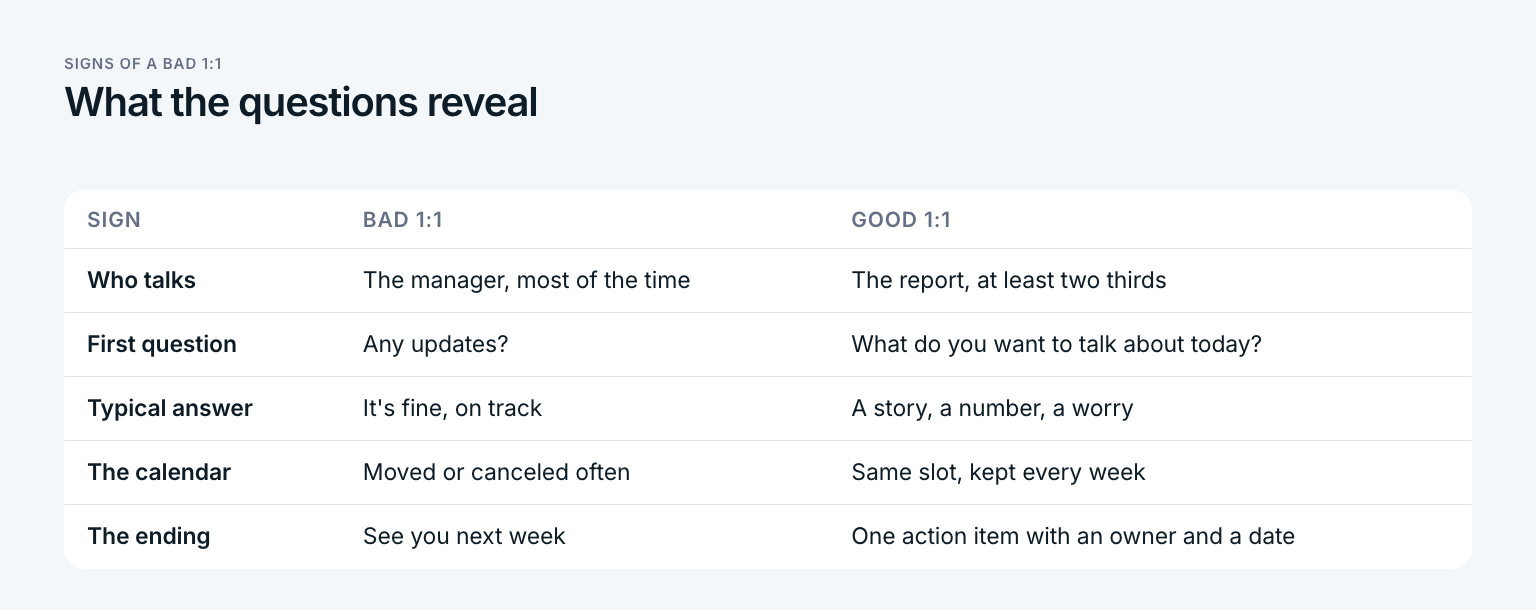
Behind almost every bad 1:1 sits one of three mistakes. None of them feels like a mistake while it is happening. Which one is yours?
The most common mistake: answering your own question
The manager asks, waits two seconds, and offers a suggestion: Is it maybe the handoff with sales? From then on the report talks about the handoff with sales, because it was offered, not because it is the problem. Whoever answers their own question only learns what they already knew.
- Asking for status. Status belongs in a shared document or a goal tracker, where anyone can read it at any time. Whoever spends the 1:1 on status uses the only private half hour of the week for the least private topic.
- Moving the meeting. Each moved 1:1 tells the report where they rank. Marcus moved nine of 60 in one quarter, and every one of them had a good reason. Together they said the 1:1 was the first thing to go.
- Answers with no consequence. The report tells you a tool costs them four hours a week, and nothing happens. Next time they answer the same question with fine. Every answer that names a problem needs a consequence: a goal, an action item, or a clear no with a reason.
In short: the questions decide what you talk about. What happens after the meeting decides whether anyone answers honestly next time.
How to pick next week's questions in four steps
You do not need a new list every week. You need a habit of picking two or three questions on purpose. This takes about five minutes per report:
Read last week's notes and the goal number
Before you choose anything, look at the open action items and where the report stands against the monthly goal. The questions should explain what the number does not, not ask again what it already shows.
Pick one question by purpose
Choose the group that fits this week: obstacles when progress stalls, growth when the work is steady, check in when someone seems off. One question from that group is enough.
Write the follow-up next to it
Usually and what else, or how do you know. In the meeting you will not remember it, because your mind is already on your own topics.
Add the question about you every second week
One question from the feedback group, asked regularly, so it stops feeling like an event. A shared [one on one meeting template](/en/blog/one-on-one-meeting-template) keeps the questions, answers, and action items in one place for both of you.
The example: Jordan's questions in weeks nine to twelve
| Week | Marcus's question | What came out | Action item |
|---|---|---|---|
| 9 | Where are you against this month's goal? | 86 percent, and four hours a week of manual usage reports | Marcus asks the data team for a usage view per account |
| 10 | What is in your way, and what would help? | Two large accounts lost their champion | Jordan books calls with the new operations leads |
| 11 | What should I do differently? | Stop moving the 1:1 for internal meetings | The slot becomes fixed, Tuesday at 9 a.m. |
| 12 | Which task would you like to take over from someone else? | Onboarding the next new account manager | Becomes Jordan's growth goal for Q1 |
The usage view went live in week ten and gave Jordan back four hours a week. One of the two at-risk accounts renewed in week eleven. Jordan closed the quarter at 89 percent, one point short of the goal and three points above where he had been when the questions changed. That means: four questions did more for the quarter than eight weeks of updates.
One on one questions along the goal chain: year, quarter, month, week, day
A weekly 1:1 can only ask good questions about progress if there is a goal to measure against. Each level of the goal chain has its own guiding question, and each answer feeds the level above it:
| Level | Where it is asked | Guiding question | For Jordan |
|---|---|---|---|
| Year | Yearly career conversation | What should be different twelve months from now? | Team renewal rate of 92 percent, Jordan onboards the next hire |
| Quarter | First 1:1 of the quarter | Which quarterly goal moves the yearly goal most? | Q1: 90 percent on his 40 accounts |
| Month | Monthly growth 1:1 | Are we on track for the month, by the number? | January: every renewal due in February has a usage review booked |
| Week | Weekly 1:1 | What is the one step this week, and what is in the way? | Three usage reviews, one new contact at an at-risk account |
| Day | No meeting | What do I do today for it? | Tuesday: send the usage view to the first account |
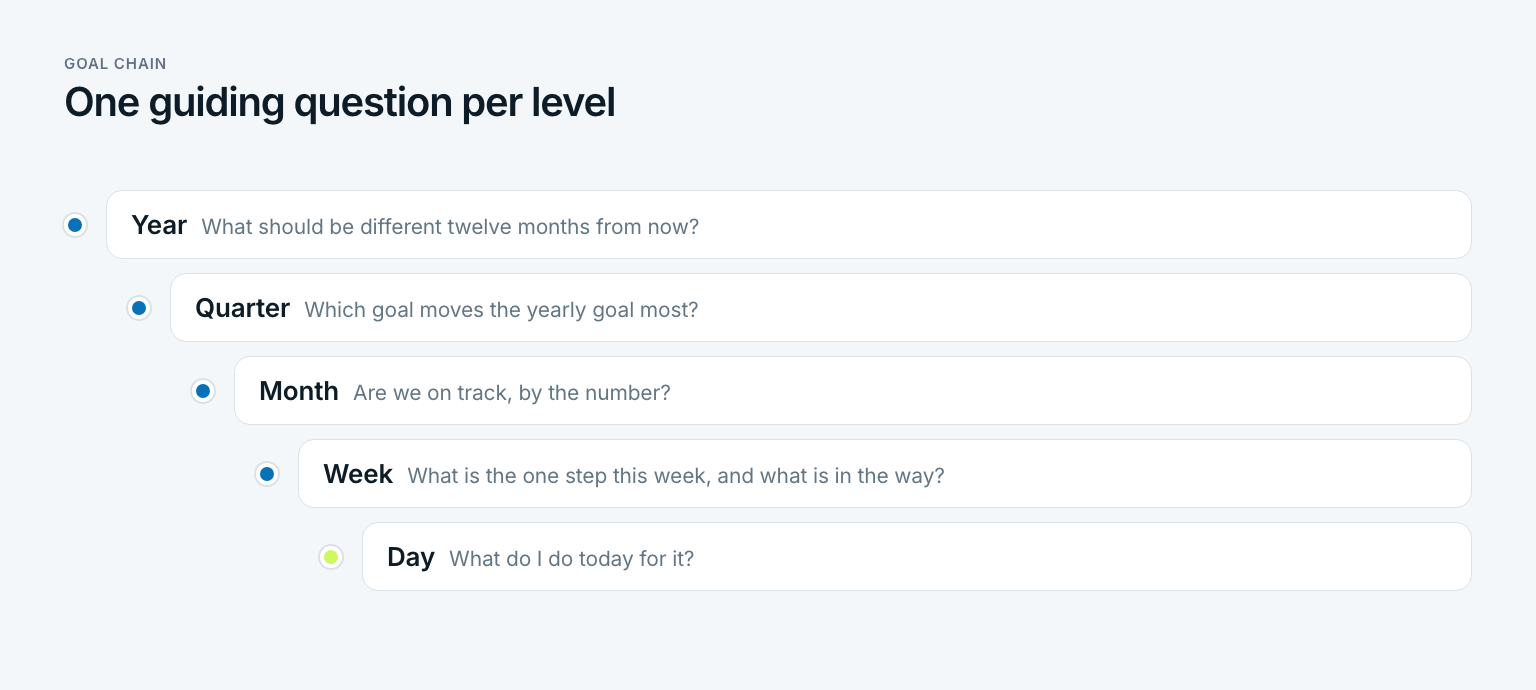
The questions get shorter and more concrete at each level. In the yearly conversation you ask about direction, in the quarter about priorities, in the month about progress, in the week about the next step. Nobody asks questions on the day itself, that is where the work gets done. Whoever asks the right question once a year does not have to ask it 52 times, because the answer already lives in the goals underneath.
In Gaapp every goal hangs from a bigger one, from the year down to the day, and Marcus and Jordan see the same progress in a shared space. The weekly 1:1 then does not start with any updates. It starts with the number both already know, and the 30 minutes go to the questions no number can answer.
Three questions for your own next round of 1:1s:
- Do you know, for each question you plan to ask, what you will do with the answer?
- Is there at least one question on your list whose answer might be uncomfortable for you?
- Did any answer from last month's 1:1s turn into a goal or an action item?
Anyone who answers no to one of these does not need more questions, but fewer and better ones. In short: a 1:1 is not measured by how many questions you ask, but by how many answers change something.
Questions about one on one meeting questions
What are good 1:1 questions?
Good 1:1 questions are open, specific to a time frame or goal, and able to change something. Examples: What do you want to talk about today? Where are you against this month's goal? What is in your way, and what would help? What should I do differently? Each one needs a follow-up, usually and what else.
What are 5 good questions to ask?
A reliable set for weekly 1:1s: What do you want to talk about today? And what else? Where are you against this month's goal? What is in your way, and what would help? What should I do differently? Together they cover the report's topic, progress, obstacles, and feedback on you.
What are some good questions to ask in a one-on-one meeting with your manager?
Ask what great looks like in your role in numbers, which of your goals matters most if you cannot finish all of them, and which decisions you can make on your own. Ask about your manager's worries for the quarter, too. Two or three questions a month are enough to show that you think beyond your own tasks.
What are signs of a bad 1 on 1 meeting?
The manager talks most of the time, the first question is any updates, the answer is always fine, and the meeting gets moved or canceled often. It ends without an action item. If most of your notes contain only project status, the 1:1 has become a status meeting.
How many questions should you ask in a one on one?
Three or four real questions fit into 30 minutes, if you follow up on each one. A topic with question, follow-up, evidence, and next step takes five to eight minutes. More questions produce shorter answers, not more information.
Should you send one on one questions in advance?
For the regular weekly 1:1, a shared agenda is enough, and the report adds topics before the meeting. For bigger conversations about career or a full quarter, send the questions a few days ahead. People who know the question bring numbers and examples instead of first impressions.
Last updated: 19 October 2026
Read next
 Leadership & Teams
Leadership Styles: Which One Fits Which Situation
Leadership styles are not personality types: 11 types compared, Lewin, Goleman, situational leadership and five steps to find the style that fits you.
14 min read
 Leadership & Teams
Retrospective: How Teams Learn From Every Sprint
A retrospective is not a blame session: what the word means, five phases, seven retrospective examples and action items that stick, shown on one team.
16 min read
 Leadership & Teams
How to Delegate Tasks: Hand Off Work, Keep Results
Delegation is not dumping work: five levels of delegation, seven steps, a handoff script and what to keep, shown on one marketing team.
15 min read