Parkinson's Law: How to Use Shorter Deadlines
Parkinson's law says work expands to fill the time you give it. Where it came from, whether it is proven, and five steps to use time budgets.

Contents
- 01Parkinson's Law: what it means
- 02Where it came from: a 1955 satire about bureaucracy
- 03Parkinson's law of time in everyday work
- 04Is Parkinson's law proven?
- 05The fix: a time budget, not just a deadline
- 06How to use Parkinson's law in five steps
- 07Example: Marcus finds eleven hours in one week
- 08When shorter deadlines backfire
- 09Parkinson's law in a goal chain: year to day
- 10Three questions before your next deadline
- 11Frequently asked questions about Parkinson's law
Parkinson's law is not a productivity hack. It is a joke that turned out to be true: work expands to fill the time available for its completion. Give a task three weeks and it takes three weeks. Give the same task three days and it usually gets done in three days. The British historian C. Northcote Parkinson wrote the line in 1955, in an essay for The Economist that was meant as satire about government offices that keep growing no matter how much work there is.
The satire became a tool. If work fills the time you give it, then the time you give it is a lever you control. You can pull that lever with shorter deadlines, and more reliably with time budgets that cap how many hours a task is allowed to cost. All of it is worked through here on one real week of Marcus, 41, an operations manager at a 45-person HVAC parts distributor in Columbus, Ohio. He wants to finish an online data analytics certificate by June. For three months he has not found a single free hour for it. His calendar is full. The question is what it is full of.
Parkinson's Law: what it means
The core sentence opens Parkinson's essay: "Work expands so as to fill the time available for its completion." It does not say people are lazy. It says something less comfortable. The size of a task is not fixed. It grows with the room you leave it.
Parkinson's own example is an elderly lady with a free day and one postcard to send to her niece. She spends an hour finding the card, another hunting for her glasses, half an hour searching for the address. Writing it takes over an hour. Deciding whether to bring an umbrella for the walk to the mailbox takes another 20 minutes. By evening she is worn out and the day felt busy. A busy person would have done the same card in three minutes. Same task. Different amount of time available.
That is what people mean when they ask about Parkinson's law of time. It is not a law about clocks. It is a law about how tasks behave when the clock is generous. Three things follow from it:
- Duration follows the deadline, not the effort. A task without a hard end fills the space until the next due date. Afterward you cannot tell whether it needed two hours or eight.
- Scope grows to match. Anyone who has time finds more steps: one more review, a third version, another round of checks. Each step is reasonable. Together they turn a small job into a big one.
- Expansion feels like diligence. Nobody stalls on purpose. You work carefully until the time runs out, and you call it being thorough.
In short: anyone who wants to know how long a task will take should first ask how much time they gave it.
Where it came from: a 1955 satire about bureaucracy
Cyril Northcote Parkinson was a British naval historian who taught at the university in Singapore in the 1950s. On November 19, 1955, The Economist ran an unsigned essay titled "Parkinson's Law," as the magazine did with most of its pieces. In 1957 he expanded it into a book of the same name, with further chapters on committees, administration, and money. The book reached far beyond academic readers and was translated into many languages.
Parkinson was not writing about personal time management. His target was government. He set out to show that the number of officials grows whether the work grows or shrinks. His favorite evidence was the British Admiralty. By his count, the number of capital ships in the Royal Navy fell by about two thirds between 1914 and 1928. Over the same years, the number of Admiralty officials rose by almost 80 percent. A smaller navy, a bigger office.
He offered two forces to explain it. First, an official wants to multiply subordinates, not rivals. Whoever feels overloaded would rather hire two assistants than one equal who might compete for the next promotion. Second, officials make work for each other. Seven people now do what one did before, and every file passes through more hands without getting any better. From both forces Parkinson derived a growth rate for administrative staff of a little over five percent a year, regardless of how much there was to do.
It is a small irony that this sentence survived as a rule for individuals. Parkinson wrote about offices that grow. Today he is read by people whose tasks grow. The mechanism is the same. Anything without a fixed size takes up the space it is given.
Parkinson's law of triviality
Parkinson wrote more than one law. His 1957 book also describes a finance committee that approves an expensive atomic reactor in minutes and then argues at length over a bicycle shed, because everyone understands a bike shed. Software teams later named this bikeshedding. A 1960 book added a second law: expenditure rises to meet income. All of them describe the same drift, applied to time, attention, and money.
Parkinson's law of time in everyday work
You do not need a government office to see it. As a time management problem, Parkinson's law shows up in five predictable places, and most weeks contain all five:
| Where | What expands | How you notice |
|---|---|---|
| Meetings | A 60-minute slot takes 60 minutes, even when the decision was made at minute 20 | The last half hour repeats what was already said |
| Email and Slack | With no fixed window, the inbox fills every gap between two tasks | At 5 p.m. you cannot say where the afternoon went |
| Projects with distant due dates | The first weeks go to preparation, real work starts right before the deadline | The final push is frantic although there was plenty of time |
| Studying for an exam | Six weeks of prep turns into serious work in week five | The early weeks felt busy without anything sticking |
| Weekends | A free Saturday fills with small errands | On Sunday night the thing that mattered is still undone |
For Marcus, the clearest case was the weekly operations report. It goes to the owner every Monday morning. His calendar has blocked Friday from 1 to 5 p.m. for it since he took the job. It has taken four hours every Friday for two years. When he finally looked at what he did in those four hours, he found about 70 minutes of actual work and almost three hours of polish: reformatting charts, rewording the summary, checking numbers a second time that had not changed.
Meetings were the second case. Nine recurring meetings sat on his calendar each week, every one of them 60 minutes, because 60 minutes is what the calendar app offers by default. Several ended early in theory and late in practice. Nobody in those meetings was wasting time on purpose. The slot was an hour, so the conversation was an hour. Does that sound like your week?
Is Parkinson's law proven?
Not in the sense of a controlled experiment. Parkinson was a historian, not a psychologist, and his Admiralty numbers were a punchline, not a study. Anyone who presents it as a law of nature is overselling it. Still, two lines of research point in the same direction.
The first is the planning fallacy. Daniel Kahneman and Amos Tversky described it in 1979: people routinely underestimate how long their own projects will take, even when they know similar projects ran late before. That sounds like the opposite of Parkinson. It is not. Both effects push work right up against the deadline. One because we plan too tight, the other because we fill loose deadlines to the brim.
The second is research on deadlines themselves. In 2002, Dan Ariely and Klaus Wertenbroch ran studies on how people handle due dates. In one, participants proofread three texts over three weeks. Those with evenly spaced deadlines found more errors and handed in fewer texts late than those with a single final deadline. People who set their own deadlines landed in between. That does not prove Parkinson's sentence. It does show that several short deadlines carry work better than one long one.
Planning fallacy
The term comes from Kahneman and Tversky and names our habit of estimating our own work too optimistically. The defense is simple. Do not estimate how long a task should take. Look up how long the last similar task actually took. That actual time is exactly what you need for your first time budget.
The opposite of Parkinson's law
The usual answer is Hofstadter's law, from Douglas Hofstadter's 1979 book Gödel, Escher, Bach: it always takes longer than you expect, even when you take Hofstadter's law into account. The two only look like opposites. Parkinson describes tasks that get too much time, Hofstadter describes tasks that get too little. Both end at the same place, the deadline. That means the fix for both is the same: base the time on what the work actually took last time, and cap it.
The fix: a time budget, not just a deadline
A deadline says when something must be done. A time budget says how much work it is allowed to cost. That difference is the whole point. A deadline three weeks out leaves open whether you put in three hours or thirty. A budget of 8 hours does not. That means the strongest defense against Parkinson is not an earlier deadline. It is a ceiling on effort.
| Aspect | Open deadline | Shorter deadline | Time budget |
|---|---|---|---|
| Question it answers | By when? | By when, but sooner? | How many hours may this cost? |
| Marcus's example | Vendor comparison due in three weeks | Vendor comparison due next Friday | Vendor comparison in 8 hours, split into fixed blocks |
| What expands | Scope and duration | Less duration, scope can still grow | Nothing, as long as done is defined |
| Risk | Work starts right before the due date | Rushed work if scope stays the same | Too tight if the budget is guessed, not measured |
| Best for | Tasks that depend on other people | Tasks with a clear output | Recurring tasks and anything that likes to grow |
Shorter deadlines and time budgets are not rivals. They work best together: a budget for the effort, a near deadline for the finish. Whoever only moves the deadline up compresses the work without limiting it. Whoever only sets a budget without a date pushes the start back. In short: the budget decides how much, the deadline decides when.
How to place budgets on your calendar as fixed blocks is covered in the guide to time blocking. For short sprints inside a block, the Pomodoro Technique and its 25-minute timer work well. This piece is about the question before both: how big the budget should be, where the number comes from, and what happens when it runs out.
How to use Parkinson's law in five steps
You need one ordinary week and a list of your recurring tasks. One-off projects come later, once the habit is in place. Then work through it like this:
Measure one week instead of estimating
For five workdays, note how long your recurring tasks really take: meetings, inbox, reports, project work. Rough notes in 15-minute chunks are enough. Without actual times you set budgets by feel, and feel underestimates.
Define done in one sentence
Write down what exists when the task is finished, for example "two-page report with four charts sent to the owner" rather than "work on the report." Without that sentence, scope grows into every budget you set.
Set the budget at actual time minus a quarter
Take the measured time and cut 25 percent. That is a rule of thumb from practice, not a number from a study. It is tight enough to squeeze out the slack and loose enough that the work still gets done. For new tasks, use the last similar task as your baseline.
Put the end on the calendar
Schedule the end of the budget, not only the start. A call booked from 2:00 to 2:25 tends to end at 2:25 when everyone can see the end. A visible timer helps you take the limit seriously.
Decide at the limit and adjust on Friday
When the budget runs out you have three options: ship what you have, add one specific extension, or cut scope. On Friday, compare budget and actual time. If a task ran over twice, the budget was too tight. If it came in well under twice, cut it further.
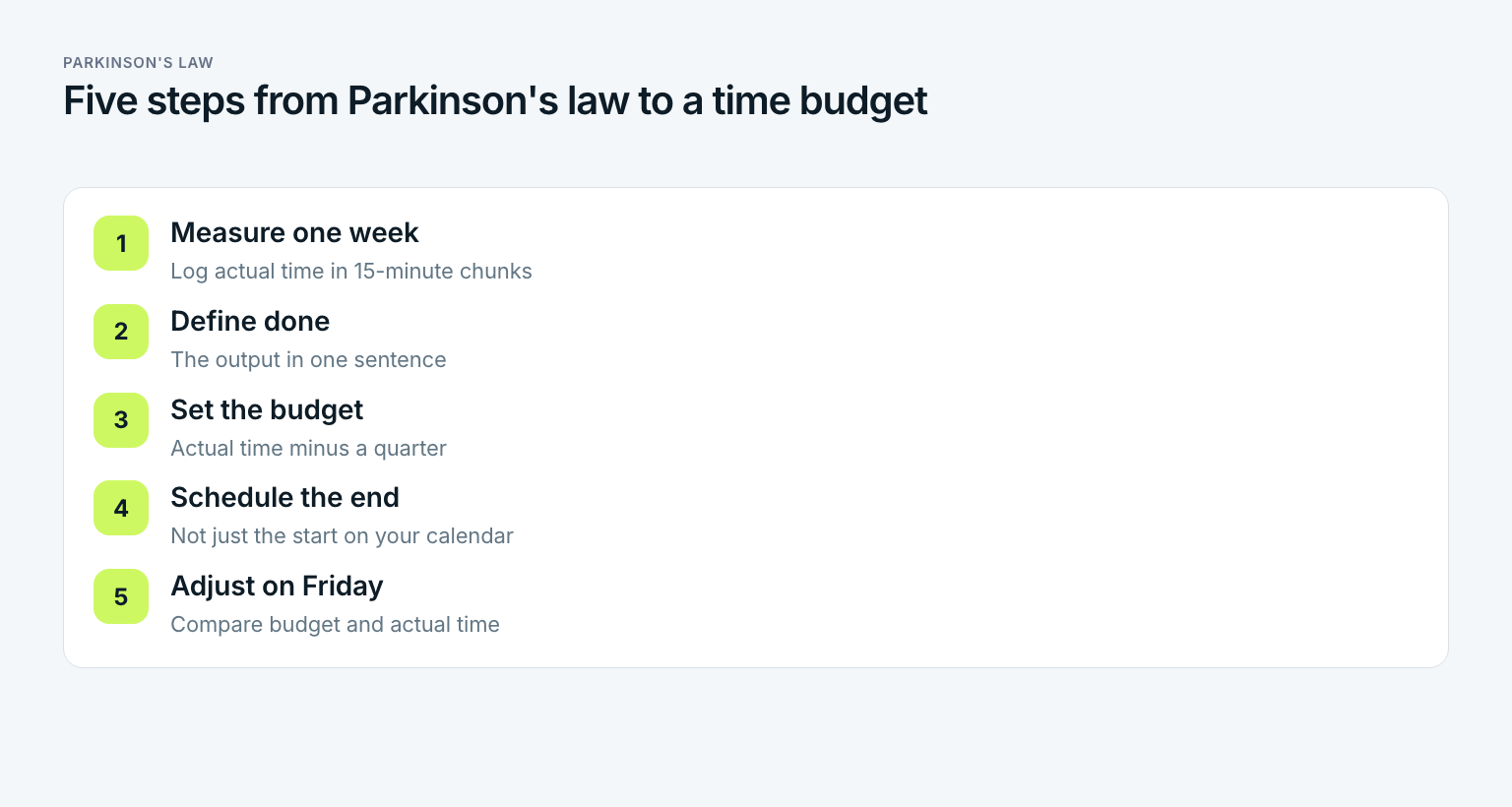
Step two looks minor and matters most. Parkinson's postcard did not eat a whole day because the lady was slow. Nothing told her when the card was good enough. Whoever defines done gives the budget a shape. Without that shape, a budget is just an alarm you learn to ignore.
Step five prevents the opposite failure. A budget nobody reviews either gets quietly blown or quietly kept while quality slips. You only catch either one if you look at the end of the week. Ten minutes on Friday is enough, and anyone who already does a weekly review can simply add the budgets to it.
Example: Marcus finds eleven hours in one week
Marcus logged one week on a notepad next to his keyboard, in 15-minute chunks. His work week runs about 45 hours, and four recurring items ate more than half of it. He then set a budget for each one, mostly by the rule of thumb, stricter where the actual time was clearly padded:
| Task | Before, per week | Budget, per week | Freed up |
|---|---|---|---|
| Recurring meetings, nine on the calendar | 540 minutes | 315 minutes: two dropped, seven at 45 | 225 minutes |
| Weekly operations report for the owner | 240 minutes on Friday | 90 minutes on Friday | 150 minutes |
| Email and Slack | 450 minutes | 250 minutes, two 25-minute windows a day | 200 minutes |
| Vendor comparison for new warehouse racking, due in three weeks | 280 minutes | 160 minutes, 8 hours total | 120 minutes |
| Total | 1,510 minutes | 815 minutes | 695 minutes |
695 minutes is a little over eleven and a half hours. Marcus gives six of them to the certificate, in three blocks on Monday, Wednesday, and Friday from 7:00 to 9:00 a.m., before the warehouse phones start. The rest stays open as a buffer. A budget without a buffer breaks the first time a truck shows up late, and the certificate would break with it.
The report is where step two did the work. Done now means two pages, four charts, and three sentences of summary, sent by 2:30 p.m. on Friday. The second round of number checks is gone, because the numbers come from the same export every week. The owner did not notice any difference. He did notice that the report arrived Friday afternoon instead of Monday at 7 a.m.
For meetings, Marcus changed one setting: the default length in his calendar. Two meetings turned out to duplicate others and were dropped. The remaining seven became 45 minutes, each with one line in the invite naming the decision it exists to make. Five of the seven ended on time in the first week. One ran 15 minutes over because a supplier changed prices that morning. That is not a failed budget. That is what the buffer is for.
What did not work right away was the inbox. In week one Marcus blew past his windows three times, because checking just once between tasks felt harmless. The budget only held once he closed email and Slack outside the two windows at 10:00 a.m. and 3:30 p.m. In short: a budget works only when the task cannot keep knocking outside its budget.
When shorter deadlines backfire
Generous deadlines exist for good reasons. They protect against rushing, leave room for surprises, and give creative work time to settle. Whoever reads Parkinson's law as permission to halve every deadline trades one kind of waste for another. What grows then is not the work. It is the stress. Three situations call for care:
- Work that needs thinking. A strategy, a hard decision, or an argument in writing rarely improves under pressure. A budget for working hours helps here, an earlier due date does not. The days between two sessions do some of the work.
- Tasks that depend on others. If you are waiting on someone else's input, an earlier deadline only shortens your waiting, not their work. That means: shorten deadlines where you control the process yourself.
- Budgets that are always too tight. A budget you overrun every week is no longer a push. It is a lie on your calendar. After two overruns, adjust it instead of feeling bad again.
The most common mistake: cutting the deadline but not the scope
Anyone who shrinks a task from three weeks to one but still expects the same output at the same level of polish gets overtime, not efficiency. Parkinson says work expands. The countermove is to limit the work, not only the time. That is why the definition of done comes before every new deadline.
A second mistake is quieter: the fake deadline nobody believes. Whoever sets themselves a Thursday deadline while knowing the real one is Monday works until Monday. Self-set deadlines need a consequence. That can be a handoff to another person, a meeting that waits on the result, or a visible entry you check on Friday. Without a consequence, an early deadline is just a good intention.
Parkinson's law in a goal chain: year to day
The longer the time frame, the harder the law hits. A yearly goal has twelve months of room, and it behaves accordingly: in January there is plenty of time, by October it is tight. Brian Moran and Michael Lennington built The 12 Week Year on exactly this observation. Whoever treats twelve weeks as the year feels urgency all the time, not only in December.
A goal chain uses the same effect at every level. One long deadline becomes several short ones, each with its own budget. For Marcus it looks like this:
| Level | Marcus's goal | Deadline | Budget |
|---|---|---|---|
| Year | Data analytics certificate done by June, an inventory dashboard used in the weekly ops meeting by September | September 30, 2027 | about 150 hours of study and build time |
| Quarter | Courses 1 and 2 of six finished | December 20 | 70 hours |
| Month | October: course 1, modules 1 to 4 | October 31 | 24 hours |
| Week | Module 2 quizzes and the spreadsheet project | Friday | 6 hours in three blocks |
| Day | Wednesday: pivot table exercise | 9:00 a.m. | 120 minutes |
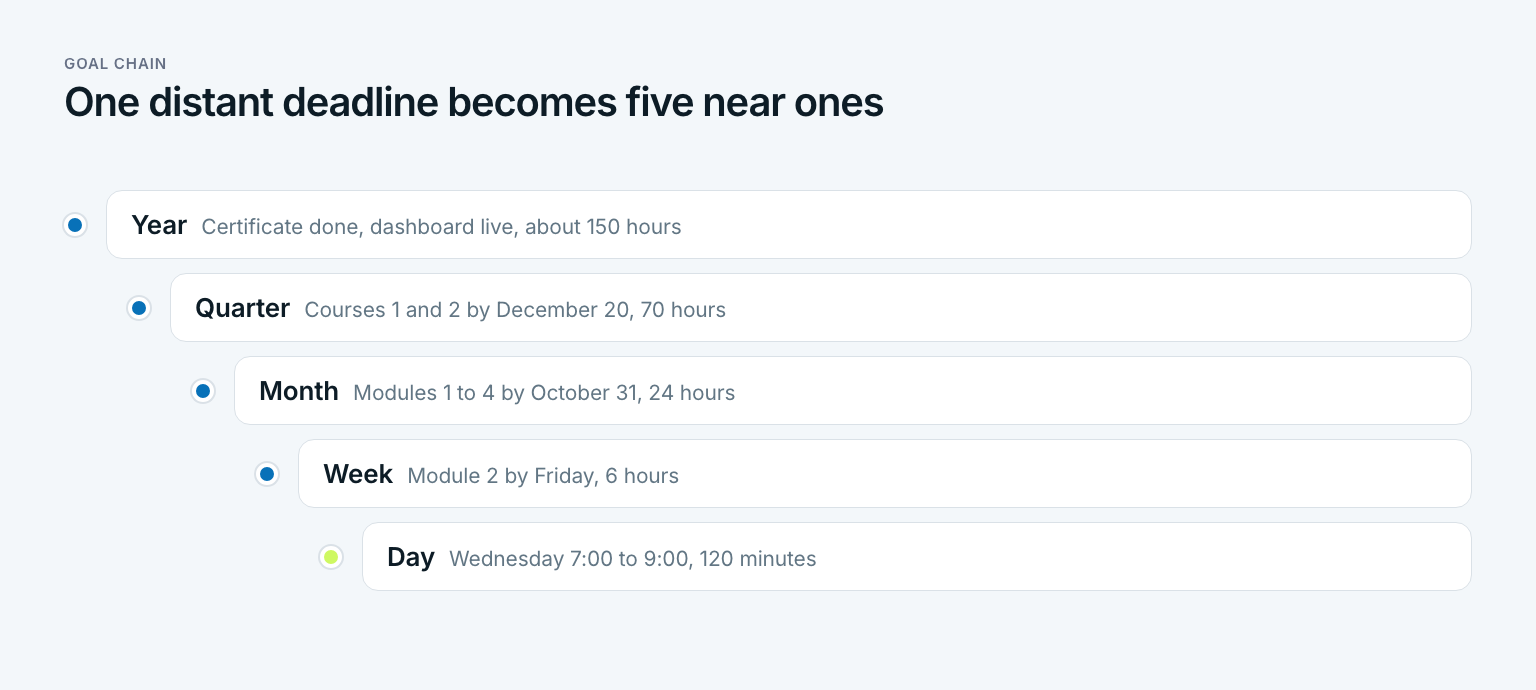
Read from the bottom, every level is a time budget with a near deadline. Wednesday has 120 minutes and ends at 9:00. The week has six hours and ends on Friday. No level gives Parkinson much room, because none is longer than you can keep in view. And when a Wednesday falls through, Marcus finds out on Friday, not in May.
How to break a yearly goal down level by level is covered in turn yearly goals into daily steps. If you would rather plan in twelve-week cycles from the start, the 12 week year page lays out the model. And for putting a single day into the right order and blocks, see how to plan your day.
Three questions before your next deadline
Before you put the next task on your calendar, ask yourself three questions:
- How long did the last similar task actually take, and how much of that was needed?
- What exists when it is done, in one sentence?
- Does my calendar show an end, or only a start?
Anyone who answers those three needs no other technique against Parkinson's law. It is not a complaint about having too little time. It is a reminder that you decide how big your tasks get.
Frequently asked questions about Parkinson's law
What is meant by Parkinson's law?
It means work expands to fill the time available for its completion. C. Northcote Parkinson wrote the line in a 1955 essay in The Economist, originally as satire about growing government offices. In practice it means a task's duration depends more on its deadline than on the effort it really needs.
Is Parkinson's law proven?
Not as a scientific law. Parkinson wrote satire, not a study. Related research supports the idea, though, including the planning fallacy described by Kahneman and Tversky and experiments by Ariely and Wertenbroch where evenly spaced deadlines beat a single final deadline.
What is the opposite of Parkinson's law?
The answer usually given is Hofstadter's law: it always takes longer than you expect, even when you account for Hofstadter's law. Parkinson describes tasks that get too much time, Hofstadter tasks that get too little. The shared fix is to budget time from what similar work actually took.
What is Parkinson's law of time?
It is another name for the same idea: the time a task takes stretches to match the time you allow for it. A meeting booked for an hour lasts an hour, and a report due in three weeks takes three weeks. Shorter, measured time budgets reverse the effect.
How do you use Parkinson's law for time management?
Measure how long your recurring tasks really take, define done for each one, and set a budget about a quarter below the actual time. Put the end of each budget on your calendar, not just the start. Review budgets against actual time every Friday and adjust.
Who came up with Parkinson's law?
Cyril Northcote Parkinson, a British naval historian. He first published it as an unsigned essay in The Economist on November 19, 1955, and expanded it into the book Parkinson's Law in 1957.
Last updated: 6 October 2026
Read next
 Productivity
Feynman Technique: Four Steps to Real Understanding
The Feynman technique is not a memorization trick: four steps, a worked example from a stats class, a one-page template, and what research says.
16 min read
 Productivity
Zettelkasten: How to Turn Notes Into Your Own Ideas
A Zettelkasten is not an archive: Luhmann's method, the three note types, a five-step setup and an Obsidian template, with a worked example.
15 min read
 Productivity
Second Brain: How to Build One You Actually Use
A second brain is not a note archive: Tiago Forte's CODE steps, the PARA method with an example, a five-step setup and the mistakes that sink it.
15 min read