How to Plan Your Day: When, How Long, in What Order
Planning your day is not filling in a planner once. When to plan, how long, and in what order: five steps, daily planning methods, a worked example.

Contents
- 01Daily planning is a sequence, not a sheet
- 02What really happens to a day without checkpoints
- 03When to plan your day: four checkpoints, 23 minutes
- 04How long: the planning budget and the length of your blocks
- 05In what order: your hardest work in your best hour
- 06How to plan your day in five steps
- 07Jordan's Thursday: planned, broken, re-planned
- 08Daily planning methods: which one answers which question
- 09How to plan your day with ADHD, and whether AI can do it
- 10The three mistakes nobody notices
- 11Your daily plan in the goal chain: from a yearly goal to 9 a.m.
- 12Frequently asked questions about planning your day
How to plan your day is not a question about the perfect planner page. It is a question about sequence: plan the night before, check in the morning, re-plan at midday, and close out at the end of the workday. Those four checkpoints take about 23 minutes in total. The daily plan is the result. Daily planning is the routine that keeps it true until evening.
Three questions decide whether that routine holds: when you plan, how long you plan for, and in what order you work. All three are worked through on two days in the life of Jordan, a freelance web developer whose plans tend to break around 9:15 a.m. Along the way you get five steps to copy, a comparison of daily planning methods, notes on planning with ADHD or with AI, and the three mistakes that quietly undo a good plan by lunch.
Daily planning is a sequence, not a sheet
Daily planning is the repeated routine of deciding what your day has to deliver and keeping that decision current as the day unfolds. It answers three questions: when you plan, how much time you budget for planning and for each task, and in what order you work. The paper or app you use is interchangeable. The routine is not.
Three terms tend to get mixed up here. None of them is wrong. Each is built for something else:
- Daily goal. The one thing that has to be done today for the day to count. It answers the question of what. The page on daily goals shows how to phrase one so you can answer yes or no at night.
- Daily plan. The page or calendar view that holds your daily goal, your fixed appointments, and one focus block. It is a snapshot from the night before. The fields it needs are laid out in the daily planner template.
- Daily planning. The routine around the plan: when it gets written, when it gets checked, and who rewrites it when a client calls at 9:12 a.m. This is the part most advice skips.
Why does it get skipped? Because planning feels like a one-time act. You sit down, write it out, done. But a plan is a forecast, and forecasts go stale. Anyone who looks at their plan once a day is working from an outdated forecast after the first surprise. That means: good daily planning needs less effort up front and more short check-ins along the way.
Plans versus planning
In a 1957 speech, Dwight D. Eisenhower said that plans are worthless but planning is everything. His point was that the value lies not in the document but in having thought the situation through, so you can change course quickly. The same holds for your Tuesday, only smaller. Last night's plan is allowed to go stale. The habit of renewing it is not.
What really happens to a day without checkpoints
A plan that breaks at 9:12 a.m. was not a bad plan. It just had no second appointment. Here is how that looks for Jordan, 33, a freelance web developer in Denver. Jordan builds sites for four regular clients and wants to open a paid shop for website templates in March 2027. The goal for 2026: six templates finished and the store page ready. The weekly goal for week 40: finish template 2, a booking site for hair salons.
On Monday night Jordan plans Tuesday carefully. Daily goal: build the booking calendar for template 2. Focus block: 9 to 10:30 a.m. After that come client work, email, and a client call at 2 p.m. At 9:12 a.m. a client's checkout page goes down. Here is the rest of the day:
| Time | What happened | Plan updated? |
|---|---|---|
| 9:12 to 11:40 a.m. | Client checkout outage, hotfix, two calls with the client | No, there was no choice |
| 11:40 a.m. to 12:30 p.m. | Slack and email backlog, 38 messages | No |
| 12:30 to 1:15 p.m. | Lunch at the desk, still in Slack | No |
| 1:15 to 2:00 p.m. | Write-up of the outage for the client | No |
| 2:00 to 3:15 p.m. | Scheduled client call, ran 30 minutes long | No |
| 3:15 to 5:30 p.m. | Small fixes for two other clients, none due this week | No |
| Total | Booking calendar: 0 minutes | Not a single checkpoint |
The outage cost two and a half hours. That was unavoidable. What followed was not. By 11:40 a.m. things were calm, and Jordan still had almost six working hours left. Nobody asked where the booking calendar fit now. So the inbox decided, then the calendar, then whichever client wrote last. Was there room? Yes. The small fixes from 3:15 p.m. on had no deadline this week. That was more than two hours, longer than the original focus block.
This is not a self-discipline problem. Anyone who comes back from two hours of firefighting reaches for whatever is closest, and the closest thing is always the inbox. By Friday template 2 was half done. That means: Monday night's plan was fine. What was missing was the moment at 11:40 a.m. when someone rewrites it.
When to plan your day: four checkpoints, 23 minutes
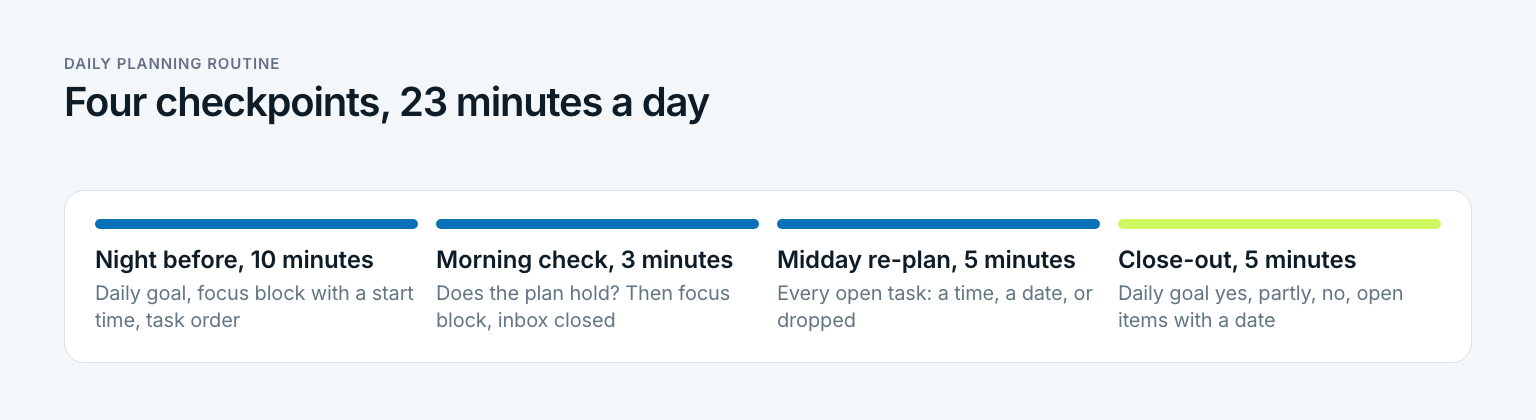
Daily planning has four fixed moments. The first one decides. The other three keep the decision alive. None of them takes longer than ten minutes:
| Checkpoint | Time | Question | Result |
|---|---|---|---|
| Night before or end of workday | 10 minutes | What has to be done tomorrow, and when will I work on it? | Daily goal, focus block with a start time, task order |
| Morning check, before the first email | 3 minutes | Does the plan still hold? | Plan confirmed or one change made |
| Midday re-plan | 5 minutes | What is still realistic today? | Each open task kept, dated, or dropped |
| Close-out | 5 minutes | What is open, and where does it go? | Open items written down, head clear |
That adds up to 23 minutes. On an eight-hour workday it is just under 5 percent. Sounds like a lot? Jordan lost two and a half hours to an outage nobody could prevent, and then more than two hours to missing re-planning. A five-minute checkpoint would have saved the second number.
The night before or the morning of?
The decision about tomorrow belongs at the end of today. In the evening you know where things stand, your head is still in the work, and the morning starts without a choice to make. Planning in the morning beats not planning at all. But the first hour is usually the strongest of the day, and whoever spends it deciding works with what is left. If your workday has a clear end, plan tomorrow in the last 15 minutes of work, not at 10 p.m. on the couch. Close-out and planning then merge into one short ritual, and the workday ends with a clean cut.
The morning check and the midday re-plan
The morning check takes three minutes and asks one thing: did anything change overnight? A client email, a moved meeting, a sick kid. If not, the focus block starts. If so, you adjust once and move on.
The midday re-plan matters more. By noon the day has shown what it really is. Whoever spends five minutes reordering it rescues the afternoon. Whoever skips it works until five from last night's plan. After a big disruption like Jordan's outage, pull the midday re-plan forward to the moment the disruption ends, whether that is 10:30 or 11:40 a.m.
How long: the planning budget and the length of your blocks
How long should daily planning take? Only as long as it takes to avoid becoming a task of its own. Ten minutes the night before is enough when your weekly goal and calendar are in front of you. Anyone who plans for 40 minutes every evening is not planning more carefully. They are postponing the decision. Planning feels productive even when it is just reshuffling.
The harder question is how long the tasks themselves take. Almost everyone gets this wrong in the same direction.
The planning fallacy
In 1979, Daniel Kahneman and Amos Tversky described how people consistently underestimate how long their own projects will take, even when they know similar projects ran long before. Kahneman returns to it in “Thinking, Fast and Slow” as the planning fallacy. For your day, that means your estimate is not wrong because you are careless. It is wrong because every estimate quietly assumes the best case. A simple correction is a fixed markup, such as multiplying by 1.5.
Jordan estimates the booking calendar at an hour. The last three comparable features took between 80 and 95 minutes. Times 1.5 lands at 90 minutes, which is exactly the length of the focus block. The rest of the day does not get planned to the minute. How much slack a whole day needs is covered in the daily planner template. The principle here is enough: the more interruptions your work has, the less of the day you schedule.
Block lengths: 25, 50, or 90 minutes
The length of a work block follows the task, not the method. Three sizes work well:
- 25 minutes for tasks that are hard to start. The Pomodoro Technique by Francesco Cirillo uses this rhythm. Short enough to begin, long enough to get something done.
- 50 minutes for ordinary work: revising a proposal, building a report, answering a batch of client questions. Then a ten-minute break and the next block or a switch.
- 90 minutes for the one task that needs depth. For most people it gets sluggish beyond that, and anything shorter is often not enough to get properly into code, writing, or numbers.
What matters is the end, not the start. In 1955, C. Northcote Parkinson wrote in The Economist that work expands to fill the time available for its completion. A block with no end grows to the size of the morning. A block with an end forces you to decide what has to be done in 90 minutes. In short: every task in your plan gets a length, and the most important one also gets a start time.
In what order: your hardest work in your best hour
Order is the most underrated part of daily planning. The same five tasks make a good day or a lost one depending on how you line them up. The rule is simple: the task with the most weight goes into the hour with the most energy. Everything else arranges itself around it.
When is that hour? In his 2018 book “When”, Daniel Pink describes three phases most people move through each day: a peak, a trough, and a recovery. For morning types, the peak comes in the morning, the trough in early afternoon, and the recovery late in the afternoon. For strong night owls, the order runs roughly in reverse. That suggests an order for the day:
| Phase | For morning types | Tasks that fit |
|---|---|---|
| Peak | about 8 to 11 a.m. | Analysis, writing, coding, decisions: your daily goal |
| Trough | about 1 to 3 p.m. | Email, admin, routine meetings, calls with a clear purpose |
| Recovery | about 3 to 5 p.m. | Brainstorming, sketching, conversations, revising, building |
Not every day will follow this pattern. Other people set meetings, and kids need pickup. But whoever has the choice should make it this way. Jordan puts the focus block at 9 a.m., not at 2 p.m., and moves client calls into the early afternoon, when they are mostly status updates anyway.
Two methods help with order at a smaller scale. Eat the Frog, from Brian Tracy, puts the hardest task first so it does not hang over you all day. The Ivy Lee method writes six tasks into a fixed order the night before, and you work through them without re-deciding. Both answer the same question: what comes first, so you are not negotiating with yourself at 9 a.m.?
What never goes first
Your inbox. Email in the morning feels like work, but it is mostly other people's requests in the order they arrived. Whoever starts the day in the inbox hands the order of the day to whoever wrote last. On Jordan's plan, Slack and email open at 10:30 a.m. Clients know that a real emergency gets a phone call. That is not rude. It is a trade: 90 quiet minutes, then Jordan is reachable all day.
How to plan your day in five steps
The five steps are spread across the whole day. They do not replace a planner page. They give it a rhythm. Have your weekly goal, your calendar, and your to-do list in front of you.
Plan the night before, ten minutes
Read your weekly goal, pick one daily goal, estimate how long it takes, and multiply by 1.5. Put the focus block into your strongest hour with a start time, then line up the remaining tasks in order. Write the daily plan where you will see it first thing.
Morning check, three minutes
Before the first email: does the plan still hold? Look for new deadlines, moved meetings, and anything urgent. If something changed, adjust once. Then start the focus block, with email and chat closed until it ends.
Protect the focus block, up to 90 minutes
One task, one end time. If you get interrupted, write one sentence on where you stopped so you can get back in fast. If the block breaks, do not push it around in your head. Reset it at the next checkpoint.
Re-plan at midday, five minutes
What is done, what is open, what still fits today? Every open task gets one of three decisions: it stays today with a new time, it moves to a specific date, or it gets dropped. Later is not a decision. After a big disruption, do this step as soon as the disruption ends.
Close out, five minutes
Mark the daily goal yes, partly, or no. Write open items down with a date, plus one sentence for tomorrow. If you plan at the end of the workday, step one follows right away, and 15 minutes later the workday is really over.
Jordan's Thursday: planned, broken, re-planned
Two weeks later, week 42. Jordan's weekly goal: template 3, a landing page for dog groomers, built and tested. On Wednesday at 5:15 p.m. Jordan closes out and plans Thursday right away. Daily goal: the pricing section and the checkout flow for template 3. Estimate: an hour. Times 1.5: a 90-minute focus block starting at 9 a.m.
| Time | Planned on Wednesday | What actually happened |
|---|---|---|
| 8:50 a.m. | Morning check | Plan holds, three minutes |
| 9:00 to 10:30 a.m. | Focus block, pricing and checkout | Stopped at 9:20 a.m., a client calls about a broken contact form |
| 9:20 to 11:30 a.m. | Rest of focus block, email, client work | Bug fix and a call with the client |
| 11:30 a.m. | not planned | Midday re-plan pulled forward, five minutes |
| 11:35 a.m. to 12:30 p.m. | Client work | As planned, one redesign moved to Monday |
| 1:15 to 2:45 p.m. | Two client calls, email | As planned |
| 3:00 to 4:10 p.m. | Buffer, three small tasks | Rest of the focus block, checkout done |
| 5:00 p.m. | Close-out | Daily goal: yes. Friday planned |
The disruption was the same kind as on Tuesday in week 40, and about as long: two hours and ten minutes. The difference is one checkpoint. At 11:30 a.m. Jordan made three decisions in five minutes:
- Moved with a date: a small redesign for a regular client went to Monday at 10 a.m., with a note to the client instead of a vague next week.
- Dropped: one of three small tasks, reorganizing old project folders. No deadline, no weight. A second one moved to Friday.
- Reset: the remaining 70 minutes of the focus block, not into the early-afternoon trough but into the recovery window from 3 p.m., when building goes better for Jordan than right after lunch.
By 4:10 p.m. the pricing section and checkout are done. Getting back in took two minutes, because at 9:20 a.m. Jordan had written one line: resume at the payment test step. By Friday template 3 is built and tested. Not a heroic day, just a day with five extra minutes of planning at the right moment.
What would Jordan have done without the routine? Probably what happened in week 40: opened Slack at 11:30 a.m. and stayed there. That means: the difference between the two days was not willpower. It was an appointment with the plan.
Daily planning methods: which one answers which question
There is no single best daily planning method. Each well-known method answers one specific question, and most of them fit one specific spot in the routine. Read them that way and you do not have to choose between them. You combine two or three.
| Method | Answers the question | Where it fits |
|---|---|---|
| Eisenhower Matrix | What deserves a place on the plan at all? | Night before, selection |
| 1-3-5 rule | How much fits into one day? | Night before, volume |
| Ivy Lee method | In what order do I work? | Night before, order |
| Time blocking | When exactly, with a start time? | Night before, calendar |
| Eat the Frog | What comes first? | First hour |
| Pomodoro Technique | How long at a stretch, and when do I break? | During the block |
| Getting Things Done | Where does everything else go? | Close-out, capture |
Notice what is missing from the table. None of these methods says anything about midday. They all set the plan at the start and assume it holds. That is fine for quiet days. It is not fine for days with a broken contact form. So the routine in this article does not replace any of these methods. It adds two checkpoints to them.
If you want to put your whole day into calendar blocks, the guide to time blocking shows how. If you are unsure what belongs on the plan in the first place, start with selection, not with the clock. The simplest combination to begin with: one daily goal picked the Eat the Frog way, one focus block from time blocking, and everything else as a short list. The 1-3-5 rule makes a good ceiling for that list: one big task, three medium ones, five small ones.
How to plan your day with ADHD, and whether AI can do it
Planning your day with ADHD
The four checkpoints work with ADHD too, but the plan itself should be smaller and more visible. Use focus blocks of 25 minutes instead of 90, a timer you can see, and the daily goal on a sticky note at eye level rather than inside an app. Many people with ADHD find that outside structure does what willpower cannot: an alarm for the morning check, a fixed time for the midday re-plan, and a body double, meaning someone working quietly next to you, in person or on a video call. Plan less than you think you can do. A day with one finished task beats a day with eight started ones. These are practical adjustments. They supplement professional support, they do not replace it.
Can AI plan your day?
AI can draft a plan. Paste in your calendar and your task list and you get a reasonable order with time estimates in seconds. What it cannot know is which task matters most this week, because that comes from your weekly goal, not from your list. Use AI for drafting and estimating, then make the one decision yourself: what is today's daily goal, and when do you work on it? Whoever outsources that decision gets a busy day, not necessarily a useful one.
The three mistakes nobody notices
Careful plans are not the problem. Anyone who plans every evening already does more than most people. Daily planning rarely fails because of the plan itself. It fails because of three mistakes in the routine, each of which feels reasonable in the moment.
The most common mistake: pushing instead of re-planning
A task falls out of the morning, and you tell yourself you will get to it later. Later has no time attached. It competes with everything that comes after and loses to every email. In the evening it is still there, and the next day the game starts over. Re-planning means a time, a date, or a deletion. Three options, and later is not one of them.
- Mistake two: planning as a substitute for work. New colors, a new app, a better system. Planning is more pleasant than the task it is for. Anyone who plans for more than 15 minutes at a stretch should ask whether they are planning or avoiding. The ten-minute limit for the night before guards against it.
- Mistake three: working in order of arrival. Whoever handles tasks in the order they come in does not have a plan. They have a queue. The urgent pushes to the front, and the important waits. The order of your day belongs to the night before, not to your inbox.
All three mistakes have one thing in common: they feel like work. Pushing feels flexible, planning feels thorough, clearing the queue feels diligent. Only on Friday does it show whether the weekly goal actually moved.
Your daily plan in the goal chain: from a yearly goal to 9 a.m.
A single day is too short to know on its own what matters. The daily goal gets its weight from above. Here is Jordan's chain. Yearly goal for 2026: six templates finished and the store page ready for a March launch. Quarterly goal for Q4: templates 2 to 6 built and the store page drafted. Monthly goal for October: templates 2, 3, and 4 built and tested. Weekly goal for week 42: template 3. Daily goal for Thursday: pricing section and checkout, 9 to 10:30 a.m.
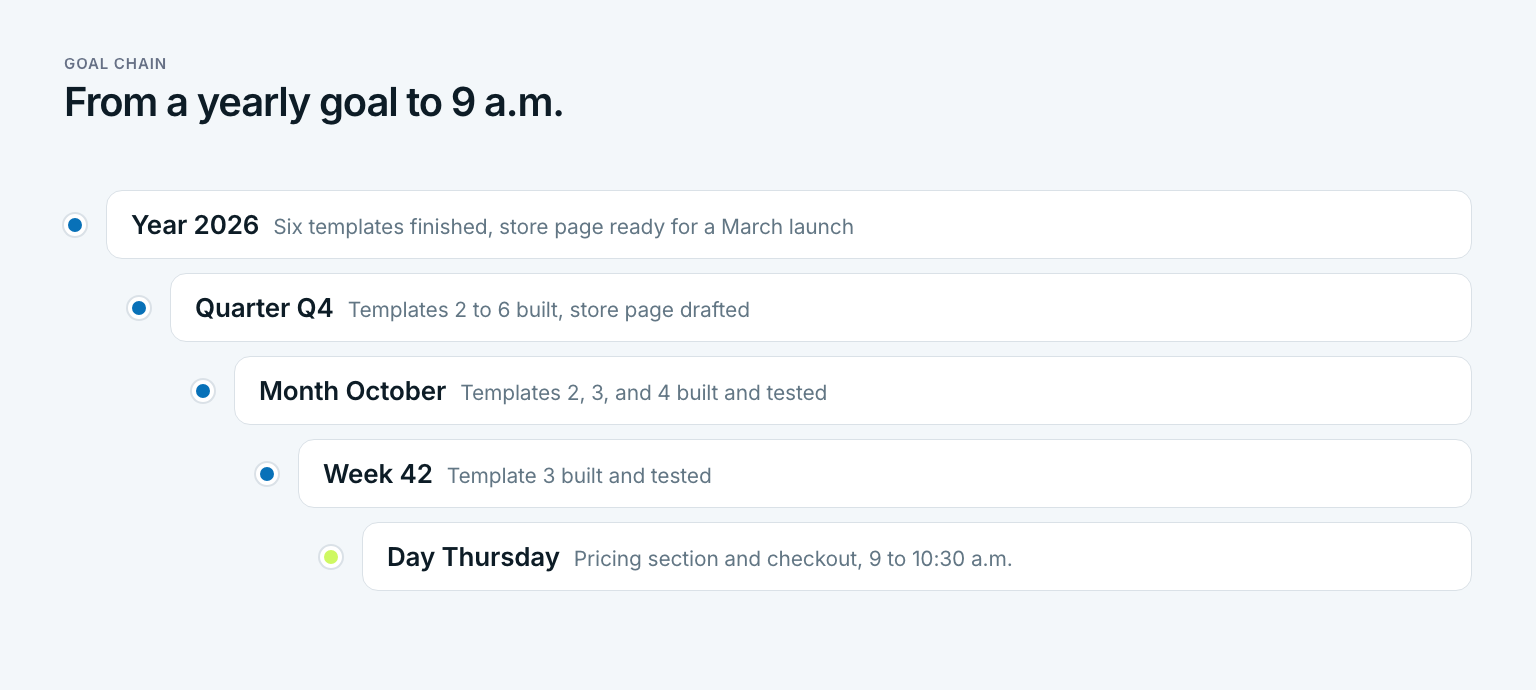
Each level answers the question of the one above it. Whoever starts daily planning without a weekly goal has to reinvent what matters every evening, and ends up choosing what is urgent. Whoever has the weekly goal in view needs two minutes to pick the daily goal. The rest of the ten minutes goes to the start time and the order.
In Gaapp, every daily goal hangs on a weekly goal, the weekly goal on the month, and so on up to the year. When Jordan checks off the checkout flow on Thursday, Friday shows how far the week has come and how much of October is done. Daily planning stays Jordan's routine, on paper, in a calendar, or both. The goal chain makes sure the routine is heading somewhere.
Three questions to close, about your tomorrow:
- Do you know when you will look at your plan for the first time tomorrow, and when for the second?
- Is your most important task sitting in your strongest hour, or wherever there happened to be room?
- What will you do if something breaks at 9:20 a.m.?
If you cannot answer the third question, you do not need a better plan. You need a second appointment with it. In short: daily planning is not the plan for your day. It is the habit of keeping that plan true as the day happens.
Frequently asked questions about planning your day
How do you plan your day with ADHD?
Keep the same four checkpoints but make the plan smaller and more visible: one daily goal on a sticky note, 25-minute blocks with a visible timer, and alarms for the morning check and the midday re-plan. Plan less than you think you can do. These are practical adjustments, not a replacement for professional support.
How should I plan my day today?
If it is already morning, take five minutes now: pick one daily goal, give it a block with a start time in your next strong hour, and list no more than three other tasks. Set a reminder for a midday re-plan. Tonight, plan tomorrow before you close your laptop.
Can AI plan my day?
AI can draft an order and estimate durations from your calendar and task list in seconds. It cannot know which task matters most this week, because that comes from your weekly goal. Let it draft, then decide the daily goal and its start time yourself.
How do you properly plan a day?
Plan the night before in ten minutes: one daily goal, one focus block in your strongest hour, and the rest in a fixed order. Check the plan for three minutes in the morning, re-plan for five at midday, and close out for five at the end of the day. That keeps the plan valid even after a disruption.
How long should daily planning take?
About 20 to 25 minutes a day, spread over four checkpoints: ten minutes the night before, three in the morning, five at midday, and five at the end of the day. If you regularly plan much longer, you are probably planning around a task instead of starting it.
Is it better to plan your day in the morning or the night before?
The night before, if you can. In the evening you know where things stand, and in the morning you can spend your strongest hour on the work instead of on deciding. Keep a short morning check to confirm the plan still holds.
Last updated: 19 October 2026
Read next
 Productivity
Feynman Technique: Four Steps to Real Understanding
The Feynman technique is not a memorization trick: four steps, a worked example from a stats class, a one-page template, and what research says.
16 min read
 Productivity
Zettelkasten: How to Turn Notes Into Your Own Ideas
A Zettelkasten is not an archive: Luhmann's method, the three note types, a five-step setup and an Obsidian template, with a worked example.
15 min read
 Productivity
Second Brain: How to Build One You Actually Use
A second brain is not a note archive: Tiago Forte's CODE steps, the PARA method with an example, a five-step setup and the mistakes that sink it.
15 min read