Project Goals: How to Set Them, With 12 Examples
Project goals are not a task list: scope, time and cost, goals vs objectives, five steps, a charter template and 12 examples, shown on one project.

Contents
- 01What Project Goals Are and What They Are Not
- 02The Three Goals of Every Project: Scope, Time and Cost
- 03What Really Happens: Goals That Show Up at Sign-Off
- 04How to Write Project Goals in Five Steps
- 05Put Project Goals in a Project Charter: The Template
- 06Project Goals Examples: 12 Goals From Work, Community and Home
- 07Project Goals Across the Five Project Phases
- 08The Three Mistakes Nobody Notices
- 09Project Goals in the Goal Chain: From Year to Day
- 10Your Self-Audit Before Kickoff
- 11Frequently Asked Questions About Project Goals
Project goals are not a task list. They describe the state a project has to reach by the end, in three dimensions: what result at what quality, by what date and at what cost. Tasks say what the team does. Project goals say how everyone will know it is enough.
Three things decide whether project goals hold up: they describe an outcome instead of an activity, they come with a clear priority between scope, time and cost, and they are written into a project charter with acceptance criteria. This guide walks through all three with Priya, 36, operations manager at a dental group with four offices around Columbus, Ohio, who is leading the switch from phone-only booking to online scheduling. Along the way you get the difference between project goals and objectives, a sentence template, a one-page charter, 12 project goals examples from a website to a school fundraiser, and the three mistakes that only show up at sign-off.
What Project Goals Are and What They Are Not
A project goal is a verifiable outcome that a project delivers by a fixed date within a fixed budget. The PMBOK Guide from the Project Management Institute describes a project as a temporary effort to create a unique product, service or result. Temporary means it has an end. The goal is what tells you where that end is.
Five terms tend to get mixed up in planning meetings. None of them is wrong. Each one is built for something else. The only question is: which one tells you when you are done?
| Term | What it describes | Priya's example |
|---|---|---|
| Project purpose | Why the project exists | Patients book without calling, and the front desk spends less time on the phone |
| Project goal | The broad outcome the sponsor signs off on | Online scheduling live in all four offices by September 30 |
| Project objective | A specific, measurable result under the goal | 40 percent of October appointments booked online |
| Milestone | A checked interim result with a date | Pilot office live by June 30 |
| Task | An activity with an owner | Write the patient guide, Maria, 12 hours |
The costliest mix-up is between purpose and goal. The purpose is a direction. The goal is the point where you arrive. Anyone who only knows the purpose keeps working until the money or the patience runs out. In short: the purpose motivates, the goal ends the project.
Project goals and objectives: what is the difference
In US project management, goals and objectives are usually split. A project goal is the broad outcome the sponsor cares about, written in plain words. Project objectives are the specific, measurable results that prove the goal was reached. One goal typically carries two to four objectives. Some guides use the two words interchangeably. The split is worth keeping anyway, because it puts the sponsor's language and the team's numbers on the same page. Here is how it looks for Priya:
- Goal: Patients can book appointments online in all four offices by September 30.
- Objective 1: At least 40 percent of October appointments are booked online.
- Objective 2: The no-show rate drops from 11 to 7 percent by December 31.
- Objective 3: Each front desk spends ten fewer hours a week on booking calls by November.
The Three Goals of Every Project: Scope, Time and Cost
Every project goal has three sides, and they are often called the three goals of a project. Textbooks also speak of performance, schedule and budget. The idea is the same:
- Scope goal. What exists at the end and at what quality. Some guides treat quality as a fourth goal, but in practice it lives inside scope. For Priya: online scheduling live in all four offices, connected to the practice software, with 40 percent of October appointments booked online.
- Time goal. When the result is in place, usually with one to three milestones in between. For Priya: the pilot office in Dublin live by June 30, all four offices by September 30.
- Cost goal. The most the project may cost, in dollars and in internal hours. Internal hours get forgotten, even though they are often the bigger number. For Priya: no more than $24,000 for setup and training, plus 300 hours from her own staff.
Two additions are missing from most project plans. Out of scope items say what explicitly does not belong to the project. For Priya, that is online payment and any switch to a new practice management system. Ground rules describe how the work gets done, for example that no office goes live without a trained front desk lead on site. Both look minor. Whoever leaves them out ends up renegotiating them in every other meeting.
The triple constraint: decide in advance what gives
Scope, time and cost pull on each other. Whoever wants more scope needs more time or more money. Whoever wants to finish sooner pays more or delivers less. This tension is called the triple constraint or the iron triangle, a model usually credited to Martin Barnes, who drew it for a project management course in 1969.
The criticism of the triangle is fair. It says nothing about whether users are happy or whether the result creates value after launch. For one decision, though, it still works better than any other model, and that decision is: which corner is fixed, which one is the target, which one is the buffer? A project where all three corners are fixed has no room for surprises. And which project runs without a surprise?
| Corner | Role | For Priya |
|---|---|---|
| Time | fixed | September 30, the day the old phone booking contract ends |
| Scope | target | All four offices, 40 percent online bookings in October |
| Cost | buffer | $24,000, may grow by up to $3,000 with the owner's approval |
Priya made time the fixed corner because the contract for the old phone booking line ends on September 30, and extending it by a single month would cost a full year. If the vendor slips in August, she spends part of the buffer on extra training days instead of moving the date. That means: the priority is not theory. It is the answer you gave before the crisis meeting even started.
What Really Happens: Goals That Show Up at Sign-Off
Most projects do not fail for lack of effort. They fail because every person involved has a different goal in mind and only finds out at the end. The team works hard for months. At sign-off, the sponsor says: that is not what I had in mind.
Priya's first draft of the project charter had exactly this problem. It was one sentence: “Roll out online scheduling.” She showed it to the owner, the clinical director and three front desk leads and asked each of them how they would know on September 30 that the project was done. The answers:
- Dr. Allen, owner: Fewer no-shows, because empty chairs cost us more than anything else.
- Karen, clinical director: Hygienists see their schedule on a tablet, not on a printout.
- Maria, front desk lead in Dublin: The phones stop ringing all morning.
- Josh, front desk lead in Westerville: Every patient can book online, including the older ones.
- Tanya, front desk lead in Grove City: The software works, and nobody double-books a chair.
Five people, five goals. None of them is wrong. But Josh is planning for every patient, Dr. Allen is counting no-shows and Maria is counting phone calls. Without that conversation, the team would have delivered a project in September that missed three of five expectations, and nobody would have known why. In short: a project goal that lives in one head is a hope.
The most common mistake: an activity instead of an outcome
“Roll out online scheduling,” “redesign the website” and “implement a new CRM” are activities. They say what will be done, not when it is enough. A project goal describes the state afterward, for example “40 percent of appointments are booked online.” The test is simple. If someone can answer yes or no on the deadline, it is a goal. If they need a discussion first, it is an activity.
How to Write Project Goals in Five Steps
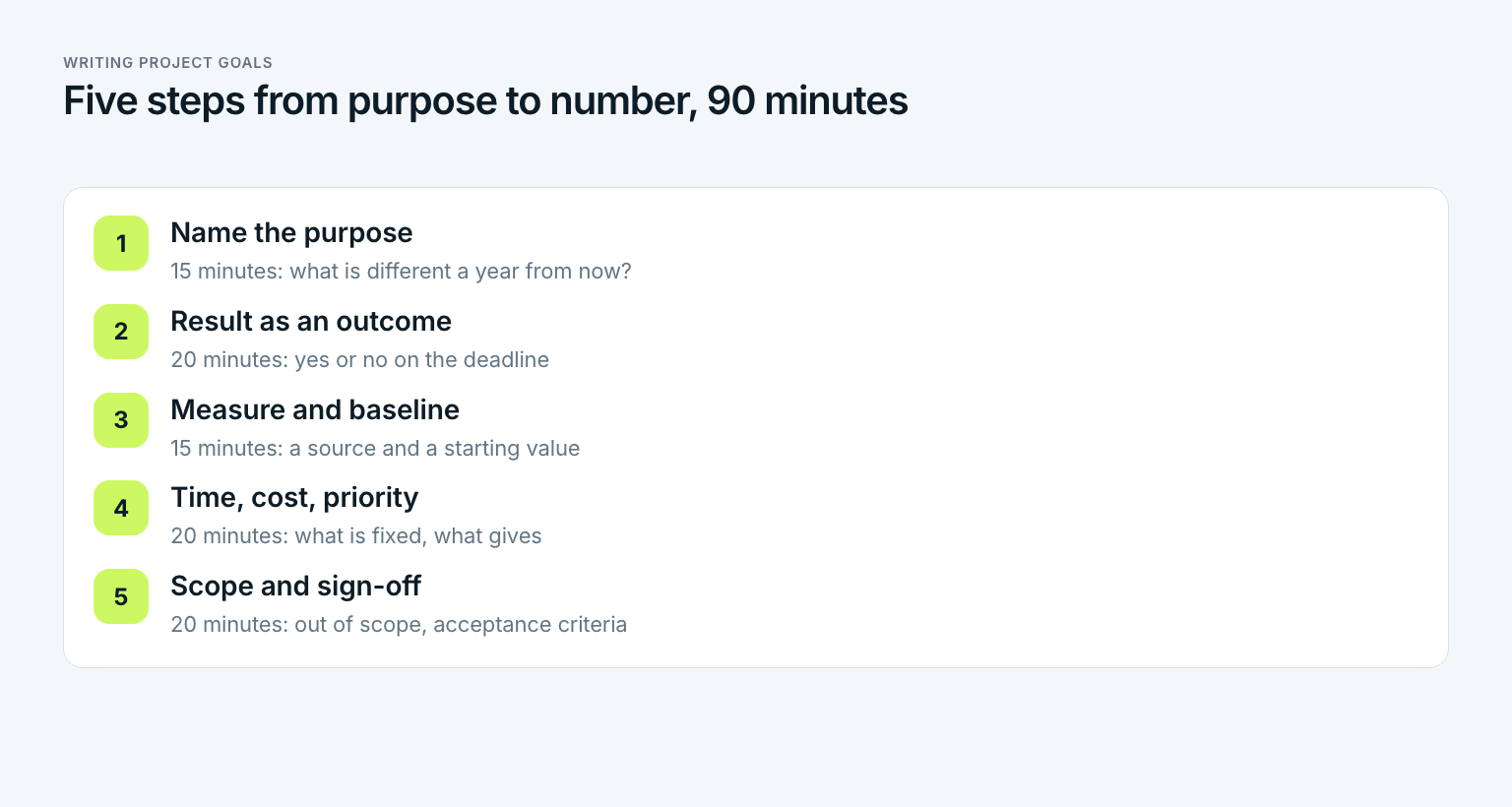
Good project goals are not written alone at the project manager's desk. They come out of a conversation with the sponsor. Priya blocked 90 minutes with Dr. Allen in April, two months before the pilot. Here is how she split the time:
Name the purpose in one sentence, 15 minutes
Ask the sponsor: what should be different a year from now because this project happened? Dr. Allen's answer was fewer empty chairs and a front desk that has time for the patients standing in front of it. That sentence is not a goal yet, but every goal has to be measured against it.
Describe the result as an outcome, 20 minutes
Write down what exists on the deadline, not what gets done. Test each sentence by asking whether an outsider could answer it with yes or no on that day. “Roll out online scheduling” became: online booking is live in all four offices, and 40 percent of October appointments are booked online.
Set the measure and the baseline, 15 minutes
Every number needs a source and a starting value. Priya pulled the last three months from the practice software: a no-show rate of 11 percent and about 1,400 phone bookings a month across the four offices. Without that baseline, “fewer no-shows” would have been impossible to check.
Fix time, cost and priority, 20 minutes
Set the end date, one to three milestones and the budget, in dollars and internal hours. Then rank the corners: which one is fixed, which one is the buffer? For Priya, time is fixed and cost is the buffer, by up to $3,000.
List out of scope items and acceptance criteria, 20 minutes
Write down what explicitly does not belong to the project and how sign-off will be judged. Only then does the sponsor sign. The signature is not a formality. It is the moment five expectations turn into one goal.
A sentence template for project objectives
One template covers most project objectives: By [date], [outcome] is in place, measured by [criterion], at no more than [cost]. It is close to the SMART criteria, which the guide on how to write SMART goals walks through line by line. Projects add the cost part, because unlike a personal goal, a project comes with a fixed budget.
| Before | After |
|---|---|
| Roll out online scheduling | By September 30, online booking is live in all four offices, measured by a test booking in each, at no more than $24,000 in vendor costs. |
| Reduce no-shows | By December 31, the no-show rate is down from 11 to 7 percent, measured by the monthly report in the practice software. |
| Train the front desk | By June 15, all 14 front desk staff have handled ten online bookings each in the test system, tracked on the training sheet. |
Anyone who writes goals this way finds the missing number fast. That is not a flaw in the template. It is the point. Priya's first gap was the baseline for no-shows, the second was the internal hours. Neither could have been rebuilt cleanly in August.

Put Project Goals in a Project Charter: The Template
The project charter is the document where project goals become binding. It fits on one page. A project of this size needs no more, and who reads twelve pages for a project with six people involved? Here is Priya's charter:
| Field | What goes in | Priya's charter |
|---|---|---|
| Background | Where things stand today, with numbers | Four offices, about 1,400 phone bookings a month, no-show rate 11 percent |
| Purpose | Why, in one sentence | Fewer empty chairs and more front desk time for patients in the office |
| Goal | The outcome the sponsor signs off on | Online scheduling live in all four offices by September 30 |
| Objectives | Measurable results | 40 percent online bookings in October, no-shows at 7 percent by December |
| Schedule | End date and milestones | Pilot in Dublin by June 30, the other three offices by September 30 |
| Budget | Dollars and hours | Up to $24,000 in vendor costs and 300 internal hours |
| Priority | What is fixed, what gives | Time fixed, scope target, cost buffer of up to $3,000 |
| Out of scope | What does not belong | Online payment, a new practice management system, the partner oral surgery office |
| Acceptance criteria | How the end is judged | Five points, see the list below |
| Roles | Sponsor, project manager, team | Dr. Allen, Priya, three front desk leads and the vendor contact |
| Risks | What threatens the goal | Summer vacations, older patients without smartphones |
The fields are not paperwork for its own sake. Background and objectives together show the distance the project has to cover. Priority and risks together show what happens when things get tight. That means: whoever fills in the goal and leaves the rest blank has a wish with a date, not a charter.
Acceptance criteria: how everyone knows the project is done
Acceptance criteria are the checklist for the last day of the project. They turn the goal into items someone with no background could check off. Because one objective is measured in October, Priya set sign-off for November 5 and wrote five criteria:
- Each of the four offices completed a test booking that showed up in the practice software within one minute.
- At least 40 percent of October appointments were booked online, according to the October report.
- All 14 front desk staff handled at least ten online bookings in the test system.
- Every office has a one-page guide for patients at the front desk.
- Vendor costs stayed at or below $24,000, or $27,000 with written approval.
The no-show rate did not make the list. It is a result of the project, but the practice only sees it in December, long after sign-off. Dr. Allen tracks it on his own. In short: the acceptance list holds only what can be checked on the last day of the project.
Project Goals Examples: 12 Goals From Work, Community and Home
The project goals examples below all follow the template. Each one has a scope, a time and a cost goal, and they double as project objectives examples, because every line is measurable. The numbers are examples, not benchmarks. Copy the shape, not the values.
| Project | Scope goal | Time goal | Cost goal |
|---|---|---|---|
| Website redesign for a plumbing company | New site with online quote requests, at least 25 requests a month in the first quarter after launch | Live by March 15 | Up to $12,000 and 60 internal hours |
| CRM rollout for a sales team | All nine reps log every deal in the CRM, the spreadsheets are retired | By September 30 | $15,000 in first-year licenses, 120 hours |
| Office move | 40 desks ready at the new site, network and phones working on the first business day | Move on the weekend of April 12 | Up to $45,000 including furniture |
| Product launch | New product on shelves in 60 stores, 2,500 units sold in the first eight weeks | Launch on May 1 | Launch budget of $30,000 |
| Industry conference | 200 paid attendees, average rating of at least 4 out of 5 | Event on October 18 | Up to $40,000, covered by ticket sales |
| Faster invoice approval | Vendor invoices approved in an average of 5 instead of 12 days | Measured from July 1 | Up to 80 internal hours, no outside costs |
| Software training program | 90 percent of 75 employees pass the basic course | By May 31 | $8,000 for the trainer |
| Kitchen remodel at home | Kitchen fully usable, final walkthrough with no open punch list items | Done by December 15 | Up to $35,000 |
| School fundraiser | 300 families attend, at least $6,000 raised for the library | Event on April 26 | Expenses of up to $1,500 |
| Capstone project | 40-page report submitted, outline approved by the advisor in advance | Due August 15 | No cost, 300 hours |
| Data privacy compliance | Records of processing complete for all 14 workflows, approved by legal | By January 31 | $5,000 in outside counsel |
| Warehouse barcode scanning | Picking errors down from 2 to under 0.5 percent, scanning at every packing station | Measured from November 1 | $40,000 for scanners and software |
Notice what does not appear in any row: improve, optimize, implement. Those words describe motion, not arrival. The home examples follow the same logic. Whoever remodels a kitchen runs a project with scope, time and budget, whether they call it that or not.
Project goals are not the same as OKRs. An objective in the OKR sense sets a direction for a quarter, key results measure progress, and 70 percent often counts as a good score. A project goal is either reached or not. If you want examples of the OKR logic, the OKR examples cover it. And when a group works toward a shared result that has no end date, team goals are the better tool.
Project Goals Across the Five Project Phases
A project moves through five phases, which the PMBOK Guide calls process groups: initiating, planning, executing, monitoring and controlling, and closing. Project goals are born in the first, needed in every other one and checked in the last. So what happens to them along the way?
| Phase | What happens to the goals | For Priya |
|---|---|---|
| Initiating | Clarify the purpose, draft goals, sign the charter | April: 90 minutes with Dr. Allen, charter signed |
| Planning | Break goals into milestones and tasks | May: pilot in Dublin, rollout to three offices, 18 tasks |
| Executing | Steer the work by the goals, not by the task list | June to September: offices go live one by one |
| Monitoring and controlling | Compare actual and plan every week, change only by request | Fridays, 20 minutes: online share and go-live dates against plan |
| Closing | Check acceptance criteria, capture lessons | November 5: sign-off with Dr. Allen, team retrospective |
Monitoring is where goals get lost most quietly. In July, Dr. Allen asked whether online payment could be added while they were at it. Priya did not say no. She wrote a change request: a second vendor module, an estimated $6,000 and 40 hours, and the last office going live after September 30. Since time was the fixed corner, Dr. Allen moved online payment into its own project for the first quarter. That means: an out of scope item is not a refusal. It is the price you worked out ahead of time.
The Three Mistakes Nobody Notices
Project goals rarely fail loudly. They fade. Three patterns come up again and again, and none of them stands out in daily work.
Mistake 1: The goal describes an activity
“Implement a CRM” is done the moment the software is installed. Whether anyone uses it, the goal does not say. The team checks the box, the sponsor is disappointed, and both are right. The fix is the state afterward: who uses what, how often, with what result?
Mistake 2: All three corners are fixed
A charter with fixed scope, a fixed date and a fixed budget sounds disciplined. In reality it pushes the decision into the crisis, when nobody has time to weigh options. Whoever ranks the corners in advance decides in five minutes instead of five meetings.
Mistake 3: The goal changes quietly
Every week a small request comes in. None is turned down, none is priced. This is called scope creep. Three months later the project is bigger, the budget is the same and the deadline is shaky. The fix is not a ban but a ritual: every change to the goal gets one sentence on what it does to time and cost, plus a signature.
Project Goals in the Goal Chain: From Year to Day
A six-month project is too long to tell you on Monday what matters today. That is why Priya hangs her project goal in the same chain she uses for her other goals: from the year to the quarter and the month, down to the week and the day. How that works with milestones and dates in general is covered in the guide to goal planning.
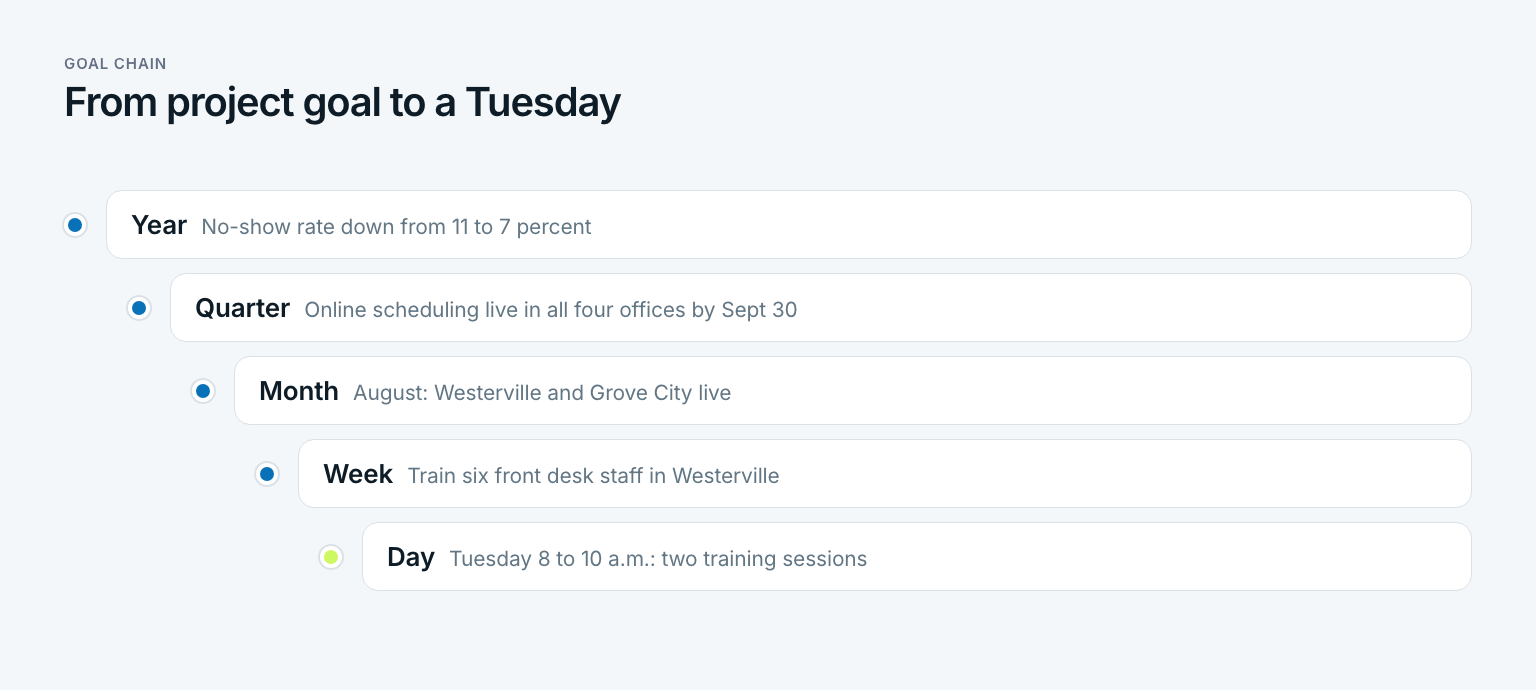
Each level answers a different question. The year says why. The quarter says which milestone is up now. The month turns the milestone into a number, the week into a list of names, the day into an appointment on the calendar. Here is Priya's chain in August:
- Year: No-show rate down from 11 to 7 percent.
- Quarter 3: Online scheduling live in all four offices by September 30.
- Month, August: Westerville and Grove City live, Dublin at 35 percent online bookings.
- Week: Six front desk staff in Westerville trained, 20 test bookings done.
- Day: Tuesday from 8 to 10 a.m., two training sessions on site in Westerville.
On Friday of that week, four of six staff had finished training. Two were on vacation. Priya moved them to the following Monday and checked the month: Grove City could still go live on August 25, but only if the vendor's setup call moved up by two days. She called the vendor that afternoon. That check takes two minutes when the chain is in place. Without it, the gap shows up in September, when there is no time left to close it. In short: the project goal lives in the charter, but it gets reached on a Tuesday at eight.
Your Self-Audit Before Kickoff
Before the project starts, answer five questions in writing. Every question that makes you hesitate points to a gap in the charter:
- Could an outsider say yes or no on the deadline whether the goal was reached?
- Do you know the baseline for every number in your objectives?
- Which corner of the triangle is fixed, which one is the buffer, and does the sponsor know?
- Is at least one out of scope item written down?
- Did you count internal hours the same way you counted dollars?
In April, Priya could answer four of the five with yes. The internal hours were missing. She worked them out, landed at 300 and settled a discussion that would otherwise have come up in August. Anyone who answers these five questions before kickoff does not have to answer them under pressure halfway through. Project goals are not a formality for the charter. They are the answer to the question of when everyone gets to stop.
Frequently Asked Questions About Project Goals
What is an example of a project goal?
A good project goal names an outcome, a date and a budget. For example: by March 15, a new website with online quote requests is live, at no more than $12,000. A weak version would be “redesign the website,” which only describes an activity.
What are the 10 examples of goals?
For projects, ten common goals are to launch a website, roll out a CRM, move an office, launch a product, run a conference, speed up invoice approval, train staff on new software, remodel a kitchen, run a fundraiser and finish a capstone report. Each one only becomes a real goal once it has a number, a date and a cost, as in the table of examples above.
What are the three goals of a project?
The three goals are scope, time and cost, often drawn as the triple constraint. Scope says what exists at the end and at what quality, time says by when, cost says at what price. Because they pull on each other, every project should decide in advance which one is fixed and which one can give.
What are 5 good goals?
Five good project goals from this guide: online booking live in four offices by September 30, 40 percent of appointments booked online in October, a no-show rate down from 11 to 7 percent by December, invoices approved in 5 instead of 12 days, and picking errors under 0.5 percent. Each one can be checked with yes or no on a fixed date.
What is the difference between project goals and objectives?
A project goal is the broad outcome the sponsor signs off on, written in plain words. Objectives are the specific, measurable results that prove the goal was reached. One goal usually carries two to four objectives.
How many goals should a project have?
One goal with two to four objectives, plus a time goal and a cost goal, is enough for most projects. More than five objectives blur the priorities. If you need more, you are often running two projects under one charter.
Last updated: 6 October 2026
Read next
 Leadership & Teams
Leadership Styles: Which One Fits Which Situation
Leadership styles are not personality types: 11 types compared, Lewin, Goleman, situational leadership and five steps to find the style that fits you.
14 min read
 Leadership & Teams
Retrospective: How Teams Learn From Every Sprint
A retrospective is not a blame session: what the word means, five phases, seven retrospective examples and action items that stick, shown on one team.
16 min read
 Leadership & Teams
How to Delegate Tasks: Hand Off Work, Keep Results
Delegation is not dumping work: five levels of delegation, seven steps, a handoff script and what to keep, shown on one marketing team.
15 min read