Goal Planning: How to Turn a Goal Into a Plan
Goal planning is not goal setting twice. Backward milestones, an hours budget with buffer, calendar blocks and reviews, worked through with a template.

Contents
- 01What goal planning is, and where goal setting ends
- 02Why a goal without a plan stalls by March
- 03How to plan goals in six steps
- 04Milestones: plan backward from the deadline
- 05Scheduling: the hours budget almost nobody runs
- 06Reviews: change the plan, keep the goal
- 07Your goal plan in a goal chain: year, quarter, month, week, day
- 08Goal planning template: one page, seven fields
- 09Three questions before you call it a plan
- 10Frequently asked questions about goal planning
Goal planning is not goal setting a second time. The goal already exists, with a number and a date. Goal planning is the work that comes after: breaking that goal into three to five milestones, giving each milestone real hours on your calendar, and deciding up front when you will check whether the plan still holds. The goal says where. The plan says through which checkpoints, in which hours, and with which review.
Three parts turn a goal into a goal plan: milestones, scheduled time, and reviews. All three are worked through here on one real project. Dana, 34, is a staff accountant in Columbus, Ohio. She has been writing a mystery novel in fits and starts for two years, and in October she finally wrote the goal down: By June 30, 2027, a complete first draft of 75,000 words is in the hands of five beta readers. Along the way you get the six steps of goal planning, an hours budget that almost everybody skips, a review rhythm, and a one-page goal planning template.
What goal planning is, and where goal setting ends
Goal planning starts where goal setting stops. How to write the goal itself, with a result, a number, and a date, is covered in the guide to goal setting. This article is about the stretch after that: What happens between the day the goal lands on paper and the day it is due? For Dana that stretch is 37 weeks. Anyone who leaves those weeks unplanned hands them to whatever else is loudest.
A goal plan has three parts. First, milestones: intermediate states you can check on a specific date. Second, scheduled time: fixed hours on your calendar where the work for the next milestone actually happens. Third, reviews: fixed points where you compare the plan with reality and adjust the plan. Leave out any one of the three and the plan breaks in a predictable place. Without milestones you find out too late that you are behind. Without scheduled time every week is too full. Without reviews you cling to a plan that stopped being true in November.
What a milestone is
A milestone is a checkable state with a date, not a task. Work on chapter four is a task. You can keep doing it forever. Chapters one through ten drafted, 20,000 words, by December 20 is a milestone, because on December 20 anyone can see whether it is true. That checkability is what makes a plan steerable.
Goal setting, goal planning, task planning: three levels that blur
People use the three terms as if they meant the same thing. They answer different questions, and each one has its own moment.
| Level | Question | Output | Dana's example | How often |
|---|---|---|---|---|
| Goal setting | What will be true by when? | One goal sentence with a number, a date, and a test | 75,000 word draft sent to five beta readers by June 30, 2027 | Once per goal |
| Goal planning | Through which checkpoints, in which hours, with which review? | Milestones, an hours budget, recurring calendar blocks, review dates | Five milestones, five to seven hours a week, reviews every Friday and at every milestone | Once at the start, then adjusted at each milestone |
| Task planning | What do I do in this block? | A list for the week and the day | Sunday 8 am: 1,250 words of chapter nine | Every week and every day |
In short: goal setting decides, goal planning allocates, task planning executes. Anyone who jumps straight from the goal to a to-do list has plenty to do and no way of knowing whether it is enough.
Why a goal without a plan stalls by March
A well written goal is worth a lot. It gives direction, it makes progress visible, and it protects you from the vague someday. It just does not plan anything. Between October and June there are more than 260 days, and Dana's goal sentence says nothing about any of them. So what happens to those days without a plan?
Three gaps show up almost every time, and none of them feels like a problem at the start:
- No checkpoint. The goal has one test date, and it is at the end. Until then every week feels roughly fine. Whether you are ahead or behind in February, you only find out in June.
- No hours. The goal competes with work, family, and plain tiredness for the same evenings. Whoever does not reserve fixed hours gets the leftovers. For Dana, the leftovers shrink to almost nothing between January and April 15, when tax season eats her evenings.
- No review. Plans go stale. A busy season runs long, a kid gets the flu, a plot stops working. Whoever has no fixed date to correct course either holds on to a broken plan or quietly drops it.
On top of that sits an effect psychology has known about for decades. In 1979 Daniel Kahneman and Amos Tversky described the planning fallacy: people consistently underestimate how long their own projects will take, even when they know that similar projects ran late before. In a 1994 study, Roger Buehler, Dale Griffin, and Michael Ross asked students to predict when they would finish their senior thesis. On average they predicted about 34 days. It took them about 56. That means: a plan based on gut feel is almost always too tight. Goal planning builds buffer and review into the plan from day one.
How to plan goals in six steps
For a yearly goal, plan on about 60 minutes split over two sittings. The first sitting covers milestones and effort. The second covers the hours budget, the calendar, and the reviews. Sleep on it in between. Estimates get more honest on the second day.
Check the goal sentence, five minutes
Read your goal out loud and check three things: Is there a number, a date, and a way to count? If not, go back to goal setting first, because without an end point there is nothing to plan backward from. Dana's sentence passes: 75,000 words, five beta readers, June 30, 2027, counted by the word count in her manuscript file and five sent emails.
Set milestones backward, 15 minutes
Start at the deadline and ask: What has to be true before this, for the goal to be possible? Then ask the same question about that state, and keep going until you reach today. Three to five milestones are enough for a year. Each one is a state with a date, not an activity.
Estimate the effort, 15 minutes
List the work behind each milestone and estimate it in hours. Think in hours rather than weeks, because weeks hide how little free time is actually in them. Dana's first pass comes to 140 hours.
Run the hours budget, ten minutes
Count the weeks to the deadline. Subtract holidays, vacation, and one week for getting sick. Multiply by the hours you really have free each week. Add 20 percent buffer to the effort. If it does not fit, cut the scope, move the date, or find more hours. Pick one now, not in May.
Put the hours on the calendar, ten minutes
Block the hours as recurring events with a weekday, a time, and a place. A block that sits in the same slot every week needs no decision. Dana writes Tuesday and Thursday from 8:30 to 10 pm at the kitchen table and Sunday from 8 to 10 am at the library.
Schedule the reviews, five minutes
Set three review levels: ten minutes every Friday, 30 minutes at the end of each month, and 45 minutes on every milestone date. Put them on the calendar right now. A review without a date does not happen.
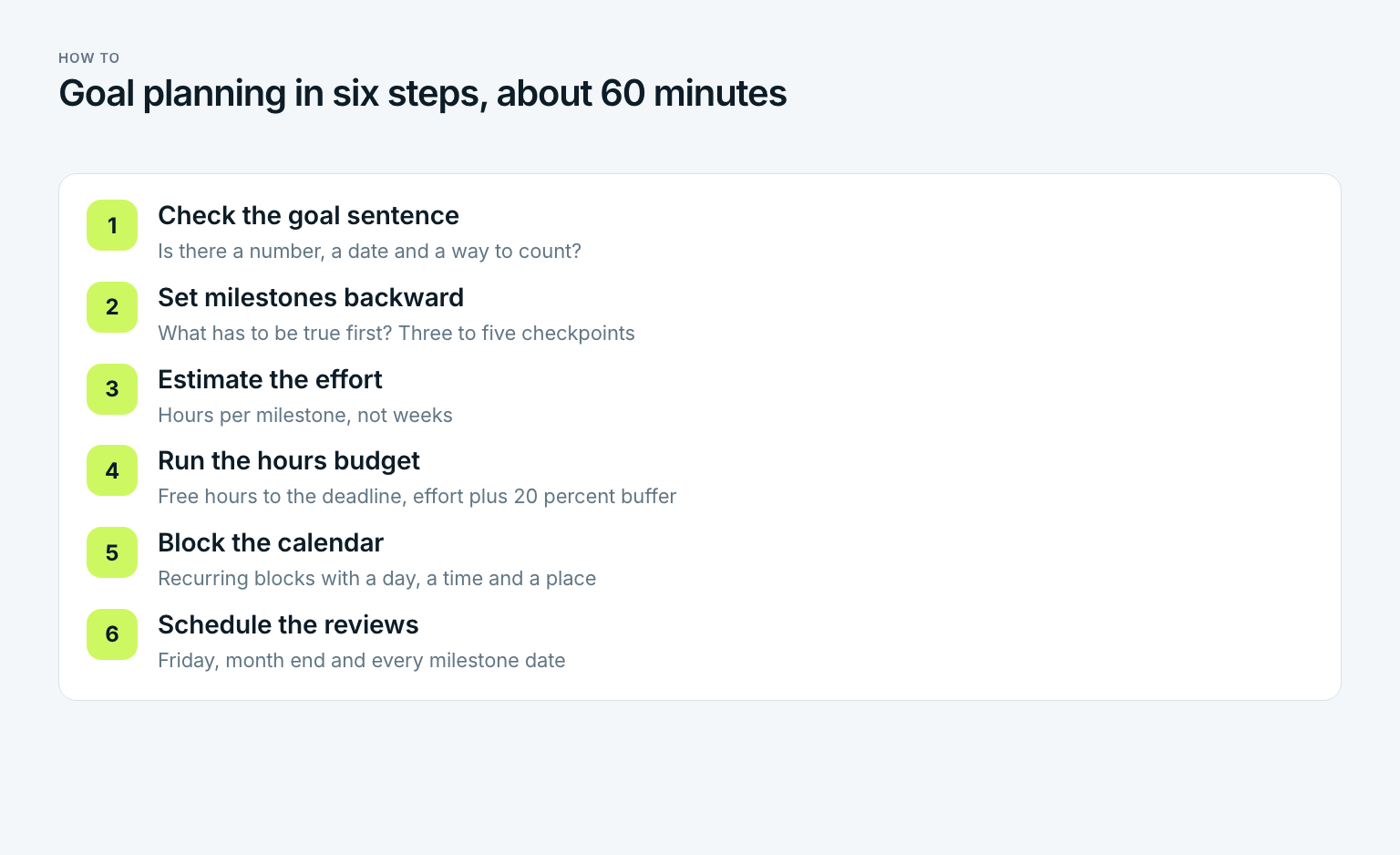
The order matters. Anyone who starts with the calendar hands out hours before knowing what they are for. Anyone who starts with tasks loses sight of the deadline. First the end point, then the checkpoints, then the hours, then the review.
Milestones: plan backward from the deadline
Planning forward feels more natural. You start with what you can do today and hope it adds up. Planning backward is less comfortable, because it shows you right away how early things have to be done. That discomfort is the point. Here is how Dana built her chain:
- Draft sent to five beta readers by June 30. What has to be true before that? A complete draft, plus two weeks for one cleanup pass and the emails.
- So: draft complete, 75,000 words, by June 13. What has to be true before that? Enough words banked before tax season ends, because April to June is her only stretch of full weeks.
- So: 40,000 words by April 18, the first weekend after the tax deadline. Before that? A real pace number, measured before the busy season starts.
- So: 20,000 words by December 20. This is her early indicator. It tells her how many words per hour she actually writes, not how many she hopes to write.
- So: outline finished by November 8, with 30 chapter beats and the ending fixed. That is the first milestone, four weeks from today.
| Milestone | Date | How Dana checks it | Gap to previous |
|---|---|---|---|
| Outline finished | November 8, 2026 | 30 chapter beats on one page, the ending written as a paragraph | 4 weeks |
| Early indicator | December 20, 2026 | 20,000 words in the manuscript file, words per hour logged | 6 weeks |
| Tax season checkpoint | April 18, 2027 | 40,000 words | 17 weeks, 15 of them busy season |
| Draft complete | June 13, 2027 | 75,000 words, every chapter has an ending | 8 weeks |
| Goal | June 30, 2027 | Cleaned draft emailed to five beta readers | 2.5 weeks |
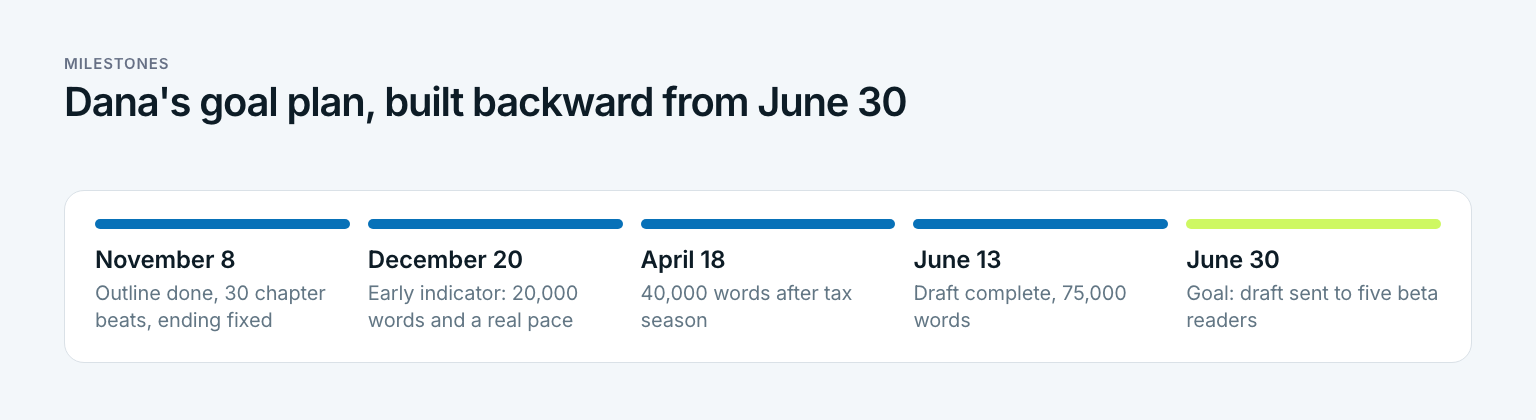
Three rules keep milestones useful. One: three to five per yearly goal, because more turns into a task list. Two: four to nine weeks apart where you can, because shorter is weekly planning and longer is flying blind again. Dana's long gap through tax season is a deliberate exception, and she covers it with monthly reviews. Three: every milestone is written so that a stranger could check it on the due date with a yes or a no. Making good progress on the middle chapters fails that test. 40,000 words in the file passes it.
Why not just check in at the end of every month? Because months follow the calendar and milestones follow the project. Whoever forces milestones onto month ends invents checkpoints the project does not have and misses the ones it really needs. Dana's real constraint is April 15, not March 31.
Scheduling: the hours budget almost nobody runs
The most important step in goal planning is the least exciting one: arithmetic. How many hours does the goal need, and how many hours do you have? Most plans do not fail because of laziness. They fail because nobody ever did this math.
Here is Dana's budget. From Monday, October 12, 2026, to June 30, 2027, there are about 37 weeks. She takes out four: Thanksgiving week, two weeks over the holidays, and one week for being sick, without knowing when it will come. Of the remaining 33 weeks, 15 fall into tax season, when she can protect only her Sunday morning. That leaves 18 normal weeks at five hours and 15 busy weeks at two hours. Total: 120 hours.
| Work package | First estimate | After the fix |
|---|---|---|
| Outline and character notes | 15 hours | 15 hours |
| Drafting 75,000 words at 750 words per hour | 100 hours | 100 hours |
| Revision before the beta read | Full pass, 20 hours | Plot and continuity pass only, 10 hours |
| Beta prep: find readers, format, write questions | 5 hours | 5 hours |
| Total effort | 140 hours | 130 hours |
| With 20 percent buffer | 168 hours | 156 hours |
| Hours available | 120 hours | 156 hours, with a Saturday block added in normal weeks |
The first plan was 48 hours short. That sounds manageable until you notice it is almost ten normal weeks of writing. Dana had three levers: move the date, find more hours, or cut the scope. She kept the date, because a summer beta read lets her revise in the fall before the next busy season. She found more hours by adding Saturday from 7 to 9 am in the 18 normal weeks, which adds 36. And she cut scope where it costs the least: the full revision moves to after the beta read, where reader notes will make it faster anyway. The plan now fits, with the buffer as the only slack. That is exactly why the December check matters.
Why 20 percent? The planning fallacy makes estimates too tight, even honest ones. Holidays and a sick week are already taken out of Dana's budget, so the buffer only has to absorb slow sessions, a plot that needs rethinking, and weeks that simply go wrong. Anyone who plans with zero buffer is planning the first delay along with everything else.
From hours to calendar blocks
An hours budget is not a schedule yet. Only when the hours have a weekday, a time, and a place do they stop competing with the couch every single evening. Kevin Kruse puts it bluntly in his interviews with high performers: they work from a calendar, not from a to-do list. Dana's blocks are Tuesday and Thursday from 8:30 to 10 pm, Saturday from 7 to 9 am, and Sunday from 8 to 10 am at the library, the one block that survives tax season. If you want to build a full week around blocks like these, the guide to time blocking walks through it.
Each block gets exactly one task at the start of the week, and that task feeds the next milestone. Not three tasks, and not work on the book. Tuesday might be: 1,000 words of chapter seven, starting at the scene in the parking garage. That means: the milestone decides what goes into the block, not your mood on Tuesday night.
The most common mistake: a plan without an hours budget
Most goal plans list milestones and dates but no hours. On paper the plan looks complete. In reality it runs a fifth or more over what fits next to a job and a family, and you notice only when the second milestone slips. Run the effort against your hours before you put the first block on the calendar.
Reviews: change the plan, keep the goal
No plan survives the first weeks unchanged. That is not failure. It is the reason reviews exist. A review compares the plan with what actually happened and decides what changes. Whoever skips it notices the gap only when it is too big to close.
| Review | When | Length | Guiding question |
|---|---|---|---|
| Weekly review | Friday, 5 pm | 10 minutes | Did every block feed the next milestone? What goes into next week's blocks? |
| Monthly review | Last Sunday of the month | 30 minutes | Are the hours on plan? Do the estimates still hold? |
| Milestone review | On each milestone date | 45 minutes | Hit, narrowly missed, or clearly missed? What changes on the way to the next milestone? |
The weekly level is laid out step by step in the ten-minute weekly review. For goal planning the milestone review carries the most weight, because that is where the plan gets rewritten. A simple traffic light helps. Green means on plan. Yellow means up to two weeks behind, recoverable with one extra block. Red means more than two weeks behind, and scope, hours, or the next milestone date get decided again.
Dana's December 20 review
On December 20 Dana opens the file. Outline: done on time. Word count: 14,500, not 20,000. Her log shows 31 hours of writing, so her real pace is about 470 words per hour, not 750. If that pace holds, the remaining 60,500 words need about 129 hours instead of 81. The light is not yellow. The number behind it is red.
Three questions structure the review: Where am I? Why? What changes? The why is in her log. She opened almost every session by rereading and polishing the previous chapter, which ate a third of each block. The change has three parts. A rule: no editing while drafting, and every session ends with a two-line note on where to start next time. A test: words per session go into the log, and January is the proof. A reserve: five vacation days in May become a writing week of 20 hours. The April 18 milestone moves from 40,000 to 36,000 words. The June dates stay. The goal stays. Only the road to it changed.
That is the core rule of goal planning: change the plan at any milestone when the numbers call for it. Change the goal only in a scheduled quarterly review, and only with a reason. The most important of these is the mid-year review, when half the year is gone and the second half can still be planned around the real pace. Whoever moves the goal every time they fall behind soon has an intention, not a goal. Whoever never touches the plan has a hope, not a plan. For how to measure progress cleanly along the way, see the guide to achieving goals.
Your goal plan in a goal chain: year, quarter, month, week, day
Milestones and the goal chain are two views of the same project. Milestones follow the logic of the work. The goal chain follows the calendar. Together they answer what to do on any given Sunday morning. The general method of breaking a yearly goal down into daily steps is covered in turn yearly goals into daily steps. Here the question is where Dana's milestones land on each level.
| Level | Dana's goal at this level | Where it comes from |
|---|---|---|
| Year | 75,000 word draft sent to five beta readers by June 30, 2027 | The goal sentence |
| Quarter 1, January to March | From 14,500 to about 31,000 words, Sundays only | Tax season pace times 13 Sundays |
| Month, January | 5,000 words over four Sunday sessions | Quarter target split by month, rounded |
| Week | One Sunday session, 1,250 words, chapter nine | Monthly target split by four |
| Day | Sunday 8 am: 1,250 words, no rereading, two-line note at the end | The one block that week |
The chain makes sure a milestone exists on more days than its due date. It shrinks a little every week, and every block carries a number you can check on Friday. In Gaapp you link the yearly goal, the quarterly goals, and the weekly goals in one chain and see on every level whether progress keeps pace with the time that has passed.
Anyone planning more than one goal at the same time should lay the milestones side by side before handing out hours. Three milestones from three different goals in the same month are a warning sign. An hours budget that barely works for one goal does not work for three. That is why a month carries no more than three monthly goals, each with its own hours budget.
Goal planning template: one page, seven fields
The template fits on one sheet. Fill it in the order of the six steps, not in the order things occur to you. Dana's entries show how concrete each field should be.
| Field | Question | Dana's entry |
|---|---|---|
| Goal sentence | What will be true by when, in what number, and how is it counted? | 75,000 word draft emailed to five beta readers by June 30, 2027 |
| Milestones | Which three to five states have to be true first? | November 8 outline, April 18 at 40,000 words, June 13 draft complete |
| Early indicator | Which number shows early whether the curve fits? | 20,000 words and a measured pace by December 20 |
| Effort | How many hours does the road take, with buffer? | 130 hours plus 20 percent, so 156 hours |
| Hours budget | How many hours do I really have before the deadline? | 18 normal weeks at seven hours plus 15 busy weeks at two hours, 156 hours |
| Calendar blocks | When, where, and how long do I work on it each week? | Tuesday and Thursday 8:30 to 10 pm, Saturday 7 to 9 am, Sunday 8 to 10 am |
| Reviews | When do I check the week, the month, and each milestone? | Friday 5 pm, last Sunday of the month, every milestone date |
Two fields are missing from most goal planning templates you will find online: the hours budget and the reviews. Without them the template is a nice overview. With them it is a goal plan you are still using in three months. Print it or keep it in a digital planner, but keep it where you do your Friday review.
Three questions before you call it a plan
Before you close the plan and put the first block on the calendar, answer three questions in writing. Each one covers one of the three gaps where goals stall in March.
- Could a stranger check every milestone on its due date with a yes or a no? If not, it is still a task, not a milestone.
- Does the effort, with buffer, fit into the hours you really have? If the math only works when you are healthy every week and nobody ever visits, it does not work.
- Is the first review already on the calendar? With a date and a time, not as an intention.
Anyone who can answer all three with yes has more than a goal. They have a road to it that can be corrected on the way. In short: a goal tells you where you want to arrive, and a plan tells you in time when you are drifting off the road.
Frequently asked questions about goal planning
What are the steps of goal planning?
Check that the goal has a number, a date, and a test. Set three to five milestones backward from the deadline. Estimate the effort in hours, run it against the hours you really have with 20 percent buffer, block those hours on your calendar, and schedule weekly, monthly, and milestone reviews before you start.
What are the 5 C's of goal-setting?
Lists vary by author, but most go back to the five principles from Locke and Latham's goal setting research: clarity, challenge, commitment, feedback, and task complexity. The guide to goal setting walks through them. For goal planning, feedback and complexity matter most, which is why milestones and an honest hours estimate sit at the center of the plan.
What are the four types of goals?
There is no single official list. A common split is by what the goal measures: outcome goals for the end result, performance goals for a measurable level, process goals for the behavior you repeat, and learning goals for a skill you build. A good goal plan usually links them: one outcome goal at the top, process goals in the weekly blocks.
What are the 5 P's of goal-setting?
Versions differ, but a common one says a goal should be positive, personal, possible, prioritized, and written in the present tense. They are useful for wording a goal. They say nothing about milestones, hours, or reviews, which is the part goal planning adds.
What should a goal plan include?
A goal plan needs seven things: the goal sentence, three to five milestones, one early indicator, an effort estimate in hours, an hours budget, recurring calendar blocks, and review dates. The template above fits all seven on one page. Most plans skip the hours budget, which is why they run late.
How many milestones should a goal have?
For a yearly goal, three to five milestones four to nine weeks apart are enough. Fewer leave long stretches with no checkpoint. More turn the plan into a task list. One extra early indicator, such as a first number after about two months, tells you in time whether the direction is right.
Last updated: 19 October 2026
Read next
 Planning
Cleaning Schedule: Daily, Weekly and Monthly Tasks
A cleaning schedule is not a Saturday to-do list: daily, weekly and monthly tasks, a printable template and a fair split for families.
15 min read
 Planning
Study Plan: How to Make One You Can Actually Follow
A study plan is not a schedule. Make one in six steps: inventory, hours math, buffer, a sample study schedule and a template, with a worked example.
17 min read
 Planning
Bullet Journal: How to Start One You'll Actually Keep
A bullet journal is not an art project. Learn the bullets, four core modules, migration and a six-step setup, with an example, 12 ideas and a goal chain.
15 min read