Self-Management: How to Run Your Own Week
Self-management means steering yourself, not just your calendar. The five skills, examples of poor self-management, five steps, and a worked week.

Contents
- 01What self-management means, and what it is not
- 02Self-management vs. time management: what each is built for
- 03What really happens in Jordan's week: 47 hours, 1.5 on the goal
- 04The five self-management skills
- 05Examples of poor self-management, and what each one signals
- 06How to improve self-management skills: five steps over four weeks
- 07Jordan's week four weeks later
- 08The three mistakes nobody notices
- 09Self-management in the goal chain: from year to day
- 10Frequently asked questions about self-management
Self-management is not time management with a new name. Self-management is the ability to steer your own goals, time, energy, and reactions so that you do what you planned, even when nobody is watching. Time management decides what goes on the calendar. Self-management decides whether you actually show up for it. Anyone who solves only the first problem has a plan. Anyone who solves both has a week that moves a goal.
Five skills make up self-management, and one weekly habit holds them together. All five are worked through here on one remote worker: Jordan, 36, a customer success manager who logged 47 hours in a week and spent one and a half of them on the project his promotion depends on. Along the way you get the five self-management skills, examples of poor self-management and what each one signals, five steps to improve over four weeks, three mistakes nobody notices, and the path from a yearly goal to a single morning block.
What self-management means, and what it is not
Self-management means watching your own behavior, comparing it to a standard you chose, and adjusting it on purpose. The idea comes from psychology. Frederick Kanfer described self-regulation in the early 1970s as three moves: you monitor what you do, you evaluate it against a goal, and you reinforce what works. By this model, whoever wants to change a habit does not need more willpower. They need a feedback loop.
Peter Drucker carried the idea into the workplace. In his 1999 Harvard Business Review essay “Managing Oneself,” he argued that knowledge workers no longer have a boss who sets their direction, pace, and tasks, so they have to manage themselves. He asked them to know their strengths, how they work best, and what they value. No app does that part for you. Today it applies to anyone working remotely, running a business alone, or chasing a goal next to a full-time job.
The term has two other homes, which explains the mixed search results. In education, the CASEL framework lists self-management as one of five core social and emotional competencies, centered on handling emotions, thoughts, and behavior in order to reach goals. In healthcare, self-management means patients handling a chronic condition day to day, a field Kate Lorig shaped at Stanford from the 1990s on. This article is about the version most adults need on a Tuesday: work, goals, and a week with more demands than hours.
What self-management is not: self-optimization. Optimization tries to squeeze more out of every hour, wake earlier, read faster, sleep less. Self-management tries to point the right hours at the right goal. Often that means doing less, not more. Is that soft on performance? No. It is the precondition for it. In short: self-management does not measure how much you do. It measures what for.
Self-management vs. time management: what each is built for
Time management is a good tool. It is just built for something else. Time management arranges tasks in time: what comes first, what goes in which slot, how long it may take. Self-management arranges the person who has to do those tasks. A perfect calendar does nothing if at 2 p.m. on Tuesday you are drained, an angry email lands, and the important task slides to tomorrow. The plan was right. The steering failed.
A third term belongs here because it gets mixed up with both: self-organization, the system behind your files, lists, and tools. All three connect, but each one answers a different question:
| Question | Time management | Self-organization | Self-management |
|---|---|---|---|
| Core question | What do I do when? | Where is everything, and how does it flow? | How do I get myself to do it? |
| Works on | Tasks, meetings, calendar | Files, lists, routines | Goals, energy, emotions, habits |
| Typical tool | Eisenhower matrix, time blocking | Checklists, folders, GTD lists | If-then plans, energy log, weekly review |
| Breaks down when | The plan runs against your energy | The system needs more upkeep than it saves | Intentions are never measured |
| What it measures | Tasks done | Search time, open loops | Hours that move a goal |
That means: time management is one part of self-management, not a substitute for it. If you want the calendar methods themselves, the time management guide compares them side by side. If your files, lists, and tools are the bottleneck, how to be more organized walks through one system for them. This article is about the layer above: why a good plan does not get carried out. Which of the three questions do you answer worst right now?
What really happens in Jordan's week: 47 hours, 1.5 on the goal
Jordan is 36 and a senior customer success manager at a software company. He has worked from home in Columbus, Ohio, since 2023, and his daughter is four. His goal for the year: get promoted to team lead in the December review. His manager was clear about what is missing: a written onboarding playbook the whole team can use, roughly 70 hours of focused work, due November 15. By August he had 18 hours in. To finish on time he needs about four hours a week, five to leave a margin. In the week he logged, he managed one and a half.
Nobody stands behind Jordan. His manager is two time zones away, and his calendar fills itself with customer calls. One week in August he wrote down what he did in 30-minute blocks, five minutes every evening, without changing anything:
| What Jordan did that week | Hours | Skill behind it |
|---|---|---|
| Customer calls and internal meetings | 14 h | Fixed, mostly not his choice |
| Slack and email, checked all day | 12 h | Impulse control |
| Renewal prep and account notes | 7 h | Necessary work |
| Customer escalations, all handled on the spot | 6 h | Time boundaries |
| Recovering after hard calls: news, snacks, scrolling | 4 h | Emotional control |
| Expense reports, tool updates, admin | 2.5 h | Necessary work |
| Onboarding playbook | 1.5 h | Goal clarity: the goal itself |
| Total | 47 h | 1.5 h on the goal, 22 h of reactions |
One and a half hours out of 47 went to the goal Jordan calls the most important thing in his year. That is not a verdict. It is a measurement. Jordan is not short of time, and he is not lazy. On Tuesday he counted 74 times he opened Slack. Twenty-two of his hours were reactions: to messages, to escalations, to his own mood after a bad call. And his best hours went to the wrong work. He is sharpest from 8 to 10 a.m. and spent those hours in his inbox. The playbook got whatever was left after 8 p.m., when his daughter was asleep and his focus mostly was too.
So a new to-do app would not have helped him. The playbook was already on his list, in first place. He knew what to do. He just never did it in the hours when he could. That means: this is exactly where self-management starts, not at the list.
The five self-management skills
Self-management comes down to five skills: goal clarity, time boundaries, energy management, emotional and impulse control, and self-monitoring. Each answers one question, and any one of them can be the bottleneck. Lists online name five, six, or ten skills. Most of their items fit into one of these five: motivation belongs to goal clarity, prioritizing to time boundaries, stress management to energy and emotions, discipline to impulse control, accountability to self-monitoring. Five skills can be checked in a week. Ten cannot.
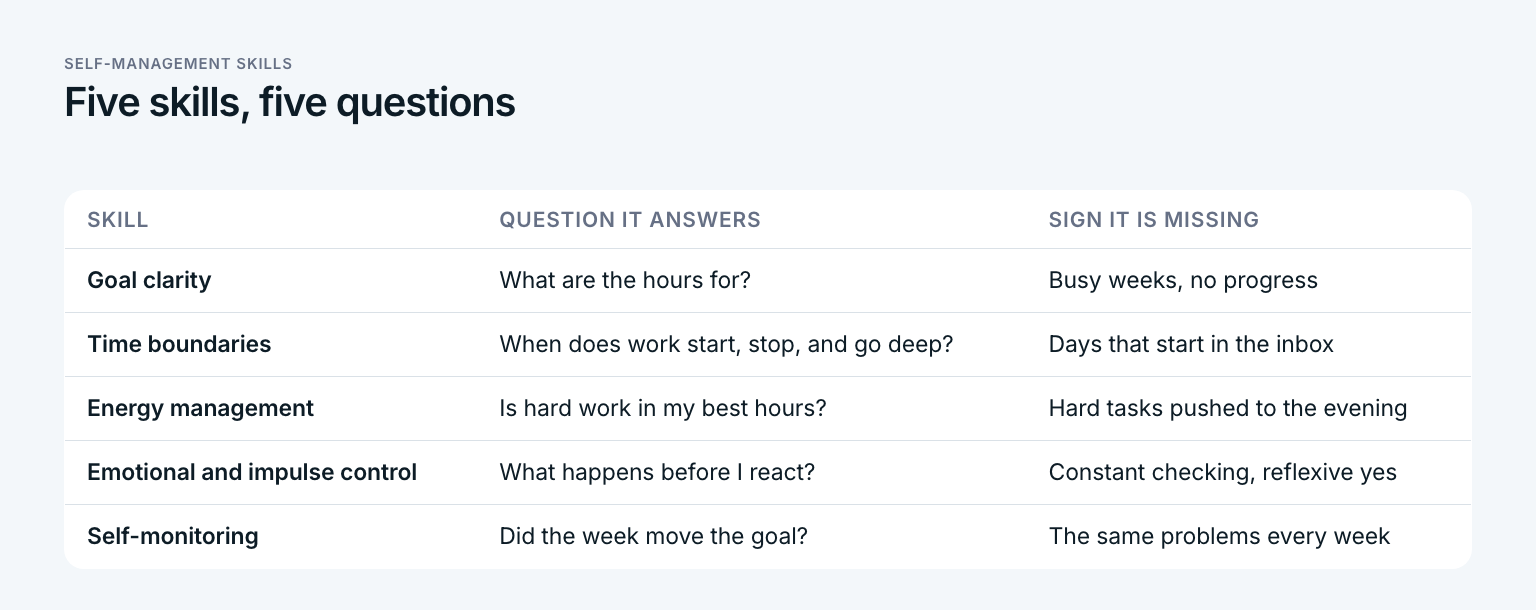
1. Goal clarity: what the hours are for
The first skill is direction. Without a goal you measure effort, not progress. A goal in self-management terms has a number and a date, and it can be translated into hours per week. For Jordan that is four to five playbook hours a week until November 15. Anyone who cannot say their goal in one sentence does not have a self-management problem yet. They have a goal problem, and that comes first. The guide on how to achieve goals shows how a wish becomes a goal with a number and a deadline. The matching technique is a goal chain from year to day.
2. Time boundaries: when work starts, stops, and goes deep
The second skill is the frame. Boundaries are not minute-by-minute planning. They are three decisions: when the day starts, when it ends, and which block belongs to the goal. Remote work erases these lines. Nobody leaves the office at six, so nobody stops. Jordan's day started in Slack and ended when he got tired, and every escalation went straight to the top of the day, urgent or not. Telling urgent from important is its own discipline, and the Eisenhower matrix is built for exactly that. The matching technique is time blocking with a fixed start and stop.
3. Energy management: hard work where your energy is
The third skill gets skipped most. An hour at 8 a.m. and an hour at 9 p.m. are the same length on paper. At work they are not. Energy covers sleep, movement, breaks, and your own curve over the day. Jordan's sharpest hours went to email. The playbook, the work that needed the most thought, got his worst hours, and a section that should take one morning took two evenings. Whoever spends their best time on small tasks works longer for less. The matching technique is an energy log for one week, then the hardest block moved into the peak.
4. Emotional and impulse control: the urge, the mood, the reflexive yes
The fourth skill is the uncomfortable one. It covers distraction, procrastination, stress reactions, and the commitments you make to be polite. Impulses are faster than plans. Slack is one click away, the playbook is a blank page, and a bad call leaves a mood that wants to be soothed before it lets you work. Jordan lost four hours a week just recovering from difficult conversations. Anyone who tries to win this skill with willpower usually loses. It needs rules that fire before the impulse does.
Those rules are called if-then plans, and they come from the psychologist Peter Gollwitzer, who summarized the research on them in 1999. You decide in advance what you will do in a specific situation: “If a call goes badly, then I take a ten-minute walk before I open anything else.” The decision is made once, not every time. That is why it works against impulses. The impulse meets a decision that has already been made.
5. Self-monitoring: measure weekly, change one thing
The fifth skill holds the other four together. Kanfer's loop starts with monitoring, because without it every evaluation is a feeling. In practice it is a fixed slot each week, ten minutes long, where you compare the week with the weekly goal, find the skill that cost the most, and change one thing. Jordan's slot is Friday at 4 p.m. How those ten minutes run is laid out in the ten-minute weekly review. In short: the first four skills tell you where to look. The fifth tells you when.
Where Getting Things Done fits
David Allen's Getting Things Done, published in 2001, is often sold as a complete self-management system. It is built for one specific problem: open loops, the commitments that circle in your head because they are not written down anywhere. That makes it a strong tool for self-organization and a partial one for impulse control. It does not tell you which goal matters or when your energy peaks. If open loops are your bottleneck, the Getting Things Done guide walks through the system.
Examples of poor self-management, and what each one signals
Poor self-management rarely looks dramatic. It looks like a normal busy week. The examples below are the most common ones, each paired with the skill behind it and a first fix. Read them as signals, not as character flaws. A signal tells you where to look. A flaw only tells you how to feel.
| Poor self-management example | Skill behind it | First fix |
|---|---|---|
| Saying yes to every request, then working nights to catch up | Time boundaries | One fixed stop time and a default answer of “let me check my week” |
| Checking Slack, email, or phone every few minutes | Emotional and impulse control | Check windows, for example ten minutes at the top of each hour |
| Doing the hardest work at the most tired hour | Energy management | Move one hard block into your peak hours |
| Snapping at a coworker after a stressful call | Emotional and impulse control | A pause rule: walk first, reply second |
| Hitting everyone else's deadlines and missing your own | Goal clarity | Translate your goal into hours per week |
| Starting every week with last week's problems | Self-monitoring | A ten-minute review every Friday |
| Working longer instead of working differently | Energy management and boundaries | Cut one hour a day and protect one block |
Which of these did you recognize from last week? Most people find two or three. That is normal, and it is also the point. Whoever tries to fix all of them at once fixes none. Pick the one that cost the most hours and start there. For Jordan that was not the most embarrassing one. It was the most expensive one: twelve hours of checking.
How to improve self-management skills: five steps over four weeks
Improving self-management is not reading a book about discipline. It is one week of observation, one chosen skill, and four weeks of testing a single rule. The five steps follow Kanfer's loop: monitor, evaluate, reinforce. You need a notepad, a calendar, and a goal with a number.
Log one week, seven days
Write down what you do in 30-minute blocks for one week. Three times a day, rate your energy from 1 to 5. Change nothing yet. A log that improves while you write it measures nothing.
Sort the hours by skill, 20 minutes
On Sunday, sort every hour into one of the five skills, the way Jordan's table does. Hours of hard work done at energy 1 or 2 count toward energy management. The skill that lost the most hours is your bottleneck.
Set a frame, 15 minutes
Decide three things: start time, stop time, and the first block of the day that belongs to your goal. Put the block in your energy peak, not wherever there happens to be space. Add all three as recurring events.
Write one if-then rule for the bottleneck, five minutes
Write exactly one rule for your weakest skill: if situation X happens, then I do Y. The situation has to be predictable and the action small. One rule, not five. Anyone who starts five rules at once tests none of them.
Review on Friday and change one thing, ten minutes
Each Friday, compare the week with your weekly goal. How many hours moved it, and did the rule hold? Keep what works and change exactly one thing for next week. After four weeks, move on to the next skill.
Why four weeks? A rule that lasts one week proves little, because the first week runs on novelty. A rule that survives four Fridays has met real life: a bad night, a customer crisis, a sick kid. Whoever moves to the next skill after two weeks will not know which change did the work. That means: patience here is not a virtue. It is how you measure.
Jordan's week four weeks later
Jordan changed four things in four weeks, each one decided on a Friday. Week one set the frame: start at 8 a.m., stop at 5:30 p.m., and the playbook from 8:00 to 9:15 a.m. Monday to Thursday, with Slack set to focus until the block ends. Week two added the impulse rule: Slack and email for ten minutes at the top of each hour, and nothing in between unless the phone rings.
Week three added the rule for hard calls: “If a call goes badly, then I take a ten-minute walk around the block before I open anything else.” Week four changed how he handles escalations: answered within the hour, but solved the same day only if the customer is actually blocked. He did not wake up earlier, install a new app, or drop a single customer. By late September his week looked like this:
| Pot | August | Late September | What changed |
|---|---|---|---|
| Onboarding playbook | 1.5 h | 5 h | Block from 8:00 to 9:15 a.m., Monday to Thursday, Slack on focus |
| Slack and email | 12 h | 7 h | Ten minutes at the top of each hour |
| Customer escalations | 6 h | 5 h | Answered within the hour, solved same day only if the customer is blocked |
| Recovering after hard calls | 4 h | 1 h | Ten-minute walk after a bad call, then the next task on the list |
| Customer calls and meetings | 14 h | 14 h | Unchanged |
| Renewal prep and account notes | 7 h | 6 h | Moved into the 2 to 4 p.m. slump, done from a checklist |
| Expense reports, admin | 2.5 h | 2 h | Batched on Friday afternoon |
| Total | 47 h | 40 h | Seven hours less, nothing after 8 p.m. |
Three and a half more hours on the goal, seven fewer hours of work, nothing after 8 p.m. That sounds like a trick. It is a shift. The playbook now sits in the hours when Jordan thinks most clearly, so a section that took two evenings in August takes one morning block. The impulses did not stop. They now meet rules that were decided in advance.
Is he done? Not yet. By the end of September he had 41 of 70 playbook hours in. At five hours a week, the remaining 29 take just under six weeks, which lands the draft around November 9, six days before the deadline. The margin is thin, and he knows it on a Friday in September instead of a Monday in November. That is the difference between self-management and grinding. Whoever grinds works more. Whoever self-manages moves what is already there until it fits.
The three mistakes nobody notices
Self-management rarely fails for lack of willpower. It fails quietly, through one of three mistakes, and none of them feels like a mistake at the time.
The most common mistake: fixing the wrong skill
When you feel unproductive, you almost always reach for time management: a new calendar, a new list, a new app. It feels like action. But if the bottleneck is energy or impulses, the new plan gets broken just like the old one, only prettier. Jordan had tried two planners and a task app before he logged a single week. None of them would have found the 22 hours of reactions. That means: diagnosis first, method second.
- Confusing self-management with self-optimization. Earlier alarms, cold showers, speed reading: any of these can be useful. None of them answers whether your hours move a goal. Anyone who tries to get more out of themselves without knowing what for burns out on a schedule.
- Changing everything at once. A new frame, three rules, a morning routine, and a new app, all on the same Monday. Each change is reasonable on its own. Together they are a move, and two weeks later you cannot tell what worked. One skill, one rule, four weeks.
All three mistakes share a root: they skip the observation. Without a log, every change is a guess, and guesses tend to hit the loudest skill rather than the costliest one. How many systems have you switched without counting a single week first?
Self-management in the goal chain: from year to day
Self-management needs a standard, and the standard comes from above. Without a goal, the Friday review can only ask whether you were busy. With a goal, it asks whether the week was enough. To make the goal checkable at every level, you break it into a chain: year, quarter, month, week, day. Here is Jordan's:
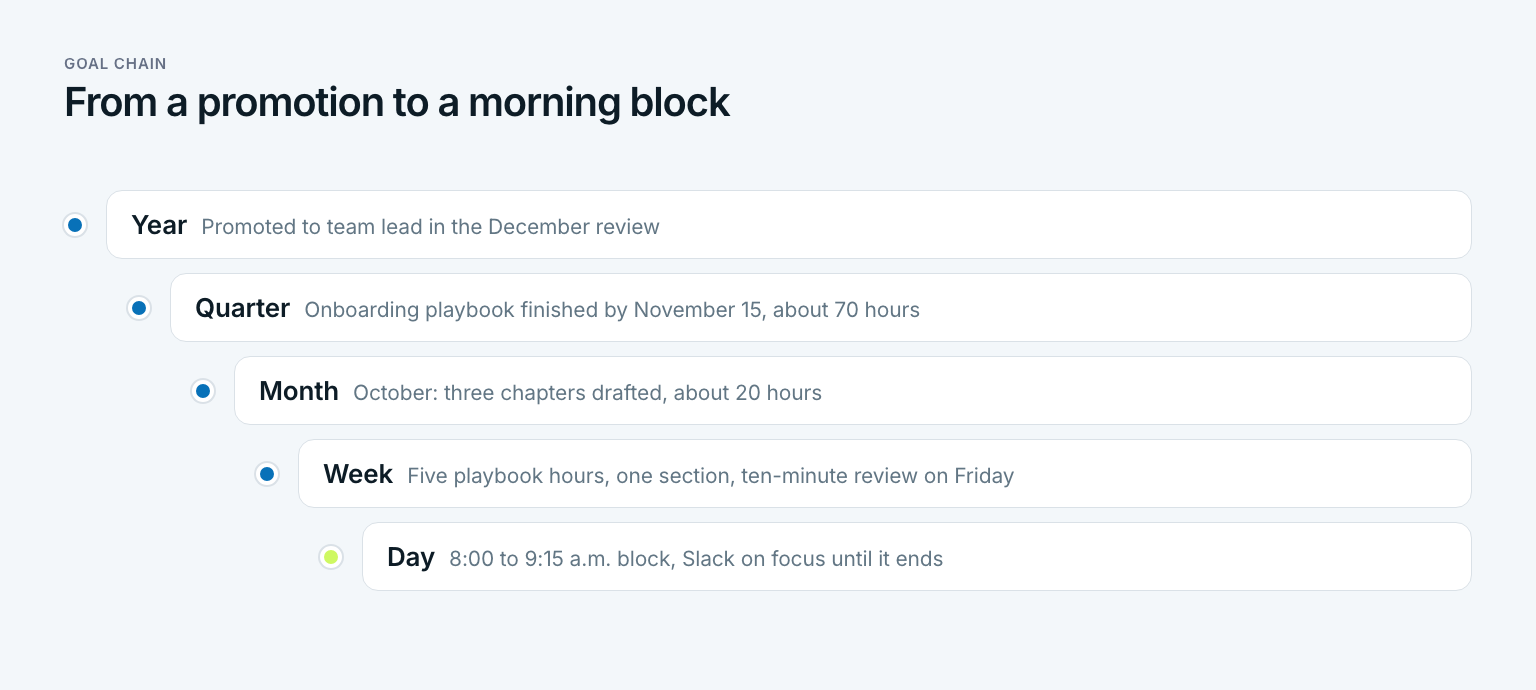
Each level runs a different skill. The year sets direction, which is goal clarity. The quarter and the month check whether the pace holds: a finished playbook by November 15 and three chapters in October are the checkpoints that tell Jordan whether December is still realistic. The week is the level of self-monitoring, the Friday slot. The day is where boundaries, energy, and impulse control live: one block, one rule, one stop time. Whoever plans only at the day level manages hours without direction. Whoever plans only at the year level has a direction without a next step.
In Gaapp, that chain is the core: five levels from year to day, with each goal hanging from a bigger one. Progress for each period is the share of goals completed, and a thin line shows how much of the period has passed. On Friday Jordan sees how many of his weekly goals are done next to how much of October is gone. That is Kanfer's monitoring step without the notepad. The evaluation and the one change stay his.
Whoever works toward shared goals with a partner, a family, or a team does not steer alone. The chain still applies, with more people in the Friday slot and the same questions. Self-management is the part each person does before saying yes to anyone else.
Three questions to close, about your last week:
- Do you know how many hours of last week moved your most important goal, as a number and not a feeling?
- Can you name the one skill out of five that cost you the most?
- Is there a fixed moment in your week when you measure and change exactly one thing?
If you answered no to any of them, you do not have a discipline problem. You have a gap in the loop, and it closes in a week with a notepad and ten minutes on Friday. In short: self-management is not the art of getting more done. It is the habit of checking what your hours are for.
Frequently asked questions about self-management
What is the meaning of self-management?
Self-management means monitoring your own behavior, comparing it to a goal, and adjusting it on purpose. The term comes from psychology, where Frederick Kanfer described self-regulation as monitoring, evaluating, and reinforcing. In everyday terms, it means doing what you planned without someone else setting the pace.
What are the 5 self-management skills?
The five core self-management skills are goal clarity, time boundaries, energy management, emotional and impulse control, and self-monitoring. Goal clarity sets the direction, boundaries set the frame, energy decides when hard work happens, impulse control handles distraction and stress, and self-monitoring checks each week whether it all added up. Most longer lists fit into these five.
What are some examples of poor self-management?
Common examples are saying yes to everything and then working nights, checking messages every few minutes, doing the hardest work at the most tired hour, reacting sharply after a stressful call, and meeting everyone's deadlines except your own. Each one points to a specific skill. Treat them as signals of where to start, not as proof of a character flaw.
What are the six self-management skills?
Lists with six skills usually take the five core skills and split one of them, most often separating stress management from impulse control. Others add accountability, which is self-monitoring shared with another person. The number matters less than the diagnosis. Find the one skill that costs you the most hours and work on that first.
What is the difference between self-management and time management?
Time management arranges tasks in time and answers what you do when. Self-management steers the person doing the tasks: goals, energy, emotions, and habits. Time management is one part of self-management. A good plan often fails not for lack of time but because of fatigue, distraction, or a bad mood, and that is where self-management comes in.
How can I improve my self-management skills?
Log one week in 30-minute blocks and rate your energy three times a day. Sort the hours by skill and pick the one that lost the most. Test one if-then rule for that skill for four weeks and review every Friday for ten minutes.
Last updated: 14 October 2026
Read next
 Productivity
Feynman Technique: Four Steps to Real Understanding
The Feynman technique is not a memorization trick: four steps, a worked example from a stats class, a one-page template, and what research says.
16 min read
 Productivity
Zettelkasten: How to Turn Notes Into Your Own Ideas
A Zettelkasten is not an archive: Luhmann's method, the three note types, a five-step setup and an Obsidian template, with a worked example.
15 min read
 Productivity
Second Brain: How to Build One You Actually Use
A second brain is not a note archive: Tiago Forte's CODE steps, the PARA method with an example, a five-step setup and the mistakes that sink it.
15 min read