Time Management: Methods, Techniques and a Worked Week
Time management means deciding what your hours are for before the week decides for you. Six methods compared, five keys, six steps, and one worked week.

Contents
- 01What time management is, in plain terms
- 02What really happens to your week: a time audit in seven lines
- 03The five keys to time management
- 04Six time management methods, compared
- 05The 3-3-3 rule, the 7-8-9 rule, and the other numbers people search for
- 06How to build your time management system in six steps
- 07Time management in your goal chain: year, quarter, month, week, day
- 08Time management skills: the four you actually need
- 09The three mistakes nobody notices
- 10Three questions before you plan next week
- 11Frequently asked questions about time management
Time management is not about doing more. It is the practice of deciding in advance what your hours are for, so that the week runs on your decisions instead of on whoever reaches you first. Most guides treat it as a speed problem: faster, tighter, more. It is a direction problem. A full calendar and a finished goal are two different things, and only one of them shows up on Friday.
Three things make time management work: an honest picture of where your hours go now, a small set of rules that decide what gets a slot, and a weekly moment to check whether the slots moved anything. All three are worked through here on one week of Elena, who runs a two-person bookkeeping practice in Phoenix with 41 clients, works 52 hours a week, and wants to launch a payroll service by the end of the quarter without adding a single hour. Her first time audit put 1.5 hours a week on that payroll goal. Four weeks later it was six, and her week was nine hours shorter.
What time management is, in plain terms
Time management is the set of decisions you make about how to spend a fixed number of hours. The number is fixed. That is the part most people skip. A week has 168 hours, roughly 56 of them go to sleep, and whatever is left is the whole budget. You cannot manage time in the sense of getting more of it. You can only manage what you put into the hours you already have. That means: every method, rule, and app in this field is a way of deciding, and the deciding is the work.
Here is the distinction that makes the rest of this useful. Being busy is a state. Being effective is a result. A busy week is full. An effective week moved a goal. Elena's 52-hour weeks were full to the edge, and her payroll service had not moved in two months. She was not lazy and she was not disorganized. She simply had no rule for what a slot was for, so the loudest request got it. That distinction is also where the 25 productivity tips in the longer guide begin. Whoever has no rule for their hours has a rule anyway, and the rule is: first come, first served.
Is that a character flaw? No. It is the default setting. Email arrives in the order it is sent, not in the order it matters, and a calendar with open space looks like availability to everyone who can see it. Time management is the small set of habits that override that default.
What really happens to your week: a time audit in seven lines
Before any method, you need the numbers. Not estimates. Elena guessed that she spent maybe four hours a week on email. She logged one week in 15-minute blocks, on paper, with no judgment and no changes to her behavior. Here is what the log said.
| Where the hours went | Hours | Share | What Elena guessed |
|---|---|---|---|
| Client bookkeeping, the actual billable work | 17 | 33% | 25 hours |
| Email and chat | 11 | 21% | 4 hours |
| Client calls and meetings | 8 | 15% | 6 hours |
| Admin, invoicing, software updates | 5.5 | 11% | 3 hours |
| Switching between tasks and quick questions | 6 | 12% | not on her list |
| Payroll service build-out, her quarterly goal | 1.5 | 3% | 8 hours |
| Unaccounted | 3 | 6% | 0 hours |
Two numbers decided everything. Email took almost three times what she thought, and the one project that would change her business got 1.5 hours, which is less than the time she lost switching between things. The audit did not tell her what to do. It told her what she was already doing, which is the only honest starting point. Anyone who skips the audit optimizes a week they have never actually seen.
The audit also showed a pattern she had not noticed. Her 17 billable hours were split into 31 separate sessions, the longest of them 50 minutes. Bookkeeping is detail work. Every restart cost her five to ten minutes of finding her place again. That means: the six hours of switching were not a separate category. They were a tax on every other category.
The five keys to time management
People search for the five keys to time management, and the lists online rarely agree on the wording. They do agree on the underlying ideas, and it is worth naming them once, in the order you need them.
- Know where your hours go. One week of logging in 15-minute blocks, before anything else. Without it you are managing a guess.
- Decide what matters before the week starts. One monthly goal, three weekly priorities. If everything matters, the calendar decides, and the calendar has no taste.
- Give the important work a slot, not a wish. A task with a time and a length exists. A task on a list is a hope.
- Protect the slot. Close the inbox, set the status, tell people when you are back. A slot without protection is a slot in name only.
- Review weekly. Ten minutes on Friday: what moved the goal, what did not, what is the one thing next week. Whoever does not review repeats the same week with new dates.
Notice what is not on the list: an app, a specific technique, a morning routine. Those are tools for one of the five keys, not keys themselves. Elena used the list as a checklist. She had key one after the audit. Keys two to five took her the following four weeks, and each one appears in the steps below.
Six time management methods, compared
Most time management techniques are variations on one of two moves: deciding what deserves time, or protecting the time once it is decided. Six methods cover almost everything you will read about. Each gets its own full article on this blog. Here is the overview, with what each one is for and where it breaks.
| Method | What it decides | Best for | Where it breaks |
|---|---|---|---|
| Eisenhower Matrix | Urgent versus important, per task | Sorting a messy list into do, schedule, delegate, delete | Everything lands in urgent and important when there is no goal to test against |
| Pareto Principle | Which 20 percent of tasks produce 80 percent of results | Cutting a long list down to the few items that matter | Needs real outcome data, otherwise it becomes a guess dressed as a ratio |
| Pomodoro Technique | How long a focus sprint lasts: 25 minutes, then a 5-minute break | Starting work you keep avoiding, detail work in fixed sprints | The timer interrupts deep work that was finally flowing |
| Time blocking | Which hours belong to which kind of work | Protecting focus time in a calendar other people can see | A plan with zero slack collapses on the first unplanned call |
| Getting Things Done | Where every open loop lives and what the next action is | Many small commitments across projects, a cluttered head | The system becomes the hobby, with more time sorting than doing |
| Eat the Frog | Which single task comes first every morning | One hard, important task that keeps slipping | Days with no clear frog, or a frog that takes six hours |
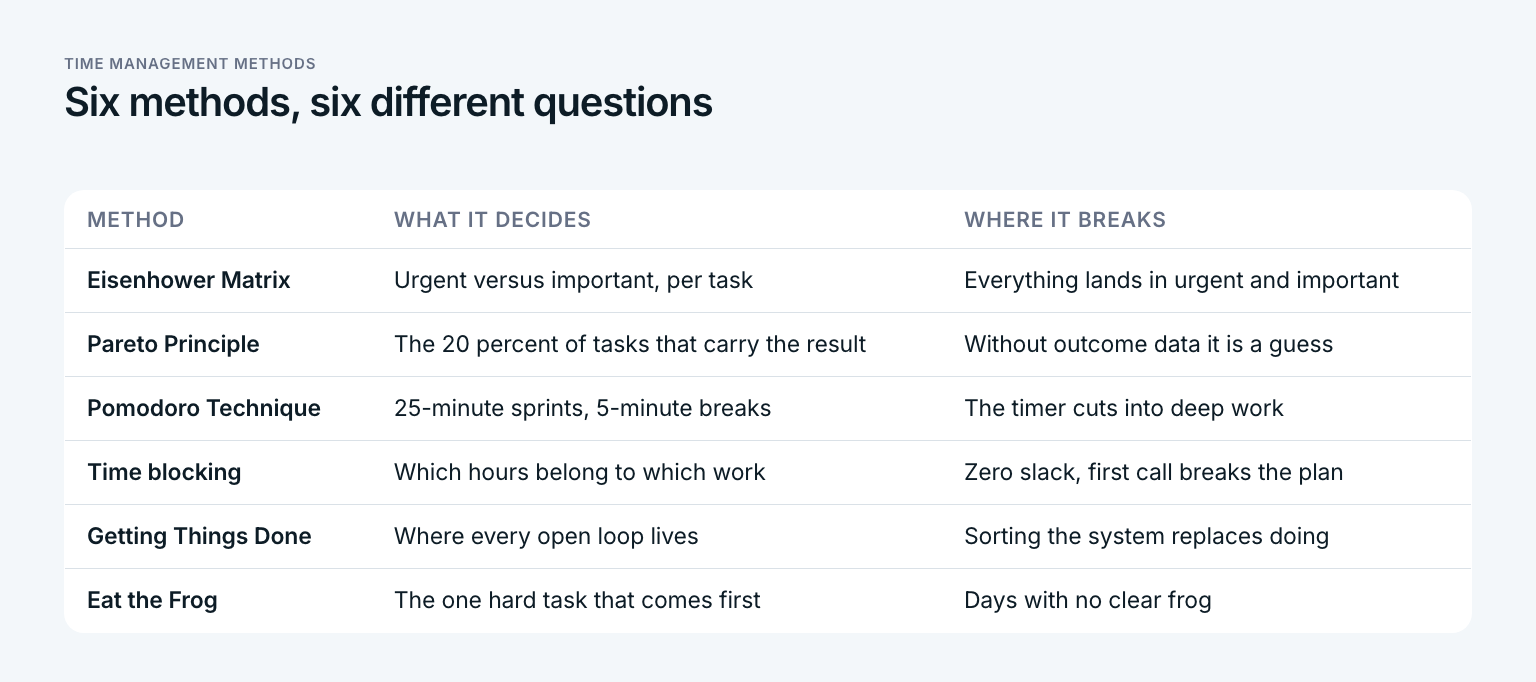
Eisenhower Matrix: sort first, then act
The Eisenhower Matrix asks two questions of every task: is it urgent, and is it important? The answers put it in one of four boxes: do now, schedule, delegate, delete. It is the fastest way to turn a 30-item list into a set of decisions. Its weak spot is the second question. Without a written goal, important becomes a feeling, and feelings vote for whatever is loudest. Elena used the matrix once, on Monday morning, to sort her audit list. Eleven of her recurring items landed in delegate or delete.
Pareto Principle: the few tasks that carry the result
The Pareto Principle, named after the economist Vilfredo Pareto and popularized for business by Richard Koch, says that a small share of causes produces most of the effect, often around 20 percent to 80 percent. Applied to time management it is a question: which few things on this list produce most of what I am paid for? For Elena, eight of 41 clients produced 61 percent of her revenue. That did not mean dropping the others. It meant the eight got scheduled first and the rest got batched into fixed slots. The ABC prioritization method turns the same question into a letter for every task on the list.
Pomodoro Technique: start, then stop on time
The Pomodoro Technique, developed by Francesco Cirillo, splits work into 25-minute sprints with 5-minute breaks, four sprints and then a longer pause. Its real strength is starting. Twenty-five minutes is small enough that resistance has nothing to push against. Its weakness is the timer going off in the middle of real concentration. Elena used it for admin and for the first half hour of any task she dreaded, and switched it off for reconciliation work once she was in it.
Time blocking: the calendar as a budget
Time blocking assigns every kind of work a fixed place in the calendar: two hours of client work here, 45 minutes of email there. The calendar stops being a list of meetings and becomes a plan for the day. It is the method that fixed Elena's 31 sessions, because a block is by definition one session. Its failure mode is a plan with no slack. Anyone who blocks 100 percent of their hours has planned to fail at the first phone call.
Getting Things Done: an empty head, a full system
Getting Things Done, from David Allen, is a system for capturing every commitment, clarifying the next physical action, and reviewing the whole list weekly. It is for people whose problem is not the hours but the open loops: 60 things half remembered, each one costing attention. It does not decide priorities for you. It makes sure nothing is lost while you decide. Its trap is tinkering with the system instead of using it.
Eat the Frog: the hardest thing before the inbox
Eat the Frog, popularized by Brian Tracy, has one rule: do your most important, most resisted task first thing, before email, before anyone needs you. Its power is that attention is freshest in the morning and the inbox is a trap. Its limit is that it decides one task per day and nothing else. For Elena, the frog was the payroll service. Ninety minutes, first thing, Tuesday through Thursday. That alone moved it from 1.5 hours a week to 4.5. Tracy's book adds 20 more principles around that one rule, and the Eat That Frog book summary walks through each in plain words.
Which one is right? The wrong question. The six methods answer different questions, and a working week usually uses two or three. Elena ended up with the Eisenhower Matrix on Monday morning, time blocks for the week, and Eat the Frog inside the first block of each day. In short: sort, then block, then start.
The 3-3-3 rule, the 7-8-9 rule, and the other numbers people search for
A handful of numbered rules show up in search results and in people also ask boxes. None of them is a complete system. Each is a useful constraint, and constraints are what time management is made of.
The 3-3-3 rule for time management
The 3-3-3 rule, described by Oliver Burkeman in his writing on productivity, structures a day as three hours on your most important project, three shorter urgent tasks, and three maintenance activities such as email, errands, or tidying. The appeal is the shape: one big thing, a few small things, and a reminder that upkeep counts. The limit is the first three. Three uninterrupted hours is a lot in a job with clients. Elena got to 90 minutes on most days, and that was enough to move the goal.
The 7-8-9 rule
The 7-8-9 rule is a balance rule, not a planning rule: seven hours of sleep, eight hours of work, nine hours for everything else, including meals, family, movement, and rest. It is useful as a weekly check. Add up your work hours. If they are at 52, like Elena's were, the rule tells you that the problem is not inside the workday. It is the size of the workday.
The 60-60-30 method
The 60-60-30 method structures a block of two and a half hours as two 60-minute focus periods, each followed by a short pause, and then a 30-minute full break. It is a longer cousin of Pomodoro, built for work that needs time to get deep. For reconciliation work, Elena found 60 minutes closer to her natural rhythm than 25.
The four types of time management
When people ask about the four types of time management, they usually mean four styles or four stages rather than four methods. The most useful version describes four stages that most people move through: reacting to whatever arrives, keeping lists, planning the calendar, and finally managing by goals, where the calendar follows the goal instead of the other way around. Most time management advice online is written for stage two or three. Everything here points at stage four.
How to build your time management system in six steps
Here is the sequence Elena followed, with her numbers. It takes one week to set up and four weeks to settle. Nothing in it requires a new app.
Log one week in 15-minute blocks
Paper or a plain spreadsheet. Write what you actually did, every 15 minutes, with no editing. Elena's log had 208 entries and took about ten minutes a day to keep. The result is the table above, and it is the only step that cannot be skipped.
Name the one goal for this month and the three priorities for the week
Elena's monthly goal: payroll service ready for the first five clients by October 31. Her three priorities for week one: finish the payroll software setup, write the client intake form, move email to two fixed slots. Three, not seven. Whoever writes seven priorities has written a list, not a decision.
Sort everything else with two questions
Take the audit list and ask of every recurring item: does it serve the monthly goal, and does it have a real deadline this week? Elena's result: eleven items delegated to her assistant or dropped, including a weekly report that nobody had opened since March.
Block the week, with 20 percent left empty
Put the goal work in first, at the time of day you are sharpest. Then client work in blocks of at least 90 minutes. Then two 45-minute email slots. Then leave a fifth of the working hours empty on purpose. Elena blocked 34 of 42 planned hours and left eight unassigned. They were used, every week, by things she could not have predicted.
Protect the first block of each day
Inbox closed, phone face down, status message on. The first block is where the goal work lives, because it is the only block that nothing has disturbed yet. Ninety minutes, Tuesday to Thursday, became Elena's payroll time. Nothing else was allowed in it.
Review for ten minutes on Friday
Three questions: what moved the monthly goal, what was planned and did not happen, what is the one thing next week. Write the answers down, adjust the blocks, and stop. The review is where the system learns. Without it, week five looks exactly like week one.
Four weeks after the first audit, Elena logged a second week. Total 43 hours. Email 5.5 hours in ten fixed slots. Switching 2.5 hours. Payroll build-out six hours. The billable client work stayed at 17 hours, but in 14 sessions instead of 31. Same work, nine hours less, one goal moving. That is what time management looks like when it is measured instead of felt.
Time management in your goal chain: year, quarter, month, week, day
Every method above works better with a goal to test against, and here is why. Important is not a property of a task. It is a relationship between the task and a goal. The question is it important has no answer until you can say important for what. A goal chain gives you the for what at every level: a yearly goal, broken into quarters, into months, into weeks, into today.
Elena's chain looked like this. Year: the practice runs on 40 hours a week and offers payroll to every client who wants it. Quarter: payroll service live for the first five clients by December 31. Month: software set up, intake form done, three clients onboarded. Week: intake form drafted and tested with one client. Day: 90 minutes on the intake form, Tuesday, first block. Each level is the reason for the one below it. When a request arrived on Tuesday morning, she did not have to think about whether it was important. She could look at the chain and see whether it was attached to anything.
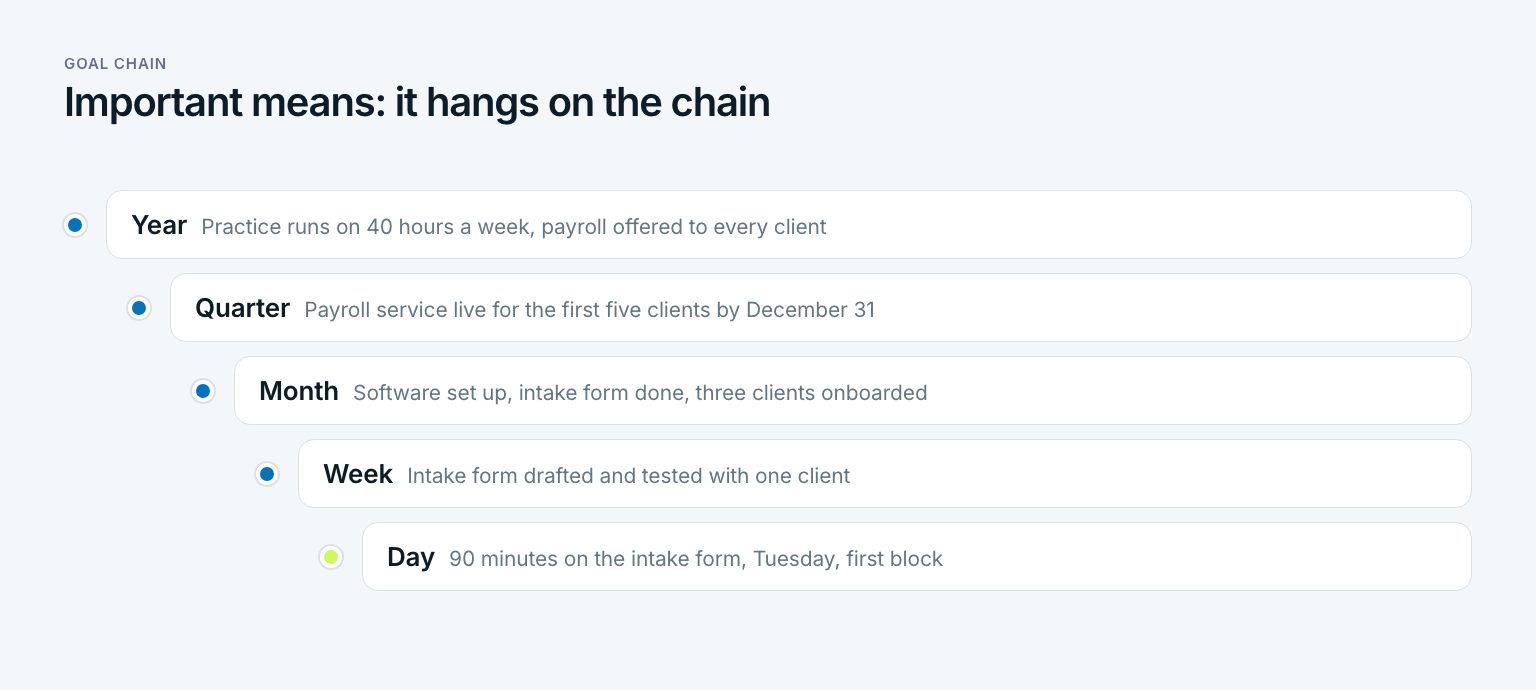
That means: your time management system does not need better willpower. It needs a chain it can check against. A tool like Gaapp holds the chain from the yearly goal down to today's task, so that the week's blocks are drawn from the goal instead of from the inbox. The same chain can live on an index card. What matters is that it exists before the week starts and that you look at it on Friday. The ten-minute weekly review is the moment where the chain gets checked and the next week's blocks get drawn from it.
Anyone who plans the week without a goal above it is time blocking in the dark. The blocks will be neat. They will also be arbitrary.
Time management skills: the four you actually need
Time management skills are often listed as if they were a dozen personality traits. In practice four skills carry the whole thing, and all four can be practiced with feedback.
- Estimating. Knowing that a task takes 90 minutes and not 30. The only way to learn it is to write down the estimate, do the task, and compare. Elena's estimates were off by about 60 percent in week one and by about 15 percent in week four.
- Deciding. Saying this and not that, before the day starts. It feels like loss, because it is. Every yes to a slot is a no to everything else that could have had it. Whoever cannot feel the no has not really decided.
- Protecting. Keeping a block intact when something arrives that is urgent but not important. The skill is a sentence: I am in a block until 11, I will come back to you then. Said for a month, it becomes a reputation.
- Reviewing. Looking at the week that happened, not the week that was planned, and changing one thing. This is the skill that separates a system from a resolution.
None of these are talents. They are reps. The weekly review is where all four get practiced at once, which is why it is the one habit that pays for every other one. If you set daily goals and check them against the week on Friday, estimating and deciding improve on their own. Skills like these sit on the border between time management and self-management, which adds energy and impulse control to the mix.
The three mistakes nobody notices
Most time management systems fail quietly, not in a crash. They fail by drifting, and three drifts account for nearly all of it.
The most common mistake: planning 100 percent of your hours
A plan that fills every hour is not a plan. It is a forecast of a day without surprises, and that day does not exist. The first unplanned call pushes everything back, the second one breaks the afternoon, and by Wednesday the plan is abandoned because it was wrong. Fix: block no more than 80 percent of your working hours. Elena left eight of 42 hours empty every week. The empty hours were never empty, and the plan held anyway.
- Managing tasks instead of goals. A perfectly executed to-do list that is not attached to a goal produces a tidy week and no progress. The fix is one line above the list: the monthly goal the list is supposed to serve. Three goals are enough, and often one is better.
- Treating the review as optional. The Friday ten minutes are the first thing cut in a busy week, and the busy week is exactly when they are needed. Skip it twice and the system is running on week-one assumptions in week six.
Have you noticed the pattern? None of the three is a failure of discipline. They are design errors, and design errors are fixed once, not every morning.
Three questions before you plan next week
Before you block a single hour, answer these three questions in writing. They take five minutes and they are the difference between a schedule and a system.
- What is the one goal this month that next week has to move? If you cannot name it in one sentence, the week has no spine, and the blocks will be filled by whatever arrives.
- Where did last week's hours actually go? Not where they were planned to go. If you do not know, log next week before you plan the one after.
- Which block will you protect even when the day goes wrong? One block. Name the time. That block is your time management system. Everything else is arrangement.
Time management is not about doing more. It is about deciding what the hours are for, giving that decision a place in the calendar, and checking every Friday whether the place was honored. Elena did not become faster. She became deliberate. Her week lost nine hours and gained one goal that moved every single week. In short: manage the decisions, and the time takes care of itself. If you want the full picture of how a yearly goal turns into a protected block on a Tuesday, the guide on how to achieve goals walks the whole chain, and annual planning is where the chain begins.
Frequently asked questions about time management
What are the 5 keys to time management?
Know where your hours go, decide what matters before the week starts, give important work a slot with a time and a length, protect that slot from interruptions, and review the week for ten minutes every Friday. Everything else, including apps and specific techniques, is a tool for one of those five. Start with the first one: log a week before you change anything.
What is the 3-3-3 rule for time management?
The 3-3-3 rule structures a day as three hours on your most important project, three shorter urgent tasks, and three maintenance activities such as email or errands. It is a shape for a day, not a complete system. Its hardest part is the first three hours, which many people shorten to 90 minutes to make it realistic.
What are the four types of time management?
The most useful version names four stages: reacting to whatever arrives, keeping lists, planning the calendar, and managing by goals, where the calendar follows the goal. Each stage improves on the previous one. Most advice is written for the list and calendar stages. Managing by goals is where the week stops being arbitrary.
What is the 7-8-9 rule for time management?
Seven hours of sleep, eight hours of work, nine hours for everything else, including meals, family, movement, and rest. It is a balance check rather than a planning method. If your work hours are far above eight, the rule tells you the problem is the size of the workday, not how it is organized inside.
What is the best time management technique?
There is no single best technique, because the methods answer different questions. The Eisenhower Matrix sorts, time blocking protects, Eat the Frog starts, Pomodoro paces, Getting Things Done captures, and the Pareto Principle cuts. Most working systems combine two or three. A common and effective stack is: sort on Monday, block the week, start each day with the hardest task.
How do I improve my time management skills?
Practice four things with feedback: estimate how long tasks take and compare afterward, decide three priorities before each week, protect one block a day from interruptions, and review every Friday what moved and what did not. Skills improve from reps, not from reading. One logged week and four weekly reviews will change more than any course.
Last updated: 19 October 2026
Read next
 Productivity
Feynman Technique: Four Steps to Real Understanding
The Feynman technique is not a memorization trick: four steps, a worked example from a stats class, a one-page template, and what research says.
16 min read
 Productivity
Zettelkasten: How to Turn Notes Into Your Own Ideas
A Zettelkasten is not an archive: Luhmann's method, the three note types, a five-step setup and an Obsidian template, with a worked example.
15 min read
 Productivity
Second Brain: How to Build One You Actually Use
A second brain is not a note archive: Tiago Forte's CODE steps, the PARA method with an example, a five-step setup and the mistakes that sink it.
15 min read