How to Be More Organized: One System for Your Week
Being organized is not a personality trait. Four areas, five steps, ten organization tips, and a worked week with real numbers, from year to day.

Contents
- 01What being organized means, and what it is not
- 02Organization vs. self-management: where the line is
- 03What really happens in Chris's week: six inboxes, 220 minutes of searching
- 04The organizing system: four areas, one inbox, one routine
- 05How to be more organized: five steps over four weeks
- 06How to get organized with the right method
- 07Organization tips: ten rules for everyday life
- 08The three mistakes nobody notices
- 09How to organize your life around a goal: from year to day
- 10Frequently asked questions about getting organized
Being organized is not a personality trait. Learning how to be more organized comes down to a system: one fixed home for your tasks, one for your appointments, one for your papers, a clear workspace, and a short weekly routine that keeps everything where it belongs. Some people look naturally tidy. Look closer and they almost always run a system they no longer notice. Anyone who wants to get organized doesn't need a new personality. They need fewer places to look and one habit that maintains them.
This guide works through the whole thing with Chris, 42, a high school chemistry teacher, assistant track coach, and father of two. In September his open tasks lived in six different places, he spent 220 minutes a week looking for things, and he missed a parent conference. You'll see what an organizing system contains, how to build one in five steps over four weeks, which methods fit which problem, ten organization tips, the three mistakes nobody notices, and how being organized connects to the goals you actually care about.
What being organized means, and what it is not
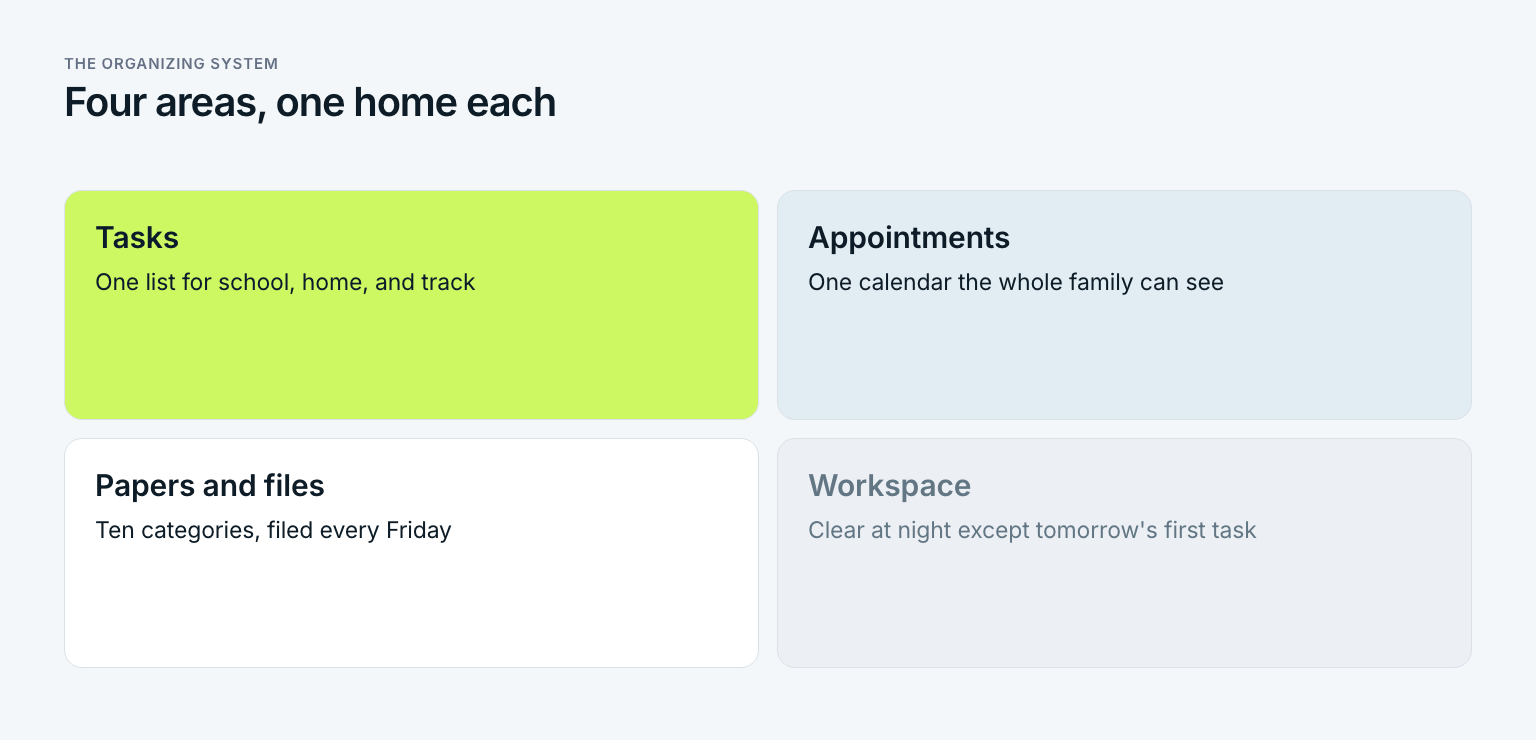
Being organized means you know what's coming up and where things are without having to think hard about it. In practice that covers four areas. Tasks are everything you need or want to do. Appointments are everything tied to a date or time. Papers and files are the documents you have to keep. Your workspace is wherever you handle all of it, whether that's a desk, a kitchen table, or a laptop. An organized person has exactly one trusted home for each of the four.
Being organized is not the same as tidying up. Tidying creates a state, organization keeps it. Whoever spends three hours cleaning every Sunday and is searching again by Wednesday has a system problem, not an effort problem. It isn't perfectionism either. A system doesn't need to look good. It needs to be simple enough that you still use it in your worst week. In short: organization is a set of places and rules that makes order cheaper than mess.
Organized vs. neat: the difference that matters
Neatness is how things look. Organization is whether you can find them. A desk covered in labeled stacks can be perfectly organized, and a spotless desk can hide a drawer full of unopened mail. That means: judge your system by search time and missed deadlines, not by how it would look in a photo.
Organization vs. self-management: where the line is
The two ideas overlap, but they answer different questions. Self-management is about steering yourself: your goals, your energy, your impulses, and why you do something or avoid it. Organization is about arranging your stuff: tasks, appointments, papers, and workspace, and where something is and when it happens. Self-management is the driver. Organization is a car where the keys always hang on the same hook. That means: anyone who has strong intentions and still misses the dentist is not short on willpower. They are short on a calendar they trust.
| Aspect | Organization | Self-management | Time management |
|---|---|---|---|
| Core question | Where is it, and when is it due? | Why do I do it, and what stops me? | What do I do when? |
| Covers | Tasks, appointments, papers, workspace | Goals, energy, impulses, habits | Hours and sequence |
| Typical symptom | Searching, forgetting, doing things twice | Procrastinating, burning out, scattering | Too much for too little time |
| Tools | Inbox, list, calendar, files | Yearly goal, weekly review, fixed rules | Daily plan, time blocks, priorities |
The three depend on each other. Time management plans hours that vanish into searching if your stuff is a mess. Self-management sets goals that drown in clutter without a system underneath. So which one is your bottleneck? A gut feeling won't tell you. A measured week will.
What really happens in Chris's week: six inboxes, 220 minutes of searching
Chris thought of himself as a disorganized person. He had bought two planners and tried three apps, and each one was abandoned within a month. Before changing anything, he tracked one ordinary school week. He wrote down every place where a task or date was stored, and every minute he spent looking for something. He wasn't allowed to fix anything that week.
He found six places holding open items:
- Sticky notes on his classroom desk: 14 notes, five of them from August.
- Flagged emails: 37 in his school account and eight in his personal one.
- Texts to himself: a running thread of reminders, photos of whiteboards, and links.
- The school-issued paper planner: lesson plans and grading deadlines, but nothing from home.
- The family calendar on the fridge: doctor visits, birthdays, and the kids' practices, but no school events.
- His head: everything he meant to remember, like calling the bus company about the track meet.
Then came the search time. Over five school days he spent 220 minutes hunting: for signed lab permission slips, for the track meet schedule, for the current version of a quiz on the shared drive, and twice for his car keys. In September he missed a parent conference and nearly missed the deadline for a field trip form. Both were written down. Just not where he looked.
The number that surprised him most wasn't the 220 minutes. It was the six. Anyone who has to check six places ends up checking none of them properly. Each place made sense on its own. Together they weren't a system. That means: Chris wasn't a messy person. He had too many inboxes and trusted none of them.
The organizing system: four areas, one inbox, one routine
A system that works has exactly one home for each area. In front of it sits an inbox that catches anything new, and behind it a weekly routine that brings everything back in line. That's all it takes. Every extra tool is one more place you have to check.
The inbox: one place for everything new
The inbox is where things land before you've decided what they are. A tray for paper, a notes app for when you're out, your email. Three inboxes are the limit. The rule is that nothing lives in the inbox. You empty it every day or two, and every item moves to its home or into the trash. David Allen calls this capturing and clarifying in his 2001 book Getting Things Done, and his GTD method builds a complete system of context lists on top of it. To get organized, you only need the core: one inbox that gets emptied on a schedule.
Tasks: one list instead of six
Every task lives in one place, whether it comes from work, home, or a side commitment. You separate the areas with headings or tags, not with separate lists. That master list is storage, not a plan for today. Each evening you pull a short selection from it for the next day, and the guide on how to write a to-do list shows what that selection looks like. Whoever confuses the master list with today's plan opens a list of 60 items every morning and starts none of them.
Appointments: one calendar for everything
One calendar means school, family, and coaching dates all show up in the same view, in different colors if you like. Two calendars that don't know about each other create exactly the gap Chris's parent conference fell through. Only things tied to a time belong in the calendar: appointments, deadlines, and reminders for deadlines. Tasks without a fixed time stay on the list. Otherwise the calendar turns into a second to-do list, and you drag ten entries to tomorrow every night.
Papers and files: a few clear categories
Paper and digital files follow the same logic. A filing system with a few clearly named categories beats an elaborate folder tree, because you'll still use it when you're tired. Most households need about ten: home, car, health, insurance, taxes, banking, work, kids, school, and everything else. Your digital folders get the same ten names, so you search the same way in both places. The most useful rule is a filing day. Receipts and forms collect in the inbox tray and get filed once a week, not one at a time on the day they arrive.
Your workspace: clear at the end of the day
The workspace is the most visible area, which is exactly why people overrate it. A clean desk doesn't make a system. But a buried desk can sink one, because new and old items blur together. The simplest rule: at the end of the day, the only thing on your desk is the first thing you'll work on tomorrow. Everything else is in the inbox, in a file, or in its place. Factories know this logic as 5S, an approach from Japanese manufacturing: sort, set in order, shine, standardize, sustain.
The routine: 20 minutes on Friday
Without maintenance, any system falls apart in three or four weeks. The routine is one fixed appointment per week where you empty every inbox, go through the list, check the calendar two weeks ahead, file papers, and clear the desk. For Chris it's 20 minutes on Friday after the last bell. Anyone who pairs it with a ten-minute weekly review also checks, in the same half hour, whether the week moved their goals forward.
How to be more organized: five steps over four weeks
You can train yourself to be organized the way you learn any skill. Not in one heroic cleanup weekend, but one step at a time over four weeks. The order matters. Whoever starts by filing papers ends up sorting documents while the tasks still live in six places.
Track one week, seven days
For one week, write down every place where a task, appointment, or document is stored. Log every search with the minutes it took. Don't change anything yet. At the end you have two numbers: how many places you use and how much time you lose searching.
Pick one home per area, 30 minutes
For each of the four areas, choose exactly one home, and allow no more than three inboxes for new items. Write it down: tasks in one app, appointments in your phone calendar, paper in the tray by the door. From today on, every other place only gets emptied, never filled.
Collect everything once, two hours
Gather everything from the old places: sticky notes, flagged emails, notebooks, your head. Every item goes into the inbox and gets one decision. Is it a task, an appointment, a document, or trash? Anything that takes less than two minutes, you do on the spot.
Start the Friday reset, 20 minutes a week
Put a recurring appointment in your calendar and run the same checklist every week: empty the inboxes, review the list, check two weeks of calendar, file papers, clear the desk. Keep the appointment when the week was hectic. Especially then.
Measure again after four weeks, 30 minutes
Track one more week: number of places and search time. Compare them with week one. Where something still sticks, change one rule, not the whole system. A system you rebuild from scratch every month isn't a system. It's a hobby.
Steps two and three do the heavy lifting. Step one makes the problem visible, step four holds the gains, and step five shows whether it worked. If you only manage one step, take step two: one home per area. That alone cuts the number of places you search down to four or five.
Chris's week, four weeks later
Chris worked through the five steps in October. His inboxes are now a tray on his classroom desk, a notes app on his phone, and his two email accounts. Tasks live in one app under three headings: school, home, track. All dates live in one shared calendar his wife can see too, and the fridge calendar is gone. His files have ten categories, and permission slips go into a single folder that he empties every Friday.
| Measure | Week one | Week five |
|---|---|---|
| Places holding open items | 6 | 4 |
| Search time per week | 220 minutes | 50 minutes |
| Missed appointments per month | 1 | 0 |
| Flagged emails | 45 | 7 |
| Fixed maintenance time per week | none | 20 minutes on Friday |
Chris didn't use the nearly three hours he got back to squeeze in more grading. They became two writing blocks for a project he had postponed for two years: a hands-on forensic chemistry unit of 12 labs. That is the real payoff of being organized. Not a clean desk, but the time and attention it frees up. In short: order isn't the goal. It's what makes room for one.
How to get organized with the right method
There are dozens of organizing methods, and most of them cover only one of the four areas. That's not a flaw. Each one is built for a specific job. The question is simply: which area is your bottleneck?
| Method | Area | What it does | When it fits |
|---|---|---|---|
| Getting Things Done by David Allen | Inbox and tasks | Empties your head, clarifies every item, sorts by context | Many open loops from many sources |
| Two-minute rule | Tasks | Do small things now instead of writing them down | Long lists full of tiny items |
| Inbox Zero by Merlin Mann | Process email to empty on a schedule, one decision per message | More than 50 emails a day | |
| One-home rule | All four | Every area and every object has exactly one place | Always, as the foundation |
| Tickler file, also called 43 folders | Papers | Paper comes back on the day you need it | Paper deadlines, school and family forms |
| 5S | Workspace | Sort, set in order, shine, standardize, sustain | Shared or crowded workspaces |
| Time blocking | Appointments | Gives big tasks a fixed slot in the calendar | Important work that never gets started |
| Weekly reset | All four | Brings the system back in line once a week | Always, or the system decays |
Two methods cover all four areas, the rest are add-ons. The one-home rule and the weekly reset are the foundation. Everything else you pick by bottleneck. Whoever drowns in email starts with Inbox Zero. Whoever misses paper deadlines starts with a tickler file. Whoever juggles too many half-finished tasks starts with a personal kanban board and a limit on work in progress. That means: you don't need more methods. You need the one that fits the area where you're stuck.
Organization tips: ten rules for everyday life
These rules are small enough to survive a busy week. None of them needs a new tool, and each one works on its own.
- Give everything a home. Keys, glasses, chargers: one spot, always the same one. That saves more search time than any app.
- Write it down instead of remembering it. Anything you want to remember goes into an inbox. Your head is for thinking, not for storage.
- Do it now if it takes under two minutes. A short reply, a form to file, a payment to approve.
- Enter every deadline twice. Once on the due date and once a week earlier as a reminder.
- One in, one out. For clothes, books, and kitchen gadgets. That way your stuff never grows faster than your space.
- File paper weekly, not daily. Receipts and forms collect in the tray and get filed on one set day.
- Clear the desk before you leave. Five minutes at the end of the day, so tomorrow doesn't start with cleanup.
- Pick tomorrow's three tasks tonight. Three from the master list, no more.
- Batch similar things. Calls, errands, and email in set blocks instead of scattered across the day.
- Spend 20 minutes on Friday. The appointment without which every other rule fades within three weeks.
Which one are you missing most? Start with that one and add the next only after it has held for two weeks. Anyone who introduces all ten on Monday has none left by Thursday.
The three mistakes nobody notices
Most attempts to get organized don't fail because of laziness. They fail because of three mistakes that feel like progress.
First: too many places. Every new tool is supposed to create order and instead creates another place to check. Chris's two planners and three apps each became one more inbox. A new tool is only worth it if it replaces an old place. If it adds one, it makes things worse.
Second: a system built for the ideal week. Systems that only work in calm weeks collapse in exactly the weeks you need them. Whoever maintains 30 labels and a color code drops both in the first crunch week. The test: would you still use it after a 10-hour day?
Third: cleaning up instead of keeping up. A big decluttering weekend feels great and rarely lasts. Order doesn't come from one big push but from small, regular maintenance. Without a fixed weekly slot, things are back where they started within three or four weeks.
The most common mistake: buying the tool before building the system
People who feel disorganized almost always buy something first: a planner, an app, a set of bins. It feels like action. But a tool without rules is just another place where open items pile up. Chris's planners solved nothing. Deciding on one home per area did. That means: settle the places and rules first, then pick the tool that fits them. For the task list, the guide to the best to-do list app narrows the choice down with five questions.
How to organize your life around a goal: from year to day
Being organized is not an end in itself. It frees up time and attention, and the real question is what for. For Chris it's the forensic chemistry unit he wants to pilot with two of his classes next spring. Here's how his chain from year to day looks:
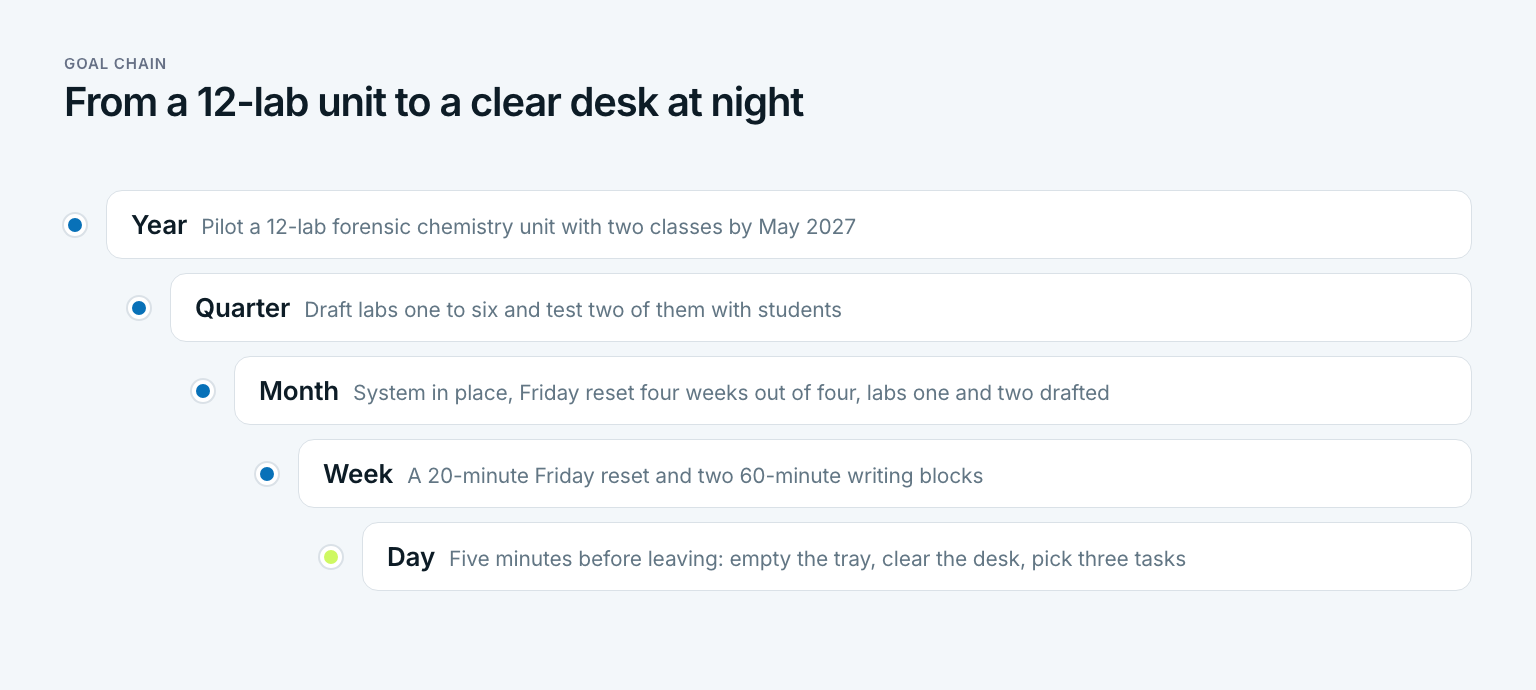
Organization doesn't sit at the top of this chain. It sits at the bottom, as the daily habit that carries the yearly goal. In the first month it is even a goal of its own, because the system has to stand before the writing blocks can happen reliably. In Gaapp you set the yearly goal once, break it down into quarters, months, and weeks, and check off the Friday reset as a weekly goal. If you first need to shape the goal itself, the guide on how to achieve goals walks you through it.
Whoever links things this way sees it all on Friday at a glance: the reset happened, the writing blocks happened, the quarter is on track. If Chris skips the reset two Fridays in a row, he notices it in the weekly number, not at the next missed conference.
Three questions for your own system
- How many places hold your open tasks and dates right now?
- How many minutes did you spend searching this week?
- When is your fixed weekly appointment to maintain the system?
If your answers are more than four, more than 60, and never, you know where to start. In the end, being organized isn't about loving order. It's about whether your system still holds on a packed Wednesday.
Frequently asked questions about getting organized
How do I train myself to be organized?
Start by measuring one week: how many places hold your open tasks and how long you spend searching. Then pick one home each for tasks, appointments, and papers, collect everything into them once, and set a 20-minute weekly reset. After four weeks, measure again and change one rule at a time.
Do people with ADHD like organizing?
Some do and some don't, because ADHD shows up differently in different people. A common pattern is that setting up a new system feels easier than maintaining it. That's why simple external structure tends to help more than elaborate setups: one visible list, fixed homes for everyday items, and a short routine on the calendar. If organizing is a persistent struggle, a clinician or ADHD coach can help tailor the approach.
What are 5 golden rules for professional organizing?
Professional organizers phrase them differently, but five rules come up again and again: give every item a home, own fewer things, group like with like, capture everything in one place, and schedule regular maintenance. The last one matters most, because every system decays without it.
What personality is very organized?
In the Big Five model of personality, being organized belongs to conscientiousness, the trait that covers orderliness, dependability, and self-discipline. People high in it tend to keep order with little effort. A trait is a starting point, not a limit, though. People low in conscientiousness can be just as organized with a simple system and a weekly routine.
What is the fastest way to get organized?
The fastest single change is to cut the number of places where open items live. Pick one list for tasks and one calendar for dates, then move everything from sticky notes, flagged emails, and your head into them in one two-hour session. The weekly reset keeps it from sliding back.
How do I organize my life when I feel overwhelmed?
Don't start with a big cleanup. Write everything that's on your mind into one inbox, sort it into tasks, dates, and documents, and pick only three tasks for tomorrow. Once that feels manageable, add the weekly reset. Overwhelm usually comes from open loops spread across too many places, not from the amount of work alone.
Last updated: 19 October 2026
Read next
 Productivity
Feynman Technique: Four Steps to Real Understanding
The Feynman technique is not a memorization trick: four steps, a worked example from a stats class, a one-page template, and what research says.
16 min read
 Productivity
Zettelkasten: How to Turn Notes Into Your Own Ideas
A Zettelkasten is not an archive: Luhmann's method, the three note types, a five-step setup and an Obsidian template, with a worked example.
15 min read
 Productivity
Second Brain: How to Build One You Actually Use
A second brain is not a note archive: Tiago Forte's CODE steps, the PARA method with an example, a five-step setup and the mistakes that sink it.
15 min read