Stages of Team Development: How to Lead Each One
The stages of team development are not a checklist: Tuckman's five stages, a worked example, five steps to lead them and the model's limits.

Contents
- 01The five stages of team development at a glance
- 02Where Tuckman's stages of group development come from
- 03The team forming stages on a real project
- 04Storming is not a failure: what the conflict is for
- 05How to lead through the stages of team development in five steps
- 06Why teams slip back, and what to do when they do
- 07What the model cannot do: limits and criticism
- 08The three mistakes nobody notices
- 09Team stages in your goal chain: from year to day
- 10Your self-audit: which stage is your team in?
- 11Frequently asked questions about the stages of team development
The stages of team development are not a checklist a team finishes once. They describe how a group of people becomes a working team in five steps: forming, storming, norming, performing and adjourning. Psychologist Bruce Tuckman published the first four in 1965 and added the fifth with Mary Ann Jensen in 1977. Anyone who knows the stages can read silence, conflict and speed in a team as signs of where it stands, and lead accordingly.
The labels are the easy part. The useful part is the question the model puts to every manager: What does my team need right now, and am I giving it? A new team needs direction. A team in conflict needs rules for working through it. A team that has found its rhythm needs room. Each stage therefore calls for a different one of the classic leadership styles, from directing through facilitating to giving room. Whoever gives every team the same thing gets at least two stages wrong.
Priya will walk you through each stage. She is a product manager at a mid-size software company, and in January she gets a new cross-functional team of six, herself included. The mission: raise the share of new accounts that are active after 30 days from 22 percent to 35 percent by September 30. In October the team will be folded into other groups. Her year shows every stage with real situations and numbers.
The five stages of team development at a glance
Each stage has its own pattern of behavior, mood and output. The table puts Tuckman's stages of group development side by side, with what you will notice as a leader and what your job is in that stage.
| Stage | What happens | What you notice | Your job as the leader |
|---|---|---|---|
| Forming | People get to know each other and test the rules | Politeness, questions aimed at the leader, little pushback | Make the goal, roles and ground rules clear |
| Storming | Ideas and egos collide, roles get negotiated | Disagreement, side conversations, meetings run long, output dips | Keep conflict in the open and offer a way to decide |
| Norming | The team agrees on how it works | Shared language, fewer escalations, a growing sense of us | Let the team write its own rules, hand over ownership |
| Performing | The team works toward the goal on its own | High pace, problems solved without the leader | Remove obstacles, make progress visible |
| Adjourning | The team disbands or loses members | Winding down, mixed feelings, worry about what comes next | Close the work well, capture lessons, say thank you |
The order matters. A team cannot agree on rules before it knows what it disagrees about. It cannot work on its own before it has rules. That means: each stage sets up the next one, and a team that skips a stage tends to go back for it later, usually at a worse moment.
Where Tuckman's stages of group development come from
Bruce Tuckman was an American psychologist who later taught educational psychology at Ohio State University. In 1965 he published a paper in the Psychological Bulletin called “Developmental Sequence in Small Groups”. He reviewed about 50 studies of small groups and looked for a shared pattern. Most of those groups were therapy groups, training groups and lab groups. Only a small share were work teams inside organizations.
Tuckman described two layers that most summaries leave out. One is the interpersonal layer: How do members relate to each other? The other is the task layer: How do they relate to the work? Something happens on both layers in every stage. In storming, people do not only clash with each other. They also push back against what the task demands. In norming, they do not only get friendlier. They start sharing honest information about the work for the first time.
The rhyming names came from Tuckman himself, and they are a big reason the model stuck. Twelve years later, he and Mary Ann Jensen reviewed newer research and added adjourning, the stage in which a team breaks up. Since then, the model has five team forming stages, not four.
Term: group versus team
A group is a set of people who are together or work side by side. A team is a group with a shared goal, distinct roles and real dependence on each other. The stages of team development describe exactly that shift, which is why the model starts with a group and ends with a team.
The team forming stages on a real project
A model stays abstract until you watch it play out. Priya's team shows how the stages feel, how long they last and what tips one into the next. On the team are Marcus and Aisha as engineers, Leo as designer, Grace as data analyst and Tom from customer success.
Forming: everyone looks to the leader
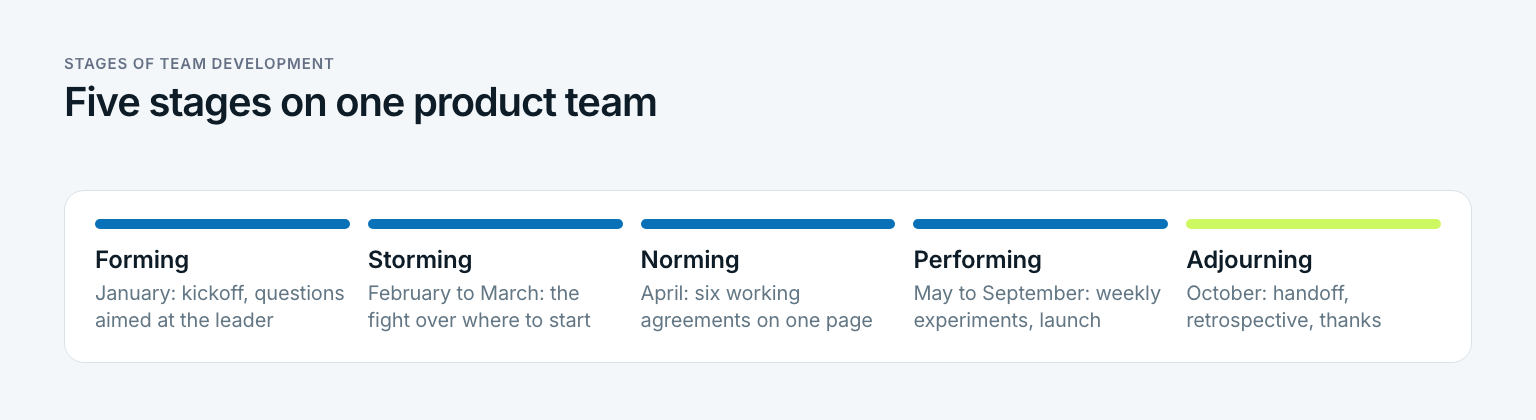
The January kickoff goes smoothly. Everyone introduces themselves, everyone nods, nobody pushes back. Most questions go to Priya: Who decides what we build? How much of our week is this? What happens if the number does not move? That is forming. People are working out what behavior is expected and how much room they have.
Priya does three things in this stage. She states the goal with a number and a date. She writes down who owns what. She sets the frame: a 30-minute planning session every Monday, a 15-minute standup on the other days, and a shared dashboard for the activation rate. Anyone who leaves too much open in forming makes it last longer. Uncertainty here is not a weakness. It is the normal state.
Storming: the fight over where to start
By mid-February the politeness is gone. Marcus wants to rebuild onboarding from scratch because the old code is fragile. Leo wants four weeks of user interviews first. Tom keeps saying the real problem is the pricing page, not onboarding at all. Standups stretch from 15 to 35 minutes, and activation sits at 22 percent.
Priya is tempted to make the call herself. It would have been faster. It would also have ended the argument without answering the deeper question of who gets to decide what. Instead, she asks Grace to pull the data on where new accounts drop off and sets up two small experiments for two weeks. The team agrees in advance that the results decide. In short: she leads the conflict instead of shutting it down.
Norming: six working agreements
In April something shifts. The data shows that 61 percent of new accounts never finish the setup checklist, and Marcus proposes rebuilding just that step first. The team writes six working agreements on one page. Among them: every meeting starts with the activation number, any decision gets one round of objections and then stands, and nobody ships a change without a way to measure it.
You can hear norming. “Your idea” becomes “our test”. Questions that used to go to Priya get settled between teammates. Whoever dictates the rules in this stage takes away the very thing that is forming: the team's sense that the rules are its own.
Performing: experiments, a setback and a launch
From May on the team ships a change almost every week. Activation reaches 26 percent in June. In July Aisha moves to another team, and a new engineer, Sam, joins. For about two weeks he asks questions everyone thought were settled, and an old debate about the setup checklist flares up again. The team slips back for a moment, but it finds its rhythm much faster than in February, because the agreements are written down.
| Month | Stage | 30-day activation | Average standup length |
|---|---|---|---|
| January | Forming | 22 percent | 15 minutes |
| February | Storming | 22 percent | 35 minutes |
| March | Storming | 23 percent | 25 minutes |
| April | Norming | 24 percent | 15 minutes |
| July | Performing, brief slip | 29 percent | 20 minutes |
| September | Performing | 36 percent | 10 minutes |
Adjourning: closing the loop
In October the team is folded into two platform teams. Priya books a two-hour closing session. The team reviews the numbers, writes down what the platform teams now need to maintain and hands over the dashboard. Each person names one thing they will take into their next team. At its core, the session is a final retrospective for the whole project. Anyone who skips this stage loses more than knowledge. They also lose people's willingness to sign up for the next project.

Storming is not a failure: what the conflict is for
Storming is the stage in which a team puts its differences on the table. People argue about goals, methods, roles and influence. Many managers experience it as a step backward because the mood turns and the pace drops. It is a step forward, because this is the first time people say what they actually think.
Harmony in forming feels good. It has one catch: it rests on nobody risking anything yet. A team that never argues has not resolved its differences. It has hidden them. Amy Edmondson of Harvard Business School showed in a 1999 study that teams learn more when members feel safe enough to raise mistakes and objections openly. She called it psychological safety. Storming is where a team finds out whether it will build that safety.
How do you know a conflict is moving the team forward? Look for three signals:
- Task conflict, not personal conflict: The argument is about the onboarding flow, not about Marcus.
- Everyone speaks: Quieter members raise objections too, not only the loudest ones.
- It ends somewhere: The argument leads to a decision or a test, not to the next round of the same debate.
If one of the three is missing, the team needs more structure from you. That might be a clear rule for how decisions get made, a private conversation, or a meeting with a neutral facilitator. For hard one-to-one conversations, a clear sequence helps, as in how to give feedback to employees: describe the behavior, name the impact, agree on what changes.
How to lead through the stages of team development in five steps
The model only pays off when you use it on a schedule. These five steps work for teams that are new or are reshuffling. Together they take less than an hour a month.
Check the stage once a month
Ask each member to place the team in one of the five stages without talking to anyone first, and to give one reason. In March, four of Priya's six voted storming and two voted norming. The split told her more than the majority did, because it showed that Marcus and Grace already considered the argument settled.
Match your leadership style to the stage
In forming you direct, in storming you coach, in norming you support, in performing you delegate. This lines up with the situational leadership model by Paul Hersey and Ken Blanchard. Whoever still gives instructions to a performing team slows down people who could run on their own.
Bring one stage question into the weekly meeting
Each stage has a guiding question. Forming: Is everyone clear on why we exist? Storming: What are we not talking about that we should be? Norming: Which rule are we still missing? Performing: What is slowing us down right now? One question, five minutes, every week.
Write the rules down
As soon as the team settles on how it works, those agreements belong on one page that everyone can see. When someone new joins, that page is the fastest way back to full speed.
Plan the ending before it arrives
Put the closing session on the calendar as soon as the end date is known. Plan time for a look back, a handoff and a thank you. A team that ends well starts faster next time.
The first step matters most. Leaders tend to rate their team's stage more optimistically than the team does. That means: your own read is a hypothesis, not a diagnosis. Only when you compare it with what the team says do you know where it really stands.
Why teams slip back, and what to do when they do
Many trainers draw the stages as a cycle rather than a straight line, and for good reason. A team can move backward. Every change in membership, a new goal or a new manager turns the clock back a little. For Priya it was Sam joining in July that pulled the team back toward storming for two weeks.
Common triggers for a slip are:
- someone joins or leaves the team,
- the goal changes or grows significantly,
- a new manager takes over,
- pressure from outside, such as budget cuts or a lost customer.
Anyone who expects these slips does not panic when a strong team suddenly argues like it did on day one. They ask what changed and pull out the agreements from norming. A second pass through the stages is usually much shorter than the first, because the team has been there before.
What the model cannot do: limits and criticism
Tuckman's model is simple, memorable and useful in practice. It also has limits you should know before you lean on it. Three objections come up again and again.
The first is the evidence. In 1965 Tuckman did not observe teams himself. He reviewed studies that mostly came from therapy and training groups. Work teams operate under different conditions: deadlines, bosses, customers. Tuckman named this limitation in his own paper.
The second is the sequence. In 1988 organizational researcher Connie Gersick followed project groups from their first meeting to their last. She did not find a steady march through stages. Instead, the groups worked in one pattern for a long stretch and then changed their approach sharply at roughly the halfway point of their available time. Gersick called this punctuated equilibrium. For practice, that means the midpoint of a project is a strong moment for a change of course. Priya used it: in early May, halfway to the deadline, the team cut two planned features and doubled down on the setup checklist.
The third is measurement. There is no number that tells you whether a team is in storming or already in norming. The stages overlap, and different members experience them at different times. In short: the model is a map, not a gauge. It helps you ask the right question, but it does not answer it for you.
The three mistakes nobody notices
Most mistakes with this model come from good intentions. They come from wanting a team to be productive quickly. That is exactly why they are hard to spot.
The most common mistake: cutting storming short
Many managers end the first real argument by making the decision themselves. It feels efficient and calms the meeting down. The conflict is not solved, though. It is postponed. It comes back the next time the team is under pressure, and this time without the agreements the team could have built during storming. Whoever leads the argument instead of ending it saves the time twice over later.
- Assuming everyone is in the same stage. A team is rarely in one stage as a whole. New members are often still forming while the rest of the team is norming.
- Treating performing as the finish line. A performing team still needs care. Without new challenges and visible results, energy drops and habit replaces thinking.
- Skipping adjourning. Projects often just fade into the next thing. Whoever does not recognize what a team achieved gets more cautious people on the next project.
All three have the same root. They treat the stages as obstacles on the way to results. The stages are the way. Once that clicks, you stop asking how to push the team through faster and start asking what it needs from you in the stage it is in.
Team stages in your goal chain: from year to day
A team does not develop in a vacuum. It develops around a goal. A goal chain turns that goal into a year, a quarter, a month, a week and a day. When you build the stages of team development into that chain, you see early whether a goal is stuck because of the plan or because of the team. How to set shared goals in the first place is covered in team goals. This section is about how the stage shapes the plan.
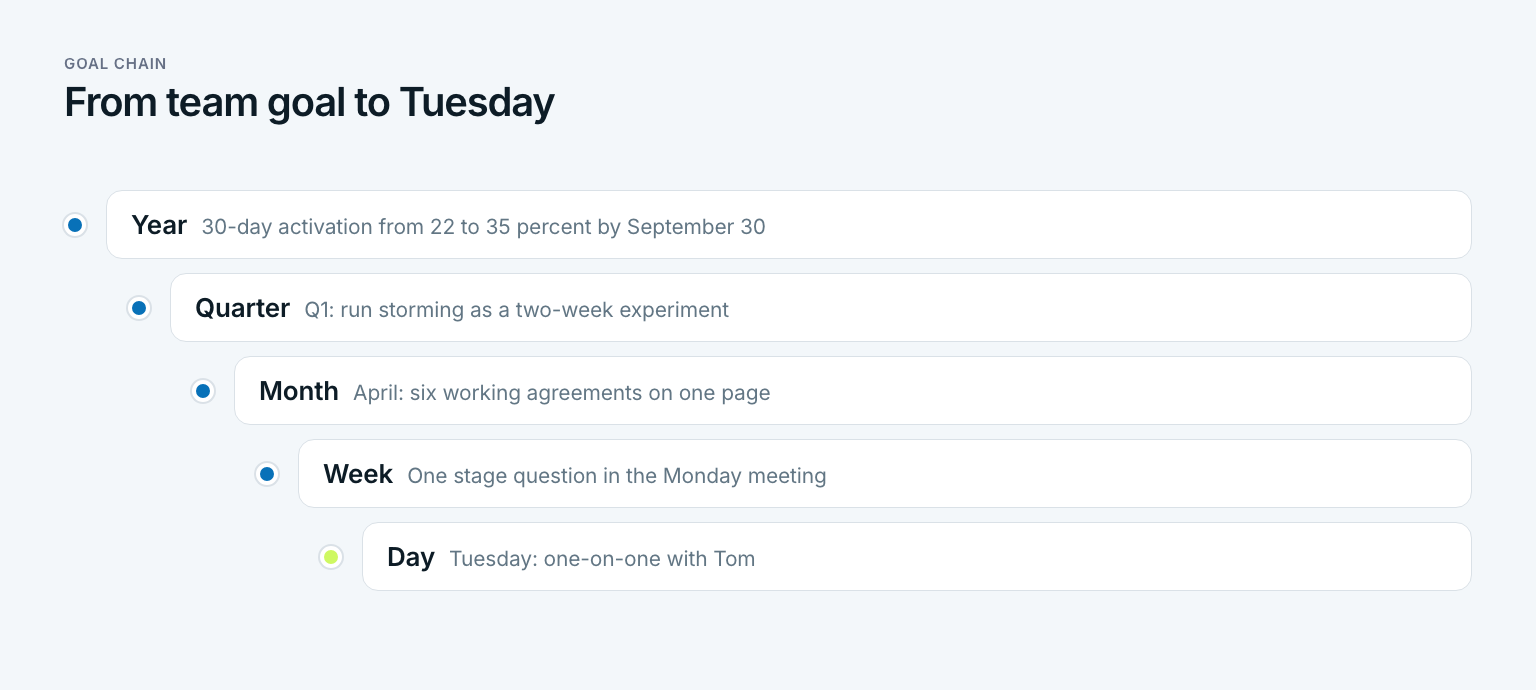
- Year: The team goal has a number and a date. For Priya: 30-day activation from 22 to 35 percent by September 30.
- Quarter: Each quarter gets a team focus that fits the stage you expect. In Q1, Priya's was: run storming as an experiment, do not shut it down.
- Month: At the end of each month, the team rates its stage and compares it with the plan. In April the monthly goal was to get the agreements on one page.
- Week: The stage question goes into the weekly meeting, next to the number of the week.
- Day: At the daily level, the stage turns into one concrete action, such as a one-on-one with Tom on Tuesday because he had been talked over during storming.
For your own role, a personal leadership goal is worth adding. Goals for managers shows how to make those measurable. In a goal app like Gaapp, the whole chain lives in one shared space: the team sees the same yearly goal and the same weekly number, and the stage becomes part of the conversation about progress.
Your self-audit: which stage is your team in?
Three questions help you place your team honestly. Answer them for yourself before you ask the team:
- When did someone last openly disagree with a decision, and what happened next?
- Which of your working agreements could every member list from memory?
- What would happen over the next two weeks if you were out sick?
If nobody can answer the first question, the team is probably still forming or is suppressing its storming. If the second question gets a shrug, norming is missing. Anyone who can answer the third question calmly is leading a performing team. To compare your read with each person's view, use your regular one-on-one meeting and ask where they think the team stands.
In the end, the stages of team development are not a route with a finished team waiting at the end. They are a shared language for talking about what is already happening.
Frequently asked questions about the stages of team development
What are the four stages of team development and growth?
The four original stages are forming, storming, norming and performing. Bruce Tuckman described them in 1965: the group gets oriented, works through conflict, agrees on norms and then performs on its own. In 1977 Tuckman and Mary Ann Jensen added a fifth stage, adjourning, for when a team breaks up.
What are the 7 C's of team building?
There is no single agreed list, and different authors use different words. Most versions combine ideas like communication, collaboration, commitment, clarity and trust. Unlike Tuckman's stages, these lists are practitioner checklists rather than findings from research.
What are the 5 P's of team building?
The five P's also vary from source to source. Most lists include purpose, people and process, and many add performance. They are best used as a quick check of what a team needs, while the stages of team development describe how a team changes over time.
What are the 5 C's of a team?
Lists of the five C's differ by author. A version you will often see names communication, camaraderie, commitment, confidence and coaching. Treat it as a reminder of what good teams have in common, not as a model with a research base.
What is the storming stage?
Storming is the second of Tuckman's stages. Team members bring their different views into the open and argue about goals, methods, roles and influence, so the mood gets rougher and output often dips. It is not a failure but the step that makes real agreements in norming possible.
How long does each stage of team development last?
There is no fixed timeline. It depends on team size, the task and how often the team meets. A project team that meets weekly often needs several weeks to a few months to reach performing, and any change in membership can restart the cycle, although a second pass is usually shorter.
Last updated: 22 October 2026
Read next
 Leadership & Teams
Leadership Styles: Which One Fits Which Situation
Leadership styles are not personality types: 11 types compared, Lewin, Goleman, situational leadership and five steps to find the style that fits you.
14 min read
 Leadership & Teams
Retrospective: How Teams Learn From Every Sprint
A retrospective is not a blame session: what the word means, five phases, seven retrospective examples and action items that stick, shown on one team.
16 min read
 Leadership & Teams
How to Delegate Tasks: Hand Off Work, Keep Results
Delegation is not dumping work: five levels of delegation, seven steps, a handoff script and what to keep, shown on one marketing team.
15 min read