Ivy Lee Method: Six Tasks a Day, in Strict Order
The Ivy Lee method is not a longer to-do list: six tasks picked the night before, done in strict order. Five steps, a worked example, a template.

Contents
- 01What the Ivy Lee method is: six tasks, one order
- 02Who was Ivy Lee? The story behind the $25,000 check
- 03The key principle of the Ivy Lee method: a limit you cannot negotiate
- 04How to use the Ivy Lee method in five steps
- 05Example: Priya’s two weeks with six tasks a day
- 06Does the Ivy Lee method work? The three mistakes nobody notices
- 07Ivy Lee vs. Eisenhower Matrix, Eat the Frog, 1-3-5 and 3-3-3
- 08The Ivy Lee method in your goal chain: year, quarter, month, week, day
- 09Ivy Lee method template: one card, six lines, one carryover column
- 10Frequently asked questions about the Ivy Lee method
The Ivy Lee method is not a longer to-do list but a shorter one: at the end of each workday you write down the six most important tasks for tomorrow, rank them, and the next day you work through them in strict order. Task two waits until task one is done. Whatever is still open in the evening moves to the next day’s list. That is every rule the method has, and its strictness is the whole point.
Three things make it work: a hard cap, a fixed order, and a decision made the night before. All three run through Priya, who owns a bookkeeping practice in Minneapolis with 34 small business clients and has carried one email on her list for six weeks while checking off about 14 other items a day. Below: the story, five steps, her two weeks in numbers, three quiet mistakes, a comparison with four other methods and a template.
What the Ivy Lee method is: six tasks, one order
The Ivy Lee method says a workday should start with a decision, not with a pile. That decision happens the evening before, when the day is over and you know what is still open. It has two parts. Which six tasks matter tomorrow? And in what order? Everything else waits.
The rules, as the story is usually told, fit on an index card:
- At the end of each workday, write down the six most important things you need to do tomorrow. No more than six.
- Rank them in order of their true importance, the most important at the top.
- Tomorrow, work only on task one until it is finished. Then move to task two.
- Handle the rest of the list the same way. Anything unfinished goes on a new list of six for the following day.
- Repeat this every working day.
It sounds too simple, which is why people underrate it. It demands two things a normal list never asks for. It demands that you cut before you start. And it demands that you stay put when task one gets sticky. Whoever keeps both promises works on fewer things at once and still finishes more of what counts.
No categories, no colors, no time estimates, no software. In short: the Ivy Lee method is not a technique for collecting tasks. It is a technique for leaving them out. The list is the tool. The cap is the method.
Who was Ivy Lee? The story behind the $25,000 check
The method is named after Ivy Ledbetter Lee, an American consultant who lived from 1877 to 1934. The story is set around 1918 and usually goes like this. Charles M. Schwab, then running Bethlehem Steel and one of the best known industrialists in the country, wanted his executives to get more done. Lee asked for 15 minutes with each of them. In those 15 minutes he explained the six tasks and the fixed order. Nothing else.
When Schwab asked about the fee, Lee reportedly waved it off. Schwab should try the method for three months and then pay whatever he thought it was worth. Three months later a check for $25,000 arrived, several hundred thousand dollars in today’s money. Not bad for a method that fits on a scrap of paper.
A fair concession belongs here. The story is well told and thinly documented. It survives mostly in retellings, and in the 2010s the writer James Clear brought it back to a wide audience. For you, that hardly matters. The method does not have to be true because Schwab paid for it. It has to work when you try it tomorrow.
Ivy Lee, the publicist
Ivy Lee is widely seen as one of the founders of modern public relations. He is credited with one of the first press releases, in 1906, and he advised the Rockefeller family. He was not a productivity researcher. His rule came from advising executives who had more on their desks than fit into a day. That is exactly what it is built for: people with more tasks than hours.
The key principle of the Ivy Lee method: a limit you cannot negotiate
Why six and not ten? The number is not a law of nature. What matters is not the six but the fact that the limit is smaller than your list. Three principles sit inside the method, and you can test each one on its own.
A cap forces a decision
An open list grows. Every email, every call and every idea gets a line, and no line ever has to compete with another. A list with six slots has a bouncer at the door. Whoever wants to add a seventh task has to throw one out or push it to the day after tomorrow. That means: prioritizing stops being something you will do someday. It happens every evening, in a few minutes, under gentle pressure.
An order replaces switching
Most workdays fall apart not from too much work but from switching. You start the proposal, answer an email, take a call, and need ten minutes to find your place again. The Ivy Lee method does not ban interruptions. No method could. It only tells you where to return: to task one, until it is done. Whoever keeps the order never has to decide again during the day what comes next.
The night before takes the bargaining out of the morning
At 8 a.m. the pull toward the easy stuff is strongest. A list written the night before takes that choice away, because it was made while you still remembered why task one matters. In short: you decide in the evening and you work in the morning. Doing both in the same morning is something almost nobody manages.
How to use the Ivy Lee method in five steps
The method takes about ten minutes in the evening and none during the day. Four of the five steps happen the night before. Most guides skip that part, which is why the list so often collapses by 10 a.m.
Close out today, two minutes
Go through today’s list and mark each task with a check or an arrow for carryover. Anything getting its third arrow gets shrunk, handed off or deleted in step three.
Collect candidates, three minutes
Write down everything that could happen tomorrow: carryovers, promises, prep for meetings, steps toward your weekly goal. The list may still have twelve items here. Cutting comes next.
Cut to six, three minutes
Ask two questions of every candidate. Does it move my weekly goal? Is someone waiting on it? Anything that passes neither goes to a holding list. Each of the six must be finishable in one day.
Set the order, two minutes
Number them one to six. Slot one goes to the task with the biggest effect on your weekly goal, not the one with the nearest deadline. Fixed appointments go in the margin with a time. They are not tasks on the list.
Work from the top tomorrow
Start with task one and stay with it until it is done. Interruptions are allowed, switching is not. After every meeting and every call, return to the highest open task, not the most comfortable one.
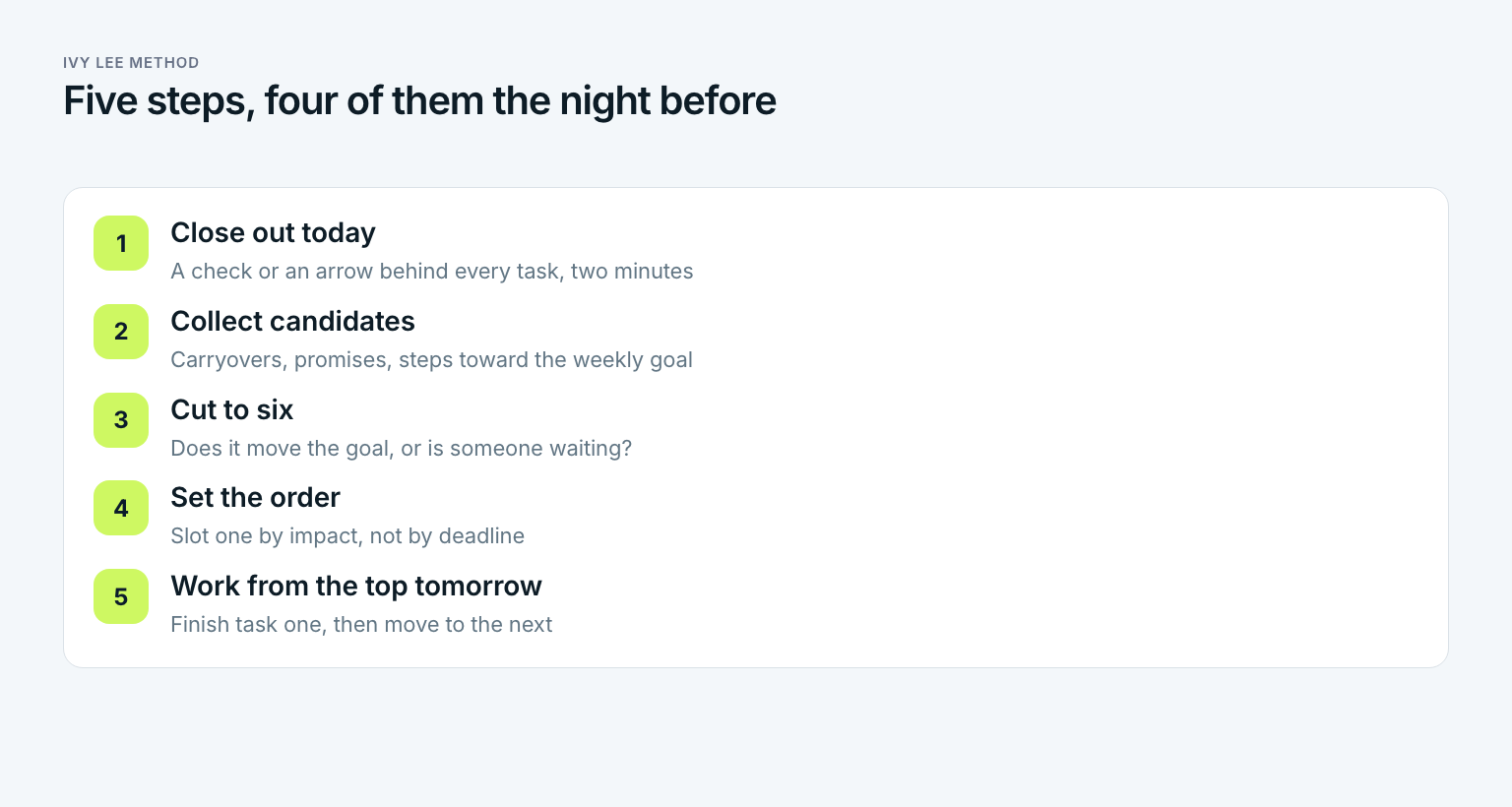
Step three is the uncomfortable one. Cutting twelve candidates to six feels like abandoning work. You are only deciding it will not happen tomorrow. An open list never makes that distinction.
Step five is the strict one. What do you do when task one stalls because you are waiting on an answer? Then it is blocked for now, and you move to task two. As soon as the answer comes in, you go back. Whoever dodges every time a task gets hard ends the day with five started tasks and none finished. Personal kanban with a WIP limit tackles exactly that pile by capping how many tasks may be open at once.
Example: Priya’s two weeks with six tasks a day
Priya is 41 and runs a bookkeeping practice in Minneapolis with one part-time assistant. She closes the books for 34 small businesses, a bakery and two dental offices among them. Most still pay by the hour, so every month ends with Priya chasing invoices. Her goal for the year is clear. By December 31, 20 of her 34 clients should be on flat monthly packages. In early October, eight are.
Her task app had 31 open items at the start of October. Every evening she checked off about 14, and every morning about as many new ones appeared. One item had been on the list for six weeks: write the email that offers monthly packages to every hourly client. Something more urgent always came first: a 1099 question, a broken bank feed, two extensions due October 15. Was she busy? Without question. But nobody ever called to ask where the package email was.
On her first evening with the method she wrote down twelve candidates and cut half of them. She put the first draft of the package email in slot one. Then she kept count for two weeks, in a notebook next to her keyboard:
| Measure | Two weeks before, open list | Two weeks with Ivy Lee |
|---|---|---|
| Items on the list each morning | 31 on average | six |
| Tasks finished per day | about 14 | 4.8 on average |
| Slot one finished the same day | no slot one defined | nine of ten days |
| Package email | open for six weeks | sent to the first ten clients on day four |
| Calls booked about packages | none | four |
| Evenings at the desk after 7 p.m. | six of ten | two of ten |
The number that jumps out first is the wrong one. Priya checked off far fewer tasks per day, 4.8 instead of about 14. Whoever counts only checkmarks reads that as a step backward. The number that matters sits two lines lower: slot one was done by evening on nine of ten days. The package email, pushed back for six weeks, went out on day four.
What happened to the other tasks? Some got done between two calls. Some traveled along for three evenings and were deleted without anyone noticing. Some solved themselves. That means: a shorter list did not move less. It moved the right things.
One day went badly. On Thursday of the second week a client discovered a payroll error from August, and Priya spent seven hours fixing it with the payroll provider. She finished exactly one item on her list and carried five over. On Friday, task one was still the first thing she finished. The method does not prevent bad days. It only makes sure the next day does not start with 36 items.
A checkmark is not progress
A checkmark shows that something is done, not that it mattered. With her open list, Priya set almost three times as many checkmarks and got no closer to her yearly goal in six weeks. That is why the Ivy Lee method does not count checkmarks at all. It asks a single question at the end of the day: did task one get finished?
Does the Ivy Lee method work? The three mistakes nobody notices
Yes, if you keep the two promises. The method rarely fails for lack of discipline. It fails because of three small drifts, and each one feels like good planning while it happens. Whoever knows them spots them on Friday. Whoever does not blames their willpower and looks for the next method. Which of the three do you recognize?
Mistake one: six lines that are not tasks
“Website” is not a task. It is a project. “Taxes” is an area of life. Six lines like that cannot be finished in a day, so the whole list moves to tomorrow and within a week the method is dead. Every line needs a result you can check off tonight. Not “package email” but “package email, first draft, one page.”
Mistake two: the urgent task in slot one
The temptation makes sense. The extension filing is due Thursday, so it goes to the top. But a task with a deadline gets done anyway, because someone is waiting and will ask. The package email had no deadline and no sender. It only gets done if it gets the best slot of the day.
The most common mistake: the most urgent task takes slot one
Slot one belongs to the task with the biggest effect on your weekly goal, not the one with the nearest deadline. Urgent work gets done because someone is waiting on it. Put it at the top and you fill the best hour of your day with something that would have been finished by 3 p.m. anyway. Test slot one with a single question: would this task stay undone without the list? Only if the answer is yes does it belong at the top.
Mistake three: the endless carryover
Carrying unfinished work forward is well meant and dangerous over time. A task that travels along for five days blocks one of six slots. Priya added one rule of her own: after three carryovers, a task gets smaller, gets handed off or gets deleted. Whoever carries tasks forward without deciding about them soon has a list of 31 items again, just spread over four days.
Ivy Lee vs. Eisenhower Matrix, Eat the Frog, 1-3-5 and 3-3-3
No time management method is the best one. Each solves a specific problem, and the Ivy Lee method solves a different one than the Eisenhower Matrix or Eat the Frog. So the question is not which method wins. The question is which problem you have right now.
| Method | What it decides | How many tasks | Built for |
|---|---|---|---|
| Ivy Lee method | selection and order for tomorrow | six, one after another | days with more tasks than time |
| Eisenhower Matrix | sorting by important and urgent | any number, in four boxes | a full list that needs cleaning up |
| Eat the Frog | the one task that comes first | one | a task you keep avoiding |
| 1-3-5 rule | the mix of big and small tasks | nine: one big, three medium, five small | days full of small obligations |
| 3-3-3 rule | how the day is split into kinds of work | one project for three hours, three urgent tasks, three maintenance tasks | people who need a protected block of deep work |
What is the difference between Ivy Lee and the Eisenhower Matrix? The matrix sorts, but it does not rank. It tells you that four tasks are important and not urgent, but not which of them comes first tomorrow. That is exactly where Ivy Lee starts. Whoever combines the two sorts the backlog with the matrix on Sunday and fills the six slots every evening from the important but not urgent box first.
Eat the Frog is, at its core, Ivy Lee with a single slot. The frog is task one, and the method stops where Ivy Lee keeps going, with tasks two through six. If you eat your frog by 9 a.m. and then drown in your inbox, you need the other five slots. Brian Tracy built a whole book around the frog, and an Eat That Frog summary covers the other 20 principles in it.
The 1-3-5 rule plans nine tasks a day: one big, three medium, five small. It is honest about small stuff, but it has no order. The 3-3-3 rule, a format often credited to the writer Oliver Burkeman, splits the day differently: three hours on your most important project, three shorter urgent tasks, three maintenance chores. It fits on top of an Ivy Lee list: slot one becomes the three-hour project.
Where the Ivy Lee method falls short
The Ivy Lee method is a good method. It is just not built for every day. Four limits deserve an honest mention:
- It does not tell you what is important. Without a weekly or monthly goal, slot one is assigned by feel, and feel picks whatever is loudest.
- It fits poorly on days packed with meetings. If you spend eight hours in calls, there is no room for six tasks. Then it is two, and that is fine.
- It has no rule for emergencies. A client’s payroll error does not care about your list. Handle it, then return to the highest open task.
- It does not break down projects. A six-week project has to be cut into daily steps before it can land on the list.
For couples and families it works on a small scale too. Whoever agrees on Friday night on three things for Saturday, in order, skips the Saturday argument. In short: Eisenhower cleans up the list, Ivy Lee turns it into a day, and Eat the Frog protects the first hour.
The Ivy Lee method in your goal chain: year, quarter, month, week, day
The method has a gap, and Lee never closed it. It tells you to write down the six most important tasks. It does not tell you how to measure importance. At Bethlehem Steel every executive knew his mandate. If you run your own business or a family, that mandate is often missing. Then gut feeling decides in the evening, and a tired gut picks whatever is most annoying.
A goal chain closes the gap. It does not derive slot one from feeling but from the next goal up. For Priya it looks like this:
- Year: By December 31, 20 of 34 clients are on flat monthly packages, so January starts without chasing hourly invoices.
- Quarter, October to December: Package page finished, offer sent to all 26 hourly clients, at least twelve clients switched by December 15.
- Month of October: Package email sent to the first ten clients, at least four calls booked, pricing table tested with two friendly clients.
- Week: Write and send the package email, file the two October 15 extensions, fix the broken bank feed for the bakery.
- Day: six tasks, with the first draft of the package email in slot one.
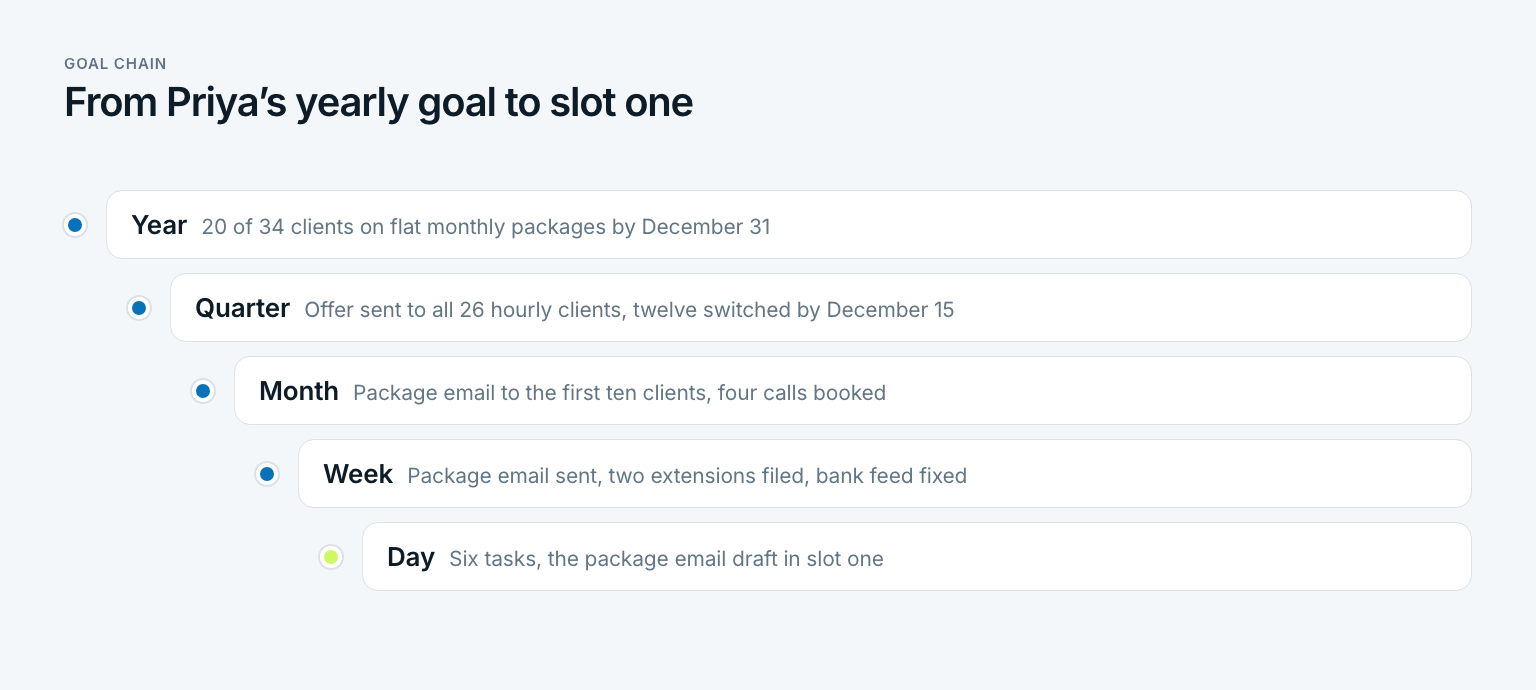
Each level answers the question of the one below it. The weekly goal tells you what belongs in slot one tonight. That means: the ten minutes in the evening shrink to five, because the hardest decision was already made on Sunday. How to break a yearly goal down to that level is covered in how to achieve goals.
In Gaapp, daily goals hang on weekly goals, and weekly goals hang on the month. For the Ivy Lee method that means slot one becomes a daily goal that is visibly tied to a weekly goal. The other five slots need no system at all, paper is enough. How to phrase a daily goal so you can check it off by evening is explained under daily goals.
Ivy Lee method template: one card, six lines, one carryover column
The template fits on an index card, just like Lee’s. The entries show Priya’s first Monday, so you can see how specific a line should be.
| Slot | Task with a result you can check off | Feeds into | In the evening |
|---|---|---|---|
| 1 | Write the package email, first draft, one page | Weekly goal: package email sent | done |
| 2 | File the extension for the landscaping owner | Deadline October 15, client waiting | done |
| 3 | Call the bank about the bakery’s broken feed | Weekly goal: bank feed fixed | done |
| 4 | Close September books for the dental office on Lake Street | Client waiting | done |
| 5 | Draft a pricing table with three package tiers | Monthly goal: pricing tested | carryover, needs numbers from slot four |
| 6 | Reply to the contractor’s 1099 question | Client waiting | done in five minutes between calls |
Three extra rules apply in the evening. A task with nothing in the third column needs a very good reason to be on the list at all. A task carried over for the third time gets smaller or disappears. And slot one never holds a task whose only reason is that someone is waiting.
If you already work with a classic to-do list, you do not have to throw it away. It becomes the holding list you pull six items from each evening. Nothing on it is forgotten. It is just not tomorrow’s turn.
Three questions before you start tomorrow:
- Do you know right now, without looking, what sits in slot one tomorrow?
- Is there a task on your list that has been traveling along for more than a week?
- Could you check off every single line on your list within one day?
Whoever cannot answer one of these cleanly does not need a better app. They need ten minutes in the evening. In short: the Ivy Lee method is not a list of things you could do. It is a decision about what you will do first tomorrow. Priya set a dozen checkmarks a day for six weeks and never wrote the package email. With six slots, it went out on day four.
Frequently asked questions about the Ivy Lee method
What’s the difference between Ivy Lee and Eisenhower Matrix?
The Eisenhower Matrix sorts tasks into four boxes by importance and urgency, but it does not tell you what to do first. The Ivy Lee method picks six tasks and puts them in a strict order for one day. They work best together: sort the backlog with the matrix once a week, then fill your six daily slots from the important but not urgent box.
Does the Ivy Lee method work?
It works if you keep two promises: no more than six tasks, and no switching away from task one until it is done. There is no controlled study behind it, so test it yourself for two weeks and count one number, how often slot one was finished by evening. Most people fail not from lack of discipline but because their six lines are projects instead of tasks.
What is the key principle of the Ivy Lee method?
The key principle is a hard limit combined with a fixed order. Because only six tasks fit, you have to decide every evening what matters, and because the order is set, you never have to decide again during the day what comes next. The number six is less important than the fact that the limit is smaller than your list.
What is the 3-3-3 rule for time management?
The 3-3-3 rule splits a workday into three hours on your most important project, three shorter urgent tasks and three maintenance chores. It protects a block of deep work while still making room for small obligations. It combines well with the Ivy Lee method if the three-hour project takes slot one.
Why six tasks and not more?
Six is a historical choice, not a scientific one. The point is a cap smaller than your usual list, which forces you to cut before you start. On days packed with meetings, three or even two slots are perfectly fine.
What happens to tasks you do not finish?
They go on the next day’s list and compete for one of the six slots again. Add one rule the original method lacks: after three carryovers, a task gets smaller, gets handed off or gets deleted. Otherwise unfinished work slowly fills every slot.
Last updated: 19 October 2026
Read next
 Productivity
Feynman Technique: Four Steps to Real Understanding
The Feynman technique is not a memorization trick: four steps, a worked example from a stats class, a one-page template, and what research says.
16 min read
 Productivity
Zettelkasten: How to Turn Notes Into Your Own Ideas
A Zettelkasten is not an archive: Luhmann's method, the three note types, a five-step setup and an Obsidian template, with a worked example.
15 min read
 Productivity
Second Brain: How to Build One You Actually Use
A second brain is not a note archive: Tiago Forte's CODE steps, the PARA method with an example, a five-step setup and the mistakes that sink it.
15 min read