Habit Stacking: The Formula and 30 Examples
Habit stacking is not a willpower trick: the formula, 20 anchors, five steps and 30 habit stacking examples, worked through eight weeks of numbers.

Contents
- 01What habit stacking is, and where the idea comes from
- 02The habit stacking formula: one sentence, two blanks
- 03How to pick an anchor: 20 cues that happen every day
- 04How to start habit stacking in five steps
- 05Andrea's stack: eight weeks of numbers
- 0630 habit stacking examples you can copy
- 07Habit stacking for ADHD: what helps and what to watch
- 08Three mistakes that knock a stack over
- 09Habit stacking in a goal chain: from a yearly goal to a coffee mug
- 10Three questions before you build your first stack
- 11Frequently asked questions about habit stacking
Habit stacking is not a willpower trick. It is a way to build a new habit by attaching it to something you already do every day, written as one sentence: after I do the old thing, I will do the new thing. The old habit is called the anchor. It reminds you of the new one at the right moment, with no alarm, no app notification, and no fresh decision every morning.
You need three things: an anchor that truly happens every day, a sentence that names the exact moment, and a new habit small enough for your worst day. Below, all of it is worked through with Andrea, a dental hygienist and mom of two who could not keep a budget for more than a week, then kept one for eight. You also get where the method comes from, a list of 20 anchors, five steps, and 30 habit stacking examples you can copy tonight.
What habit stacking is, and where the idea comes from
Habit stacking means placing a new habit on top of one that already runs on autopilot, the way you would stack one book on another. The bottom habit carries the top one. Anyone who brushes their teeth every morning already owns a moment that shows up more reliably than any resolution.
Three names belong to the story. The term comes from the author S. J. Scott. His book Habit Stacking, published in 2014, describes how to bundle several small habits of a few minutes each into a fixed sequence you run at the same occasion every day. For Scott, a stack is a short routine with several links.
James Clear made the term famous. In Atomic Habits, published in 2018, he presents habit stacking as a way to make a new habit obvious and gives it a formula: after your current habit, you do the new one. Clear calls it a special form of an implementation intention, the if-then plan studied by the psychologist Peter Gollwitzer since the 1990s.
The formula itself builds on BJ Fogg, the behavior scientist at Stanford who created the Tiny Habits method. His recipe reads: After I …, I will …. Fogg calls the existing behavior the anchor, keeps the new behavior tiny, and adds a quick celebration right after it so the sequence sticks. Clear credits Fogg as the source. Fogg lays out the full method in his 2019 book Tiny Habits.
| Who | Work | What a stack is | What you borrow |
|---|---|---|---|
| S. J. Scott | Habit Stacking, 2014 | A fixed sequence of several small habits that together form a routine | The idea of chaining short links into one block |
| James Clear | Atomic Habits, 2018 | One new habit placed right after an existing one, written as a sentence | The formula and the list of your daily anchors |
| BJ Fogg | Tiny Habits recipe, book Tiny Habits, 2019 | Anchor, tiny behavior, instant celebration | The word anchor, the tiny version, and the celebration |
What an anchor is
An anchor is something you do so reliably that you no longer think about it: pouring coffee, starting the car, taking off your shoes. It has a clear end point, and the new habit hooks onto that end point. That is why in the morning is not an anchor, and after I set my coffee mug on the counter is.
Habit stacking is one tool among several. How a habit forms in general and how long it takes is covered in how to build good habits. The four laws Clear wraps around the technique are in the Atomic Habits summary. This article stays with the tool itself: the formula, the anchors, the examples.
The habit stacking formula: one sentence, two blanks
The formula is a single sentence with two blanks. The first blank matters more than the second. Clear writes the blanks in capital letters so it is clear something of your own goes there.
The habit stacking formula
After I CURRENT HABIT, I will NEW HABIT. The first blank takes something that happens every day and has a clear end point. The second takes a habit you can finish in two minutes or less. Filled in, it sounds like this: After I set my coffee mug on the counter, I will write down yesterday's spending.
Why does it work? New habits rarely fail for lack of wanting. They fail for lack of a moment, because nobody decided when exactly they happen. The anchor fixes that moment, and it uses something your brain already does without thinking. That means: you no longer have to remember the new habit, only notice the end of the old one, and that end arrives on its own.
A phone reminder is a fine tool. It is built for appointments, not habits. It goes off at 7 a.m. whether you are in the shower or in traffic. An anchor shows up when you are already in the right place. Anyone whose days do not run on a clock still runs them on the same small motions.
How to turn a vague intention into a precise stack
Most first drafts are too vague. The fix: a time span becomes a single motion, a wish becomes an amount.
| Vague | Precise | What changes |
|---|---|---|
| I'll work out in the morning. | After I put my toothbrush back in the cup, I will roll out the mat and do a 20-second plank. | The moment is a motion, not a time of day. |
| I'll read after work. | After I hang my work bag on the hook, I will read two pages. | After work lasts hours. The hook takes one second. |
| I'll drink more water. | After I sit down at my desk, I will drink one glass of water. | The habit has an amount and a place. |
Three checks for your sentence. Does the anchor happen on every day the new habit should happen? Could someone watching tell when the anchor ends? Could you do the new habit on your worst day? Whoever answers no to any of the three rewrites the sentence before starting.
Fogg adds a third part: celebrate right after the new behavior with a nod or a quick good job. It sounds silly. His point holds anyway: a good feeling in the moment wires the behavior to the anchor. Anyone who feels awkward can use a check mark on paper instead.
How to pick an anchor: 20 cues that happen every day
The best anchor is one you already have. Clear suggests two lists: things you do every day without fail, and things that happen to you every day, like a red light on your commute or the sun going down. The list below is a starting point. Cross out anything that does not happen every single day for you.
| Time of day | Anchor | End point to hook onto | Good for |
|---|---|---|---|
| Morning | Turn off the alarm | Phone back on the nightstand | Drink water, read today's goal |
| Morning | Get out of bed | Both feet on the floor | Make the bed, three slow breaths |
| Morning | Brush your teeth | Toothbrush back in the cup | Short strength move, floss |
| Morning | Start the coffee | Machine is running | Write today's one goal |
| Morning | Pour the first cup | Mug set on the counter | Check today's calendar, log spending |
| Morning | Kids get on the bus | Bus pulls away | Two-minute walk around the block |
| Morning | Start the car | Engine is running | Start an audiobook or language lesson |
| Work | Open the laptop | Home screen is up | Open the most important task before email |
| Work | A meeting ends | Call window closes | Write the next step in one line |
| Work | Finish lunch | Container is closed | Ten-minute walk |
| Work | Refill your water bottle | Cap is on | Ten squats |
| Work | Close the laptop | Screen goes dark | Write three tasks for tomorrow |
| Transition | Walk in the front door | Keys on the hook | Phone into a drawer |
| Transition | Take off your shoes | Shoes on the rack | Two minutes of stretching |
| Evening | Sit down to dinner | Everyone is seated | Each person names one good thing |
| Evening | Start the dishwasher | Cycle is running | Five-minute kitchen reset |
| Evening | Zip the kids' lunchboxes | Lunchboxes in the fridge | Pack your own lunch |
| Evening | Plug in your phone | Cable clicks in | Check off today's habits |
| Evening | Turn off the bathroom light | Room is dark | Read ten pages |
| Weekly | Put away the groceries | Fridge door closes | Write next week's goals |
The third column does the real work. Brushing your teeth is a two-minute process. Toothbrush back in the cup is a point in time, and only a point can carry a new habit.
Fogg adds three checks for matching anchor and habit. Location: the anchor happens where the new habit can happen, which is why push-ups belong next to the kitchen counter and not next to the office coffee machine. Frequency: a daily habit needs a daily anchor, a monthly habit a monthly one. Purpose: the two fit together, the way writing tomorrow's tasks fits closing the laptop and flossing does not. In short: the right anchor is in the right place, comes at the right rhythm, and makes sense. Anyone who can tick two of the three can start. Anyone who ticks only one keeps looking, because the stack will wobble right there.
How to start habit stacking in five steps
You can build a stack in one evening. You need an index card, a pen, and one habit you actually want. Here is the order:
Pick one habit that serves a goal
One habit, not five. It should belong to something you want to reach this year. Otherwise, on day twenty, you will not remember why you are doing it.
Write the tiny version
Describe what the habit looks like on your worst day: 20 seconds instead of ten minutes, one page instead of a chapter. The tiny version is not the goal. It is the floor you never drop below.
Choose the anchor from your list
Check location, frequency, and purpose. Then find the end point, the last motion the new habit attaches to.
Write the sentence and put it where the anchor happens
After I CURRENT HABIT, I will NEW HABIT. Tape the card where the anchor takes place: the bathroom mirror, the coffee maker, the inside of a cabinet door. Lay out what you need the night before.
Count for four weeks, then add a link
Check off each day and work out the weekly rate: days done divided by seven. Only when the rate stays at 80 percent or higher for four weeks in a row does a new link go on top.
Step five is the one most people skip. Whoever adds a second and third link after one good week builds a tower on a base that cannot carry it yet. That means: a new link only goes on top of one that already runs by itself. How to keep the weekly rate without turning it into a guilt list is covered in the guide to the habit tracker.
Andrea's stack: eight weeks of numbers
Andrea is 37, a dental hygienist in Columbus, Ohio, with two kids, eight and eleven. In September she owed $8,400 on two credit cards. Her yearly goal: a zero balance by September 30, 2027, which means $700 a month. She had tried budgeting before. In September she downloaded a budgeting app and opened it on nine of 30 days, mostly the morning after a bad surprise.
Was that a discipline problem? No. Tracking her spending was never tied to a moment in her day, and free-floating intentions lose to school drop-off every time.
The stack she built instead
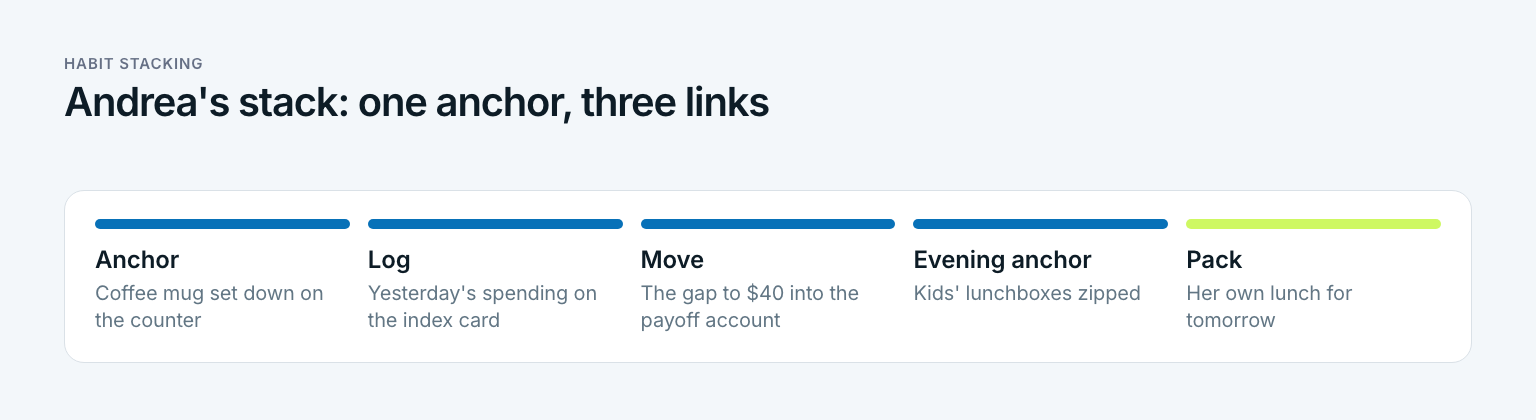
What does happen every morning, no matter what: she pours coffee and sets the mug on the counter. At the start of October she hooked two links onto that, plus one evening sentence:
- After I set my coffee mug on the counter, I will open the banking app and write yesterday's spending on the index card taped inside the cabinet door.
- After I write the number, I will move the gap between it and my $40 daily budget into the payoff account. If the number is over $40, I write it in red and move nothing.
- After I zip the kids' lunchboxes in the evening, I will pack my own lunch for tomorrow.
The morning stack takes about 90 seconds. Card and pen live inside the cabinet door above the coffee maker. This is a stack in Scott's sense: each link is the anchor for the next. The evening sentence covers the biggest leak in her budget. A bought lunch near her office runs about $13, a packed one about $4.
Eight weeks in one table
| Week | Mornings with stack | Lunches packed | Moved to payoff |
|---|---|---|---|
| 1 | 6 of 7 | 3 of 5 | $48 |
| 2 | 7 of 7 | 4 of 5 | $65 |
| 3 | 3 of 7 | 2 of 5 | $22 |
| 4 | 6 of 7 | 4 of 5 | $58 |
| 5 | 6 of 7 | 5 of 5 | $61 |
| 6 | 7 of 7 | 4 of 5 | $70 |
| 7 | 6 of 7 | 5 of 5 | $57 |
| 8 | 7 of 7 | 5 of 5 | $69 |
| Total | 48 of 56, 86 percent | 32 of 40, 80 percent | $450 |
Week three teaches the most. After a perfect week two, Andrea added a third morning link: after I move the money, I will unsubscribe from one store email. Some mornings that meant scrolling through her inbox for five minutes. On three rushed school mornings she skipped the whole stack, not just the new link, because the stack now felt like a chore. In week four she took the link off again, and the rate came straight back.
The other numbers: on top of her $700 monthly payment, $450 went to the cards in eight weeks. The 32 packed lunches kept about $288 in her account that would have gone to takeout. At this pace the payoff date moves from September to around July 2027. Will it hold? She does not know yet. She knows the rate, and the rate tells her more than her mood does. Weeks five through eight all stayed above 80 percent, so in week nine a new link may go on top.
30 habit stacking examples you can copy
Each example below is a finished sentence with an anchor that has a clear end point and a new habit in its tiny version. Pick one, not all of them, and swap the anchor for one from your own list if it does not happen every day for you. Which of them feeds a goal you actually want to reach this year?
Morning habit stacking examples
- After I turn off my alarm, I will drink the glass of water I set on the nightstand last night.
- After I start the coffee maker, I will write today's one goal on a sticky note.
- After I pour my first cup, I will look at today's calendar.
- After I put my toothbrush back in the cup, I will floss one tooth.
- After the kids' bus pulls away, I will walk once around the block before going back inside.
Anyone who wants to turn several morning links into a full morning routine builds it the same way: one anchor, then one link at a time. Stacks at lunch and after work extend it into a daily routine with anchors from morning to night.
Work habit stacking examples
- After I open my laptop, I will open the most important task before I open email.
- After a meeting ends, I will write the next step in one line.
- After I close my lunch container, I will take a ten-minute walk.
- After I refill my water bottle, I will do ten squats.
- After I close my laptop for the day, I will write three tasks for tomorrow.
Health and fitness habit stacking examples
- After I take off my work shoes, I will stretch my calves for two minutes on the bottom stair.
- After I change out of work clothes, I will step outside for five minutes.
- After I sit down in the car, I will take three slow breaths before I start the engine.
- After I fill my plate at dinner, I will add one vegetable before I sit down.
- After I set my phone on the charger, I will lay out tomorrow's workout clothes.
Money habit stacking examples
- After I set my coffee mug on the counter, I will write yesterday's spending on a card.
- After I see my paycheck land, I will move my fixed savings amount the same day.
- After I put a receipt in my wallet, I will snap a photo of it for my budget that evening.
- After I add something to an online cart, I will close the tab and wait 24 hours.
- After I pay a bill, I will write the next due date on the calendar.
Habit stacking examples for parents and couples
- After everyone sits down to dinner, each of us will name one thing that went well today. It is a spoken version of a gratitude journal.
- After the kids' bedroom door closes, we will ask each other what tomorrow looks like.
- After I zip the lunchboxes, I will lay out the kids' clothes for tomorrow.
- After we put away the groceries on Sunday, we will write the family's three goals for the week on the fridge.
- After I start the dishwasher, I will spend five minutes resetting the kitchen.
Evening and learning habit stacking examples
- After I plug in my phone, I will check off today's habits.
- After I turn off the bathroom light, I will read ten pages.
- After I start the car for my commute, I will play one language lesson.
- After I finish a chapter, I will write one sentence on what I will use from it.
- After I fill the kettle, I will review five flashcards until it boils.
Notice what every example has in common: the new habit is smaller than it needs to be. Ten pages instead of a chapter, one tooth instead of all of them. That is on purpose, and it is Fogg's central idea. On good days you do more. On bad days the tiny version still happens, and the stack stays standing.
Habit stacking for ADHD: what helps and what to watch
Habit stacking is not a treatment for ADHD and does not replace one. It is a planning tool. Many people with ADHD say time-based plans slip away from them. A stack does not ask you to watch the clock, only to notice something your hands already do. Four adjustments help:
- Make the anchor physical. Setting a mug down or plugging in a phone beats a moment you have to remember.
- Put the tool on the anchor. If you have to go find the tool, the stack breaks at that step.
- Keep the stack short. One or two links, about 90 seconds, as Andrea's week three showed.
- Restart without a penalty. A missed day is data. Pick the stack back up at the next anchor, not next Monday.
Three mistakes that knock a stack over
Habit stacking rarely fails because of the formula. It fails because of choices that feel like good ideas at first. The most common one is in the anchor itself.
The most common mistake: an anchor that does not happen every day
Showering, the gym, the commute: many anchors only show up on some days. Anyone who hangs a new habit on the commute loses it on every remote day and every weekend. Before you start, check that the anchor happens on every day the habit should. If it does not, write a second sentence for the days that run differently.
Three more show up after a few weeks:
- An anchor without an end point. After breakfast is not a moment, it is half an hour. Breakfast is a fine habit. It just does not end at a fixed point. Pick the last motion instead: putting the bowl in the sink.
- A stack that grows too fast. Three new links in one week feel like momentum. They are a risk, because each link is the anchor for the next. When the first one falls, everything after it falls too. One link at a time, each after four steady weeks.
- A new habit at full size. Thirty minutes of budgeting is the goal, not the start. Without a tiny version, the habit drops out on the first tired day and takes the rest of the stack with it. The floor has to be small enough that you could do it after a double shift.
How do you find your mistake? Look at the days the stack failed. If the anchor was missing, the anchor was wrong. If the anchor was there but the habit was not, the habit was too big. If the same spot keeps failing, there is one link too many above it.
Habit stacking in a goal chain: from a yearly goal to a coffee mug
A stack without a goal is a nice way to start the morning. A stack with a goal is the smallest building block of a plan. You see the difference when you run it through the five levels of a goal chain. For Andrea it looks like this:
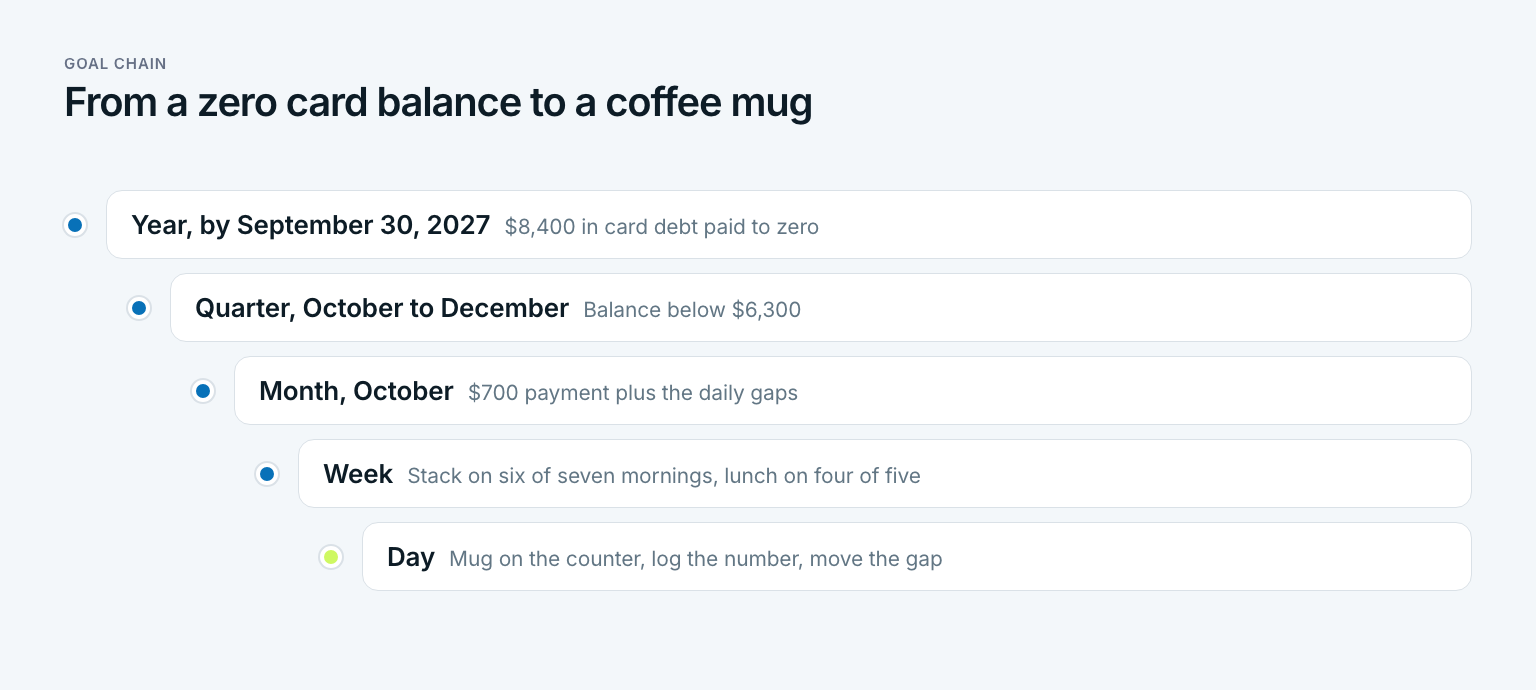
Each level answers a different question. The year asks where to. The quarter asks how far by December. The month and the week ask whether the stack is running. The day only asks about the anchor. That means: in the morning, Andrea decides nothing. She sets the mug down, and the rest follows.
In Gaapp you build exactly this chain: a yearly goal, then quarter, month, week, and day. The stack sits as a daily goal and gets checked off. A week's progress is the share of daily goals done, with a thin line next to it showing how much of the week has passed. So you see on Sunday whether the month still works, not in December. For the full method from yearly goal to daily step, see the guide on how to achieve goals.
Three questions before you build your first stack
Before you write the card tonight, answer three questions:
- What do you do on every single day, weekends and vacations included, without thinking about it?
- Which goal for this year does the new habit belong to, and how will you know in December that it worked?
- What does the habit look like on your worst day, small enough that you never skip it?
Anyone who cannot answer the first question does not need a stack yet. They need a list of their anchors. Whoever cannot answer the second is building a stack without a reason. Whoever cannot answer the third is building it too tall. In short: habit stacking is not a resolution you push through, it is an address where your new habit gets picked up every day.
Frequently asked questions about habit stacking
What is a habit stacking example?
A classic example: after I pour my morning coffee, I will write down today's one goal. Others: after I close my laptop, I will write three tasks for tomorrow. After I plug in my phone at night, I will check off today's habits. The list above has 30 more for mornings, work, health, money, families, and evenings.
What is the 3-3-3 rule for habits?
The 3-3-3 rule has no single author and several versions. The best known is Oliver Burkeman's 3/3/3 method for a workday: three hours on your most important project, three shorter urgent tasks, three maintenance tasks. For habits it is usually read as three habits at a time, three weeks before adding a fourth, and a start small enough for three minutes. More on limits in the guide to the habit tracker.
What is a habit of stacking?
The phrase usually means habit stacking: building a new habit by attaching it to one you already do every day. To stack means to pile one thing on another. The existing habit is the bottom of the pile and carries the new one.
What is habit stacking for ADHD?
It is the same technique, adjusted so it relies less on memory and time. You hang the new habit on a physical motion, put the tool right at the anchor, and keep the stack to one or two links. It can make routines easier to keep, but it is a planning tool, not a treatment.
Who invented habit stacking?
The term comes from S. J. Scott, whose book Habit Stacking appeared in 2014. James Clear made it widely known in Atomic Habits in 2018 and gave it the formula after I CURRENT HABIT, I will NEW HABIT. That formula builds on BJ Fogg's Tiny Habits recipe, After I …, I will ….
How many habits can you stack?
Start with one. Add the next link only after the previous one has run on at least 80 percent of days for four weeks. Stacks of three to five short links work well as long as the whole sequence takes only a few minutes.
Last updated: 19 October 2026
Read next
 Habits
75 Hard: Rules, Risks and a Version You Can Finish
75 Hard is not a fitness program. The full rules, four health risks, 75 Soft compared and a custom version built around a real goal.
15 min read
 Habits
Digital Detox: A 7-Day Plan to Reduce Screen Time
A digital detox isn't a weekend offline. What the research shows, how to measure and reduce screen time, plus a 7-day plan with a worked example.
15 min read
 Habits
Delayed Gratification: Meaning, Examples, How to Build It
Delayed gratification isn't self-denial, it's a trade: what the marshmallow test really showed, everyday examples, five proven strategies and a plan.
15 min read