1-3-5 Rule: A To-Do List That Fits Your Day
The 1-3-5 rule is not a to-do list with numbers but a daily budget: one big, three medium, five small tasks. Five steps, a worked example, a template.

Contents
- 01What the 1-3-5 rule means: one big, three medium, five small tasks
- 02Why the 1-3-5 rule works: three mechanisms
- 03Big, medium, small: how to size a task
- 04The 1-3-5 method in five steps
- 05Example: Marcus’s two weeks with the 1-3-5 rule
- 06Three mistakes nobody notices
- 071-3-5 rule vs Ivy Lee, Eat the Frog and ABC: which fits what
- 08The 1-3-5 rule in your goal chain: year, quarter, month, week, day
- 091-3-5 rule template: nine lines on one page
- 101-3-5 rule FAQ
The 1-3-5 rule is not a to-do list with numbers attached but a budget for your workday: each day you plan one big task, three medium tasks and five small ones, and nothing else. Nine tasks, picked before the day starts. Anything that does not fit gets another day. The numbers are not magic. They force you to decide, before your inbox decides for you, how much of the day goes to important work and how much goes to the small stuff.
Anyone who ends the day exhausted and still feels that nothing important got done usually has a mix problem, not a time problem. That was the case for Marcus, a customer success lead at a 60-person software company in Denver. He looks after 45 accounts, answers about 50 emails a day, and has carried a renewal playbook on his list for five weeks. Below: where the rule comes from, a size test for tasks, five steps, his two weeks in numbers, three quiet mistakes, a short comparison with other methods and a template.
What the 1-3-5 rule means: one big, three medium, five small tasks
The 1-3-5 rule says a realistic workday has room for nine tasks of different sizes. One is big and takes two to three hours of focused work. Three are medium and take 30 to 60 minutes each. Five are small and take a quarter of an hour or less. You write the list before the day begins, and you do not add to it while the day runs.
It sounds like a numbers game. In fact there is a calculation behind it that almost nobody spells out. Whoever adds up the sizes ends up with roughly five and a half hours of planned work:
- One big task: about 150 minutes, in one stretch, with email closed.
- Three medium tasks: about 45 minutes each, a little over two hours together.
- Five small tasks: about ten minutes each, just under an hour together.
That adds up to around 335 minutes. On an eight-hour day, about two and a half hours are left over. That gap is not a rounding error. It is the real point of the rule. It belongs to meetings, to questions from colleagues and to everything nobody can predict in the morning. That means: the 1-3-5 rule does not fill your day. It fills about 70 percent of it, and the rest is buffer on purpose.
What the rule leaves out tells you just as much. It says nothing about the order you work in, and it has no categories like urgent or important. It only controls the mix. In short: the 1-3-5 rule is not a sorting technique. It is a cap by size.
Where the 1-3-5 method comes from
The 1-3-5 method has no clearly documented inventor. It is usually linked to two names. One is Alexander Kjerulf, a Danish author and speaker who has written about happiness at work for many years. The other is The Muse, the US career site whose piece on a better to-do list carried the rule across the English-speaking internet. From there it spread into blogs, paper planners and apps, mostly without a source.
For daily use the origin matters less than the design. The rule does not come from research. It comes from office life, from people whose days are made of many small requests and whose big tasks keep sliding to the back of the list. That pattern is exactly what it is built to break.
A rule of thumb, not a formula
Neither Kjerulf nor The Muse presents the rule as the result of a study. It is a rule of thumb from practice. Anyone looking for evidence that exactly nine tasks is the optimum will not find it. The numbers are a convention that holds up in an ordinary office week, and you are free to adjust them to your calendar as long as the mix survives.
Why the 1-3-5 rule works: three mechanisms
First: the big task gets a reserved slot
On an open list, every task competes on equal terms for your time. Small tasks win that race almost every time, because they are quick and give you an instant checkmark. The 1-3-5 rule ends the race by giving the big task a fixed slot that no email can take. Whoever plans exactly one big task a day takes about 20 big steps in a month instead of three random ones.
Second: small tasks get a limit instead of guilt
Many methods treat small tasks as noise. The 1-3-5 rule is more honest. Callbacks, approvals and quick replies are part of the job, and whoever lets them pile up blocks other people. So they get five fixed slots. That is generous enough to keep things moving and tight enough to stop them from eating the whole day.
Third: nine checkmarks are a finish line you can reach
A list with 31 items never ends. You stop in the evening because you are tired, not because you are done. Nine tasks fit into a normal day, and that changes how the end of the day feels. When did you last close your laptop because the list was empty? The rule turns that into the normal case instead of the exception.
The three mechanisms depend on each other. The reserved slot makes sure the important work shows up. The limit on small tasks makes sure it gets time. And the reachable finish line makes sure you still want to use the list the next morning. Remove any one of the three and the method slides back into the old habit.
Big, medium, small: how to size a task
The 1-3-5 rule stands or falls on a question most guides skip: what actually counts as big? The answer does not depend on the topic. It depends on three things: how long the task takes, how much focus it needs and what happens to your weekly goal if it slips. An email to your CEO can be small. A call to a client can be medium if you first have to pull the numbers together.
| Size | Time | Focus | Marcus’s example | Test question |
|---|---|---|---|---|
| Big, one a day | two to three hours | one stretch, email closed | Risk signals section of the renewal playbook | Does this move my weekly goal forward in a way I can see? |
| Medium, three a day | 30 to 60 minutes | one sitting, a short interruption is fine | Quarterly review deck for a logistics client | Do I need more than one 15-minute attempt? |
| Small, five a day | up to 15 minutes | can be done between meetings | Approve a credit note, update a CRM note | Could I finish this between two calls? |
| Not on the list | more than a day | cannot be planned in one piece | Build the renewal playbook | Is this a project rather than a task? |
The fourth row matters most. A project fits in no slot, not even the big one. Whoever writes “build the renewal playbook” as the big task sits down every morning in front of the same line that cannot be finished. The project has to be broken into steps first. Only a step of two to three hours is a big task.
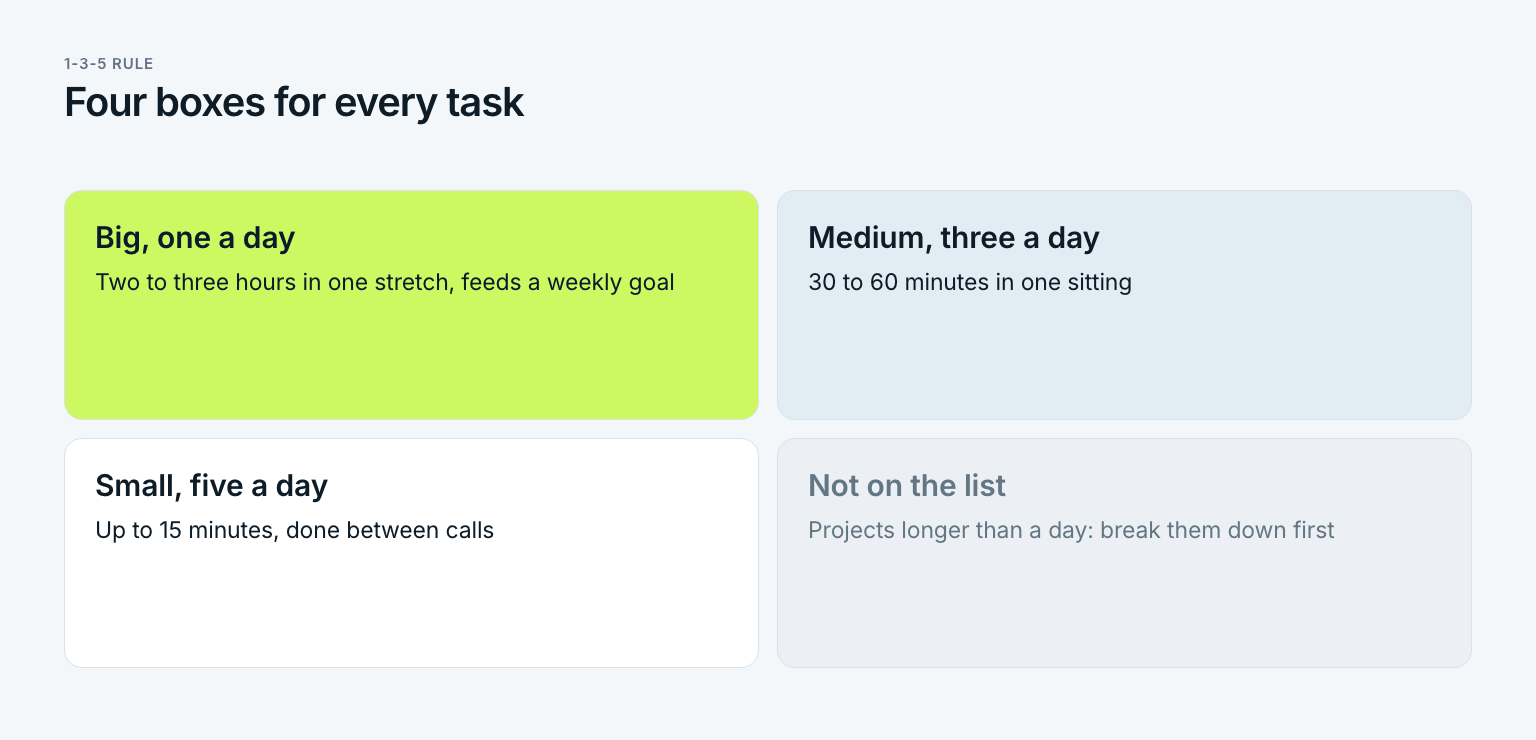
The times are guidelines for a full-time day. The ratio is what counts. The big task gets roughly as much time as the three medium ones together and far more than all five small ones. Whoever flips that ratio still has nine lines on paper, but the day is back to being all small stuff.
A second test helps with borderline cases. Ask what happens if the task does not get done today. With a small task, someone waits one more day. With a medium task, a meeting or a deadline moves. With a big task, your weekly goal moves. The consequences often say more about size than the estimated time does.
The 1-3-5 method in five steps
The method takes about ten minutes in the evening and one minute in the morning. The steps assume a full-time day. Anyone who works part time or has a packed calendar shrinks the numbers, as described further down. The order of the steps is deliberate.
Pull the big task from a weekly goal
Look at your weekly goals before you write anything else. Which step of two to three hours would visibly move one of them tomorrow? That task goes on the list first. If you have no weekly goal, that is the real bottleneck, not the list.
Pick three medium tasks
This is where proposals, prep work, client calls and anything else that needs a real sitting go. Pick three that either feed a weekly goal or that someone is waiting for. Everything else gets another day.
Choose five small tasks
Callbacks, approvals, short replies. Take the five that are due tomorrow or that block someone. All other small items go on a running list that you clear once a week in a single block.
Put the big task on your calendar
Block two to three hours in one stretch, ideally in the part of the day when you focus best. Without a calendar slot, the big task becomes whatever time is left. Medium and small tasks need no fixed slot. They fill the gaps.
Count in the evening, do not judge
Before you log off, check only two things: is the big task done, and how many of the nine are finished? Write both numbers down. After two weeks you will see whether your sizes are right or whether you keep misjudging them.
Whoever starts with the small tasks fills the list with whatever is loudest, and the big task gets what is left. Planning top down, big first, then medium, then small, is already half of what the method does. The other half is the calendar block in step four. Without it, you renegotiate every morning whether the big task really has to happen today.
One detail decides how the morning goes: the list already exists when you open your laptop. Anyone who plans after checking email plans around other people’s priorities. That is why planning belongs at the end of the previous day, when you still know what is open and do not yet know what tomorrow will throw at you.
Example: Marcus’s two weeks with the 1-3-5 rule
Marcus tried the rule for two work weeks. For the two weeks before, he only counted how he already worked. His starting point was typical. His morning list held 31 items on average, about 17 were done by evening, and nearly all of those were small. The renewal playbook had been stuck at page two for five weeks, while ten of his accounts were due to renew in January.
In the first week with the rule, he cut about 22 items down to nine every evening. It felt wrong. What if a client was waiting on an answer that was no longer on the list? He had his answer by day three. Most of the items he cut either got handled in the two and a half hours of buffer or took one of the five small slots the next day. Nothing important was lost.
| Measure | Two weeks before, open list | Two weeks with 1-3-5 |
|---|---|---|
| Items on the list in the morning | 31 on average | nine |
| Tasks finished per day | about 17, nearly all small | 7.6 on average |
| Big task finished the same day | none defined | on eight of ten days |
| Renewal playbook | stuck at page two for five weeks | full first draft on day nine |
| Client emails answered the same day | almost all | almost all, in two batches |
| Hours worked after 6 p.m. per week | about seven | about two |
The most striking number is not the big task. It is the number of finished tasks, which fell from 17 to under eight while Marcus got far more done that mattered. Whoever only counts checkmarks will call the first week a step backward. Whoever looks at the playbook sees that something big got finished for the first time in over a month.
The two days when the big task did not get done had the same cause. Both had a half-day onsite visit with a client, and the two to three hours in one stretch simply did not exist. Marcus made a rule of his own from that. On days with onsite visits he plans no big task, just four medium ones. That is not breaking the method. It is fitting the method to a real calendar.
Fewer checkmarks, more progress
The number of finished tasks is the most tempting metric at work and the least useful one. With the open list, Marcus checked off more than twice as many items and moved no closer to his quarterly goal in five weeks. So track one number above all when you use the 1-3-5 rule: on how many days this week did the big task get done?
Three mistakes nobody notices
The 1-3-5 rule rarely fails loudly. It fails quietly, in three places that look like a working list from the outside.
Mistake one: the big task is a project
The most common mistake: a project in the big slot
“Write the playbook,” “redo the website,” “do the taxes”: entries like these look like big tasks but are projects. They cannot be finished in a day, and a line that is never done by evening loses its pull after three days. Test the big slot with one question: tonight, can I say this exact line is done? If not, break it down until the answer is yes.
Marcus made this mistake himself on his first two days. The big slot said “renewal playbook” both times. Only when he turned it into “risk signals section, two pages,” “outreach timeline for 90 days before renewal” and “escalation path for at-risk accounts” did the big slot get checked off in the evening.
Mistake two: the small slots overflow
Five small tasks are a ceiling, not a starting point. Even so, for many people who try the rule, this group quietly grows to eight or ten. Each item looks harmless. Together they eat exactly the hour the big task was missing. Whoever checks off more than five small items most evenings does not need a stricter list. They need two fixed blocks for small stuff, say at 11 a.m. and 4 p.m.
Mistake three: nine tasks on a day full of meetings
The rule assumes a day where you control most of your time. Anyone who sits in meetings for five hours does not have five and a half hours for nine tasks. Yet many people write the full list on those days and feel like they failed in the evening, when the outcome was set in the morning. So count your free hours before you plan. Under four free hours, use a smaller version such as 1-2-3, or skip the big task entirely.
1-3-5 rule vs Ivy Lee, Eat the Frog and ABC: which fits what
The 1-3-5 rule is not the only method that caps a daily list. What sets it apart is that it sorts by size, not by importance or order. Each of the methods below is built for a different problem.
| Method | What it controls | Built for |
|---|---|---|
| 1-3-5 rule | the mix of big, medium and small tasks | days full of small requests where the big work disappears |
| Ivy Lee method | six tasks in a strict order | days when you keep jumping between tasks |
| Eat the Frog | the one dreaded task first | a task you have been avoiding for days |
| ABC method | tasks ranked by value in three classes | a long list that needs to be ordered by what matters |
If you keep switching between tasks instead of finishing one, the Ivy Lee method is the stricter sibling of the 1-3-5 rule. If there is one task you have been dodging for days, Eat the Frog is the better fit. And if you first need to figure out which tasks carry real value, start with the ABC prioritization method. The methods do not exclude each other. Plenty of people do the big slot of the 1-3-5 rule first thing in the morning, which turns it into the frog of the day.
When the 1 3 5 rule does not fit
The rule is built for knowledge work with a mix of tasks. It fits badly with shift work, with days that run on a fixed schedule, or with stretches when one project crowds out everything else. Whoever spends a whole week writing a single proposal does not have three medium tasks. They have one big task that lasts five days. In that case, a weekly plan with time blocks is the more honest tool.
For part-time work and full calendars there is a simple rule of thumb: shrink the number of tasks, not the idea. With four free hours, one big task of about 90 minutes, two medium and three small ones fit. The mix stays, only the volume shrinks. Whoever drops the big task and plans only medium and small ones has abolished the rule without noticing.
The 1-3-5 rule in your goal chain: year, quarter, month, week, day
The 1-3-5 rule tells you how many big tasks to plan, but not which ones. That gap is why many people give up on it after three weeks. The big slot gets filled with whatever is pressing, and the rule turns into a tidier version of the old chaos. The answer to the question of what belongs in the big slot is not on the daily list. It sits above it.
For Marcus, the chain looks like this:
- Year: Keep at least 42 of his 45 accounts through the 2027 renewals.
- Quarter: The renewal playbook is written and tested on the ten accounts that renew in January.
- Month of October: The full playbook draft is done and approved by his VP of customer success.
- Week: Risk signals and outreach sections drafted, two January renewals called, review meeting booked.
- Day: The big slot holds the risk signals section, two pages. The three medium slots hold a quarterly review deck, a renewal call and a review of support tickets for three at-risk accounts.
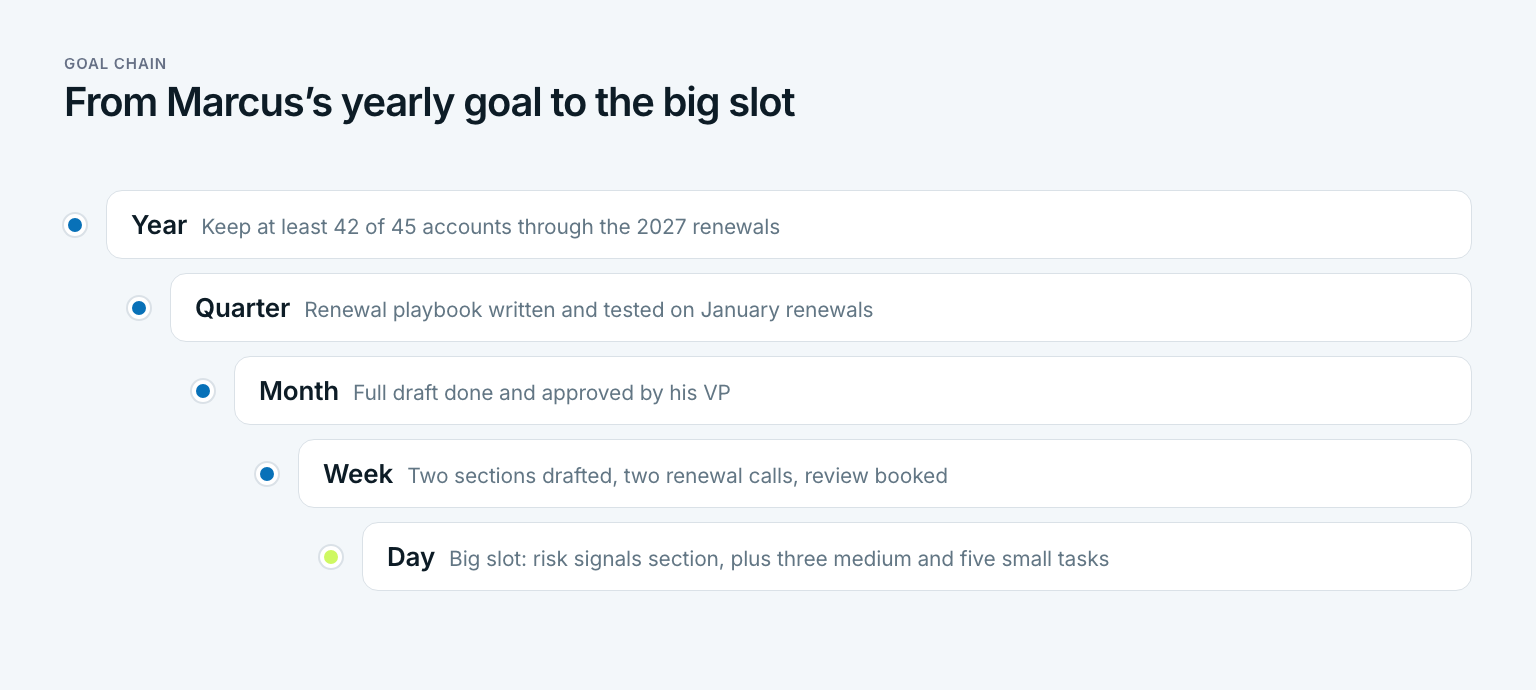
That means: the big slot of the 1-3-5 rule is where your yearly goal touches your Tuesday. Whoever pulls it from a weekly goal every day works visibly on the year five days a week, without needing more hours. Whoever fills it from the inbox has a tidy list and no direction.
The medium slots deserve a second look. For Marcus, one of the three usually feeds the weekly goal as well, while the other two serve clients and colleagues. That split is healthy. A list that only feeds your own goals ignores the people you work with. A list with no link to any goal is just maintenance.
A goal app like Gaapp can hold this chain: the yearly goal becomes a quarterly goal, the quarterly goal becomes a weekly goal, and the big slot of each day is the daily goal that feeds it. The three medium and five small tasks stay on your regular list.
1-3-5 rule template: nine lines on one page
The template fits on an index card or in any notebook. Next to each task you note what it feeds, and in the evening what became of it. That way you see while writing whether the big slot is tied to a weekly goal. Here is Marcus’s page from day nine:
| Slot | Task with a finish line | Feeds | In the evening |
|---|---|---|---|
| Big | Risk signals section, two pages, sent to his VP | Weekly goal: two sections drafted | done |
| Medium 1 | Quarterly review deck for the logistics client | Meeting on Thursday | done |
| Medium 2 | Renewal call with a January account about its usage drop | Weekly goal: two renewal calls | done |
| Medium 3 | Review support tickets of three at-risk accounts | Weekly goal: risk signals | carried over |
| Small 1 | Approve a credit note for a client | Billing is waiting | done |
| Small 2 | Send the onboarding link to a new admin | Client is waiting | done |
| Small 3 | Book the room for Friday’s playbook review | Weekly goal: review booked | done |
| Small 4 | Update the CRM note from yesterday’s call | Team visibility | done |
| Small 5 | Answer a teammate about coverage next week | Teammate is waiting | done |
Three features turn the template into a tool. The “Feeds” column keeps the big slot from losing its purpose. The “In the evening” column collects the data for your weekly review. And writing each task with a finish line makes sure every row can actually end. The guide on how to write a to-do list that gets done covers that last point in detail.
The carryover in the fourth row is not a failure. A carried-over medium task costs you nothing as long as it gets a slot tomorrow. It becomes a problem only when the same line moves for the third time. By then it is too big, too vague or not important enough, and that is the call you should make instead of pushing it again.
Three questions before you log off
Before you write tomorrow’s list, answer three questions:
- Did the big task get done today, and if not, was it the size or the calendar?
- How many small tasks did I really do, five or nine?
- Does tomorrow’s big slot feed a weekly goal, or just a full inbox?
Anyone who answers these three questions honestly for two weeks knows their real task sizes better than any template could tell them. In short: the 1-3-5 rule is not a list that organizes you. It is a budget that makes you take one big decision every day.
1-3-5 rule FAQ
What is the 1/3/5 rule?
The 1/3/5 rule is a way to cap your daily to-do list by size: one big task, three medium tasks and five small ones, nine in total. It makes sure the important work gets a fixed place in the day instead of being crowded out by small requests. The same numbers mean something else entirely in golf, photography or language learning.
What is the 1-3-5 rule for time management?
In time management, the 1-3-5 rule is a daily budget. One big task takes about two to three hours, three medium tasks about 45 minutes each and five small tasks about ten minutes each, around five and a half hours in total. The rest of an eight-hour day stays free for meetings and surprises.
What is a good answer to how do you prioritize tasks?
Name a system and back it with an example. For instance: every evening I pick one big task tied to a weekly goal, three medium tasks and five small ones, and I block time for the big one first. Then give one real case where this got something important finished. Interviewers want to hear that you decide before the day decides for you.
Does the 1-3-5 rule actually work?
There is no controlled study behind it, so test it yourself for two weeks. Track one number: on how many days the big task was done by evening. Most people who drop the rule did not lack discipline. They put a project in the big slot or let the small slots overflow.
Can you combine the 1-3-5 rule with the Pomodoro Technique?
Yes, and the two fit well. The big task gets four to six 25-minute sessions in a row, the medium tasks one or two each, and the small tasks are batched into a single session. The 1-3-5 rule decides what you work on, and Pomodoro decides how you stay with it.
What if an emergency wrecks the plan?
Swap, do not add. The emergency takes a slot, usually a medium one or the big one, and the task it pushed out moves to tomorrow. The list stays at nine lines. If days like that pile up, plan less every day and leave more buffer.
Last updated: 6 October 2026
Read next
 Productivity
Feynman Technique: Four Steps to Real Understanding
The Feynman technique is not a memorization trick: four steps, a worked example from a stats class, a one-page template, and what research says.
16 min read
 Productivity
Zettelkasten: How to Turn Notes Into Your Own Ideas
A Zettelkasten is not an archive: Luhmann's method, the three note types, a five-step setup and an Obsidian template, with a worked example.
15 min read
 Productivity
Second Brain: How to Build One You Actually Use
A second brain is not a note archive: Tiago Forte's CODE steps, the PARA method with an example, a five-step setup and the mistakes that sink it.
15 min read