Building Resilience: Seven Steps for Hard Seasons
Resilience is not armor. Building resilience in seven steps, with the four pillars, six exercises, real examples, and a twelve-week plan.

Contents
- 01What resilience means, and what it does not
- 02Resilience examples from everyday life
- 03The four pillars of resilience
- 04Mental resilience and emotional resilience: two different muscles
- 05The most common mistake: confusing resilience with toughness
- 06Building resilience in seven steps
- 07Resilience exercises: six for daily life
- 08The example: Marcus's twelve weeks in numbers
- 09Building resilience with a goal chain: year, quarter, month, week, day
- 10Frequently asked questions about building resilience
Building resilience means strengthening the skills, habits, and relationships that help you recover after stress, loss, and setbacks, and you do it with small routines you set up before the next hard season arrives. Resilience is not armor that makes things bounce off you. It works more like a suspension system. Anyone who is resilient still feels the hit, but they find their way back to a working routine sooner. The good news: most of it can be learned.
You need three things: an honest picture of what currently holds you up, two or three exercises that fit into a full life, and a plan that runs for several weeks. The worked example is Marcus, 42, a product manager in Columbus, Ohio, married with two kids. In January his logistics software company cuts a third of its staff, and his job is gone. Marcus does what he has always done. He grinds. Six weeks later he sleeps about five hours a night, has stopped returning friends' texts, and rates his stress at eight out of ten every evening.
What resilience means, and what it does not
Resilient means able to adapt to hard experiences and return to a working life afterward. The American Psychological Association describes resilience as both a process and an outcome: the question is not only whether someone gets through a crisis, but how. The word comes from materials science, where it describes something that springs back into shape after being bent. For people, the image only half fits. Whoever has lived through a real crisis rarely returns to exactly where they stood before.
The best known study on resilience comes from developmental psychologist Emmy Werner. Together with Ruth Smith, she followed all 698 children born in 1955 on the Hawaiian island of Kauai for decades. Almost a third of them grew up with serious risks: poverty, family conflict, a parent with mental illness. About one in three of those high risk children still grew into a confident, capable adult. Werner and Smith published the results in 1982 in the book “Vulnerable but Invincible.”
For a long time, resilience was seen as rare. Psychologist George Bonanno showed in 2004 that the opposite is closer to the truth: after loss and potentially traumatic events, a stable path is the most common outcome for many people. Developmental psychologist Ann Masten called resilience “ordinary magic” in 2001 for that reason. It comes not from extraordinary traits but from ordinary protective factors: relationships that hold, a sense that your actions matter, and routines that keep the day together. In short: resilience is not a rare talent. It is a system most people have and anyone can strengthen.
What resilience is not: feeling nothing. Anyone who is angry or sad for days after losing a job is not failing at resilience. Resilience does not show in the absence of pain. It shows in the pain not taking over your days for good. That means: the goal is not to feel less, but to get back to acting sooner.
Resilience examples from everyday life
Resilience examples are easiest to see side by side. The same event can lead to two very different weeks, and the difference is rarely talent. It is usually what a person does in the first days after the hit:
| Situation | A resilient response | A less resilient response |
|---|---|---|
| You lose your job | Tell two friends the same week and set a daily job search block | Tell no one and refresh job boards until midnight |
| A project you led fails | Write down what you would change and share it with your team | Replay the meeting for weeks and avoid the next project |
| A parent gets sick | Split the care schedule with siblings and keep one evening for yourself | Take it all on and cancel everything else |
| A relationship ends | Keep your workout and your Thursday dinner with friends | Drop every routine that reminds you of the old life |
| You get harsh feedback | Ask for one concrete example, then decide what to keep | Treat it as a verdict on who you are |
Notice what the resilient column has in common. Almost every response involves another person, a small concrete action, or a routine that stays in place. None of them involves feeling fine. Psychologist Albert Bandura described in 1977 how people build self-efficacy, the belief that they can handle what comes, mostly from their own small successes. Every line in the left column is a small success in the making.
Marcus filled out a version of this table on a Sunday night. His honest answers sat almost entirely in the right column. He had not told his closest friend about the layoff. He had stopped going to the gym. He was applying to twenty jobs a week without tailoring a single letter. Anyone who sees that pattern knows where to start: not with the strongest pillar, but with the one that is falling away.
The four pillars of resilience
The four pillars of resilience, as the American Psychological Association groups them in its guide to building resilience, are connection, wellness, healthy thinking, and meaning. Other models use different names and counts, but these four show up again and again in the research. They are useful because each one comes with a question you can ask yourself on a bad evening.
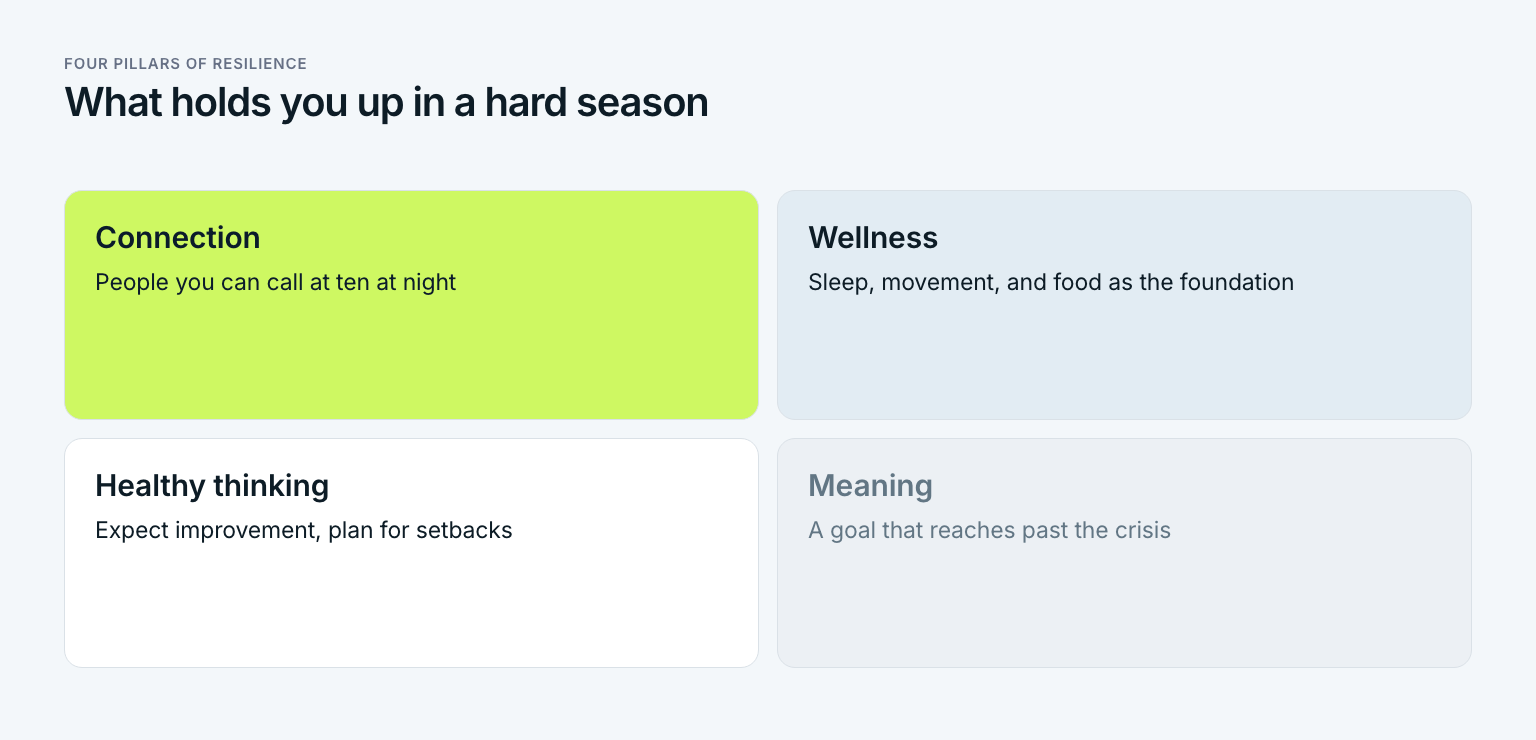
- Connection: Who can you call at ten at night? Relationships are the protective factor that appears in nearly every resilience study, from Werner's Kauai children onward.
- Wellness: Are sleep, movement, and food roughly stable? Whoever runs on five hours of sleep has very little left for the other three pillars.
- Healthy thinking: Do you expect things to improve while still planning for setbacks? Jim Collins called this the Stockdale Paradox in his 2001 book “Good to Great,” after Admiral James Stockdale, who survived more than seven years as a prisoner of war by facing the brutal facts and keeping faith in the end.
- Meaning: What are you working toward beyond getting through this? A goal that reaches past the crisis gives the week a direction that is more than damage control.
Marcus scored himself on each pillar from one to ten. Healthy thinking came out at seven. He is a natural problem solver. Connection was a two and wellness a three. That means: more thinking would not help him. His weak spots were his body and his people.
The 7 C's of resilience
The 7 C's of resilience come from Kenneth Ginsburg, a pediatrician at Children's Hospital of Philadelphia, who described them in his book “Building Resilience in Children and Teens,” first published by the American Academy of Pediatrics in 2006. The seven are competence, confidence, connection, character, contribution, coping, and control. Ginsburg wrote them for parents, but they work for adults too. Contribution is the one adults most often forget: helping someone else is one of the fastest ways to feel capable again.
A third list comes from Karen Reivich and Andrew Shatté of the University of Pennsylvania. In their 2002 book “The Resilience Factor,” they described seven trainable skills: emotion regulation, impulse control, causal analysis, self-efficacy, realistic optimism, empathy, and reaching out. The lists overlap heavily. Whoever works on one covers most of the others.
Mental resilience and emotional resilience: two different muscles
Mental resilience is how you think about a hard situation, and emotional resilience is how you handle the feelings it brings up. People often use the terms as synonyms, but they answer different questions, and someone can be strong in one and weak in the other.
| Aspect | Mental resilience | Emotional resilience |
|---|---|---|
| The question | Can I see this problem as solvable? | Can I feel this without being run by it? |
| What it looks like | Reading a rejection as information, not a verdict | Naming anger or fear before reacting to it |
| Typical weak spot | Catastrophizing: one setback becomes a life story | Avoiding feelings until they spill out sideways |
| A first exercise | The ABC log to check your interpretation | Expressive writing for fifteen minutes |
Marcus had strong mental resilience and weak emotional resilience. He could map his job search like a product roadmap. What he could not do was say out loud that he was scared. Whoever avoids the feeling usually ends up acting on it anyway, often at two in the morning.
The most common mistake: confusing resilience with toughness
Toughness is a real strength. Anyone who keeps functioning in a crisis often holds a family or a team together. For one week, that is exactly right. For three months, it becomes a risk.
Resilience does not mean carrying everything alone without a break. George Bonanno and Charles Burton described in 2013 what matters instead: flexibility. Resilient people do not have one correct coping strategy. They switch between several. Sometimes they distract themselves, sometimes they talk about the problem, sometimes they step back. What matters is noticing when a strategy stops working and choosing another. Rigid toughness is the opposite: one strategy, no matter what.
The most common mistake: resilience as gritting your teeth
Whoever confuses resilience with toughness cuts exactly what holds them up during a crisis: sleep, exercise, friends, breaks. It feels efficient and drains the reserves. The test is simple: did you drop something in the last four weeks that used to give you energy? Then bringing it back is your first step, not your last. How to put those sources of energy back on your calendar is covered in self care ideas for your week.
Marcus had dropped three things in six weeks: his Saturday morning run, the monthly poker night, and reading before bed. All three cost time. All three had given him energy. In short: he had taken apart his own protective factors, out of a sense of duty.
When self-help is not enough
Exercises can build resilience in daily life, but they do not replace treatment. If exhaustion, hopelessness, or anxiety last for weeks or you have thoughts of harming yourself, talk to a doctor or therapist, and in the US you can call or text 988 at any time to reach the Suicide and Crisis Lifeline.

Building resilience in seven steps
Building resilience works best with a plan that runs for twelve weeks. That is long enough for new routines to take hold and short enough to stay with. The seven steps follow a clear order: first secure the foundation, then train your thinking, then plan forward. You need a notebook or an app, a calendar, and the willingness to spend one week just observing. Here is how to do it:
Take stock
For one week, rate your stress every evening from one to ten and note how long you slept. Score yourself on the four pillars and mark the two weakest. Marcus: average stress 8.0, sleep 5.2 hours, weakest pillars connection and wellness.
Secure the physical foundation
Set a fixed anchor for sleep, such as a time after which screens go off, and plan two short workouts a week. Marcus put his phone on the kitchen counter at 10 p.m. and brought back his Saturday run.
Schedule two connections a week
Put two conversations a week in your calendar, and a phone call counts. Be honest about how you are doing. Whoever goes through a crisis without telling anyone gives up the protective factor that shows up most often in the research.
Accept what you cannot change
Write down what you cannot change, one sentence per item. Next to it, write what you can influence instead. Marcus: the layoff happened. What he can influence is which roles he targets and how many hours a day he spends searching.
Check your thoughts instead of believing them
When a heavy thought shows up, use the ABC log: adversity, belief, consequence. Then look for a second belief that fits the facts just as well. Three logs a week are enough.
Write an if-then plan for setbacks
Think about which setback is most likely and decide in advance what you will do. Marcus: if I get a rejection after a final round, I call my brother that evening before I open my laptop again.
Set a goal beyond the crisis
Name a goal for the next twelve months that is more than damage control. It gives each week a direction. Once a week, check how far you have come.
The plan takes little time: five minutes each evening for the stress rating and sleep, ten minutes for an ABC log, fifteen minutes on Sunday to plan the week. How to sort and reduce the stressors themselves is covered in the guide to stress management. This article is about the other side: not less load, but more capacity to carry it. Whoever confuses the two keeps waiting for calmer times that often do not come.
The order matters. Steps two and three come before thought training, because an exhausted mind is bad at rethinking. Anyone who tries to question their beliefs on five hours of sleep usually finds proof for the worst one. That means: the exercises for your head work best once your body and your people give you some footing again.
Resilience exercises: six for daily life
The seven steps are the frame, and the exercises fill it in. Each of the following has been studied or comes from established training programs. None takes more than twenty minutes, and you do not need all six:
- The ABC log. Based on the work of psychologist Albert Ellis: note the adversity, write your belief about it word for word, and record the consequence for your feelings and actions. Then look for a second belief that fits the facts just as well. The Penn Resiliency Program, developed in Martin Seligman's circle at the University of Pennsylvania, is built on this exercise.
- Three good things. Each evening, write down three things that went well and why. Martin Seligman and colleagues tested this exercise in 2005, and participants reported more well-being up to six months later. How to turn it into a lasting routine is covered in the guide to the gratitude journal.
- Expressive writing. On three or four days in a row, write for fifteen to twenty minutes about a stressful event, including your thoughts and feelings. James Pennebaker has studied the method since 1986. In his early studies, participants visited the doctor less often in the months that followed.
- The circle of influence. Draw two circles on a page: inside, what you can influence, outside, what concerns you but lies beyond your control. Stephen Covey made the image popular in 1989. It separates acceptance from action in two minutes.
- If-then plans with WOOP. Gabriele Oettingen showed in experiments that positive fantasies alone can lower effort. Her alternative is WOOP: wish, outcome, obstacle, plan. Naming the obstacle in advance is realistic optimism in four lines.
- The connection anchor. One standing appointment a week that only gets cancelled for illness. It sounds trivial, and it is the protective factor that shows up in almost every study. Whoever hooks it onto an existing routine, such as a Saturday run with a friend, does not forget it.
Why exercises instead of insights? Because resilience shows up in situations, not in intentions. A good thought helps on Sunday. A practiced action helps on Tuesday, when the rejection email lands. Each completed exercise also feeds your self-efficacy, the belief that you can handle the next thing.
Which two fit you? Your stock-taking will tell you. Whoever is isolated starts with the connection anchor. Whoever lies awake replaying things starts with the ABC log or expressive writing. Whoever feels powerless starts with the circle of influence. Marcus chose the connection anchor and the ABC log, and added three good things in week four.
The example: Marcus's twelve weeks in numbers
Marcus started at the beginning of March. His goals for twelve weeks: average at least six and a half hours of sleep, two real conversations a week, and fewer but better applications. So went the weeks:
| Weeks | Focus | Average stress | Average sleep | Conversations per week | Tailored applications per week |
|---|---|---|---|---|---|
| 1 to 3 | Taking stock, phone in the kitchen at 10 p.m. | 8.0 | 5.2 hours | 1 | 2 |
| 4 to 6 | Saturday run, told his best friend | 7.1 | 6.0 hours | 2 | 4 |
| 7 to 9 | ABC logs, narrowed search to two role types | 6.3 | 6.4 hours | 2 | 5 |
| 10 to 12 | If-then plans, yearly goal written down | 5.4 | 6.8 hours | 3 | 5 |
In week eight came the setback Marcus had planned for. After four interview rounds, a company he really wanted chose another candidate. In the old pattern, he would have opened his laptop at nine that night and fired off ten generic applications. This time the if-then plan kicked in. He called his brother, went for a run the next morning, and wrote one ABC log. His stress rating that week rose to seven, not nine.
Two things in the table matter more than the numbers. First: stress did not drop to zero. In May his savings were thinner than in March, and he still had no offer. What changed was his capacity to carry it. Second: sleep and conversations rose first, and only then did the stress rating fall. Anyone who works on their thinking while sleeping five hours is swimming against the current. In week eleven, Marcus received an offer from a smaller company. He did not count it as proof of resilience. He counted the weeks before it.
Marcus's monthly goal and weekly goal in April
Here is how small the plan gets at the lowest level. Monthly goal for April: five tailored applications for operations product roles, each with a referral where possible. Weekly goal in week 15: talk to two former colleagues who work at target companies and write down what they say. Daily goal on Wednesday: twenty minutes after lunch, message one former colleague. Small enough for a hard day, specific enough to check off.
Building resilience with a goal chain: year, quarter, month, week, day
Resilience itself cannot be scheduled, but the routines that build it can. A goal chain breaks a plan into five levels, and each level answers a different question. The guide to turning yearly goals into daily steps shows how it works in general. For building resilience, the chain looks like this:
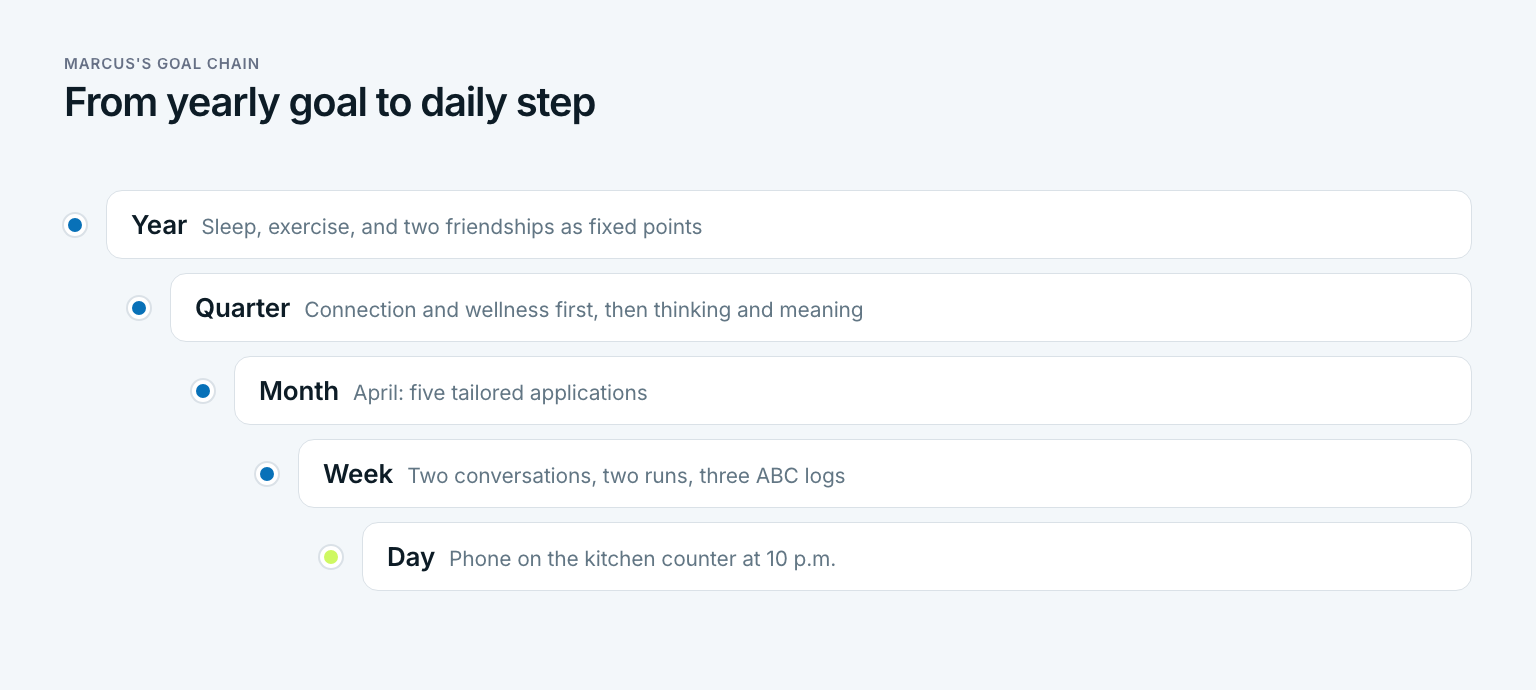
- Year: What should carry you twelve months from now? Marcus: a week where sleep, exercise, and two friendships are fixed points, and a new role past its first review.
- Quarter: Which pillar comes first? In the second quarter, connection and wellness. In the third, healthy thinking and meaning.
- Month: What result is visible by the end of the month? April: five tailored applications. May: a written budget for the next six months.
- Week: Which routines do you keep this week? Two conversations, two runs, three ABC logs.
- Day: What is the one step today? Phone on the kitchen counter at 10 p.m.
Progress at each level is the share of goals you completed, and that share is valuable in a crisis. It shows you in black and white that you are doing more than you believe on a bad evening. In weeks one to three, Marcus hit four of twelve weekly goals. In weeks ten to twelve, he hit eleven of twelve. In Gaapp, this chain is the core: five levels from year to day, and every routine you keep counts toward the yearly goal.
For couples and families, the same chain works as a shared ritual. On Sunday, each person names one thing that was hard that week and one thing that helped. For coaches, it is the record between sessions. The client logs stress and sleep, the coach reads the trend, and the session starts with data instead of the mood of the day.
Three questions before you close this tab
Three questions for yourself, answered honestly:
- Which source of energy did you cut in the last four weeks, and why?
- Who could you call tonight if things got really hard, and does that person know it?
- Which setback is most likely in the coming weeks, and what will you do when it happens?
Whoever cannot answer one of the three does not need a new resolution. They need one week of taking stock. That is how Marcus began, with one number from one to ten each evening. In short: building resilience does not mean getting harder. It means protecting what holds you up before you need it.
Frequently asked questions about building resilience
What does the word “resilient” mean?
Resilient means able to adapt to hard experiences and return to a working life afterward. The word comes from materials science, where it describes something that springs back after being bent. In psychology, it describes both the process of adapting and the outcome.
What are the four pillars of resilience?
The American Psychological Association groups its advice on building resilience into four areas: connection, wellness, healthy thinking, and meaning. Connection means relationships that hold, wellness means sleep, movement, and food, healthy thinking means realistic optimism, and meaning means a purpose beyond the current crisis. Start with the pillar that is weakest right now.
What are the 7 C's to build resilience?
The 7 C's come from pediatrician Kenneth Ginsburg: competence, confidence, connection, character, contribution, coping, and control. He described them in 2006 in a book for parents of children and teens. The model also works for adults, especially contribution, because helping others is a fast way to feel capable again.
What to do if you are not doing well mentally?
Tell one person you trust how you are actually doing, and protect your sleep and basic routines first. If the low mood, anxiety, or exhaustion lasts for weeks, talk to a doctor or therapist. If you are in crisis or thinking about harming yourself, call or text 988 in the US at any time.
What is the difference between mental and emotional resilience?
Mental resilience is how you think about a hard situation, such as seeing a problem as solvable. Emotional resilience is how you handle the feelings it triggers, such as naming fear before acting on it. Many people are strong in one and weaker in the other, which is why the right first exercise differs.
Can adults still build resilience?
Yes. Meta-analyses, such as the one by Samuel Joyce and colleagues in 2018, found that resilience training programs improve measured resilience moderately in adults, most clearly when they combine cognitive behavioral methods with mindfulness. The effect depends on whether the exercises continue after the program ends.
Last updated: 22 October 2026
Read next
 Personal Growth
Maslow's Hierarchy of Needs: The 5 Levels Explained
Maslow's hierarchy of needs sorts motivation into five levels. What each level means, what research says today and a needs audit you can run yourself.
14 min read
 Personal Growth
Mindfulness Exercises: 12 for Everyday Life
Mindfulness exercises are not about emptying your mind. 12 techniques for stress and focus, what research shows, and a four-week plan to practice daily.
16 min read
 Personal Growth
Positive Affirmations: 50 Examples You Can Believe
Positive affirmations are not magic words. What research shows, 50 daily affirmations you can believe, and a five-step method with a worked example.
16 min read