Self Care Ideas: 60 Activities to Plan Into Your Week
Self care is not a spa day. 60 self care ideas sorted by the time you have, five evidence-based areas, a 14-day energy audit and a plan that sticks.

Contents
- 01What self care actually means
- 02The five areas of self care and what the research says
- 03How to find self care activities that actually work for you
- 0460 self care ideas sorted by the time you have
- 05Self care activities for adults with no free time
- 06How to build a self care routine in five steps
- 07Dana's self care plan from year to day
- 08Three mistakes that quietly kill self care
- 09When self care is not enough
- 10Three questions before you start
Self care is not a spa day. It is the ongoing work of protecting the basics your energy runs on: sleep, movement, rest, people and time outside. The best self care ideas are small enough to fit into an ordinary Tuesday, and they work because they happen every week, not because they feel luxurious once a year.
A spa day is a fine thing. It just can't make up for six months of six-hour nights. Anyone who only looks after themselves once they are running on empty is doing repair work, not self care. This guide follows Dana, 34, a middle school teacher with a two-year-old and a partner who works night shifts. You get five areas backed by research, a 14-day energy audit, 60 ideas sorted by how much time you have and a plan that runs from the year down to a single evening.
What self care actually means
The World Health Organization describes self care as the ability of individuals, families and communities to promote health, prevent disease, maintain health and cope with illness, with or without the support of a health worker. That definition comes from its 2019 guideline on self care interventions. It is far less glamorous than the version on social media. Self care is maintenance, not reward. It covers anything that protects your physical and mental baseline and that you control yourself:
- Body. Sleep, movement, regular meals and the doctor's appointments you keep postponing.
- Mind. Breaks where nobody can reach you, and time for something that challenges you without being work.
- Emotions. Noticing how you feel and talking to yourself kindly when something goes wrong.
- People. Friends you don't have to perform for, and limits with people who ask for too much.
- Surroundings and meaning. Time outdoors, a space that isn't chaos, and activities tied to your core values.
What doesn't count is anything that calms you for ten minutes and costs you tomorrow. The third glass of wine feels like relief. The sleep after it is worse. Retail therapy rarely counts either. Whoever shops online after a brutal day is soothing the moment, not caring for the person. The test is simple: will I feel better tomorrow because of this, or only for the next ten minutes?
The writer Audre Lorde framed self care in 1988, in her essay collection A Burst of Light, as self preservation rather than indulgence. That framing still holds. Self care is not a break from your responsibilities. It is what keeps you able to carry them.
The five areas of self care and what the research says
There is no official list of self care activities. For planning purposes, five areas are enough, and each one has a solid benchmark. The numbers are not rules. They are a yardstick for measuring where you stand right now.
| Area | Question to ask | Benchmark | Source |
|---|---|---|---|
| Sleep | Do I sleep enough to wake up rested? | 7 hours or more per night for adults | Watson and colleagues, consensus of the American Academy of Sleep Medicine and Sleep Research Society, 2015 |
| Movement | Do I move enough to get out of breath? | 150 to 300 minutes of moderate activity per week | World Health Organization, physical activity guidelines, 2020 |
| Connection | Who do I talk to without having to perform? | Regular contact, no fixed number | Holt-Lunstad, Smith and Layton, meta-analysis of 148 studies, 2010 |
| Nature | When did I last spend real time outside? | About 120 minutes per week in green or blue spaces | White and colleagues, survey of nearly 20,000 people in England, 2019 |
| Recovery | Do I actually switch off after work? | Detachment, relaxation, mastery and control | Sonnentag and Fritz, recovery experiences, 2007 |
Two findings stand out. Julianne Holt-Lunstad's meta-analysis found that people with stronger social relationships had about a 50 percent greater likelihood of survival over the study periods. That doesn't turn friendship into medicine. It does make it part of the baseline. Mathew White and his team found that people who spent at least 120 minutes a week in nature were more likely to report good health and high wellbeing, and it barely mattered whether those minutes came in one visit or several.
What does that mean for you? You don't have to fix all five areas at once. You only need to know where you stand. Anyone with three areas in good shape and one deep in the red should start with the red one. A wheel of life puts that picture on a single page if you want a fuller view.
How to find self care activities that actually work for you
The honest answer to what helps you doesn't come from a list. It comes from your own week. Other people's ideas are a starting point, but only observation tells you whether a walk recharges you or just eats time. Two weeks and two minutes each evening are enough.
Work psychologists Sabine Sonnentag and Charlotte Fritz described four experiences that make up real recovery in 2007: mentally detaching from work, relaxing, mastering something new and having control over what you do. Use those four as a filter. An activity is good self care for you if it delivers at least one of them and you have more energy afterward than before. The audit itself has four lines:
- Each evening, write down three things that gave you energy and three that drained it.
- Rate your energy at the end of the day from 1 to 10.
- Add last night's hours of sleep and whether you went outside today.
- Mark the days when you had a full hour to yourself.
Dana ran the audit in January. The results were sobering and useful at the same time. She averaged 6.2 hours of sleep, had an hour to herself on 1 of 14 evenings and moved for more than 20 minutes on 4 days. Her average energy score was 4.5. On the four days she moved, it was 6.5. On the one evening alone, it was 7. That means: the audit didn't tell her what is good for people in general. It showed her what works for her.
The drain column held a surprise too. The toddler's bedtime wasn't what wore her out most. It was the hour and a half of scrolling in bed afterward, often until 12:30. Whoever blames all of their exhaustion on the big obvious load tends to miss the small leaks next to it. Those leaks are the fastest to fix. Without the audit, Dana would have booked a massage. With it, she bought a $9 phone charger for the kitchen.
60 self care ideas sorted by the time you have
Most lists sort self care ideas by category. Real life asks a different question: how much time do I have right now? So here are 60 ideas grouped by the time they take. Each one is concrete enough to do today.
Two-minute ideas
- Drink a full glass of water before your next coffee.
- Take three slow breaths, breathing out longer than you breathe in. It is one of the shortest mindfulness exercises for everyday life.
- Drop your shoulders and unclench your jaw.
- Look out a window at something far away for one minute.
- Turn off one notification that annoys you every day.
- Write one sentence about how you feel right now.
- Text someone you just thought of.
- Set tomorrow's alarm before it gets late.
- Clear your desk for tomorrow morning.
- Ask yourself what you would tell a friend in your situation.
- Step outside and feel the air for a moment.
- Put your phone in another room while you eat.
- Stretch your arms overhead and roll your neck.
- Say no to one small request you don't have room for.
- Put on a song you love and listen to the whole first verse.
Fifteen-minute ideas
- Walk around the block with your phone in your pocket.
- Call someone you don't have to explain yourself to.
- Stretch after a long day of sitting.
- Read a chapter of a book that has nothing to do with work.
- Book the checkup you've been putting off.
- Cook a warm meal instead of eating over the sink.
- Take a shower without a podcast.
- Write down three things that went well today.
- Tidy one surface that bothers you every time you see it.
- Sit in the sun with a cup of tea and nothing else.
- Do a short guided relaxation or body scan.
- Plan one fun thing for the coming weekend.
- Water your plants or repot one.
- Cancel a commitment you only made out of guilt.
- Lie on the floor with your legs up the wall.
One-hour ideas
- Exercise that makes you sweat: a run, a swim, a bike ride.
- Dinner with a friend, booked like any other appointment.
- An hour outdoors in a park, a forest or by the water.
- A hobby that uses your hands: cooking, drawing, gardening, building.
- A weekend nap with no guilt attached.
- Plan your week and block two evenings for yourself.
- Take a class or watch a lesson on something you're curious about.
- A bath, if you like baths, with your phone in another room.
- Time with a child or a pet with no multitasking.
- Declutter one drawer, one closet or one inbox folder.
- Visit a library or bookstore and browse with no goal.
- Play a board game or a sport with people you like.
- Journal about one question that has been on your mind.
- Meal prep three healthy lunches for the week.
- Go to a yoga, dance or climbing class.
Self care day ideas
- A day with zero appointments, blocked in your calendar a week ahead.
- A hike with snacks and no schedule down to the minute.
- A day trip to a town you've never visited.
- A day offline, with one person who can reach you in an emergency.
- A day spent only with people who leave you lighter.
- A checkup day: dentist, skin check and eye exam back to back.
- A day at a spa, a sauna or a hot spring.
- A day for a project you've wanted to finish for months.
- Sleep in, read, cook and go to bed early.
- A personal day off work that is not used for errands.
- A beach or lake day with a book and a cooler.
- A museum day at your own pace.
- A cooking day that fills the freezer for two weeks.
- A volunteering day for a cause you care about.
- A planning retreat for yourself: review the past quarter, plan the next.
The list is a menu, not a program. Anyone who starts 60 ideas at once will have none left in three weeks. Pick one from each group that already showed up in your energy audit and ignore the rest for this quarter. Dana chose the glass of water, the walk around the block, dinner with her sister Kim and one zero-appointment Saturday a month.

Self care activities for adults with no free time
Most adults don't lack self care ideas. They lack open space in the calendar. The answer is rarely to add a new block of time. It is to attach self care to moments that already exist. Habit researchers call this a cue: an existing action that reliably triggers the new one. The habit stacking formula puts it in one sentence: after I do X, I will do Y.
| Moment you already have | Self care activity attached to it | Area |
|---|---|---|
| Morning coffee brewing | Drink a glass of water and look outside | Body |
| Commute or school drop-off | Call a friend hands-free, or walk the last stretch | People, movement |
| Lunch break | Ten minutes outside before eating, phone in the bag | Nature, recovery |
| Child's nap or screen time | Fifteen minutes of reading or stretching, not chores | Mind, body |
| Closing the laptop | Write tomorrow's top task, then shut down for real | Recovery |
| Brushing your teeth at night | Phone goes on the kitchen charger | Sleep |
Dana used three of these. Her phone went on the kitchen charger while she brushed her teeth. Her lunch break started with ten minutes on the bench behind the school. And her Saturday walk happened during her son's stroller nap, which turned dead time into active time. None of it needed a babysitter. That means: whoever waits for free time to start self care will wait a long time. Whoever borrows existing moments can start tonight.
How to build a self care routine in five steps
Building a self care routine doesn't mean learning more about self care. It means turning a few actions into something as automatic as brushing your teeth. That takes the same tools as any other habit: a clear trigger, a small start and a number you track.
Audit before you change anything
Run the energy audit for 14 days. Don't judge, just record. Dana's numbers were 6.2 hours of sleep, 1 evening alone in two weeks and an energy score of 4.5. Those three numbers are her starting line.
Pick one area, not five
Choose the area that is furthest below its benchmark and most likely to raise your energy. For Dana that was sleep, because the late scrolling cost her more than any single task.
Set a minimum that survives a bad week
Not an ideal, a floor. Dana committed to phone in the kitchen by 10 p.m. on school nights and two 30-minute walks a week. Whoever plans for their best week misses the target in every normal one.
Give it a fixed slot
Self care without a time slot loses to everything that has one. Dana put Wednesday and Saturday walks into her calendar as recurring events and told her partner which times were hers.
Count weekly, adjust monthly
On Friday, take two minutes: how many nights with the phone in the kitchen, how many walks? At the end of the month, decide whether the minimum holds or whether a second area can join.
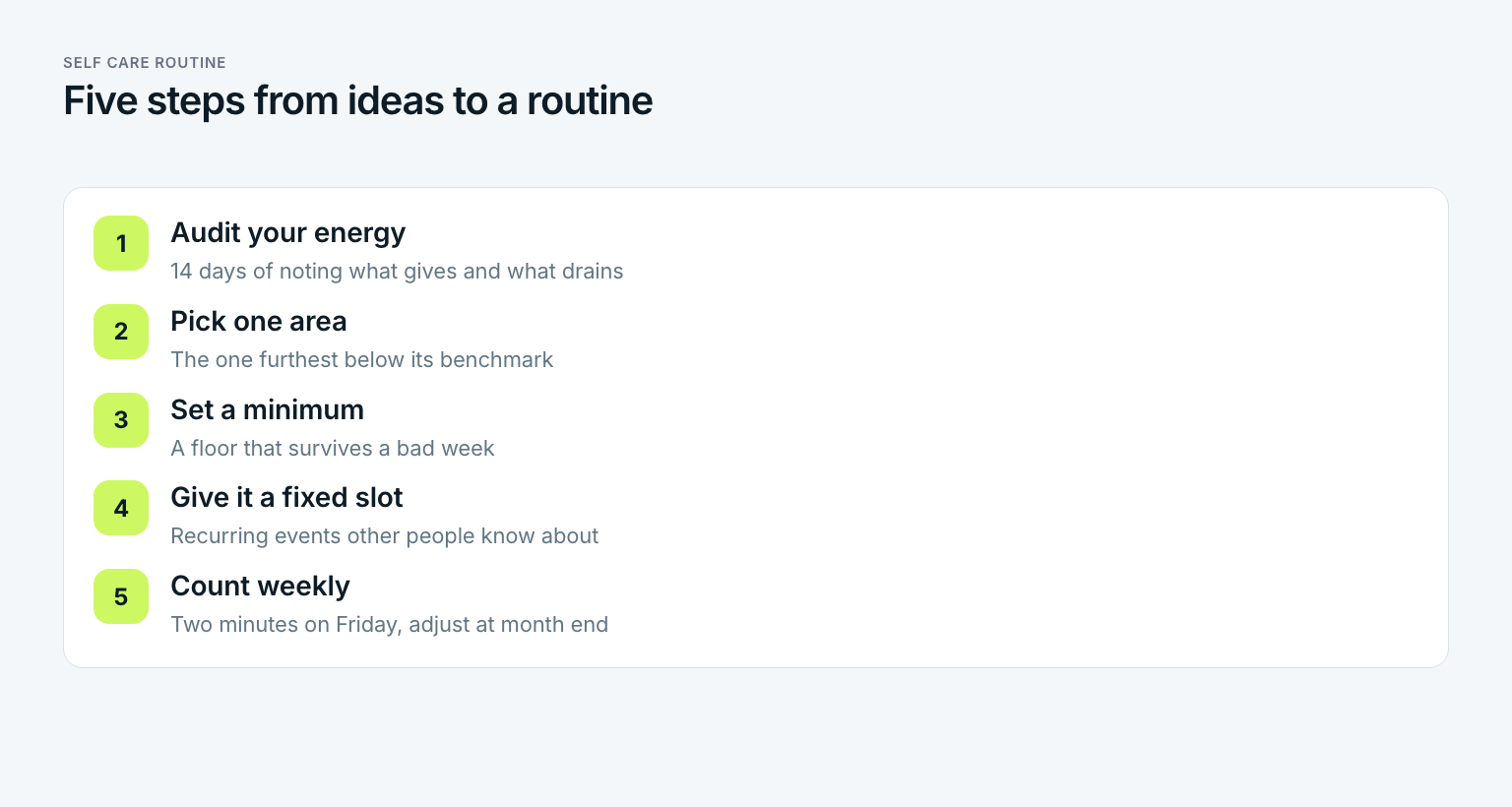
Step three matters most. A minimum has an advantage no ideal ever has: you can meet it in the week your toddler has a fever and report cards are due. Anyone who holds their minimum in a week like that learns that self care is not a luxury for calm times. The hour before bed is usually the easiest place to start, and an evening routine turns that hour into a reliable on-ramp to sleep.
Dana's self care plan from year to day
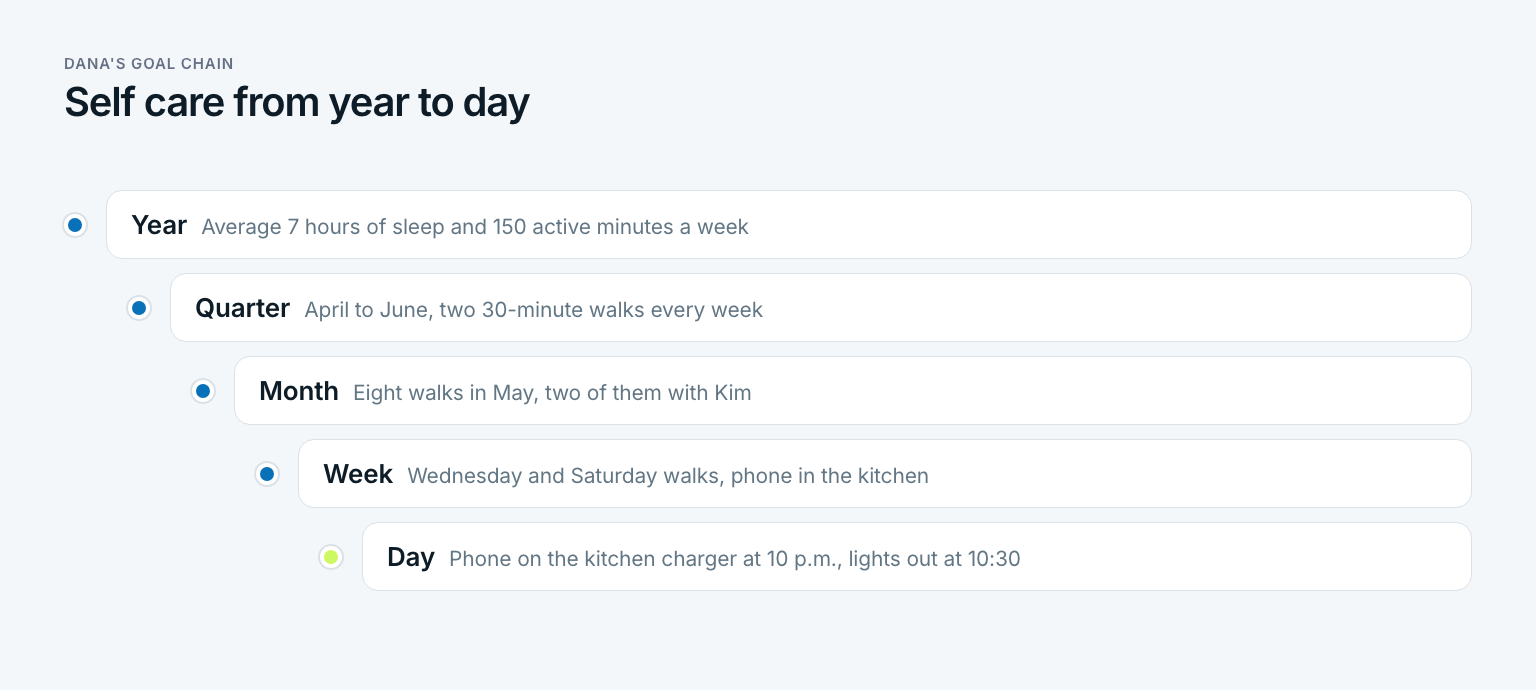
A resolution like “take better care of myself” rarely survives February. A goal broken down from the year to the day has better odds, because every single day shows what counts today. Here is Dana's chain:
- Year: By December, average 7 hours of sleep and 150 active minutes a week, measured monthly.
- Quarter: From April to June, two 30-minute walks every week with no exceptions.
- Month: Eight walks in May, two of them with Kim.
- Week: Walks on Wednesday after school and Saturday during the nap, phone in the kitchen on school nights.
- Day: Phone on the kitchen charger at 10 p.m., lights out at 10:30.
| Quarter | Focus | Average sleep | Active minutes per week | Energy score |
|---|---|---|---|---|
| January to March | Audit, phone out of the bedroom | 6.6 hours | 60 | 5.2 |
| April to June | Two walks a week, no exceptions | 6.8 hours | 90 | 5.8 |
| July to September | Summer break: add a weekend swim | 6.9 hours | 150 | 6.4 |
| October to December | Hold through the school year | 7.0 hours | 140 | 6.4 |
These numbers are an example, not a promise. They do show a pattern that turns up in almost every plan. The first change brings the biggest gain, and after that the curve flattens. Anyone who feels let down in the fourth quarter because the energy score stopped rising is reading the number wrong. The goal for the second half of the year is not more. It is holding on.
Gaapp is built for exactly this chain: one yearly goal, quarterly and monthly goals underneath and the one daily goal to check off at night. Paper works too. What matters is that the 10 p.m. charger is connected to the yearly goal, or it disappears the first time the calendar fills up. For drawing the line between work and the rest of life, see the guide to work-life balance.
Three mistakes that quietly kill self care
Self care rarely fails for lack of knowledge. Nearly everyone knows that sleep and movement help. It fails because of three patterns that are easy to miss.
The most common mistake: treating self care as a reward
Many people treat time for themselves as something to earn first: once the work is done, once the kids are asleep, once the house is clean. It sounds disciplined. The trouble is that the work is never quite done. Whoever plans this way loses self care in exactly the weeks they need it most. The fix: time for you goes into the calendar first, and the to-dos fill in around it.
Mistake two: distraction instead of recovery
A show until midnight is a decent distraction. It feels like rest because your mind gets a break. It also costs sleep, and sleep is the area with the biggest leverage. Anyone who unwinds with a screen and wakes up tired has traded recovery for distraction. The energy audit is the referee: what is your score the next evening?
Mistake three: everything at once
New year, new me: yoga, meditation, journaling, clean eating, earlier bedtime. Five new habits at once break at the same point as a crash diet. Three weeks in, a hard week arrives, everything drops at once and you're left feeling like you failed. One area, one minimum, one quarter is slower. It also lasts. Do you recognize yourself in one of these three? Then you know where to start.
When self care is not enough
Self care is prevention, not treatment. It helps you protect your energy, but it does not cure depression, an anxiety disorder or burnout. Anyone who has barely slept for weeks, can't enjoy anything anymore or doesn't know how to get through the next day needs more than a free evening. The first step is a primary care doctor or a licensed therapist. If you are in crisis, call or text 988 in the US to reach the Suicide and Crisis Lifeline at any hour.
Chronic stress often needs more than recovery in the evening, too. Whoever only cushions the effects changes nothing about the cause. The guide to stress management shows how to work on triggers, appraisal and recovery together.
Three questions before you start
Before you pick the first idea from the list, answer three questions in writing:
- Which of the five areas is furthest below its benchmark for me?
- What minimum would I have kept even in the worst week of the last quarter?
- Which two fixed times each week belong to me, and who needs to know about them?
Anyone who has answered those three questions doesn't need another list of self care ideas. In short: self care is not the reward for getting through the week. It is the reason you get through the next one.
What are 10 self-care practices?
Ten practices with good evidence behind them: sleeping seven hours or more, moving 150 minutes a week, spending about two hours a week outdoors, seeing friends regularly, eating regular meals, taking breaks without your phone, keeping medical checkups, limiting work hours, doing a hobby that absorbs you and talking to yourself kindly after a setback. You don't need all ten at once. Start with the one where you are furthest behind.
What to do when you can't cope with life?
Tell someone today, a friend, a family member or your doctor, so you are not carrying it alone. If you are in crisis or thinking about harming yourself, call or text 988 in the US to reach the Suicide and Crisis Lifeline at any time. Self care helps with everyday strain, but it does not replace professional support.
What are the 5 C's of self-care?
There is no single scientific model behind the 5 C's of self-care. Different coaches and websites list different words, often including calm, connection, compassion, consistency and care. A more useful check is whether your week covers the five basic areas: sleep, movement, connection, time outdoors and real recovery.
What are 5 self-care strategies?
Five strategies that make self care stick: track your energy for two weeks, pick one area, set a minimum that survives bad weeks, give it a fixed slot in your calendar and count it every Friday. Together they turn a list of self care ideas into a routine.
Is self care selfish?
No, as long as nobody else is permanently carrying your load. Self care keeps you able to show up for others over months and years. Selfishness takes something from others without asking.
What should I do on a self care day?
Plan it a week ahead, clear all appointments and choose one or two things that scored high in your energy audit, such as a hike, time with a friend or a long nap. Keep errands out of it. One planned self care day a month does more when your weekly minimums are already in place.
Last updated: 22 October 2026
Read next
 Personal Growth
Maslow's Hierarchy of Needs: The 5 Levels Explained
Maslow's hierarchy of needs sorts motivation into five levels. What each level means, what research says today and a needs audit you can run yourself.
14 min read
 Personal Growth
Mindfulness Exercises: 12 for Everyday Life
Mindfulness exercises are not about emptying your mind. 12 techniques for stress and focus, what research shows, and a four-week plan to practice daily.
16 min read
 Personal Growth
Positive Affirmations: 50 Examples You Can Believe
Positive affirmations are not magic words. What research shows, 50 daily affirmations you can believe, and a five-step method with a worked example.
16 min read