Career Goals: 30 Examples and How to Set Your Own
A career goal is a capability with a date and evidence, not a title. Four kinds, 30 examples, five steps, three interview answers, a chain to this week.

Contents
- 01What career goals are, and what they are not
- 02Why most career goals stall at the promotion
- 03The four kinds of career goals, and the one you are probably missing
- 04Career goals examples: 30 you can copy and make your own
- 05How to set career goals in five steps
- 06What is the best answer for career goals in an interview? Three sample answers
- 07From the 18-month goal to Tuesday: the goal chain for career goals
- 08The three mistakes that quietly kill career goals
- 09Your self audit before the next review, and one sentence to keep
A career goal is not a job title. It is a statement of what you want to be able to do, be trusted with, or be known for by a specific date, written so that you can work on it this week. Career goals that read like job titles, Senior Manager by 35, Director by 40, depend on somebody else's decision. Career goals that read like capabilities depend on yours.
Three things make a career goal work: a direction you have tested against reality, a horizon of one to five years, and a chain of smaller goals that reaches down to this week. Jordan is 29, an account manager at a logistics software company, and wants to move into product management within 18 months. Her goal runs through every section, from the four kinds of career goals and 30 career goals examples to the interview answer and the goal chain down to Tuesday afternoon.

What career goals are, and what they are not
A career goal describes a future state of your working life that you choose and that you can influence. Three parts are fixed: a capability or position, a date, and the evidence that would show you got there. Wanting more is not a goal. Wanting to lead a team of five by the end of next year, having run two cross-team projects before that, is one. Anyone who writes a career goal without evidence is writing a wish.
A promotion is a fine thing to want. It is just an outcome that sits in another person's calendar. Your manager decides, the budget decides, a reorganization decides. That does not make promotions useless as goals. It means the promotion belongs at the top of the chain, and the things you control belong underneath it: the skills, the visible work, the relationships, the conversations you ask for. Whoever confuses the two levels feels stuck for years while doing everything right.
Jordan's first version was: become a product manager. Her second version, two weeks later: by March of next year, be the person the product team asks when they need to know what customers actually say, having run 40 documented customer interviews and shipped twelve insight reports. The first version is a title. The second is work she can start on Monday. Which of your own goals would survive that test?
Career goal, career plan, career path: three words that get mixed up
A career goal is the destination with a date: what you want to be able to do or be trusted with by when. A career plan is the chain of smaller goals that leads there, by year, quarter, and month. A career path is the sequence of roles people in your field typically move through. It is useful as a map, not as a goal. Whoever adopts a path as a goal ends up chasing the next box on somebody else's chart.
Why most career goals stall at the promotion
Wanting a promotion is normal and healthy. It is also where most career goals stop, and that is the problem. Three things go wrong at once: the goal is an outcome you do not control, it has no horizon shorter than someday, and it gets no feedback until the yearly review. A goal that gets feedback once a year is not a goal you are working on. It is a goal you are waiting for.
Edwin Locke and Gary Latham, whose goal setting theory from 1990 rests on hundreds of studies, found that specific and difficult goals lead to higher performance than vague encouragement to do your best. The effect holds only when the person gets feedback on progress and believes the goal is reachable. A promotion goal fails both tests. Feedback comes once a year, and reachability is decided in a room you are not in.
Herminia Ibarra, in Working Identity from 2003, studied people who changed careers and found that almost none of them thought their way into the new role. They tried small experiments, a side project, a course, a conversation with someone already doing the job, and adjusted after each one. A side project works as an experiment when it has project goals with a scope, a date and a budget. That means: a career goal is not finished when you write it down. It is finished when you have tested it against one real piece of work. Jordan's first test was a single customer interview she wrote up for a product manager who had not asked for it. He replied within an hour and asked for more.
The four kinds of career goals, and the one you are probably missing
Career goals come in four kinds, and most people only write one of them. Skill goals answer the question what can I do. Role goals answer what am I trusted with. Skill goals overlap most with professional development goals, which turn a skill into something another person can check. Network and reputation goals answer who knows what I can do. Work design goals answer how work fits my life. The last two are the ones most lists skip, and they decide whether the first two ever pay off.
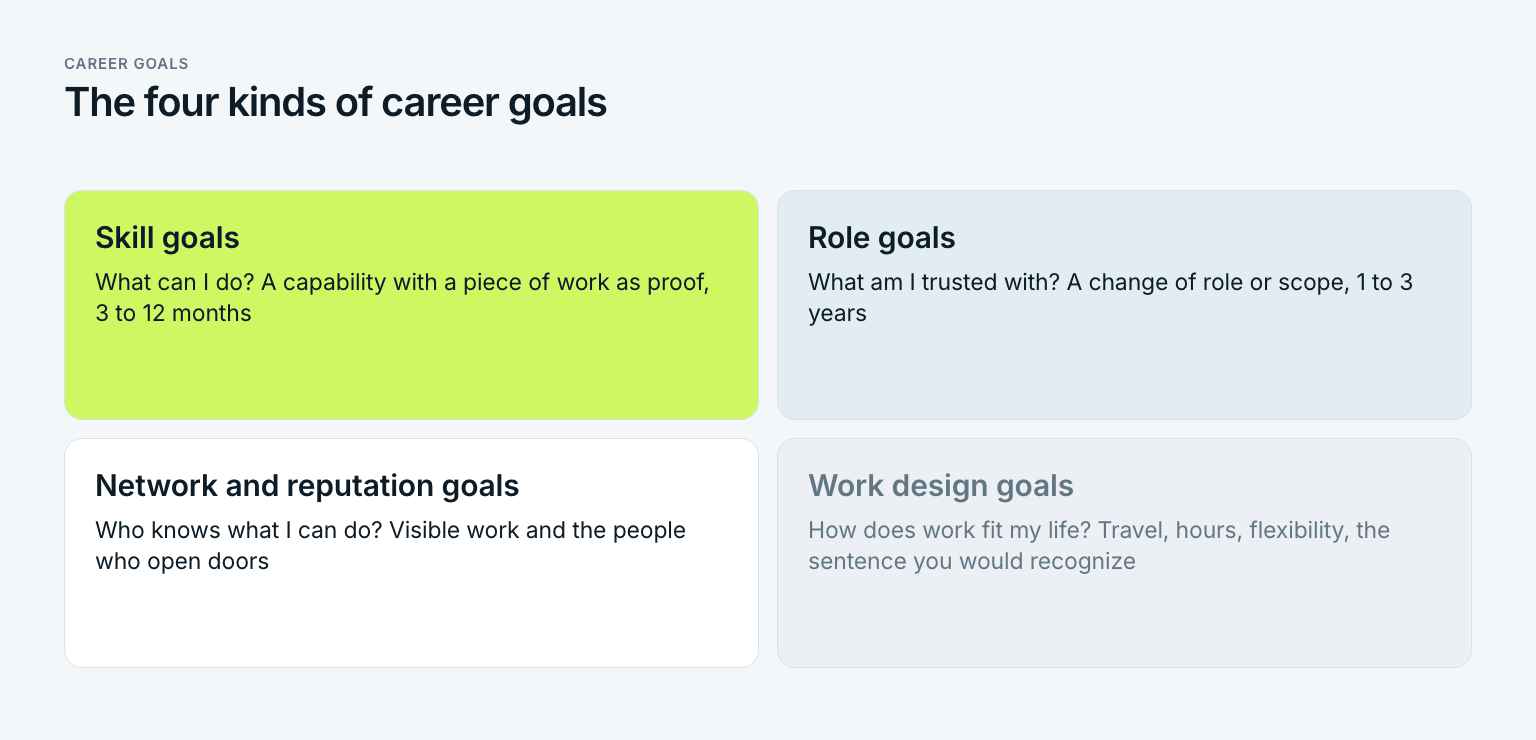
Jordan had a role goal, product manager, and nothing else. When she wrote the other three, the picture changed. Her skill goal became customer discovery and writing. Her reputation goal became being known inside the company as the person who brings customer evidence to product decisions. Her work design goal, which she had never said out loud, was to stop traveling two weeks a month. Written next to each other, the four goals pointed in one direction, and a product role was where all four met.
The second axis is time. Short-term career goals run three to twelve months and are mostly skill goals and visible work. Mid-term career goals run one to three years and usually mean a change of role or scope. Long-term goals run three to ten years and describe a kind of work and a kind of life more than a title. Anyone who only has long-term goals has a direction and no traction. Anyone who only has short-term goals has traction and no direction.
| Horizon | Typical kind | What a good one sounds like | Jordan's version |
|---|---|---|---|
| Short term, 3 to 12 months | Skill goal, visible work | A capability you can demonstrate by a date, with a piece of work as proof | 40 documented customer interviews and twelve insight reports by March |
| Mid term, 1 to 3 years | Role goal, scope goal | A change of role or responsibility, with the capabilities it requires named | A product role owning one feature area by the end of next year |
| Long term, 3 to 10 years | Work design, reputation | The kind of work and the kind of life, as a sentence you would recognize on arrival | Lead a small product team in a company whose product I would use, travel under four days a month |
Write all three horizons, then work only on the shortest. The long-term goal gives the short-term one its reason. The short-term goal gives the long-term one its first step. The guide on how to achieve goals walks through the mechanics of breaking a long goal into the next step.
Career goals examples: 30 you can copy and make your own
Every example below names a capability, a date, and a piece of evidence, because that is the form that makes a goal workable. Replace the numbers with yours and keep the structure. A list of career goals examples is only useful if you leave with one goal you can start on Monday, so pick one from each group at most.
Ten skill goals
- Present to a group of 30 or more three times this year, with written feedback after each one.
- Complete a SQL course by June and answer 20 real data requests from your team by December.
- Write twelve pieces this year, internal or external, each at least 800 words, on a topic in your field.
- Lead one hiring process from job description to offer, including at least eight interviews.
- Run a project with a budget above 50,000 dollars from kickoff to close, and write the retrospective yourself.
- Give prepared, written feedback to a peer or a report once a month for a full year.
- Earn one certification your target role lists as required, with the exam booked within 30 days.
- Negotiate three agreements this year and record what you asked for and what you got.
- Read a profit and loss statement well enough to explain your team's numbers to a new hire in 15 minutes.
- Facilitate ten meetings with a written agenda and a decision log, and ask two attendees what to change.
Ten role and responsibility goals
- Own one product area, customer segment, or region end to end within 18 months, with a metric you report monthly.
- Move from individual contributor to team lead by the end of next year, having led two cross-functional projects first.
- Run onboarding for every new hire on your team for a year and cut their time to first independent task by a third.
- Become your manager's deputy during absences, with the written backing of their manager.
- Change functions, from sales to product or from support to engineering, within 24 months, with one project in the target function done first.
- Represent your team in a company-wide initiative and bring back one decision per quarter.
- Build a quarterly review for your area that your director attends and uses.
- Mentor two junior colleagues for a year with a monthly 1:1 each.
- Take on three to five reports within two years, with a management course finished before the first hire.
- Open a new line of work for your team and run it for a year before handing it over.
Ten goals for the job you already have
- Cut weekly overtime from eight hours to two by the end of the quarter by dropping or delegating three recurring tasks.
- Ask for a scope or title change in your current role within six months, with the case written down first.
- Send a short monthly summary of outcomes to your manager and two stakeholders for twelve months.
- Build a working relationship with three people outside your department, one coffee each per quarter.
- Replace one weekly manual process with a simpler one and measure the hours saved.
- Raise your customer or stakeholder satisfaction score by a step agreed with your manager in advance.
- Take every vacation day you are entitled to this year, planned by the end of January.
- Attend two industry events and implement one idea from each within 30 days.
- Ask for a pay review with a written case, benchmark data, and twelve months of outcomes.
- Finish the backlog item everyone avoids and document how you did it.
Thirty examples are too many to work on, and that is the point. Jordan chose three: one skill goal, 40 interviews and twelve reports, one role goal, a product role by the end of next year, and one goal for the job she had, travel down to one week a month by handing over two accounts. Three goals, three kinds, one direction. Narrowing a long list down to three to five is a skill of its own, and the guide on yearly goals for work shows how to choose ones that last. The SMART goals examples page shows the same discipline in a different format.

How to set career goals in five steps
Setting career goals takes one afternoon and three conversations, not a retreat. The order matters. Most people start with the goal and skip the evidence. The method below starts with the evidence, writes three candidate goals instead of one, and tests them before committing. Jordan's afternoon was a Saturday in October. Her three conversations took the next two weeks.
Look back before you look forward, 60 minutes
List ten pieces of work from the last two years that you remember. Next to each, write whether it gave you energy or drained it, and what exactly you were doing in that moment. Patterns show up fast. Jordan's list had eleven items. The four that gave her energy were all moments where she helped a customer rethink a workflow. None were negotiations, which was most of her job description.
Write three candidate goals, not one, 30 minutes
Write three directions as full sentences with a date and evidence. Writing three stops you from falling in love with the first one. Jordan's were product management, solutions consulting, and customer success leadership. All three used the thing she had energy for. Only one removed the travel.
Test each one against a real person, two weeks
For each candidate, talk to one person who does that work today. Ask three questions: What does a normal Tuesday look like? What did you have to learn that nobody told you? What would you want to see from someone with my background? The solutions consultant Jordan met traveled more than she did. The customer success lead spent her week on renewals. The product manager asked for a sample customer write-up before the coffee was over.
Choose one and write it with a date and evidence, 20 minutes
Pick the candidate that survived the conversations and write the final sentence. Jordan's: by March, be the person the product team asks what customers say, with 40 documented interviews and twelve insight reports, and by December of next year hold a product role owning one feature area. Then add one line that says why. Hers: I want to decide what gets built, not sell what got built.
Build the chain down to this week and set the review, 30 minutes
Break the 18-month goal into quarters, this quarter into months, this month into weeks, and this week into a single next step. Then put a ten-minute review in the calendar every Friday. A career goal without a weekly review becomes a New Year's resolution by February. The review format is in the [ten-minute weekly review](/en/blog/ten-minute-weekly-review).
Five steps, roughly three hours of desk time, three coffees. Whoever skips step three ends up a year into a goal they would have dropped after one conversation. Whoever skips step five has a well-written goal and no reason to look at it before the next review.
What is the best answer for career goals in an interview? Three sample answers
The best answer for career goals in an interview has three parts and takes under a minute: the direction you are heading, why this role is a real step on that path, and one thing you have already done toward it. The interviewer is not testing your ambition. They are testing whether you will still be there in two years and whether the role will still fit you. An answer that is all direction sounds like you are passing through. An answer that is all this job sounds like you have not thought about it.
Career goal sample for an early career candidate
I want to become someone a team relies on for clear analysis. Over the next two years I want to own a reporting area end to end and present the numbers to people outside my team at least once a quarter. This role is the first place I would get both, because the job description mentions monthly reporting to the leadership team. I have already finished a data analysis certificate and built the dashboard my student organization still uses.
Career goal sample for a mid-career candidate
In the next three years I want to lead a team of four to six people in operations and be known for making processes simpler rather than adding more of them. In my current role I have led two cross-team projects and I mentor two junior colleagues, so I know I want the people side. What I do not have yet is formal responsibility for a team's results, and this role has it.
Career goal sample for a career changer
Jordan's version, used in two interviews so far: I am moving from account management into product. My goal is to own a feature area within 18 months and to be the person who brings customer evidence into the room. I have run 23 customer discovery interviews in the last four months and written seven insight reports that the product team at my current company now asks for. This associate product role is where the evidence I gather starts turning into decisions I make.
The question behind the question
When an interviewer asks about your career goals, they are asking three things at once: Will you stay? Will this role bore you in a year? Do you know yourself well enough to manage your own development? That means: the honest answer with a direction beyond this job is stronger than the safe answer that pretends this job is the destination. Nobody believes the safe answer anyway.
What not to say is shorter. Do not name a title and a date and nothing else, because it sounds like a demand. Do not say you have not thought about it. And do not borrow a goal from a list. Interviewers hear the same five borrowed answers every week.
From the 18-month goal to Tuesday: the goal chain for career goals
Career goals fail in the gap between the horizon and the calendar. The horizon is 18 months away. The calendar is this week. Nothing connects them unless you build the connection, and it has five levels: year, quarter, month, week, day. The year says where. The quarter says what has to be true in 90 days. The month says what gets finished. The week says what gets done. The day says what gets started.
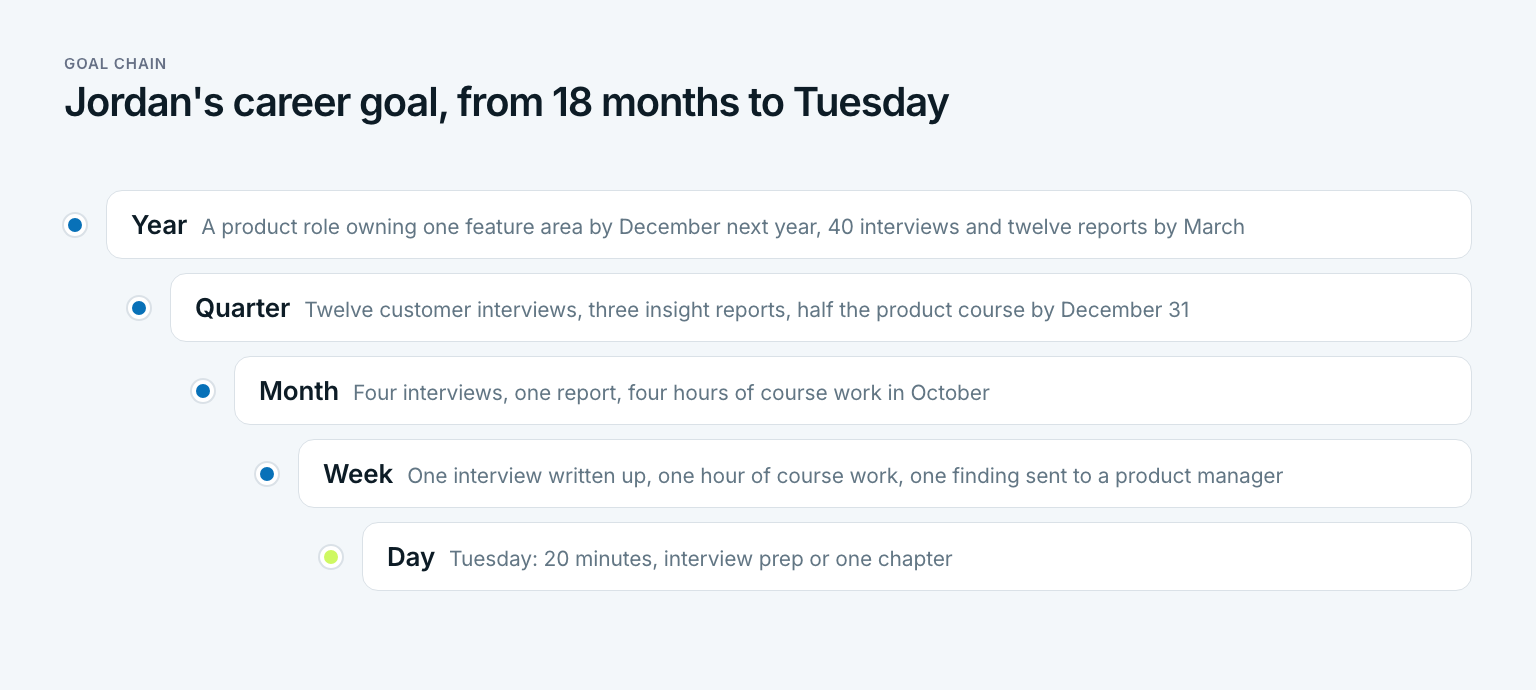
Jordan's chain looks like this. Year: by December of next year, hold a product role owning one feature area, with the March milestone of 40 interviews and twelve reports on the way. Quarter: twelve customer interviews, three insight reports, and the first half of a product management course by December 31. Month: four interviews, one report, four hours of course work in October. Week: one interview conducted and written up, one hour of course work, one message to a product manager with a finding. Day: 20 minutes, either preparing tomorrow's interview or reading one chapter.
The numbers are small on purpose. One interview a week sounds like nothing. Over 40 weeks it makes her the most informed person about customers in a company of 300. Anyone who has tried to find a free Saturday for the big push knows why the small daily step wins: the Saturday never comes, and 20 minutes on a Tuesday always does.
After 14 weeks, Jordan's Friday reviews showed eleven of 14 weekly goals met, 13 interviews instead of twelve, three reports shipped, and one outcome she had not planned. In week nine the head of product invited her to the monthly roadmap meeting as the voice of the customer. That invitation did not come from a request for a promotion. It came from seven reports that arrived in people's inboxes without being asked for. How to build this kind of chain for any yearly goal is in the article on how to turn yearly goals into daily steps, and the yearly level itself in the guide to annual planning.
Tools matter less than the chain, but the chain has to live somewhere you look every week. A notebook works. A goal tracker like Gaapp is built for exactly this shape, one yearly goal with quarterly, monthly, and weekly goals underneath it and the week's progress visible next to the time already spent. Whatever you use, the test is the same: can you see on Friday whether the week moved the year?
The three mistakes that quietly kill career goals
Career goals rarely die loudly. They fade. The three reasons they fade are the same across industries and levels, and none of them is a lack of ambition: too many goals at once, a goal nobody else knows about, and a goal that never gets reviewed. Each one is easy to fix once you can see it, and almost impossible to notice from inside.
The most common mistake: a career goal nobody else knows about
Most people keep their career goal private, out of modesty or out of fear that saying it out loud makes it binding. The result is that the one person who could open doors, your manager, plans your year without knowing where you want it to go. Jordan told her manager in week two. The manager did not love losing an account manager, and said so. She also moved two of Jordan's travel-heavy accounts to a colleague by week six and mentioned Jordan's reports to the head of product. Whoever keeps the goal secret has to do all the opening alone.
- Too many goals. Five career goals at once means five things that each get a fifth of a free evening. Pick three at most, one per kind, and work on the shortest horizon. The others wait, written down, for next quarter.
- A goal with no review. A career goal written in January and read in December was never a goal. It was a hope with a date. Ten minutes every Friday is enough: Did the week move the month? What is the one thing next week?
- A goal borrowed from a list. Lists like the one above are a starting point, not an answer. A goal that does not survive the question why do I want this, asked three times in a row, is somebody else's goal with your name on it.
A goal that changes because of evidence is working. Jordan's changed twice in 14 weeks, once when she dropped the consulting option, once when the roadmap invitation showed that an internal move was more realistic than an external one. A goal that changes because of a bad week is not working. Can you tell which one is happening to yours?
Your self audit before the next review, and one sentence to keep
Before your next 1:1, performance review, or quiet Sunday evening, run your current career goal through five questions. Each takes less than a minute to answer and more than a minute to answer honestly.
- Is my goal a capability with a date and evidence, or a title with a hope attached?
- Have I tested it against one real person who does that work today?
- Does my manager know it, in the words I would use for it?
- Is there a weekly goal underneath it that I can finish by Friday?
- When did I last look at it, and did I change anything because of what I saw?
Two no answers are normal and fixable this week. Four no answers mean you have a direction and no goal yet, which is a fine place to start the five steps from. Zero no answers mean you are Jordan in week 14, and the next thing to do is ask for the conversation about the role.
In short: a career goal is not a title you wait for. It is a capability you build in public, one week at a time, until the title becomes the obvious next step for everyone in the room.
What are your career goal examples?
Strong career goal examples name a capability, a date, and evidence. For example: lead a team of four to six within two years, having run two cross-team projects first. Or: become the person my team relies on for data analysis by completing a SQL course by June and answering 20 real requests by December. Or: own one product area end to end within 18 months, with a success metric I report on monthly. Titles alone are not goals, because somebody else decides them.
What is the best answer for career goals?
The best answer has three parts and takes under a minute: the direction you are heading, why this role is a real step on that path, and one thing you have already done toward it. For example: I want to lead a small operations team within three years and be known for simplifying processes. This role gives me formal responsibility for results, which I do not have yet. I have led two cross-team projects and mentor two junior colleagues. Avoid naming only a title and a date, and avoid pretending this job is your final destination.
What are top 3 career goals?
The three career goals that come up most often in interviews and coaching conversations are a change of role or scope, usually a promotion or a move into management, a new skill that the next role requires, and a change in how work fits life, such as less travel, more flexibility, or a shorter week. Most people write only the first one. The strongest plans have one goal of each kind, pointing in the same direction.
What are the 10 examples of goals?
Ten workable career goals: present to 30 or more people three times this year, complete a required certification by a booked exam date, lead a hiring process from job description to offer, own one product area or region end to end within 18 months, move from individual contributor to team lead by the end of next year, mentor two junior colleagues for a year, cut weekly overtime from eight hours to two by the end of the quarter, send a monthly outcomes summary to your manager for twelve months, build working relationships with three people outside your department, and ask for a pay review with a written case.
What is the difference between short-term and long-term career goals?
Short-term career goals run three to twelve months and are mostly skill goals and visible work, such as 40 customer interviews by March. Long-term career goals run three to ten years and describe a kind of work and a kind of life more than a title, such as leading a small product team with travel under four days a month. Mid-term goals, one to three years, are usually a change of role. Write all three, then work only on the shortest, because the long-term goal gives the short-term one its reason and the short-term one gives the long-term one its first step.
How often should I review my career goals?
Review the weekly goal every Friday in ten minutes, the monthly goal at the end of each month, the quarterly goal every 90 days, and the career goal itself twice a year, ideally before your performance review and before your annual planning. The weekly review is the one that matters most, because it is the only one that can change what you do next week. A career goal reviewed once a year was never really being worked on.
Last updated: 19 October 2026
Read next
 Leadership & Teams
Leadership Styles: Which One Fits Which Situation
Leadership styles are not personality types: 11 types compared, Lewin, Goleman, situational leadership and five steps to find the style that fits you.
14 min read
 Leadership & Teams
Retrospective: How Teams Learn From Every Sprint
A retrospective is not a blame session: what the word means, five phases, seven retrospective examples and action items that stick, shown on one team.
16 min read
 Leadership & Teams
How to Delegate Tasks: Hand Off Work, Keep Results
Delegation is not dumping work: five levels of delegation, seven steps, a handoff script and what to keep, shown on one marketing team.
15 min read