Couples Bucket List: 70 Ideas and a Plan for Two
A couples bucket list is not a date night list. It is a shared plan. 70 ideas, six steps, a template, and what the 7-7-7 and 2-2-2 rules really mean.

Contents
- 01What a couples bucket list is, and what it is not
- 02Why new experiences matter more than expensive ones
- 03How to make a couples bucket list in six steps
- 04Priya and Sam's list: 45 wishes, eleven matches, three for 2027
- 05Bucket list ideas for couples: 70 items in seven groups
- 06The 7-7-7 rule, the 2-2-2 rule, and what keeps a list moving
- 07Your couples bucket list in the goal chain
- 08A couples bucket list template you can copy
- 09Three mistakes that stall a shared list
- 10When you want different things
- 11Frequently asked questions about a couples bucket list
A couples bucket list is a shared list of experiences you want to have together, each with a target month, a budget and one person who makes it happen. It is not a list of date night ideas. Date ideas fill a Friday. A couples bucket list fills the next ten years with the stories you will still be telling each other at seventy.
Most lists online give you 100 or 115 ideas. That is a fine place to start. What they skip is the part where couples actually get stuck: agreeing on three items and fitting them into a life with two jobs, one budget and a calendar that is already full. This guide covers that part, with 70 bucket list ideas for couples, a six-step method, a template, and a straight answer to the 7-7-7 and 2-2-2 rules you keep seeing.
Priya and Sam show how it works. Priya is 31 and an ER nurse on rotating shifts. Sam is 33 and teaches high school chemistry. They have been married four years, live in Columbus, Ohio, with a rescue dog named Biscuit, and are saving for a down payment. Their most common sentence of the past two years: We should really do that sometime. In the fall of 2026 they turned that sentence into a list.
If you want to start with a list of your own first, the guide to writing a bucket list covers the basics, where the term comes from, and 100 ideas for one person. This article is about what changes when there are two of you. More changes than you would think.
What a couples bucket list is, and what it is not
A shared bucket list is not two personal lists stapled together. It holds only the items you both want, plus one personal item each that the other person backs. That sounds like a small tweak. In practice it changes who writes the list, who decides, and who books.
Three kinds of lists get mixed up all the time. Here is how they differ:
| Feature | Personal bucket list | Couples bucket list | Date night list |
|---|---|---|---|
| Time frame | A lifetime | The next five to ten years | The next few weeks |
| Who decides | You | Both of you, every item needs two yeses | Whoever plans this week |
| Typical item | See the northern lights | A week in Iceland together | Try the new ramen place |
| Effort per item | Often large | A mix of small, medium and large | One evening |
| What it is built for | Shaping your own life | Writing a shared story | Breaking up the routine |
Date night lists are not the problem. They are built for something else. A date keeps the relationship warm on a normal Tuesday. An item on a couples bucket list creates a moment that stands out from every normal Tuesday. Anyone who mixes the two up ends up with 80 restaurant tips and not one story worth retelling.
There is a second difference people miss. A personal list can hold wishes nobody else understands. A couples list only works if both of you can explain every item on it. That makes it a conversation about who you want to be as a couple, not just a to-do list. What would be on yours if you started tonight?
Why new experiences matter more than expensive ones
Doing new things together is good for a relationship, at least on average and in the short run. Psychologists Arthur and Elaine Aron described why in their self-expansion model in 1986. People seek out relationships partly because they grow through them: new views, new skills, new places. Early on, that happens by itself. Four years into a marriage, you have to schedule it.
Two studies back this up. In 1993, Charlotte Reissman, Arthur Aron and Merlynn Bergen asked married couples to spend 90 minutes a week on a shared activity for ten weeks. One group picked activities both partners rated as exciting. The other picked activities both rated as pleasant. The exciting group reported higher marital satisfaction at the end. In a 2000 lab study, Aron and colleagues found a similar effect: couples who were tied together at the wrist and ankle and crawled through a short obstacle course felt more satisfied afterward than couples given a dull task.
None of this is magic. The samples were small, the effects were moderate, and no list repairs a relationship that is in constant conflict. If every talk about what you want ends in a fight, a couples counselor will help more than any idea list. For couples who like each other and have simply gone on autopilot, though, the direction is clear: new beats familiar.
Self-expansion: why new matters more than costly
Self-expansion means that a relationship lets you become more than you would be alone. What drives it is novelty, not price. A cooking class for a cuisine neither of you knows expands you more than a third trip to the same resort. For your list that means: test every item by asking whether it is new for both of you.
Relationship researcher John Gottman adds a second reason. In "The Seven Principles for Making Marriage Work" from 1999, his seventh principle is creating shared meaning: rituals, roles and goals that a couple holds together. A couples bucket list is exactly that kind of goal. It says where you are headed. That means: the list starts working before you check anything off. It works the moment you talk about what belongs on it.
How to make a couples bucket list in six steps
The method takes two evenings of about an hour each and then 30 minutes every quarter. The most important step is the first one, and you do it apart.
Write your lists apart
Sit in different rooms and give yourselves 20 minutes each. Write down everything you would love to experience together, at least 15 items, without editing and without peeking. Writing apart protects the quiet wishes. Priya wrote 26 items. Sam wrote 19.
Swap and mark every item
Read each other's list and mark every item yes, maybe or no. A no needs no defense. Ask what sits behind an item before you judge it. Sam's "cabin with no Wi-Fi" turned out to mean one weekend where nobody can page Priya.
Keep the double yeses
Every item with two yeses goes on the shared list. Items with one yes and one maybe go on a waitlist. Out of 45 items, Priya and Sam ended up with eleven double yeses and eight on the waitlist.
Pick three for next year
Choose one small item for an evening or a day, one medium item for a weekend, and one big one. The mix keeps the list moving even when the big item slips.
Give each one a month, a budget and an owner
Each of the three items gets a target month, a dollar amount and one person who books and organizes. The owner does not decide alone. The owner makes sure it happens.
Check in once a quarter
Every three months, take 30 minutes and answer three questions: What happened? What is the next step? What do we drop? An item that has been pushed back twice goes back to the waitlist.
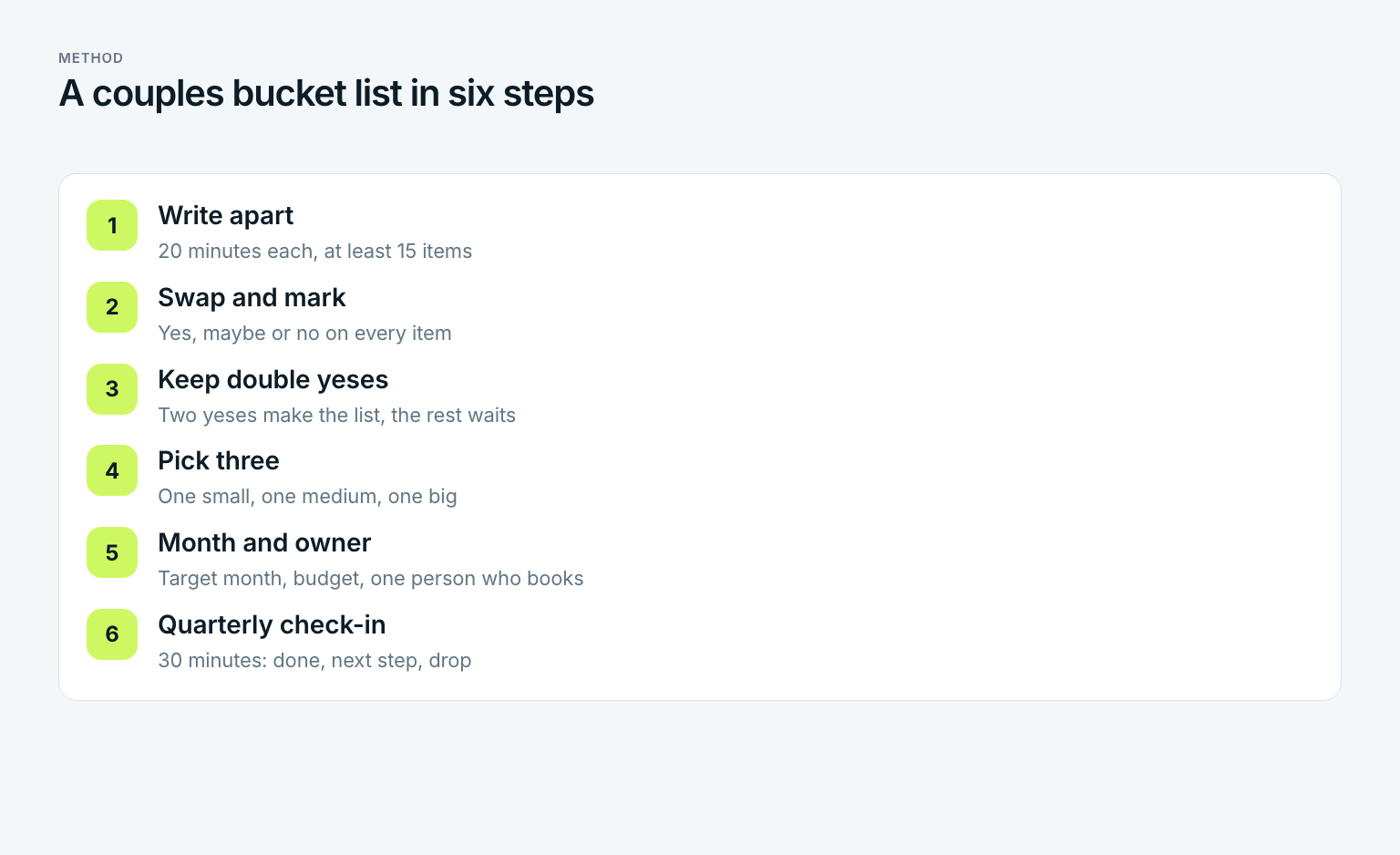
Whoever does this for the first time usually underestimates step two. Marking the other list is where you learn something new about each other. Gottman calls this a love map, the mental picture one partner holds of the other's inner world. Reading your partner's wishes in quiet updates that map faster than any talk about how the day went.
A note on step four: small does not mean minor. The small item is the one that actually happens in the first quarter. It proves to both of you that the list works. Anyone who starts with the big item tends to wait a full year for the first check mark.
Priya and Sam's list: 45 wishes, eleven matches, three for 2027
Priya and Sam did the six steps over two Sunday evenings in October, both on weeks when Priya was off nights. Phones stayed in the kitchen. On the first evening they wrote apart and swapped. On the second they marked, sorted and chose.
The surprises came with the swap. Priya had written "take a pottery class," which Sam never saw coming. Sam had written "see the ocean in fall, somewhere cold." Both had, separately, written down a sunrise hike. What would you guess is on your partner's list right now?
| Item | Size | Target month | Budget | Owner |
|---|---|---|---|---|
| Sunrise hike in Hocking Hills State Park | Small | April 2027 | $60 | Sam |
| Finish an eight-week pottery class and eat off our own plates | Medium | June to August 2027 | $320 | Priya |
| Five days in Acadia National Park | Big | October 2027 | $1,600 | Sam |
| Priya's own item: finish ASL levels one and two | Personal | January to June 2027 | Priya's account | Priya |
| Sam's own item: build a dining table at a community woodshop | Personal | March to May 2027 | Sam's account | Sam |
Together the three shared items cost $1,980. That works out to $165 a month, which goes into a separate savings account by automatic transfer. That turns the list into one of their financial goals, with a monthly rate instead of a vague hope. It is real money next to a down payment fund, so they cut one streaming service and one takeout night a month to cover it. The personal items come out of each person's own spending money.
The personal item is not a concession to independence. It is part of the couples list. Whoever covers Saturdays alone so the other can spend three months in a woodshop is writing the shared story too. Priya takes the dog to the vet and handles groceries on Sam's shop days. Sam drives Priya to her ASL class when she comes off a twelve-hour shift.
Eight items sit on the waitlist, including a Broadway show and a hot air balloon ride. Iceland has two yeses but no room in 2027. It is penciled in for 2029, after the house, with its own savings goal. The list is not finished. For the first time, it is moving.
Bucket list ideas for couples: 70 items in seven groups
These ideas are sorted by what they ask of you, not by how romantic they sound. Use them as fuel for step one, not as a checklist to get through. Every group mixes small and big.
Bucket list items for couples under $50
- Watch the sunrise from the highest point in your city
- Spend one day only going places neither of you has been
- Camp in your own backyard or on the balcony for a night
- Take a free walking tour of your own city
- Cook a full meal from a cuisine neither of you has tried
- Have a screen-free evening with a board game you have never played
- Go stargazing somewhere dark enough to see the Milky Way
- Answer Arthur Aron's 36 questions in one evening
- Write each other a letter to open in ten years
- Take one photo in the same spot every month for a year
In your own town
- Eat at a restaurant from every continent within driving distance
- Take a night hike with headlamps
- See a concert in a genre neither of you listens to
- Volunteer at the same place for a full season
- Take a ride on every bus or train line to the last stop
- Go to a minor league baseball game and keep score
- Run a 5K together, walking breaks allowed
- Spend a day as tourists and visit every museum in town
- Throw a dinner party for people who have never met each other
- Go back to the place you had your first date
Weekend trips
- Rent a cabin with no Wi-Fi for two nights
- Drive a scenic byway with no plan for where to sleep
- Stay in a treehouse, a lighthouse or a fire lookout
- Visit the town where one of you grew up, with a guided tour by that person
- Take a train trip instead of a flight
- See a game at a stadium you have always wanted to visit
- Go canoeing or kayaking on a river for a full day
- Visit a state park in every season of one year
- Spend a weekend in a city where you know no one
- Go to a music festival and camp on site
Big trips
- See the northern lights in Iceland, Norway or Alaska
- Spend a week in a national park you have never visited
- Take a road trip across at least five states
- Travel to the country one of your families comes from
- Go somewhere neither of you speaks the language
- Hike a multi-day trail and sleep in huts or tents
- Take an overnight train
- See a total solar eclipse
- Spend a week on an island with no cars
- Take a trip where you decide the next stop every morning
Learn something together
- Take a dance class and go out dancing afterward
- Learn enough of a new language for a simple conversation
- Take a pottery class and use what you make
- Build a piece of furniture together
- Get certified in CPR and first aid
- Learn to sail or paddleboard
- Learn to play one song together on two instruments
- Take a photography class and make a photo book of your year
- Take a cooking class for a cuisine you both love
- Learn to scuba dive or snorkel
Adventure and nerve
- Go tandem skydiving or paragliding
- Summit a peak above 10,000 feet
- Take a hot air balloon ride
- Do a polar plunge in winter
- Go rock climbing outdoors after a gym course
- Sleep one night under the open sky
- Swim in the ocean at night
- Ride a roller coaster you have both been avoiding
- Go white water rafting
- Pick one fear each and face it together
Give back and leave a mark
- Plant a tree and photograph it every year
- Foster a pet for a local shelter
- Bury a time capsule to open in ten years
- Throw a party for both families at once
- Ask your grandparents how they met and write it down
- Give another couple a night off from their kids
- Write down your own story, each from your side
- Run or walk a charity race together
- Make a recipe book of the meals that are yours
- Renew your vows or make a new promise after ten years
What belongs on a couples bucket list? Anything you both want that is new for both of you. If you are unsure about an item, ask three questions. Will we remember this in ten years? Is it new for both of us? Is there a month where it realistically fits? Three yeses, and it stays.

The 7-7-7 rule, the 2-2-2 rule, and what keeps a list moving
A list without a rhythm turns into a wish list. Two rules of thumb make the rounds online, and one relationship researcher has a third. None of them comes from a study. Treat them as starting values you adjust to your life.
| Rule | What it suggests | Where it comes from | Works best for |
|---|---|---|---|
| 7-7-7 rule | A date every seven days, a weekend away every seven weeks, a vacation together every seven months | A rule of thumb from advice columns and social media, not research | Couples without kids or with reliable childcare |
| 2-2-2 rule | A date every two weeks, a weekend away every two months, a week-long vacation every two years | Also a rule of thumb with no study behind it | Couples with young kids, shift work or tight budgets |
| Gottman's six hours | About six hours a week for goodbyes, reunions, appreciation, affection, a date and a weekly check-in | John Gottman, 1999 | Everyday connection, not the big moments |
| Couples list in a goal chain | Three items a year, one small, one medium, one big, each with a target month | Derived from goal planning | Anyone who wants wishes to turn into dates |
Gottman's six hours include one habit that answers a question many couples search for: what should we do for 20 minutes a day? He recommends a conversation after work in which each of you talks about the day's stress and the other listens and takes your side, without jumping to fixes. The topic is stress from outside the relationship, not conflict inside it. That talk is not a bucket list item. It is the floor you build the items on.
Priya and Sam picked a mix. For everyday life they use the 2-2-2 rule, because Priya's shifts rotate and a weekly date would fail by February. For the big moments they use the couples list with three items a year. In short: the number rules keep you close on ordinary weeks. The list gives you the stories.
Your couples bucket list in the goal chain
An item only becomes likely once it has a place on your calendar. The goal chain turns a wish into five levels: year, quarter, month, week and day. That sounds like project management. It is really just an honest answer to the question of when you will do what.
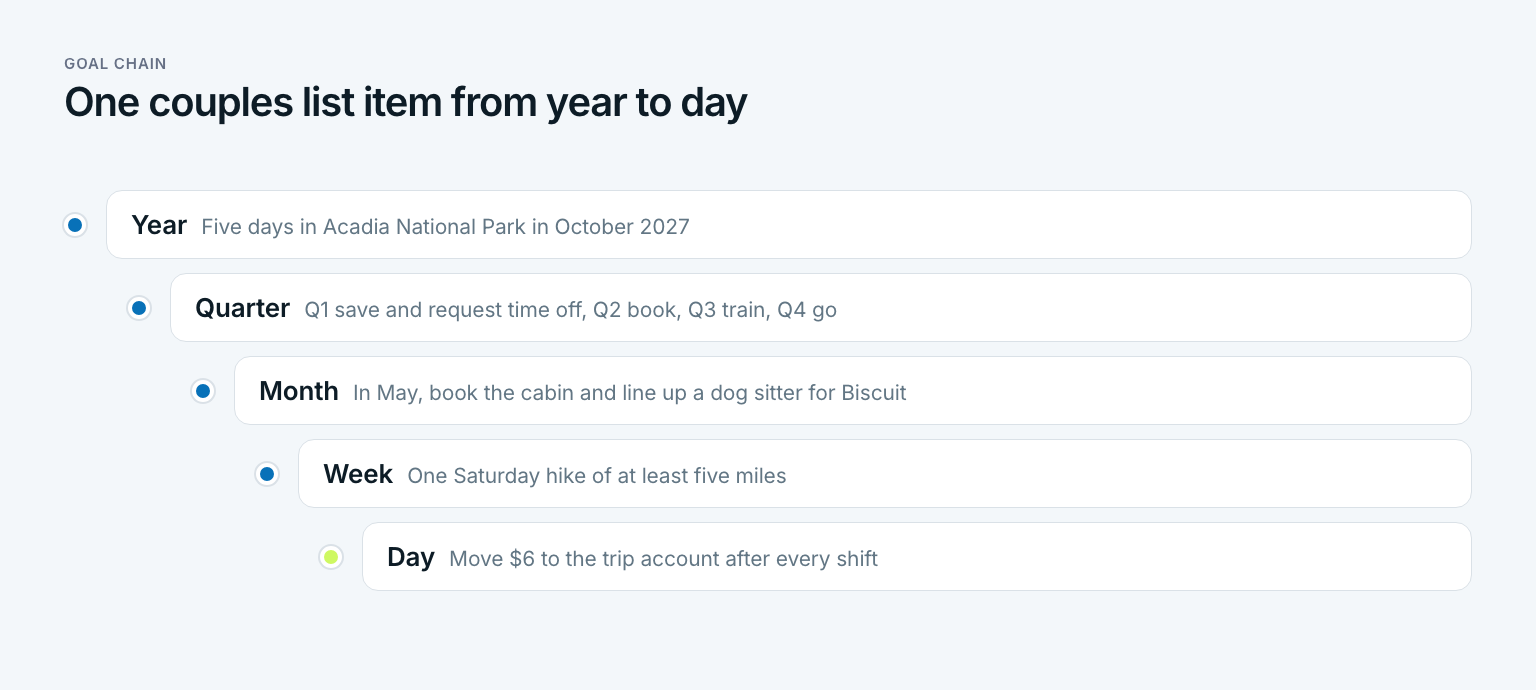
Here is the Acadia trip as a chain. The yearly goal: five days in Acadia National Park in October 2027. In the first quarter, Priya and Sam open the savings account and request the time off, since Priya's hospital wants vacation requests months ahead. In the second they book. In the third they build up to longer hikes. In the fourth they go. The monthly step in May is booking the cabin and lining up a dog sitter for Biscuit. The weekly step is one Saturday hike of at least five miles. The daily step is tiny: Priya moves $6 to the trip account after every shift.
Anyone who spreads the planning across quarters sees early when an item starts to slip. The guide to quarterly planning shows how to turn a yearly goal into quarterly steps. Couples add one twist: both of you have to see the goal. A goal that lives in one head is that person's project. The article on shared goals in a space explains how to run goals together so each of you can see your own next step.
Gaapp is built for exactly this chain, including two people working in one shared space. You add the three items as yearly goals, spread them across quarters, and each Sunday you both see which step belongs to the coming week. App, fridge door or notebook: what matters is that the list lives somewhere you both pass every week.
A couples bucket list template you can copy
The template fits on one page. Print it or copy it into a spreadsheet. It connects your full collection of items with the plan for next year. The sample rows come from Priya and Sam.
| Item | Priya | Sam | Size | Target month | Budget | Owner | First step |
|---|---|---|---|---|---|---|---|
| Pottery class | Yes | Yes | Medium | June 2027 | $320 | Priya | Compare three studios |
| Broadway show | Yes | Maybe | Medium | Waitlist | Open | Open | Ask again in spring |
| Hot air balloon ride | Maybe | Yes | Medium | Waitlist | Open | Open | Check prices near Columbus |
| Northern lights in Iceland | Yes | Yes | Big | 2029 | $4,500 | Sam | Open a savings goal |
| Your item | Yes, maybe or no | Yes, maybe or no | Small, medium or big | Month or waitlist | Amount | Name | One step under 30 minutes |
The columns with your names are the core. Each one holds yes, maybe or no for every item. Only rows with two yeses get a target month. Everything else stays visible, without pressure. Whoever plans with kids adds a column for family items. To fit the dates into ordinary weeks, a short weekly planning session on Sunday helps.
The last column decides whether an item lives. A first step under 30 minutes is small enough to happen in any normal week. Compare three studios is a step. Learn pottery is not.
Three mistakes that stall a shared list
Most shared lists do not fail for lack of interest. They fail because of three patterns nobody notices while writing them.
The most common mistake: brainstorming at the same table
Whoever brainstorms side by side ends up writing the louder partner's list. One person suggests, the other nods or goes quiet, and the softer wishes never reach the paper. A year later, one of you feels the list belongs to the other. Always write apart first, then swap.
Mistake two: the list is a travel catalog
Many couples lists are almost all big trips. That makes sense, because travel is the most visible thing you do together. It also ties the list to vacation days, money and, later, childcare. With a mortgage or a toddler, every big trip slides back by years, and the list becomes a list of things you cannot do right now. A mix of small, medium and big keeps it alive.
Mistake three: everyone owns it, so nobody does
We should do that sometime is the sentence most items die on. Without an owner, each of you waits for the other to book. The owner is not the boss. The owner is the person who emails the pottery studio on Monday. Priya and Sam switch the role from item to item so the planning load does not always land on the same person. Anyone who wonders why their list is stuck should first check whether every item has a name next to it.
When you want different things
Different lists are normal. They are even useful, because they show you what drives the other person. Often they reflect different core values, such as adventure for one of you and security for the other. It only gets hard when one of you has a big wish the other turns down.
Three questions help. What exactly sits behind the wish? Is there a smaller version you would both enjoy? Could it become a personal item that the other person supports without joining in? Sam wanted to go skydiving together. Priya said no. The jump is now on Sam's personal list for 2028, and Priya has promised to film the landing.
John Gottman found that a large share of conflicts in couples never fully go away, about 69 percent in his research. Many of those lasting issues hide a dream one partner does not want to give up. The way out is not winning the argument. It is understanding the dream. A bucket list is a good occasion for that, because it talks about wishes, not complaints.
Kids shift the list. They do not erase it. Children under twelve think in weeks, not decades, so a separate column for family items next to the couples list works well. The couples items stay couples items. Whoever runs both lists side by side does not have to choose between being parents and being partners.
Three questions to end with, for your list:
- Can each of you name next year's three items without looking?
- Does each of those items have a target month, a budget and an owner?
- Is there at least one item on the list that the quieter one of you suggested?
Anyone who answers no to one of these does not have a list that is too short. They have a list without a plan. In short: a couples bucket list is not a collection of dreams. It is your shared story, written in advance.
Frequently asked questions about a couples bucket list
What is the 7-7-7 rule for couples?
The 7-7-7 rule says a couple should have a date every seven days, a weekend away every seven weeks, and a vacation together every seven months. It is a popular rule of thumb from advice columns and social media, not a research finding. Treat it as a starting point and adjust it to your jobs, budget and childcare.
What are 100 fun things couples can do together?
The 70 ideas in this guide cover the main groups: cheap dates under $50, things to do in your own town, weekend trips, big trips, skills to learn together, adventures, and ways to give back. For more, add one idea from each group that is new for both of you. Novelty matters more than the count, since research by Arthur Aron links new shared experiences with higher satisfaction.
What is the 2-2-2 rule for couples?
The 2-2-2 rule suggests a date every two weeks, a weekend away every two months, and a week-long vacation every two years. Like the 7-7-7 rule, it is a rule of thumb without a study behind it. It tends to fit couples with young kids, shift work or a tight budget better.
What is the top 10 bucket list?
There is no official top 10, but the same classics show up again and again: see the northern lights, hike a multi-day trail, learn a language, climb a mountain, take an overnight train, learn an instrument, volunteer, sleep under the stars, see a total solar eclipse, and write a letter to your future self. For couples, what counts is which of them you both want.
How many items should a couples bucket list have?
The full list can be long, and 20 to 40 items is a healthy pool. What matters is the number of active items: three a year, one small, one medium and one big. Everything else stays visible on the list without a date.
What if we want completely different things?
Write apart, mark each item yes, maybe or no, and put only the double yeses on the shared list. Big wishes that only one of you has can become personal items the other supports. If talking about what you want regularly ends in fights, a couples counselor can help.
Last updated: 22 October 2026
Read next
 Personal Growth
Maslow's Hierarchy of Needs: The 5 Levels Explained
Maslow's hierarchy of needs sorts motivation into five levels. What each level means, what research says today and a needs audit you can run yourself.
14 min read
 Personal Growth
Mindfulness Exercises: 12 for Everyday Life
Mindfulness exercises are not about emptying your mind. 12 techniques for stress and focus, what research shows, and a four-week plan to practice daily.
16 min read
 Personal Growth
Positive Affirmations: 50 Examples You Can Believe
Positive affirmations are not magic words. What research shows, 50 daily affirmations you can believe, and a five-step method with a worked example.
16 min read