Evening Routine: How Tomorrow Starts the Night Before
An evening routine is not self-care: three parts, five steps, the 3-2-1 rule compared, 21 ideas and a worked example that protects tomorrow's goal.
Contents
- 01What an evening routine is and what it is not
- 02Why the best evening routine starts with tomorrow's alarm
- 03Dana's evenings, measured: lights out at 12:15
- 04The three parts of a night routine: close, prepare, power down
- 05How to build a bedtime routine for adults in five steps
- 06The 3-2-1 rule and four other bedtime formulas, compared
- 07Evening routine ideas: 21 things to do before bed
- 08The evening routine in the goal chain: from yearly goal to tomorrow
- 09The three mistakes that quietly end an evening routine
- 10Three questions before you turn off the light
An evening routine is not a self-care ritual. It is the fixed sequence of the last 30 to 60 minutes of your day in which you do three things: close the day, prepare tomorrow morning, and power down. A self-care night makes you feel good tonight. An evening routine decides whether your goal gets a fair shot tomorrow.
You need three pieces for it: a hard stop for work, a fixed lights-out time, and one decision about tomorrow. The worked example follows Dana, who is learning Spanish before a family Christmas in Mexico and whose evenings kept ending after midnight. You also get five steps, the 3-2-1 rule next to four other bedtime formulas, 21 evening routine ideas, and the three mistakes that end most routines within a month.
What an evening routine is and what it is not
An evening routine is a chain of small actions that run in the same order every night and hang on the same trigger. The trigger is rarely the clock. It is usually something that happens anyway: closing the dishwasher, turning off the kids' light, brushing your teeth. Anyone who ties a routine to an event like that stops renegotiating the start time every night.
What it is not: a spa menu. Bath, candle, chamomile tea, ten minutes of yoga. These are good things, and for some people they belong to every evening. There is nothing wrong with that. They are just built for a different job. A relaxing night is built to feel good. An evening routine is built to hand the day over cleanly: from work to free time, from free time to sleep, from today to tomorrow.
That means: a good evening routine is short and a little boring. It takes 45 minutes on a good night and ten on a bad one. And it does not end with feeling relaxed. It ends with knowing exactly what happens first tomorrow.
Why the best evening routine starts with tomorrow's alarm
Mornings are made the night before. That sounds like a fridge magnet, but it is plain arithmetic. Whoever turns off the light at 12:15 a.m. and gets up at 6:00 a.m. has slept less than six hours. The American Academy of Sleep Medicine and the Sleep Research Society recommended in 2015 that adults sleep seven hours or more on a regular basis. The missing hour comes back as a debt in the morning: the snooze button, the second coffee, the feeling that the day is lost before it starts.
A fair concession first. Not every bad morning starts the night before. Toddlers wake up at 3 a.m., shift schedules rotate, and some people are simply wired later than others. Anyone who works until 11 p.m. does not need a 10 p.m. bedtime but a decent landing. Still, for most adults the part of sleep they can control starts with one number: the time the light goes out. And you do not control that number at 11:30 p.m. You control it at 9 p.m. When did you last decide at 9 p.m. when you would go to bed?
The second reason is attention. Whoever does not decide at night what matters tomorrow decides it in the morning, at the worst possible moment. By then the inbox is open and the first message of the day sets the agenda. An evening routine moves that decision to a quiet minute the night before, so the morning only has to execute. The morning routine picks up exactly where the evening leaves off: it carries out what the night already decided. Together the two ends give your whole daily routine a fixed start and a fixed finish.
Why the hour before midnight is not magic
The old saying that sleep before midnight counts double refuses to die. Only part of it holds up. Deep sleep is concentrated in the first half of the night, whenever that night begins. Matthew Walker describes the pattern in his 2017 book Why We Sleep: deep non-REM sleep dominates the early cycles, REM sleep the later ones. For your evening routine, the clock time is not the point. A consistent lights-out that leaves enough hours before the alarm is.
Dana's evenings, measured: lights out at 12:15
Dana, 34, is a customer success manager at a software company in Austin. Her husband's family lives in Monterrey, Mexico, and this Christmas she wants to do something she has never managed: hold a 20-minute conversation in Spanish with her mother-in-law, without her husband translating. Her plan is 30 minutes of Spanish every weekday morning, from 6:15 to 6:45 a.m., before her first customer call at 8.
In September she planned 20 morning sessions and did seven. Her own diagnosis was a lack of discipline. Before changing anything, she logged a week of evenings, from dinner to lights out. A typical Tuesday looked like this:
| Time | What happens | Length | Who owns the time? |
|---|---|---|---|
| 6:30 p.m. | Home, dinner with her husband | 50 minutes | Family |
| 7:20 p.m. | Gym class or errands | 60 minutes | Health and home |
| 8:20 p.m. | Laptop on the couch, Slack and customer emails | 75 minutes | Work |
| 9:35 p.m. | TV with her phone in hand | 90 minutes | Nobody |
| 11:05 p.m. | Kitchen, shower | 25 minutes | Home |
| 11:30 p.m. | Phone in bed, Instagram, news | 45 minutes | Nobody |
| 12:15 a.m. | Lights out, alarm set for 6:00 a.m. | 5 hours 45 minutes to the alarm | Sleep |
Two things stand out. First, the morning does not fail in the morning. On three of five weekdays Dana turned off the alarm at 6:00 and fell back asleep, every time after a night with lights out past midnight. On the two days she studied, she had been in bed before 11. Second, more than two hours of her evening belong to nobody. TV with a phone in hand is not rest. It is a state somewhere in between.
And the 75 minutes of email on the couch? They feel like being on top of things. In that week Dana answered customer emails on four evenings, and not one of them was read before 9 a.m. the next day. In short: the evening has no end because work has no end. And as long as the evening has no end, the night starts too late. That makes it a work-life balance problem before it becomes a sleep problem.
The three parts of a night routine: close, prepare, power down
Every night routine that lasts has three parts, and each answers one question. Close: what is done today, and what is still open? Prepare: what happens first tomorrow? Power down: how does your head get from the day into sleep? The first two parts take ten to 20 minutes together and belong right after work or the household rush. The third starts 30 to 45 minutes before lights out. The time in between is your actual evening, and it belongs to you.
Close the day
Closing means ending the workday on purpose instead of letting it leak into the night. Three moves are enough. Check off today's goal or mark it honestly as open. Write down everything that is still circling in your head, each item with its next concrete step. Then give yourself a fixed end signal. Cal Newport describes such a shutdown ritual in Deep Work, published in 2016: he reviews every open task, makes a plan for it, and ends with a set phrase that declares the workday over. Anyone who finds a spoken phrase silly can close the laptop and put it in a drawer. The point is that the signal is the same every night.
Open loops, and why a plan closes them
In 1927 Bluma Zeigarnik observed that interrupted tasks stay in memory longer than finished ones. That is why the half-done slide deck shows up again at 11 p.m. when you are trying to sleep. E. J. Masicampo and Roy Baumeister showed in 2011 that a task does not have to be finished to let go of you. A specific plan for when and how you will continue is enough. That is the whole idea behind the close: not finishing everything, but giving everything open a next step.
Prepare tomorrow
Preparing means taking every decision away from the morning. What is tomorrow's goal? What needs to be ready for it? When does the alarm go off? Dana leaves her workbook open on the kitchen table at the right lesson, headphones on the charger next to it. The fewer choices the morning has to make, the less often it chooses the snooze button.
Tomorrow's goal is the most important part. Write it so you can answer it with yes or no tomorrow night: “lesson 7.2 and 50 flashcards from 6:15 to 6:45,” not “do some Spanish.” The guide on daily goals shows how to derive one from your weekly goal.
The note even helps you fall asleep. In 2018 Michael Scullin and his team at Baylor University had young adults write for five minutes before bed. Those who wrote a to-do list for the coming days fell asleep about nine minutes faster in the sleep lab than those who wrote about tasks they had already completed. Whatever is on paper no longer has to be held in your head.
Power down
Powering down means telling your body the day is over. Three levers work reliably: light, screens, and temperature. Light: from the start of this part, only warm, dimmed lamps. Screens: your phone does not sleep next to you. It charges in the kitchen or the hallway. Anne-Marie Chang and her colleagues showed in 2015 that reading on a light-emitting device before bed delayed sleep and left people less alert the next morning than reading the same book on paper. Temperature: a cool bedroom helps your body lower the core temperature it needs to fall asleep. Walker suggests around 65 degrees Fahrenheit.
What belongs here is deliberately dull: shower, teeth, a paper book, a short conversation, three lines in a notebook. What does not: email, news, and anything with an endless feed. Powering down is not the time to get one more thing done. It is the time when nothing else needs to get done.
How to build a bedtime routine for adults in five steps
You do not build a bedtime routine at 11 p.m. You build it on a quiet afternoon with a sheet of paper. Five steps, about 30 minutes in total. The order matters: you start at the alarm and work backward, not at dinner and hope forward.
Set the alarm time, five minutes
Start with the time your morning has to begin so your goal gets its slot. For Dana that is 6:00 a.m., because Spanish starts at 6:15 and her first call is at 8. This time holds on every weekday and shifts by an hour at most on weekends.
Count back to lights out, five minutes
Subtract seven and a half hours from the alarm: seven hours of sleep plus 30 minutes to fall asleep and for brief wake-ups. For Dana that is 10:30 p.m. Anyone who does this math for the first time is usually shocked. Good. That is exactly where the problem sits.
Set a hard stop for work, ten minutes
Pick a time or an event after which you open no more email and touch no more work. Attach the close and prepare parts to it: check off today, write open items with next steps, set tomorrow's goal, laptop in the drawer. Dana's anchor is closing the dishwasher, usually around 8:30 p.m.
Build the power-down window, five minutes
Count back 40 minutes from lights out. From that point on: phone on a charger outside the bedroom, lights dimmed, only shower, paper, and conversation. For Dana the window starts at 9:50 p.m. with the phone going to the kitchen.
Run it for two weeks and count, one minute a day
Change nothing for two weeks. Each morning, log two numbers: when did the light go out, and did the daily goal happen? After ten weekdays you know whether the routine holds. Only then do you adjust it.
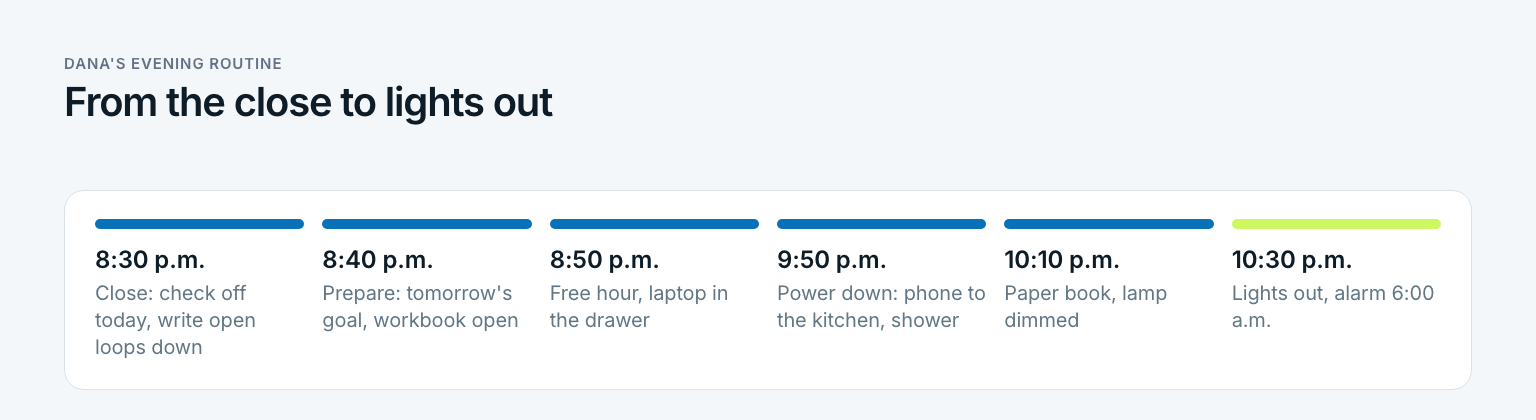
This is Dana's evening since early October, written on a card on the fridge:
| Time | Part | What happens | Length |
|---|---|---|---|
| 8:30 p.m. | Close | Laptop at the kitchen counter, check off today's goal, open items with next steps on the list | ten minutes |
| 8:40 p.m. | Prepare | Write tomorrow's goal, workbook open at the lesson, headphones on the charger, laptop in the drawer | ten minutes |
| 8:50 p.m. | Free | TV with her husband, phone stays on the counter | 60 minutes |
| 9:50 p.m. | Power down | Phone on the charger in the kitchen, shower | 20 minutes |
| 10:10 p.m. | Power down | Paper book in bed, lamp dimmed | 20 minutes |
| 10:30 p.m. | Lights out | Alarm set for 6:00 a.m. since 8:40 | 7.5 hours to the alarm |
The math behind it: lights out at 10:30 instead of 12:15 means an hour and 45 minutes more sleep per night, almost nine hours per work week. Her free evening got shorter, but for the first time it is actually free: an hour with no laptop and no phone in her hand. Customer emails now go out at 7:45 a.m., before her first call. After two weeks her log read: lights out at 10:41 on average, nine of ten Spanish sessions done. No miracle and no willpower. Just a time at night she had never set before.
The 3-2-1 rule and four other bedtime formulas, compared
Bedtime formulas are useful. Each one is built for a specific part of the evening, and none of them covers all three. The most common is the 3-2-1 rule: no food or alcohol three hours before bed, no work two hours before bed, no screens one hour before bed. It is a rule of thumb that spread through coaching and social media, not the result of a single study. Still, every cutoff in it lines up with standard sleep advice.
| Formula | What it says | What it covers | What it misses |
|---|---|---|---|
| 3-2-1 rule | No food or alcohol 3 hours before bed, no work 2 hours before, no screens 1 hour before | Power down, with clear cutoffs | Nothing about tomorrow |
| 10-3-2-1-0 rule | Adds no caffeine 10 hours before bed and zero snooze presses in the morning | Caffeine and the morning handover | Still no decision about tomorrow's goal |
| Shutdown ritual, Cal Newport | Review open tasks, plan each one, end with a fixed phrase | Close, very thoroughly | Sleep and the power-down window |
| PM reflection, Ryder Carroll | Review the day in your journal before bed, mark what is open, note what matters | Close and a little prepare | A hard stop for work and a lights-out time |
| Stimulus control, Richard Bootzin | Bed is for sleep only, get up if you are still awake after about 20 minutes | What to do when sleep does not come | Everything before lights out |
Read the last column again. Every formula leaves a gap, and the gap is almost always tomorrow. The 3-2-1 rule protects your sleep but does not say what the sleep is for. The shutdown ritual closes the workday but says nothing about the phone in bed. That means: use the formulas as parts, not as the plan. The 3-2-1 rule makes a good power-down window, the shutdown ritual a good close. The prepare part, the one that links tonight to tomorrow's goal, you add yourself.
The ten-hour caffeine cutoff sounds extreme until you do the math. Walker puts the half-life of caffeine at five to seven hours, so half of a 4 p.m. latte is still in your system at bedtime.
Evening routine ideas: 21 things to do before bed
A routine needs three to six elements, not 21. Treat this list as a parts bin: take one or two from each part and leave the rest. Which idea would survive your worst evening of the week? Start with that one.
Ideas to close the day
- Check off today's goal, or mark it open with one sentence on why.
- Dump every open loop onto paper, each with its next concrete step.
- Glance at tomorrow's calendar for one minute, read only.
- Clear your desk so only the material for tomorrow's goal is left on it.
- Move every unanswered email into one folder for the morning instead of answering it now.
- Close the laptop with a fixed phrase and put it in a drawer.
- Write three lines: what went well, what did not, what you take into tomorrow. Keep only the first line on hard weeks, and you have the core of a gratitude journal.
Ideas to prepare tomorrow
- Write tomorrow's goal with a time and an amount.
- Lay out clothes, gym gear, or work material.
- Pack your bag and put it by the door.
- Prep breakfast: overnight oats, coffee maker filled.
- Set the alarm and plug the phone in outside the bedroom in one move.
- Spend five minutes on the kitchen so the morning does not start with dishes.
- Agree on tomorrow morning with your partner: who does drop-off, who gets the first hour?
Ideas to power down
- Read on paper, fiction rather than work books.
- Take a warm shower or bath about an hour before lights out.
- Dim the lights and switch off the overhead ones.
- Have a conversation without a screen, ten minutes is enough.
- Stretch gently or try progressive muscle relaxation after Edmund Jacobson.
- Open the window for a few minutes and keep the bedroom cool.
- Listen to an audiobook on a sleep timer instead of videos on autoplay.
Anyone who takes one idea from each part has a three-step routine. That is enough to start. Dana started with three: laptop in the drawer, workbook open on the table, phone in the kitchen. The paper book in bed came in week two, once the first three had stuck.
The evening routine in the goal chain: from yearly goal to tomorrow
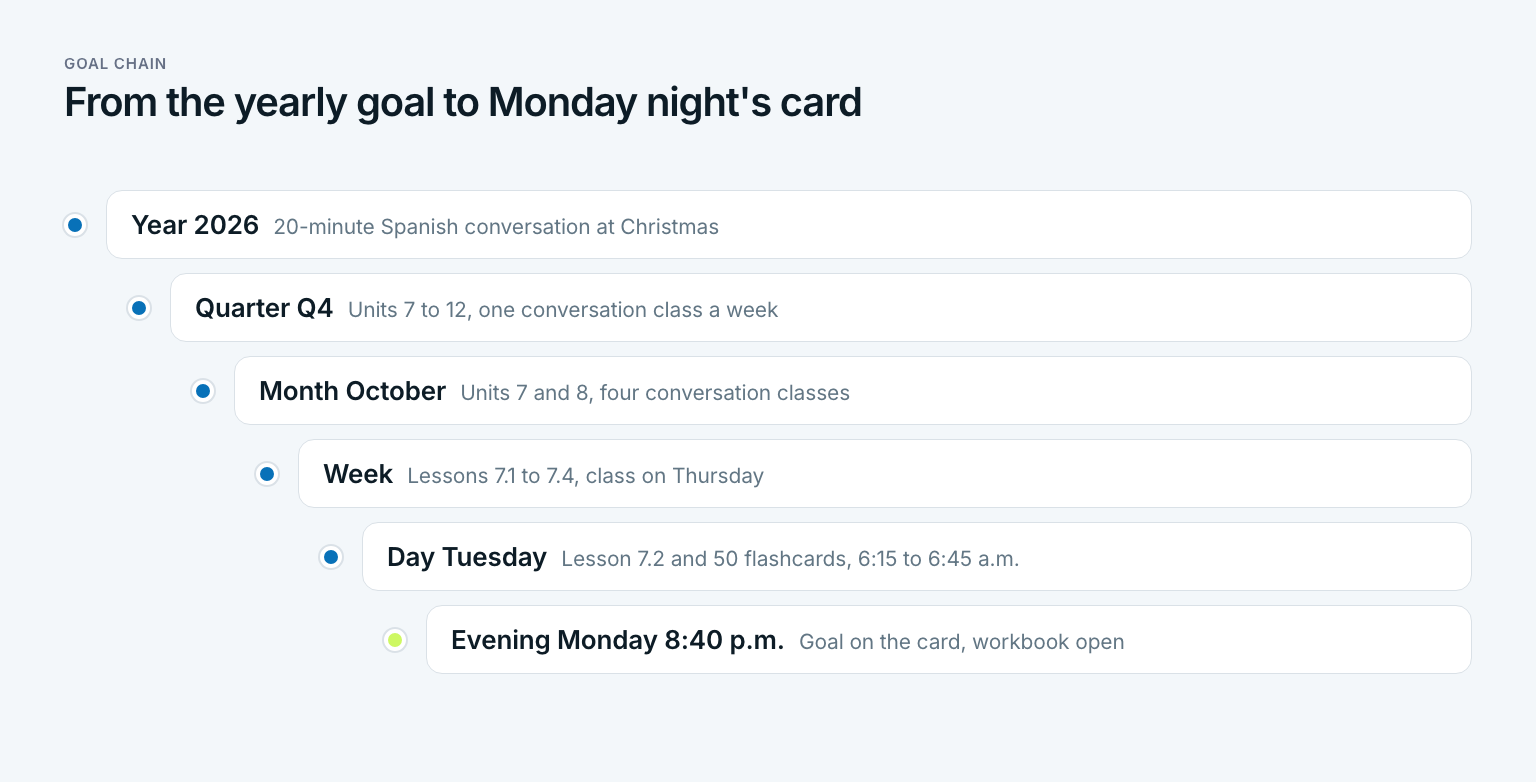
An evening routine without a goal above it is sleep hygiene. That is worth a lot, but it is not the whole story. An evening routine with a goal above it is the hinge between two days: it checks today's goal and sets tomorrow's. That puts it on the same chain as every other goal, from the year through the quarter, the month, and the week down to the day.
Here is Dana's chain. Yearly goal for 2026: a 20-minute conversation in Spanish with her mother-in-law at Christmas. Q4 goal: finish units 7 to 12 of her B1 course book and take one 30-minute conversation class every week. October goal: units 7 and 8, four conversation classes. Weekly goal: lessons 7.1 to 7.4, class on Thursday. Tuesday's daily goal: lesson 7.2 and 50 flashcards, 6:15 to 6:45 a.m. And on Monday at 8:40 p.m., that exact goal goes on her card while the workbook is already open at the right page.
The payoff does not show up on Tuesday morning. It shows up on Friday. In her weekly review, Dana checks two numbers: how many of five Spanish sessions happened, and on how many nights the light was out by 10:45. The two numbers move together. When the second one is a two, the first one is rarely a five.
In Gaapp this chain is the core: five levels from year to day, and every daily goal hangs on a weekly goal. The evening routine becomes the moment you check off today's goal and add tomorrow's. Whoever does not have a yearly goal yet should not start with the evening routine but one level up. The guide on how to turn yearly goals into daily steps shows the full breakdown.
The three mistakes that quietly end an evening routine
Most evening routines do not fail for lack of willpower. They fail on the clock. Three mistakes show up again and again, and none of them feels like a mistake while you are making it. Which one is yours?
The most common mistake: a routine that starts after the evening is over
Many people plan their routine for 11 p.m.: tea, book, lights out. But 11 p.m. never arrives on time, because nobody ended the evening before it. Behind this sits a pattern that got a name around 2020: revenge bedtime procrastination. Whoever had no minute to themselves all day takes it back at night and pays with sleep. The fix is not an earlier bedtime. It is an earlier hard stop for work, so the free hour happens before the routine, not instead of it. For Dana that meant 8:30 p.m. instead of never.
Mistake two: a routine built for Sunday
The second trap is the nine-step routine: tea, stretching, journaling, meditation, a five-step skincare sequence, reading, gratitude list. On a calm Sunday it works. On a Wednesday after a late client call, it does not. BJ Fogg explains why in Tiny Habits, published in 2019: behavior sticks when it is small enough to happen on a bad day. Anyone who designs a routine for the worst evening of the week gets one that also survives the good ones.
Mistake three: bed as a waiting room
The third trap starts after the light goes out. Whoever lies awake for 40 minutes replaying the day teaches the body that bed is a place for replaying the day. Richard Bootzin described stimulus control back in 1972: the bed is for sleep only. If you are still awake after about 20 minutes, get up, read in dim light, and go back when you feel sleepy. That means: lying awake is not part of the routine. It is a signal to pause it.
Three questions before you turn off the light
Before you write your own card for the fridge tonight, test the plan against three questions. They are uncomfortable, which is exactly why they save you two weeks of trial and error.
- Does your plan include a time or an event when work ends? If not, it is not a plan for the evening. It is a plan for the night.
- Do you know at 9 p.m. what happens first tomorrow? If you decide in the morning, your inbox decides for you.
- Where is your phone when the light goes out? The honest answer says more about your evening routine than any list.
Anyone who answers with a time, a goal, and the word kitchen has an evening routine that will hold. Anyone who leaves one blank has a good intention. Start with the question that made you most uncomfortable.
In short: an evening routine is not the end of today. It is the first step of tomorrow.
What is the best evening routine?
The best evening routine is not a recipe but a structure in three parts: close the day, prepare tomorrow, power down. It starts with a hard stop for work and ends with a fixed lights-out time that leaves at least seven hours before the alarm. It is the best one for you if it still happens on your worst evening of the week.
What is the 3:2:1 rule before bed?
The 3-2-1 rule says no food or alcohol three hours before bed, no work two hours before bed, and no screens one hour before bed. It is a rule of thumb rather than a study result, but each cutoff matches common sleep advice. It covers the power-down part well and says nothing about preparing tomorrow, so pair it with a short evening plan.
What are 7 things I should do before bed?
A solid set of seven: check off today's goal, write down open loops with next steps, set tomorrow's goal, lay out what the morning needs, plug the phone in outside the bedroom, dim the lights and cool the room, and read a few pages on paper. The first four take about 15 minutes right after work. The last three fill the 30 to 40 minutes before lights out.
What is your evening plan?
An evening plan is the short written decision about tomorrow that you make before you power down: one daily goal with a time and an amount, plus what needs to be ready for it. It takes two to five minutes. Without it, tomorrow's first hour belongs to whatever lands in your inbox first.
How long should a night routine be?
30 to 60 minutes covers it for most adults. Ten to 20 minutes go to closing and preparing right after work, and 20 to 40 minutes to powering down before lights out. On a bad night it can shrink to ten minutes, as long as tomorrow's goal is written down.
Should my evening routine be the same every night?
The order and the lights-out time should be. The free hour in between can look different every night. On weekends, shift the whole routine by an hour at most, otherwise Monday morning feels like jet lag.
Last updated: 19 October 2026
Read next
 Habits
75 Hard: Rules, Risks and a Version You Can Finish
75 Hard is not a fitness program. The full rules, four health risks, 75 Soft compared and a custom version built around a real goal.
15 min read
 Habits
Digital Detox: A 7-Day Plan to Reduce Screen Time
A digital detox isn't a weekend offline. What the research shows, how to measure and reduce screen time, plus a 7-day plan with a worked example.
15 min read
 Habits
Delayed Gratification: Meaning, Examples, How to Build It
Delayed gratification isn't self-denial, it's a trade: what the marshmallow test really showed, everyday examples, five proven strategies and a plan.
15 min read