List of Goals: 100 Goal Ideas You Can Measure
A list of goals is not a bucket list: 100 measurable goal ideas in ten areas of life, 10 examples, five steps, a template, and how to pick three.

Contents
- 01What a list of goals is, and what it is not
- 02Why a 100 goals list works better than ten
- 03How to make goals measurable: 10 examples of goals, before and after
- 04Goal ideas: a list of goals in ten areas of life
- 05How to make your goals list in five steps
- 06Worked example: Rachel's list, from 100 lines to three goals
- 07The three mistakes that turn a goals list into a wish list
- 08Your list of goals in a goal chain: year, quarter, month, week, day
- 09Frequently asked questions about lists of goals
A list of goals is not a bucket list. It is a written inventory of what you want to achieve across every area of your life, usually about 100 lines long, with a number in every line so you can tell when a goal is done. A bucket list collects experiences you want to have once. Life goals describe, in three to five sentences, who you want to be in 20 years. Personal goals are the three you are working on this year. Your list of goals is the pool behind all three: wider than your life goals, more measurable than your bucket list, and too big for any single year.
Three things turn a long list into a tool: a number in every line, a structure by area of life, and one draft day a year. Below: 100 measurable goal ideas in ten areas, ten before and after examples, five steps, a template, and Rachel's list, which went from 100 lines to three goals for 2027.
What a list of goals is, and what it is not
A list of goals is a written collection of goals for your whole life, sorted by area, where every line contains a number you can count, measure, or check off. A line gets a deadline only when you pick it for a specific year. Until then it is inventory, not an assignment. That keeps short-term and long-term goals apart: the inventory spans decades, the pick covers one year.
Four kinds of lists get mixed up all the time. None of them is wrong. Each one is built for a different job:
| List | What goes on it | Length | Time frame |
|---|---|---|---|
| List of goals | Goals from every area of life, each with a number | about 100 lines | your whole life, reviewed once a year |
| Bucket list | Experiences you want to have once | 20 to 50 lines | before you die |
| Life goals | States that describe your life ten to 20 years out | three to five sentences | ten to 20 years |
| Yearly goals | Goals with a number and a deadline that you are working on now | three | twelve months |
So your list of goals does not compete with the other three. It feeds them. “See the northern lights in Norway, three nights there” can move to the bucket list. “Still run a 10K in under an hour at 55” points at a life goal. And three lines each year become yearly goals with a date. That means: Anyone who keeps a list of goals never starts January with a blank page.
Why a 100 goals list works better than ten
Anyone can write ten goals in five minutes. That is exactly the problem. The first lines on any goals list are the ones you have heard a hundred times: lose weight, read more, go to Japan, buy a house. They come from conversations, ads, and old New Year's resolutions, not necessarily from you.
Somewhere around line 40, it gets hard. The obvious answers are used up, so you have to think. What did you want to be able to do when you were twelve? Who do you miss? What annoys you every single time you walk past it? That is where your own lines come from. In short: The number 100 is not a target. It is a trick that forces you past the easy answers.
The idea is old. The American adventurer John Goddard said he wrote a list of 127 life goals in 1940, at fifteen, including climbing Kilimanjaro and exploring the Nile. He reached many of them, but not all. That is the second point. A 100 goals list is not meant to be finished. Whoever reaches 30 lines in ten years and crosses out 20 has used the list exactly right.
How to make goals measurable: 10 examples of goals, before and after
A list of 100 wishes is easy to write. A list of 100 goals needs one rule: every line contains a number you can count, measure, or check off. The deadline can wait. The number cannot.
Why that order? A deadline only makes sense once you know which year you will work on the goal, and for 97 of your 100 lines, that year is not this one. The number, on the other hand, decides today whether a line is a goal or a mood. Edwin Locke and Gary Latham spent decades showing that specific, challenging goals lead to better performance than being told to do your best. They summarized the research in 1990 in A Theory of Goal Setting and Task Performance.
The most common mistake: 100 directions instead of 100 goals
“Exercise more,” “eat healthier,” and “spend more time with family” are good directions. As lines on a list, they fail, because they are never done. A list of directions feels great while you write it and moves nothing afterward. Anyone who catches themselves writing a direction should ask right away: How would I know I had arrived? The answer with a number in it is the goal.
Here is the rule applied to ten examples of goals, the kind that show up on almost every list:
| What you write first | Measurable goal | The number that decides |
|---|---|---|
| Get in shape | Run a 5K in under 30 minutes | finish time |
| Save more | Build an emergency fund of $10,000 | account balance |
| Pay off debt | Pay off $6,400 in credit card debt | balance owed |
| Read more | Read 24 books in one year | books finished |
| Learn Spanish | Pass the DELE B1 Spanish exam | pass or fail |
| Be a better parent | One-on-one time with each kid every week, 45 weeks a year | weeks logged |
| Get promoted | Lead a team of at least four people | people reporting to you |
| See friends more | Host twelve dinners a year, one a month | dinners hosted |
| Write a book | Finish a 60,000-word manuscript | word count |
| Sleep better | In bed by 11 p.m. on 300 nights a year | nights logged |
Notice anything? None of the measurable versions needs a date to be clear. The date comes in step five. Anyone who wants to check every line against all five SMART criteria should do it only for the three goals they pick for the year. For 100 lines, a number is enough.
Goal ideas: a list of goals in ten areas of life
These 100 goal ideas are sorted into ten areas, ten per area, and every one contains a number. Do not copy any of them as is. Change the number until it fits you, and cross out any idea that leaves you cold. Which ten areas you use matters less than leaving none of them empty. If you want to score your areas first, the wheel of life takes twenty minutes.
Health and fitness
- Do ten pull-ups in a row.
- Run a half marathon, all 13.1 miles.
- Walk 8,000 steps a day, five days a week, for a full year.
- Hold a plank for two minutes.
- Get your blood pressure under 130 over 85 on three readings in a row.
- Go 30 days in a row without alcohol.
- Bike 50 miles in one day.
- Lose 20 pounds and keep them off for twelve months.
- Make all four yearly checkups: physician, dentist, eye doctor, dermatologist.
- Swim a mile without stopping.
Family and relationships
- Go on twelve date nights a year, phones in a drawer.
- Take each kid on a one-on-one outing once a month.
- Take a week-long vacation as a couple once a year.
- Visit the grandparents four times a year.
- Read aloud to the kids on 250 nights a year.
- Record ten hours of your parents' life stories.
- Hold a 20-minute family meeting on 40 Sundays a year.
- Spend one full day a year planning the year with your partner.
- Sign a will and a healthcare power of attorney.
- Make a 50-page family photo book every year.
Friends and community
- Call one long-lost friend every month.
- Host a party for 30 people once a year.
- Build three new friendships, with five get-togethers each in a year.
- Keep 40 birthdays in your calendar and reach out on every one.
- Take one weekend trip a year with your college friends.
- Join a club and show up to 20 meetings or practices a year.
- Know ten neighbors by name and have each one over once.
- Start a game night that meets ten times a year.
- Send 52 handwritten cards a year, one a week.
- Help a friend with a project for 20 hours.
Career and work
- Get a raise of 15 percent.
- Give a talk in front of 100 people.
- Earn a professional certification in your field, such as the PMP.
- Take two weeks off without checking email.
- Keep up with 50 contacts, one real conversation each per year.
- Find a mentor and meet six times a year.
- Build a side business that brings in $500 a month.
- Publish an article in a trade publication.
- Cut your workweek to 35 hours.
- Land a first job in a new field within 18 months.
Money and finances
- Build an emergency fund that covers six months of expenses.
- Max out your Roth IRA for one full year.
- Save 15 percent of your salary for retirement.
- Track every expense for twelve months without a gap.
- Cut subscriptions and bills by $100 a month.
- Reach a net worth of $250,000.
- Pay off your student loans, balance zero.
- Save $20,000 per kid for college before they turn 18.
- Raise your credit score to 760.
- Go one year without financing a single purchase.
Learning and growth
- Reach Italian at level B1 and pass the exam.
- Read twelve nonfiction books in a year, with a page of notes on each.
- Play ten songs on the guitar from memory.
- Finish a 40-hour online course.
- Build a small app and get ten people to use it.
- Get your motorcycle license.
- Renew your CPR and first aid certification every two years.
- Memorize ten poems.
- Take one college class for credit and pass it.
- Reach a chess rating of 1500 online.
Travel and adventure
- Visit 30 of the 50 states.
- See the northern lights, with three nights in northern Norway.
- Hike the John Muir Trail, about 211 miles.
- Set foot on five continents.
- Camp one night above 10,000 feet.
- Take a train trip of at least 2,000 miles.
- Travel for ten days with no itinerary and one backpack.
- Visit 20 of the 63 national parks.
- Climb a 14,000-foot peak.
- Visit 30 countries.
Creativity and hobbies
- Write twelve short stories, one a month.
- Show 20 of your photos in a local coffee shop.
- Build a piece of furniture, such as a dining table for six.
- Cook ten dishes without a recipe.
- Record a song and release it.
- Grow 15 kinds of vegetables in a raised bed.
- Sketch for 100 days in a row.
- Sing in two concerts with a community choir.
- Sew a piece of clothing you wear at least ten times.
- Perform in a community theater production, all three shows.
Home and environment
- Clear out the garage and give away 200 items.
- Buy a home with a 20 percent down payment.
- Finish the home office in six weeks.
- Cut your electric bill by 20 percent.
- Install an 8 kW solar system.
- Clear the home repair list, which has 14 items today.
- Go one year without buying new clothes.
- Sort ten years of digital photos and keep two backups.
- Get down to one car for a year.
- Live somewhere with a commute under 20 minutes.
Giving and purpose
- Volunteer 50 hours a year.
- Give 5 percent of your income every year.
- Donate blood four times a year.
- Mentor a young person for a year, twelve meetings.
- Coach a youth sports team for one season.
- Run a charity 10K and raise $1,000.
- Serve on a nonprofit board for two years.
- Plant ten trees.
- Teach ten free workshops on something you know.
- Register as a bone marrow donor.
A hundred ideas are not a plan. They are a head start. Anyone who just copies it ends up with a stranger's list. Whoever crosses out ten, rewrites five, and adds 30 ends up with their own. That means: The list above helps with the hard lines after number 40. It does not replace them.
How to make your goals list in five steps
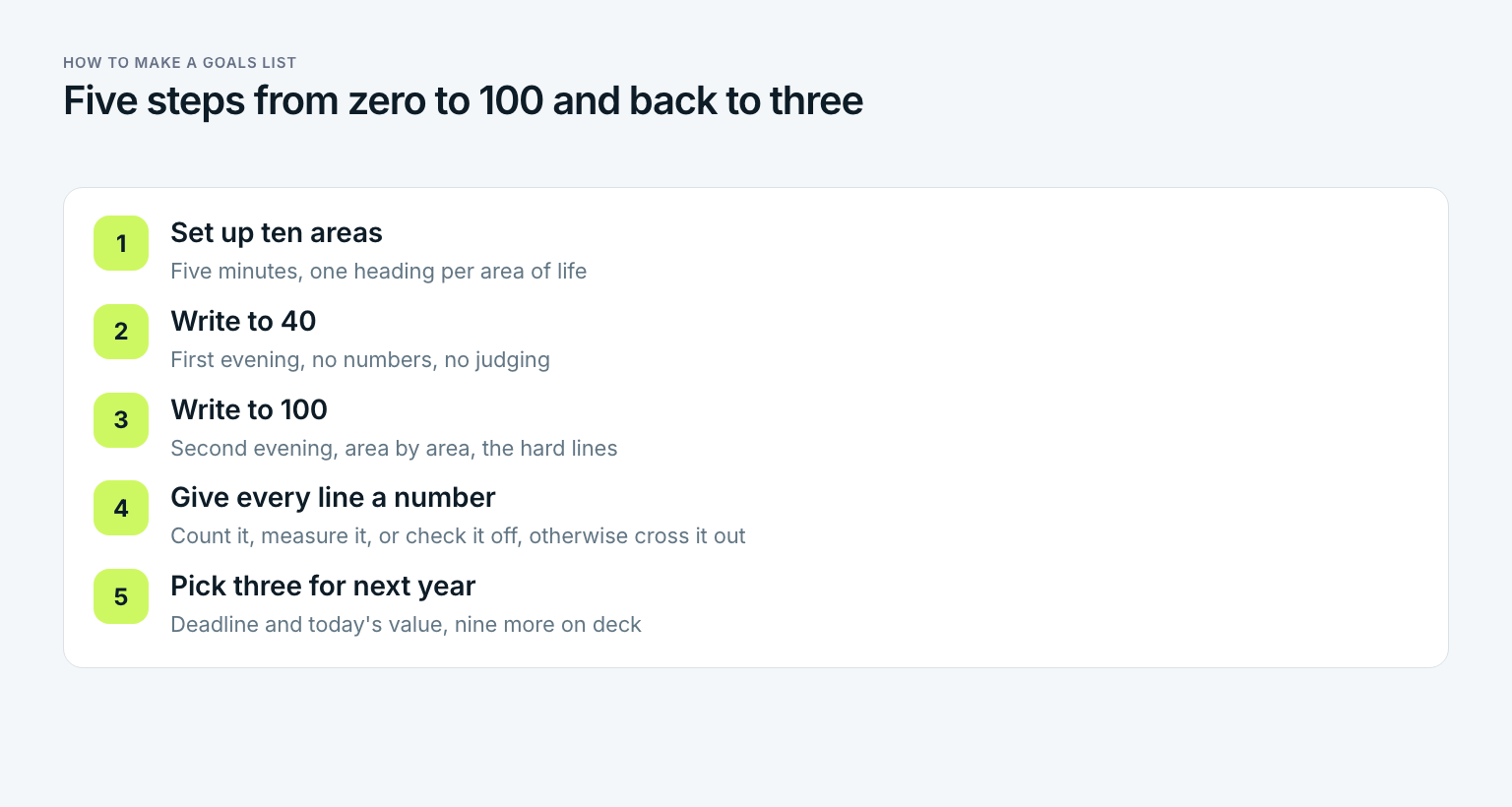
You do not write a 100-line goals list in one sitting. Two evenings is realistic, plus an hour for numbers and picks. Here is the sequence:
Set up ten areas as headings, five minutes
Use the ten areas above or your own. Write each one as a heading. Empty areas will show you later where you have not been looking.
Write to 40, first evening
Write down everything, without numbers and without judging. The first 40 lines usually take 30 to 45 minutes. Stop there, even if you are on a roll.
Write to 100, second evening
Now it gets slow, and that is the point. Go area by area and ask what is missing. When nothing comes, read the 100 goal ideas above and take only the ones that hit you.
Give every line a number, 30 minutes
Turn every direction into a measurable goal. A line that will not take a number can stay if you can clearly check it off. Everything else gets crossed out.
Pick three for next year, 30 minutes
Choose three lines from at least two areas, and give each one a deadline and today's value. Put nine more on deck for the year after. The rest stays in the pool.
Step four takes the most nerve. Why? Turning a line into a number shows you which lines only sounded good. “Become a better person” has no number. “Help someone without being asked on 100 days a year” does, and suddenly you have to ask whether you actually want it. That question is the whole point of the step.
What the on-deck list is
The on-deck list holds nine lines that are not up next year but are up the year after. It keeps a good goal from getting lost among 100 others. Anyone who plans a new year looks at the on-deck list first and at the rest of the pool second.
A goals list template with seven columns
A table with seven columns is all you need, on paper, in a spreadsheet, or in a notes app. You update the status and year columns once a year. The sample rows come from Rachel, whose list the next section walks through.
| No. | Area | Goal with a number | Today | Status | Year | First step |
|---|---|---|---|---|---|---|
| 4 | Health | Run a 5K in under 30 minutes | 36 minutes | This year | 2027 | Sign up for the October 30 race |
| 47 | Money | Student loans paid off | $8,400 owed | This year | 2027 | Set up a $700 autopay |
| 58 | Learning | Play ten songs on guitar from memory | one song | This year | 2027 | Book four lessons for January |
| 71 | Travel | Hike the John Muir Trail | longest hike 12 miles | On deck | 2028 | none before 2028 |
| 86 | Home | Clear out the garage, give away 200 items | 0 | Pool | open | none |
Worked example: Rachel's list, from 100 lines to three goals
Rachel is 41 and teaches high school chemistry in Columbus, Ohio. She is married to Dev, and their son Eli is ten. In October 2026 she notices that her resolutions have been the same for four years: get in shape, pay off the loans, finally learn guitar. This time she blocks two evenings and writes 100 goals instead.
On the first evening, 41 lines come in 40 minutes, mostly travel, health, and family. The second evening takes 75 minutes for the other 59. She is stuck at four lines under Friends for a long time, until she remembers the college roommate she has not called in three years. Three more lines follow.
| Area of life | Lines written | After the number check | Example |
|---|---|---|---|
| Health | 12 | 10 | Run a 5K in under 30 minutes |
| Family | 11 | 10 | A one-on-one outing with Eli every month |
| Friends | 7 | 6 | Call my college roommate four times a year |
| Career | 10 | 5 | Present at the state science teachers conference |
| Money | 9 | 8 | Pay off $8,400 in student loans |
| Learning | 12 | 9 | Play ten songs on guitar from memory |
| Travel | 14 | 9 | Hike the John Muir Trail |
| Creativity | 6 | 4 | Build a bookshelf for Eli's room |
| Home | 10 | 7 | Clear out the garage, 200 items |
| Giving | 9 | 6 | Coach Eli's soccer team for one season |
| Total | 100 | 74 |
The number check in step four crosses out 26 lines. Five of them come from Career, including “become assistant principal.” When Rachel tries to put a number on it, she realizes she does not want more responsibility. She wants her summers. The line “Take three summers in a row completely off” stays. That is the pattern: Anyone who makes every line measurable finds out fast which ones are only there out of habit.
From 74 lines to three goals for 2027
Rachel asks every candidate three questions. Would I want this even if nobody ever found out? Does it fit into a normal week together with the other two? What is most likely to stop me, and what will I do when it happens? The third question comes from Peter Gollwitzer's research on if-then plans. In a 1999 paper in American Psychologist, he showed that people who decide in advance when, where, and how they will act follow through more often than people who only set the goal. When two candidates look equally strong, weighting your criteria breaks the tie, as the guide to how to make decisions shows with a decision matrix.
She ends up with three goals from three areas:
- Health: By October 30, 2027, Rachel runs a 5K in under 30 minutes. Today she needs 36.
- Money: By December 31, 2027, her student loans are paid off. Today she owes $8,400, which comes to $700 a month.
- Learning: By December 31, 2027, she plays ten songs on the guitar from memory. Today she knows one.
Together the three cost about 90 minutes of running a week, two 30-minute guitar sessions, and one hour, once, to set up the autopay. That fits next to a full teaching load. Nine lines go on deck for 2028, including the John Muir Trail and the college roommate. Sixty-two stay in the pool. Before, Rachel had three resolutions that vanished every February. Now she has three goals with numbers, nine candidates, and a pool for the next decade.
The three mistakes that turn a goals list into a wish list
A list of goals rarely fails while you write it. It fails afterward, quietly. Three mistakes are almost always behind it:
- Treating the list as a to-do list. Working through 100 goals sounds ambitious. In practice it is a setup for guilt. Anyone who reads every line as an assignment feels behind by March and stops opening the list. A pool is something you draw from, not something you work through.
- No date for the draft. Without a fixed date, the list stays a nice document. Pick one day a year, ideally in October or December, to pull three lines and refill the on-deck list. One hour is enough.
- Never crossing anything out. A list that keeps everything you ever wrote becomes an archive of a younger you. Goals you wrote at 25 often do not fit at 40. Crossing out is not failure. It is proof that you actually read the list.
All three mistakes share one cause: the list gets written but not used. Without a yearly pick, a list of goals is a wish list with numbers.
Your list of goals in a goal chain: year, quarter, month, week, day
A line on your list is too big for a week. Nobody takes six minutes off a 5K in January, and nobody pays off $8,400 on a Tuesday. For a goal from the pool to reach your calendar, you break it into five levels: year, quarter, month, week, day. Each level answers the same question. What has to be true by the end of this period so the level above it holds?
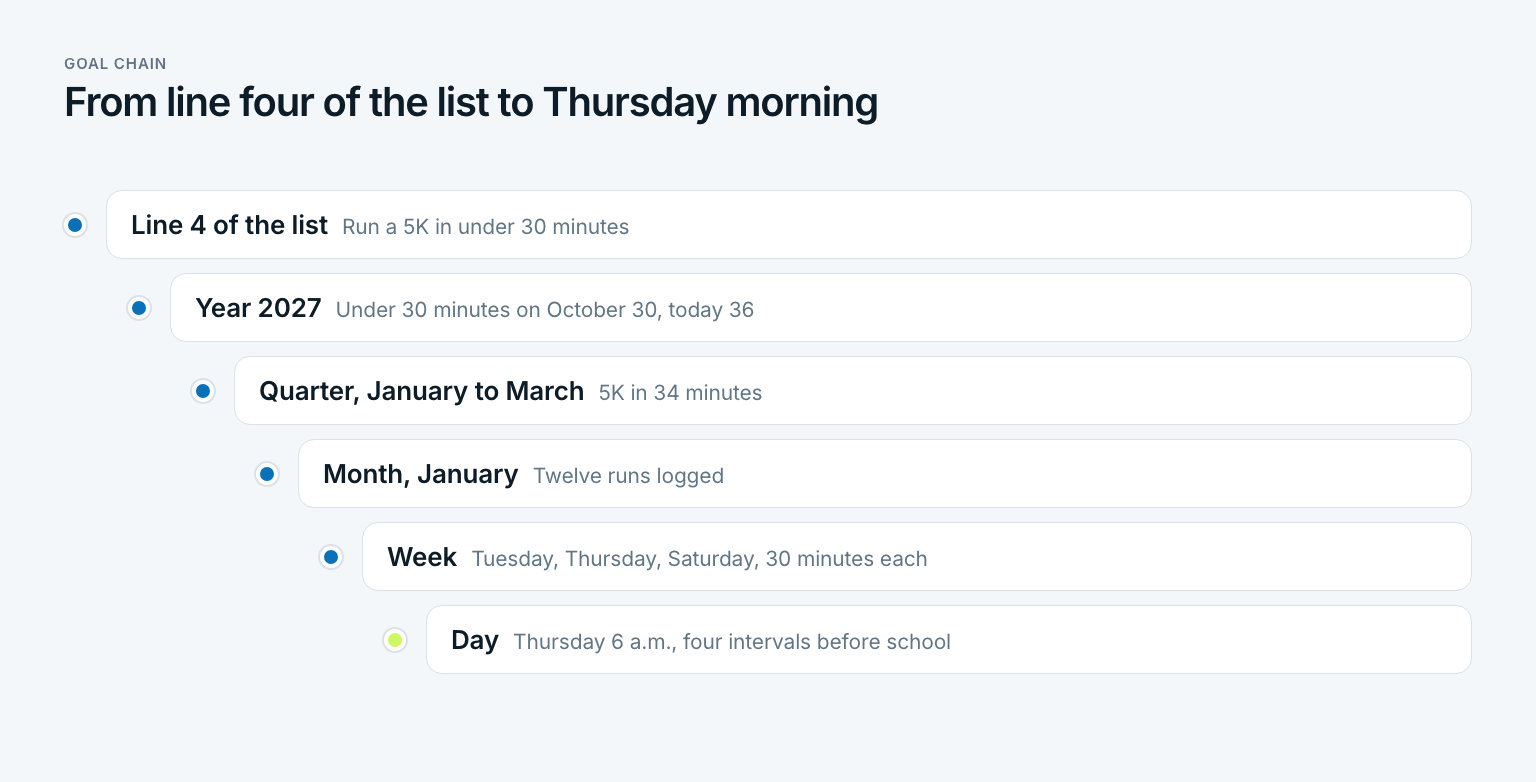
| Level | 5K under 30 minutes | Student loans | Ten guitar songs |
|---|---|---|---|
| Year 2027 | Under 30 minutes on October 30 | Zero owed by December 31 | Ten songs from memory by December 31 |
| Quarter, January to March | 5K in 34 minutes | $2,100 paid | Three songs from memory |
| Month, January | Twelve runs logged | Autopay running | Four lessons, first song clean |
| Week | Tuesday, Thursday, Saturday, 30 minutes each | Nothing to do | Two 30-minute practice sessions |
| Day | Thursday 6 a.m., four intervals | Nothing to do | Sunday 4 p.m., 30 minutes on song two |
The table shows two things. First, not every goal needs something every week. The money goal runs on its own after one hour of setup. Second, the weekly level decides whether a goal stays alive. Anyone who tracks goals only at the year level finds out in October that nothing has happened since May. For breaking a year into quarters and months, see the guide to annual planning.
Gaapp is built around exactly this chain. You enter the three goals from your list as yearly goals and hang quarter, month, week, and day underneath. Next to each level you see progress against time elapsed. The other 97 lines stay where they belong: in the pool.
Three questions before you close your list:
- Does every line contain a number you can count, measure, or check off?
- Do you know which three lines you will pick next year, and is the date for picking them on your calendar?
- Have you crossed out at least one line in the past year?
If you answered no to any of them, you do not have too few goals. You have too little choosing. In short: A list of goals is not a program for your life. It is a pool you draw three goals from every year.
Frequently asked questions about lists of goals
What are the 10 examples of goals?
Ten useful examples, one per area of life: run a 5K in under 30 minutes, take each kid on a monthly one-on-one outing, host twelve dinners a year, give a talk to 100 people, build a $10,000 emergency fund, read 24 books in a year, visit 20 national parks, write twelve short stories, cut your electric bill by 20 percent, and volunteer 50 hours a year. Each one has a number, so you can tell when it is done. Swap the numbers for your own before any of them goes on your list.
What is a list of goals?
A list of goals is a written collection of everything you want to achieve, sorted by area of life, with a number in every line. It is usually long, often 100 lines, and works as a pool rather than a to-do list. Each year you pick three lines, give them a deadline, and leave the rest for later.
What are the 10 goals in life?
There is no official set of ten, but most lists cover the same ten areas: health, family, friends, career, money, learning, travel, creativity, home, and giving. A good life has goals in most of them over time, not in all of them at once. Use the areas as headings for your own list, then fill each one with goals that carry a number.
What are 10 good life goals?
Ten that hold up well: be debt-free by 50, still run a 10K at 60, read 500 books, visit 30 countries, keep three close friendships for 30 years, give $50,000 to causes you care about, speak a second language at B2, own your home outright, coach one youth team, and sign a will. What makes them good is not the topic but the number and the fact that you chose them. For a deeper way to find yours, see the guide to life goals.
How many goals should be on a goals list?
About 100 for the full list, because the honest lines usually start around number 40. Work on no more than three at a time, from at least two areas of life. Three goals fit into a normal week, five only fit on paper.
How do I choose which goals to work on first?
Ask every candidate three questions: Would I want this even if nobody found out? Does it fit into a normal week next to the other two? What will most likely stop me, and what will I do then? Pick the three that pass, and put the next nine on deck for the following year.
Last updated: 19 October 2026
Read next
 Goal Setting
Intrinsic Motivation: What Drives You From the Inside
Intrinsic motivation is not a personality trait. Meaning, 12 examples, the three needs behind it and five steps to build it, with a worked example.
17 min read
 Goal Setting
Financial Goals: How to Turn Wishes Into a Plan
Financial goals are not wishes with a dollar sign. Short and long term examples, SMART savings goals and a five step plan, worked through one year.
17 min read
 Goal Setting
WOOP Method: Four Steps From Wish to If-Then Plan
The WOOP method is not positive thinking. What WOOP stands for, the research, if-then plans, eight goal examples and a five-minute guide.
18 min read