GROW Model: Coaching in Four Steps, With Questions
The GROW model is not a script: four stages, 24 questions, a worksheet, a 45-minute session plan and the main criticisms, shown with one example.

Contents
- 01What Is the GROW Model? Where It Comes From
- 02The Four Stages of the GROW Coaching Model
- 03GROW Model Questions: 24 to Use by Stage
- 04How to Run a GROW Coaching Session in 45 Minutes
- 05GROW Coaching Model Worksheet
- 06Other Coaching Models and How They Compare
- 07Criticisms of the GROW Model
- 08Three GROW Mistakes Nobody Notices
- 09The GROW Model on a Goal Chain: Year to Monday
- 10Self-Check: Are You Coaching or Telling?
The GROW model is not a script you read from top to bottom. The GROW model is a four-stage structure for coaching conversations: Goal, Reality, Options and Will. You agree on what the person wants, look at where things stand today, list what they could do, and finish with one committed step and a date. Sir John Whitmore made it famous in 1992, and it is still one of the most widely taught coaching frameworks in business. Anyone who learns it gets better conversations from discipline about order, not from talent.
One example runs through this guide. Marcus manages a customer success team of eight at a software company in Denver. Jenna, one of his account managers, told him in her review that she wants to lead a team within a year. Two lead roles opened in the past twelve months, and both went to someone else. Marcus could tell her what to do. Instead he uses the GROW coaching model, and you will see each question he asks and what comes out of it.
What Is the GROW Model? Where It Comes From
GROW is an acronym for Goal, Reality, Options and Will. Some sources replace Will with Way Forward or Wrap-up. The meaning is the same: the conversation ends with action. The model was developed in the UK in the late 1980s. Graham Alexander, Alan Fine and Sir John Whitmore are usually credited, and all three were coaching business executives at the time. Whitmore spread it worldwide with his book “Coaching for Performance” in 1992.
The roots go back further. In “The Inner Game of Tennis” in 1974, Timothy Gallwey described how players improved faster when a coach directed their attention instead of correcting their swing. He later summed it up in a formula: performance equals potential minus interference. Whitmore, a former racing driver, carried that idea from sport into the office. A coach does not hand over the answer. A coach asks questions until the other person sees the situation clearly and decides for themselves. In situational leadership, that is the participating style, meant for people who know how to do the work but need confidence or a sounding board.
Awareness and responsibility
Whitmore named two things coaching should build: awareness and responsibility. Awareness means seeing your situation precisely, with numbers and without excuses. Responsibility means making the choice yourself instead of following an instruction. GROW is only the scaffolding for those two. Whoever runs through the four stages without them in mind is conducting an interview, not coaching.
That explains why the model spread so far. You can learn it in five minutes. It fits a ten-minute hallway chat as well as a two-hour session, and it works for managers as well as professional coaches. It even works for a conversation with yourself. In short: GROW is not a theory of coaching. It is an order of questions that stops a conversation from jumping to solutions too early.
The Four Stages of the GROW Coaching Model
The GROW coaching model splits a conversation into four parts, and each part has its own output. The table shows what each stage produces and roughly how much time it gets in a 45-minute session.
| Stage | Core question | Output | Time in 45 minutes |
|---|---|---|---|
| Goal | What do you want, from today and overall? | A session goal and a bigger goal behind it | 8 minutes |
| Reality | What is happening now, in numbers and examples? | A shared picture without judgment | 15 minutes |
| Options | What could you do, and what else? | A list of at least five options | 12 minutes |
| Will | What exactly will you do, and by when? | One or two steps with a date and a measure | 10 minutes |
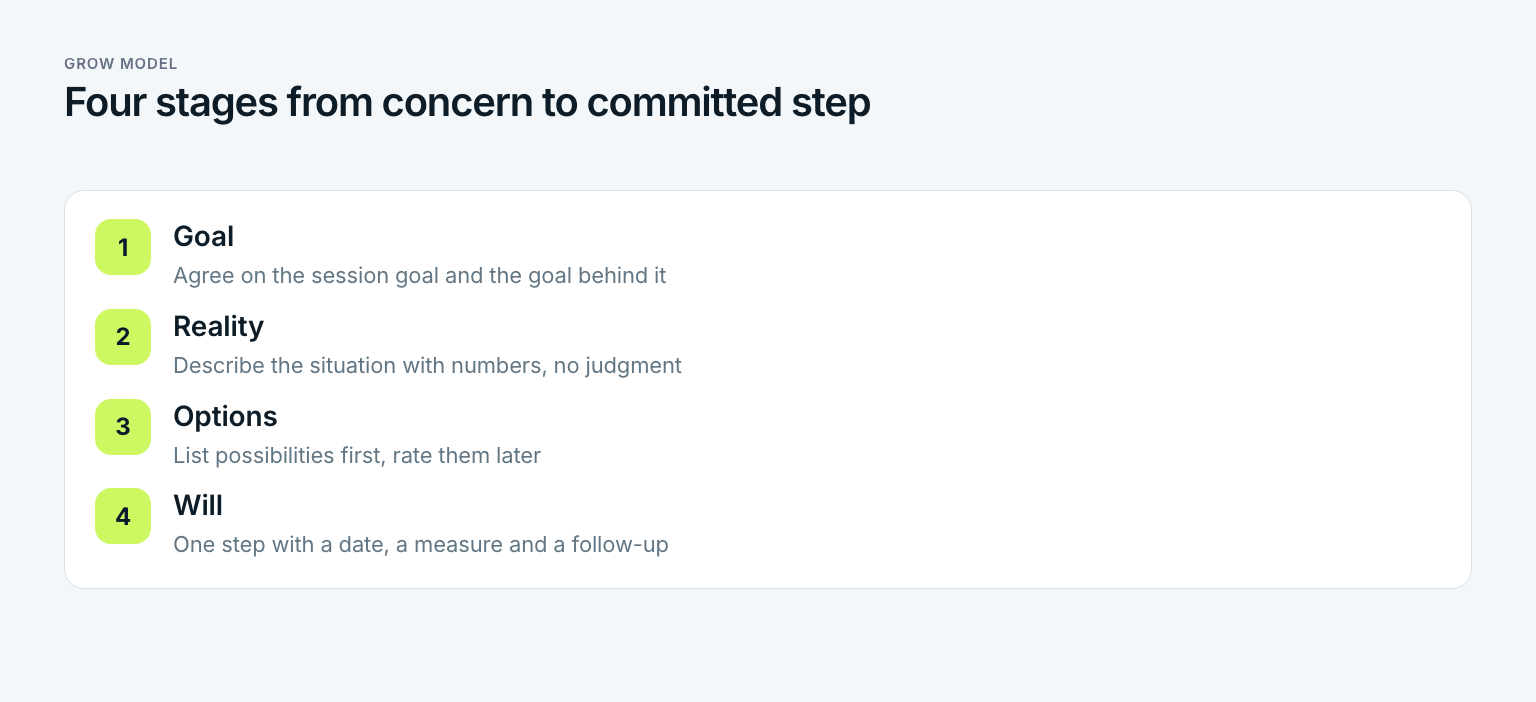
Notice the order. Goal comes before Reality, even though it seems more logical to check the facts first. Whitmore's reasoning: goals built from the current situation tend to be reactive, a response to a problem, and capped by past performance. Anyone who states what they want first looks at the facts differently. They stop searching for blame and start measuring the gap.
The stages are not a one-way street, though. Reality often shows that the goal was wrong, and then the conversation steps back. That is normal, not a failure. Whitmore himself described GROW as a sequence you may cycle through more than once.
Goal: What do you want?
The first stage settles two goals. One is for the session itself: what should be different at the end of these 45 minutes? The other sits behind it: what is the person working toward overall? Whitmore separates the end goal, which you never fully control, from the performance goal, which describes your own level of performance and can be measured. Many coaches add a process goal, the behavior that produces the performance.
Jenna starts with “I want more responsibility.” That is honest, but it is not a goal. Marcus asks how she would know she had it. Three questions later the bigger goal reads: by October 2027, I hold a team lead role, here or elsewhere. That end goal depends on hiring panels. So they add a performance goal she controls: by the end of January, she has led one piece of work that involves other people and has a visible result. The session goal is smaller: leave with two things she can start this month. For help turning statements like hers into clear sentences, see how to write SMART goals.
Reality: What is happening now?
Reality is the longest stage and the most important one. It is about facts, not opinions. Whitmore recommends descriptive questions that start with what, when, where, who and how much. He avoids why, because it sounds like a demand for justification and puts people on the defensive.
Marcus asks what the last lead hiring panel said. Jenna pulls up the email: strong with customers, no evidence of leading peers. He asks about her numbers. She manages 42 accounts with a 91 percent renewal rate over twelve months, against a team average of 86 percent. Then he asks how much time she spends helping colleagues. She has never counted. After a minute she estimates three hours a week, mostly answering questions about her renewal process in chat. Nobody, including Marcus, sees that work. What she has tried so far: asking Marcus for more responsibility, twice, without saying what that would look like.
None of these facts was new on its own, yet together they changed the picture. That means: Reality is not a warm-up. It is the moment the person sees their situation clearly for the first time. This is what Whitmore meant by awareness.
Options: What could you do?
In the third stage you collect possibilities without judging them yet. The longer the list, the better. In “The Coaching Habit”, Michael Bungay Stanier calls “And what else?” the best coaching question in the world, because the first answer is rarely the best one. Marcus asks it four times. Jenna ends up with seven options and rates them herself.
| Option | Effort | Shows lead-level work? | Jenna's call |
|---|---|---|---|
| Mentor Sam, the new hire starting November 9, for 60 days | medium | yes, leading a peer | start now |
| Turn her renewal process into a 45-minute team training | medium | yes, visible to the whole team | by December 4 |
| Run the Thursday team standup | low | partly | later, once Marcus agrees |
| Lead the Q1 churn reduction project | high | yes | ask about it in January |
| Take a management course | medium | indirectly | not now |
| Apply externally right away | high | no | not yet |
| Ask Marcus again for more responsibility | low | no | replace with a concrete ask |
Marcus holds back his own ideas during this stage. Only when Jenna runs dry does he ask whether he can add one. Whoever offers their own solution first gets variations of it for the rest of the conversation. Asking permission keeps the suggestion where it belongs: one option among several.
Will: What exactly will you do, and by when?
The last stage turns the list into a decision. The person chooses, sets who does what by when, and names how success will be visible. Whitmore asks direct questions here. What will you do? When? What could get in the way? Who needs to know?
Jenna picks two options. She mentors Sam for his first 60 days, starting with a kickoff on Monday, November 9. She builds the renewal training and runs it at the team meeting on December 4. Marcus asks how confident she is, on a scale of 1 to 10, that she will follow through. She says seven. When he asks what would make it a nine, she says time. Marcus agrees to move six of her accounts to a colleague for the next quarter. That decision is his to make, and he says so.
There is solid research behind this stage. Peter Gollwitzer showed in 1999 that people act on intentions far more often when they decide in advance when, where and how they will act. “Monday at 10 a.m. I meet Sam for 45 minutes” is that kind of plan. “I'll try to help the new guy” is not.

GROW Model Questions: 24 to Use by Stage
Good GROW model questions are open, short and about one thing at a time. These 24 cover most conversations. Pick two or three per stage, not all six.
| Goal | Reality | Options | Will |
|---|---|---|---|
| What do you want to walk away with today? | What is happening right now, in concrete terms? | What could you do? | Which option will you choose? |
| What would success look like in six months? | How often does it happen, and what does it cost you? | And what else? | What is the very first step, and when? |
| How would you know the problem is solved? | What have you tried so far, and what did it change? | What would you do with twice the time? | What could get in the way, and what will you do then? |
| Which part of this is in your control? | Who else is involved, and how would they describe it? | What would someone you admire do here? | Who needs to know about your plan? |
| What makes this important to you now? | What is stopping you today? | What is the smallest thing you could try this week? | How confident are you, from 1 to 10? What would raise it? |
| By when do you want to get there? | What do you know now that you did not know at the start? | Which option would you pick if nobody was watching? | When will we check in on it? |
Two kinds of questions are missing on purpose. Questions that start with why tend to sound like criticism. Questions that can be answered with yes or no usually hide a suggestion. If you want more questions for regular check-ins, the guide to one on one meeting questions has 50 sorted by purpose.
How to Run a GROW Coaching Session in 45 Minutes
A GROW session needs a short setup and a firm ending. This is how Marcus structured his conversation with Jenna. The times are guidelines for 45 minutes.
Set the frame, 2 minutes
Say that you will ask rather than advise, and that the other person decides. Marcus said: “I don't have an answer ready for you. I'll ask questions, and you choose what to try.” That takes pressure off and makes ownership clear.
Agree on the goal, 8 minutes
Ask for the session goal and the goal behind it. Write both down and read them back. Move on only when the person agrees with the wording.
Explore reality, 15 minutes
Ask descriptive questions and ask for numbers. Summarize every few minutes. For Jenna the turning point was a summary: strong results, three invisible hours a week of helping others, no proof of leading peers.
Generate options, 12 minutes
Ask “And what else?” at least three times. Rate options only once the list is done. Offer your own ideas last, after asking permission.
Commit to steps, 6 minutes
Let the person choose one or two options and say them as a sentence with a date. Ask for the confidence score and the biggest obstacle.
Book the follow-up, 2 minutes
Put the next conversation in the calendar before you leave. Marcus and Jenna met two weeks later for 20 minutes. Sam had his kickoff and two follow-up sessions, and the training outline was done. The goal was not reached yet, but the first proof existed.
Managers face one complication. You are not neutral. You know the work, you have opinions, and you share responsibility for the result. That does not rule out GROW. It means you should say openly when you are asking as a coach and when you are deciding as a manager. Moving six accounts was Marcus's call. Everything else was Jenna's. Anyone who blurs the two gets answers that sound like what the boss wants to hear.
The most common mistake: advice disguised as a question
“Have you thought about mentoring the new hire?” sounds like a question. It is a suggestion, and the other person knows it immediately. Questions like this jump straight to Options before Goal and Reality are clear, and they take the decision away from the person. Whoever notices that a question can be answered with yes or no and already contains a solution should not ask it. An open question such as “What could you do to show you can lead peers?” reaches the same place, on the other person's path.
GROW Coaching Model Worksheet
A GROW coaching model worksheet is a single page with the four stages and room to write. You can use it to prepare a session, to take notes during one, or to coach yourself. Copy the left two columns onto paper. The right column shows how Jenna's sheet looked after her session.
| Stage | Prompt | Jenna's answer |
|---|---|---|
| Goal: session | What do I want from this conversation? | Two things I can start this month |
| Goal: bigger | What do I want by when, and which part do I control? | Team lead role by October 2027. Lead one piece of work with a visible result by the end of January |
| Reality: facts | What is true today, in numbers? | 42 accounts, 91 percent renewals, three hours a week helping peers, never formally led anyone |
| Reality: tried | What have I tried, and what happened? | Asked for more responsibility twice, nothing changed |
| Options | What could I do? And what else? | Seven options, from mentoring Sam to applying elsewhere |
| Will: steps | What exactly will I do, by when? | Mentor Sam from November 9 for 60 days. Team training on December 4 |
| Will: confidence | How sure am I, from 1 to 10? What would raise it? | Seven. Six accounts moved off my plate |
| Follow-up | When do I check progress? | In two weeks, 20 minutes with Marcus |
When you use the worksheet alone, write every answer out. In your head you jump to solutions after the first sentence. On paper you stay in Reality longer, and that is where the useful facts come from. What self-coaching lacks is a person who asks follow-up questions. Replace that person with a date. Anyone who sets aside ten minutes at the end of each week to check whether the Will step happened has a follow-up with themselves. The guide to weekly goals shows how to make those ten minutes a habit.
Other Coaching Models and How They Compare
GROW is the best known coaching model, but not the only one. Most others are variations or shift the emphasis. These five come up most often in coaching training and books.
| Model | Origin | Steps | Stronger than GROW for |
|---|---|---|---|
| GROW | Alexander, Fine, Whitmore, late 1980s | Goal, Reality, Options, Will | Getting started and short conversations |
| T-GROW | Myles Downey, “Effective Coaching”, 1999 | Topic before Goal, then GROW | Vague requests that need a topic first |
| OSKAR | Paul Z. Jackson and Mark McKergow, “The Solutions Focus”, 2002 | Outcome, Scaling, Know-how, Affirm and Action, Review | Solution-focused work with scales |
| CLEAR | Peter Hawkins, early 1980s | Contracting, Listening, Exploring, Action, Review | Longer engagements with a clear contract |
| Seven questions | Michael Bungay Stanier, “The Coaching Habit”, 2016 | Seven fixed questions from “What's on your mind?” to “What was most useful for you?” | Managers coaching in everyday work |
The models do not exclude each other. Many coaches use GROW as the frame and borrow the scaling question from OSKAR or the topic step from T-GROW. Keep one distinction in mind. GROW structures a single session. A coaching engagement over several sessions has its own stages, from contracting through goal setting to evaluation. How to turn a client's first vague request into a goal is covered in the guide to coaching goals.
Criticisms of the GROW Model
The GROW model has structured countless conversations. It is simple, easy to remember and hard to misunderstand. That simplicity is also at the heart of the criticism, and the criticism comes from coaching research itself.
Anthony Grant, who founded the world's first coaching psychology unit at the University of Sydney, published a paper in 2011 titled “Is it time to REGROW the GROW model?”. His observation: training programs often teach GROW as a fixed sequence, and beginners then work through it like a checklist. Grant suggested opening every follow-up session with a review and an evaluation of progress since the last one, which is where the name REGROW comes from. That turns single conversations into a learning process.
Three more objections come up often:
- The goal is often unclear. GROW assumes the person knows what they want. With a vague concern like “I'm not sure I'm in the right job,” the goal question leads nowhere. T-GROW or a separate session to clarify the goal helps.
- Emotions and beliefs get too little room. The model asks about facts and actions. Anyone who has believed for years that they are not leadership material will not fix that with a list of options.
- It stays shallow when the questions are weak. GROW tells you what to ask when, not how well. The quality depends almost entirely on listening and follow-up.
And there is one boundary no conversation model should cross. Coaching is meant for people working toward a goal, not for people in crisis. If a conversation reveals a crisis, point the person to professional help. In the US they can call or text 988.
Whether coaching works at all is better studied than many assume. A 2014 meta-analysis by Tim Theeboom, Bianca Beersma and Annelies van Vianen found positive effects of coaching in organizations on performance, well-being, coping, work attitudes and goal-directed self-regulation. Which conversation model was used is hard to tell from such studies. That means: the model is a tool. The effect comes from the conversation.
Three GROW Mistakes Nobody Notices
Advice disguised as a question is easy to spot with practice. Three other mistakes slip through because the conversation still feels pleasant.
- The coach's goal instead of the person's. Marcus would have liked Jenna to take the management course. Had he framed the goal that way, the course would have landed in Will, and Jenna would have taken it out of duty. Self-chosen goals carry further. Daniel H. Pink describes this difference between control and autonomy at length in “Drive”.
- A rushed Reality stage. Many conversations spend three minutes on the situation and twenty on solutions. Without numbers, options stay generic. If Marcus had not asked about the time spent helping colleagues, the mentoring idea would never have surfaced.
- Will without a follow-up. A step with a date is good. A step with a date that nobody asks about still disappears. Without the follow-up, every GROW session becomes a pleasant chat that ends in resolutions.
All three mistakes have one thing in common. They shorten the part where the other person thinks. Anyone who tries to speed the conversation up takes away exactly the work coaching is meant to leave with them.
The GROW Model on a Goal Chain: Year to Monday
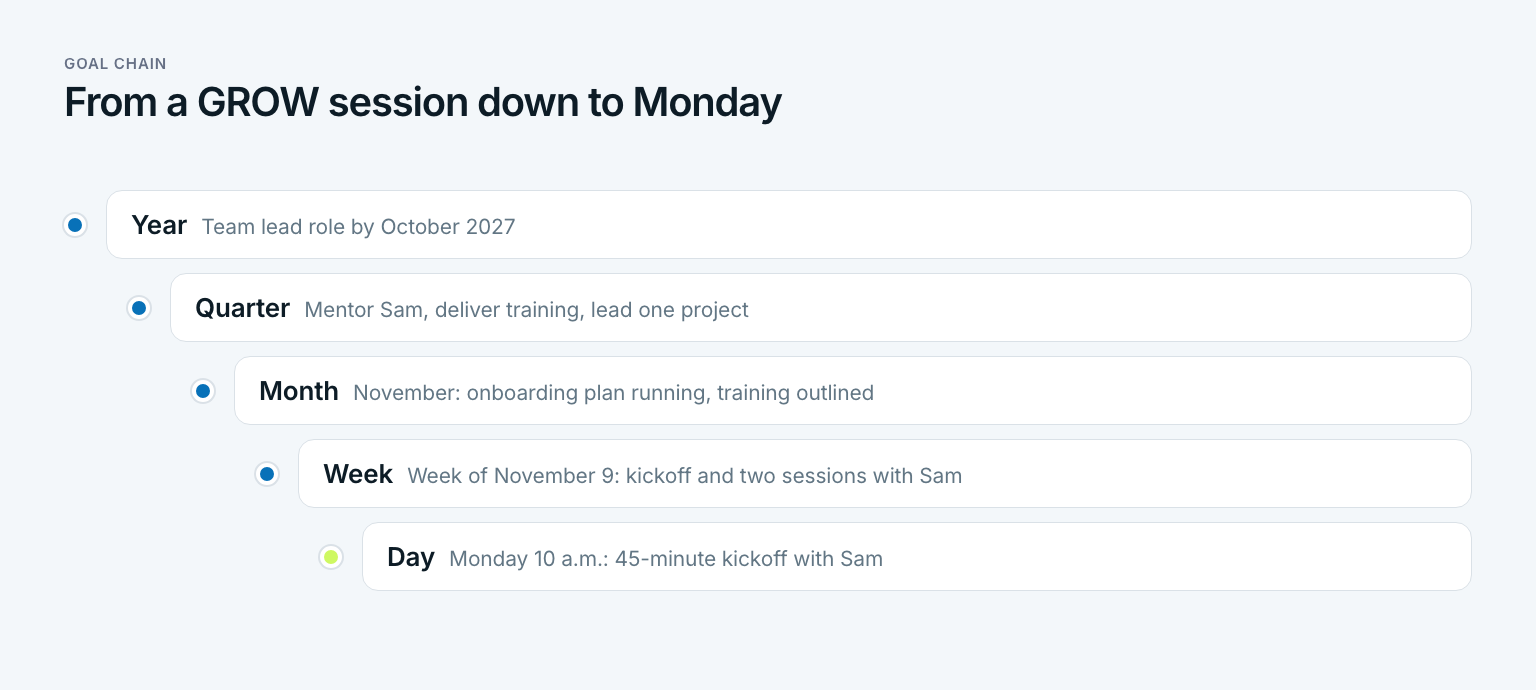
A single GROW session ends with a step for next week. To keep that step from floating free, attach it to a bigger goal. The Goal stage supplies the yearly or quarterly goal. The Will stage supplies the weekly and daily step. For Jenna it looks like this:
| Level | Jenna's goal | How she measures it |
|---|---|---|
| Year 2027 | Team lead role by October, here or elsewhere | Offer or promotion |
| Quarter, November to January | Sam handles accounts on his own, team training delivered, one cross-team project led | Sam's first solo renewal, training held, project result |
| Month, November | Sam's 30-day onboarding plan running, training outline finished | Plan shared, outline reviewed by Marcus |
| Week of November 9 | Kickoff and two onboarding sessions with Sam | Three sessions held |
| Day | Monday 10 a.m.: 45-minute kickoff with Sam | Done or not |
The follow-up two weeks later is not a new coaching session. It is a quick look at this chain. Which level holds, which one wobbles? After two weeks the weekly steps had happened and the training outline was ready. The quarterly goal stayed, and the next weekly step was a dry run of the training with two colleagues. Gaapp is built around exactly this chain: the goal from the Goal stage becomes a yearly or quarterly goal, and the Will steps become weekly and daily goals. In the follow-up, both of you see at a glance what happened.
Managers with several direct reports benefit from a fixed rhythm. One GROW session per person per quarter plus short check-ins every two weeks is manageable for most teams. Anyone with eight reports needs about one and a half hours a week for it. That sounds like a lot. It is less than unclear problems cost when nobody talks about them.
Self-Check: Are You Coaching or Telling?
Five questions to answer after your next conversation. Anyone who hesitates on two of them knows what to work on next time.
- Did the other person put the session goal in their own words?
- Did I ask for numbers and summarize before we talked about solutions?
- How many times did I ask “And what else?”
- Did the other person say the next step and its date out loud?
- Is the follow-up already in the calendar?
Marcus spends five minutes on these questions after every session. After his third conversation with Jenna he noticed that he still offered ideas too early in Options. That is now his own weekly goal. In short: the GROW model turns a good conversation from a lucky accident into a habit.
What is the GROW model of coaching?
The GROW model is a four-stage structure for coaching conversations: Goal, Reality, Options and Will. It was developed in the UK in the late 1980s and popularized by Sir John Whitmore in “Coaching for Performance” in 1992. It keeps a conversation from jumping to solutions before the goal and the facts are clear.
What are the 7 steps of coaching?
There is no single standard seven-step process. The best-known set of seven is Michael Bungay Stanier's seven questions from “The Coaching Habit”, starting with “What's on your mind?” and ending with “What was most useful for you?”. Other authors describe a coaching engagement in stages from contracting to evaluation, with varying numbers of steps.
What are the 5 C's of coaching?
There is no agreed list. Different trainers use the label for different sets of words, such as clarity, curiosity, courage or commitment. Treat any version as a reminder of attitudes, not as a session structure like GROW.
What are the criticisms of the GROW model?
Critics say it is often taught as a rigid checklist, assumes the person already knows their goal, and leaves little room for emotions and beliefs. In 2011 Anthony Grant proposed REGROW, which opens each follow-up session with a review and evaluation of progress. The model's value depends heavily on the quality of the questions.
Can you use the GROW model on yourself?
Yes, as written self-coaching in about 15 minutes. Answer the four stages on paper and end with one step and a date. Replace the missing coach with a fixed check-in time when you look at whether the step happened.
How long should a GROW coaching session take?
A full session usually takes 30 to 60 minutes, with Reality taking the largest share. A small topic can work in ten minutes if each stage gets two or three questions. More important than length is that the session ends with a step and a date.
Last updated: 22 October 2026
Read next
 Leadership & Teams
Leadership Styles: Which One Fits Which Situation
Leadership styles are not personality types: 11 types compared, Lewin, Goleman, situational leadership and five steps to find the style that fits you.
14 min read
 Leadership & Teams
Retrospective: How Teams Learn From Every Sprint
A retrospective is not a blame session: what the word means, five phases, seven retrospective examples and action items that stick, shown on one team.
16 min read
 Leadership & Teams
How to Delegate Tasks: Hand Off Work, Keep Results
Delegation is not dumping work: five levels of delegation, seven steps, a handoff script and what to keep, shown on one marketing team.
15 min read