Management by Objectives: How MBO Works in Practice
Management by objectives is not a bonus plan: MBO meaning, the four steps, the research, the criticism and how it compares to OKRs, on one real team.

Contents
- 01MBO meaning: what management by objectives stands for
- 02Who introduced management by objectives
- 03The four steps of the MBO process
- 04Why MBO is important: what the research shows
- 05Criticism of MBO: three weaknesses, taken seriously
- 06MBO vs OKR: what changed and why
- 07MBO in the goal chain: from yearly objective to Tuesday
- 08MBO objectives examples by role
- 09The three mistakes nobody notices
- 10Self-audit: is your MBO still alive?
Management by objectives is not a bonus plan. Management by objectives, or MBO, is a management approach in which a manager and an employee agree on specific objectives together and later measure performance against those objectives, not against hours, effort or activity. Anyone who treats MBO as a form for the annual bonus gets cautious goals. Anyone who treats it as a way to lead gets a team that knows what it is working toward.
This guide follows Rachel, 39, operations manager at a family-owned HVAC parts distributor in Columbus, Ohio. She runs a team of nine across inside sales, purchasing and the warehouse. In September the owners decided to roll out MBO in January, and Rachel's team goes first. You will see where the method comes from, the four steps, what the research says, the strongest criticism, how MBO differs from OKRs, examples by role and one objective broken down from the year to a single Tuesday.
MBO meaning: what management by objectives stands for
MBO stands for management by objectives. The idea is simple. Instead of telling people what to do each day, a manager agrees with them on what should be achieved by the end of a period and leaves the how to them. That means: control moves from the activity to the result.
A working definition has four parts. First, individual objectives are derived from the objectives of the organization. Second, they are agreed, not assigned. Third, both sides review progress at fixed points during the year. Fourth, the result is evaluated at the end, often with consequences for pay or development. Drop any one of the four and what is left is a target handed down under a nicer name.
In US companies the term has a second, narrower meaning. In sales compensation, an MBO is often the part of a bonus tied to goals other than quota, such as onboarding new accounts or finishing a certification. That usage is real, but it is a slice of the method, not the method itself. Whoever reduces MBO to a payout line ends up managing the payout, not the work.
| Term | What it means | Role in MBO |
|---|---|---|
| Assigned target | The number comes from above | A starting point, never the end |
| Agreed objective | Manager and employee settle the goal together | The core of the method |
| Progress review | A check-in during the year | Corrects course while there is still time |
| Performance review | A look back at results | Measured against the agreed objective |
| MBO bonus | Pay tied to non-quota goals | Optional, and often the source of trouble |
Rachel had seen MBO at her last employer. There it was a spreadsheet you signed in January and found again in December, usually the week before reviews were due. Whether it works differently for her team depends less on the form and more on how she runs the four steps.
Who introduced management by objectives
Peter F. Drucker introduced the term in 1954 in his book The Practice of Management. The chapter is called Management by Objectives and Self-Control, and the second half of that title matters more. Drucker wanted managers to steer their own performance against their own objectives instead of being supervised from above. For him objectives were a tool for self-direction, not for surveillance.
Drucker also named eight areas in which a business needs objectives: market standing, innovation, productivity, physical and financial resources, profitability, manager performance and development, worker performance and attitude, and public responsibility. His point was blunt. Anyone who manages only for profit ignores the areas that produce next year's profit.
George S. Odiorne turned the idea into a system. His 1965 book Management by Objectives: A System of Managerial Leadership added the meetings, forms and appraisal cycle that most companies still use. Through the 1960s and 1970s MBO spread through large American corporations. At Intel, Andrew S. Grove built a leaner version with objectives and key results, which he described in High Output Management in 1983. That version later became OKRs. In Japan, the 1960s produced a parallel approach, Hoshin Kanri strategy deployment, which links objectives to Deming's improvement cycle and aligns them from the top down to teams.
So when people talk about MBO today, they usually mean one of two things. One is Drucker's idea of self-control. The other is the yearly ritual of goal sheets and bonuses that grew out of it in many HR departments. The idea has aged well. The ritual has not.
The four steps of the MBO process
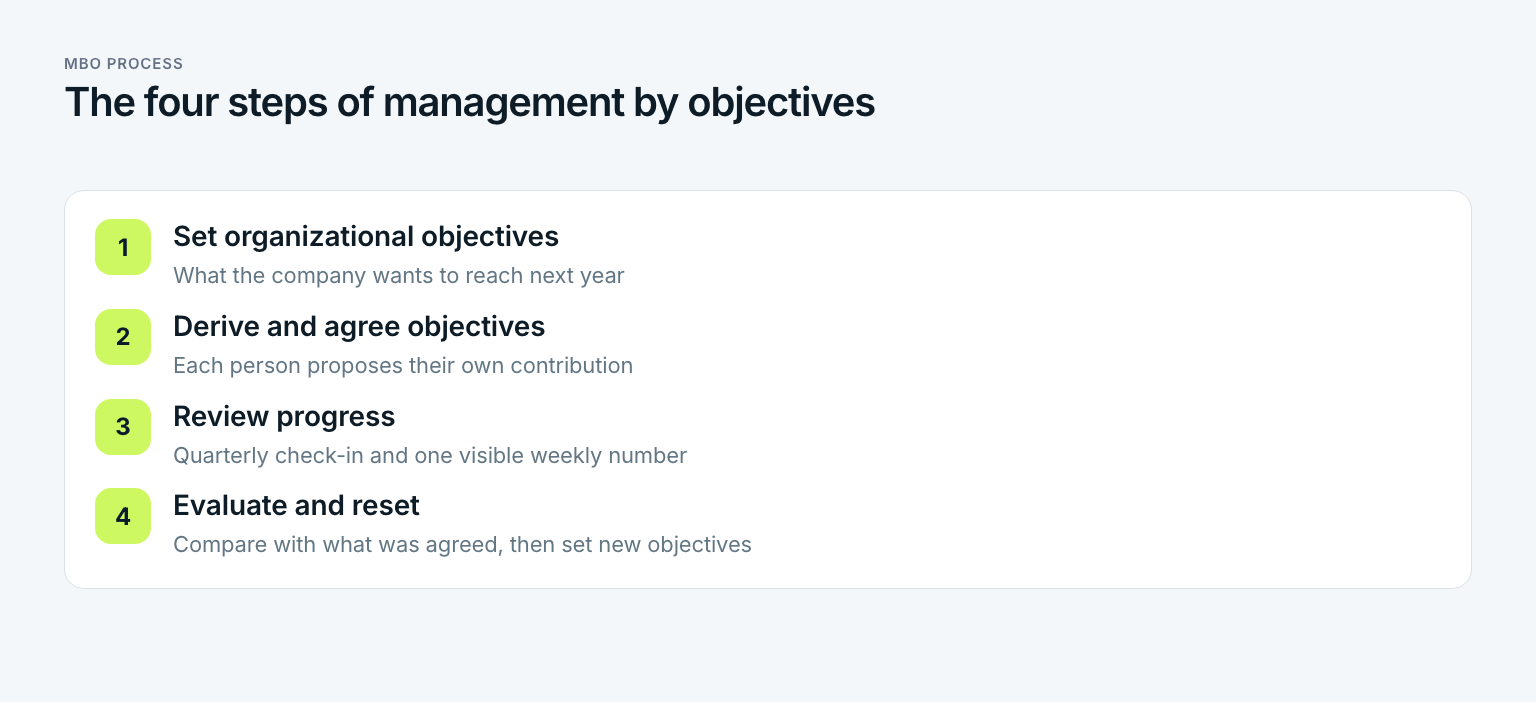
Most textbooks list four steps. Some count five or six because they separate feedback or rewards. The sequence is the same either way, and it runs in a loop:
Set organizational objectives, October
It starts with what the company wants to achieve next year. Rachel's owners chose three objectives: grow revenue by 8 percent, raise order accuracy to 99.5 percent and cut the share of revenue from the two largest accounts from 38 percent to under 30 percent. Without this level, every individual objective floats.
Derive and agree individual objectives, November
Each team asks what it can contribute. Rachel proposed that her inside sales team send 80 percent of quotes the same business day, up from 58 percent. Then she met with each of her nine people about their own contribution. Agreed means the employee can push back and make a counteroffer.
Review progress, every quarter
An objective nobody looks at until December steers nothing. Rachel set four 30-minute quarterly check-ins and one number the team sees every Monday. When a number slips, the question is what is missing, not who is to blame.
Evaluate results and reset, December
At year end, results are compared with what was agreed. That leads to a conversation about development and, if the company pays one, the MBO bonus. Then the loop starts over with next year's objectives.
Step two is where MBO usually breaks. Anyone who simply pushes targets down the org chart saves a few meetings and loses buy-in. Edwin A. Locke and Gary P. Latham summarized decades of research in A Theory of Goal Setting and Task Performance in 1990: specific, challenging goals improve performance most when people are committed to them. The article on goal setting theory covers those findings in more depth.
Setting objectives together: the MBO conversation
The objective-setting meeting is the tool. MBO is the system around it. How to run a single goal conversation with an employee, step by step, is covered in goal setting for employees. Here the focus is what that conversation has to do inside an MBO system.
Three things separate an MBO conversation from a target handed down. The employee sees the company objective before discussing their own. The employee makes the first proposal. And both sides agree how the result will be measured before anyone mentions money. Why that order? Because a bonus mentioned first colors every question that follows.
Rachel tried this with Tyler, 31, an inside sales rep who has handled independent HVAC contractors for three years. She showed him the company objective first: depend less on the two largest accounts. Tyler proposed winning 15 new contractor accounts in the year. Rachel asked how many he had won this year. The answer was five. They settled on 12, with a checkpoint of three by the end of March.
| Objective | Measure | Baseline | Target | Weight |
|---|---|---|---|---|
| New contractor accounts | Accounts with at least three orders | 5 | 12 | 40 percent |
| Faster quotes | Share sent the same business day | 55 percent | 80 percent | 30 percent |
| Fewer order errors on his accounts | Order accuracy | 98.6 percent | 99.5 percent | 20 percent |
| Own development | Pricing course completed and applied | no | yes | 10 percent |
Four objectives are enough. Whoever agrees on ten objectives has really agreed on no priorities at all. For wording each objective so it can be measured, the SMART goals for work article has examples by role and industry.
Why MBO is important: what the research shows
The evidence on MBO is better than its reputation. Robert Rodgers and John E. Hunter reviewed 70 studies of MBO programs in the Journal of Applied Psychology in 1991. In 68 of them, productivity went up. The more important finding was elsewhere. When top management was highly committed, the average productivity gain was 56 percent. When commitment was low, it was 6 percent.
That means: MBO works when the people at the top live it themselves. Handed down as an HR project, it fades. Rachel found that uncomfortable, so she asked the owners whether they would set MBO objectives too. They said yes, and she told her team exactly that in the kickoff meeting.
Beyond productivity, four benefits show up in daily work:
- Clarity. Everyone knows what they will be measured on and can tell for themselves whether they are on track.
- Alignment. Individual objectives connect to company objectives. A rep who sends quotes faster can see how that feeds the revenue goal.
- Autonomy. Because the result is agreed, the path does not have to be prescribed. The manager stops checking every step, and the team gets room to decide.
- Fairer reviews. A review built on agreed numbers is less exposed to gut feeling than one built on impressions.
Is MBO the answer for every team? No. All four benefits depend on one condition: the objectives must be measurable, within the person's control and genuinely agreed. Miss one and each benefit turns into its opposite. Clarity becomes pressure. Alignment becomes compliance.
MBO fits best where results can be traced to one person and a year is a sensible planning horizon. Sales, purchasing, logistics and finance usually qualify. It gets harder when work depends heavily on the team or changes every few weeks, as in software. Whoever sets yearly individual objectives there mostly measures how well someone guessed in January. Shorter cycles work better for those teams, as the comparison with OKRs below shows.

Criticism of MBO: three weaknesses, taken seriously
MBO has famous critics. That is not a reason to drop it. It is a reason to look closely at what it was built for and what it was not.
W. Edwards Deming listed fourteen points for management in Out of the Crisis in 1986. Point eleven calls for eliminating management by objectives and management by numerical goals. His argument was that most of a person's performance comes from the system they work in. Anyone who judges individuals on numbers the system controls ends up rewarding luck and punishing bad luck.
Steven Kerr described the same trap in 1975 in the Academy of Management Journal, in his paper On the Folly of Rewarding A, While Hoping for B. Organizations, he showed, often reward exactly the behavior they want to avoid. Tie objectives to money, and people optimize what is measured and neglect what matters. In 2009 Lisa Ordóñez and three colleagues argued in Goals Gone Wild that goals set too narrowly or too aggressively can encourage risky and unethical behavior.
Those objections show up in practice as three weaknesses:
- Sandbagging. When the bonus depends on hitting 100 percent, everyone negotiates the target down. It is the rational move.
- Rigid yearly objectives. A January objective often no longer fits in June. Without a reset, the December review measures a world that no longer exists.
- Tunnel vision. What is on the goal sheet gets done. What is not, like helping a colleague or reporting a mistake early, gets less attention.
The most common mistake: the objective is the bonus
The first draft of Rachel's company plan paid the full MBO bonus only at 100 percent achievement. In the first round of conversations, all nine people proposed objectives just above last year's numbers. Whoever ties money to exact achievement gets the objectives that are safe to hit. Rachel got the plan changed so the bonus starts to pay out at 70 percent and part of every conversation is reserved for development.
So the criticism lands less on the idea than on the link to pay and the rigid year. Drucker himself framed objectives as a means of self-control, not a pay formula. In short: MBO is built for alignment, not for accounting.
MBO vs OKR: what changed and why
OKRs are the best-known descendant of MBO, not a rebellion against it. Grove kept the core idea at Intel and changed three things: shorter cycles, objectives everyone can see, and measurable key results written directly under each objective. John Doerr brought the model to Google in 1999 and described it in Measure What Matters in 2018.
| Feature | Management by objectives | OKR |
|---|---|---|
| Cycle | usually one year | usually one quarter |
| Visibility | often private between two people | open to the whole team |
| Link to pay | often direct | deliberately separate |
| Expected achievement | close to 100 percent | about 70 percent on ambitious goals |
| Direction | mostly top down | top down and bottom up at once |
| Measure | one target per objective | two to five key results per objective |
Which one fits depends on the question you need answered. MBO is good at answering what a person will be evaluated on at year end. OKRs are good at answering what a team wants to move this quarter. Many companies run both: MBO for individual performance, OKRs for shared initiatives. The OKR framework article explains how OKRs work in detail, and OKR vs KPI shows how both differ from the metrics you simply keep healthy.
Rachel chose a middle path. The yearly objectives and the review follow MBO because the owners decided so. The interim goals, though, she resets every quarter, visible to the whole team and with no money attached. That takes much of the sting out of Deming's and Kerr's critique.
MBO in the goal chain: from yearly objective to Tuesday
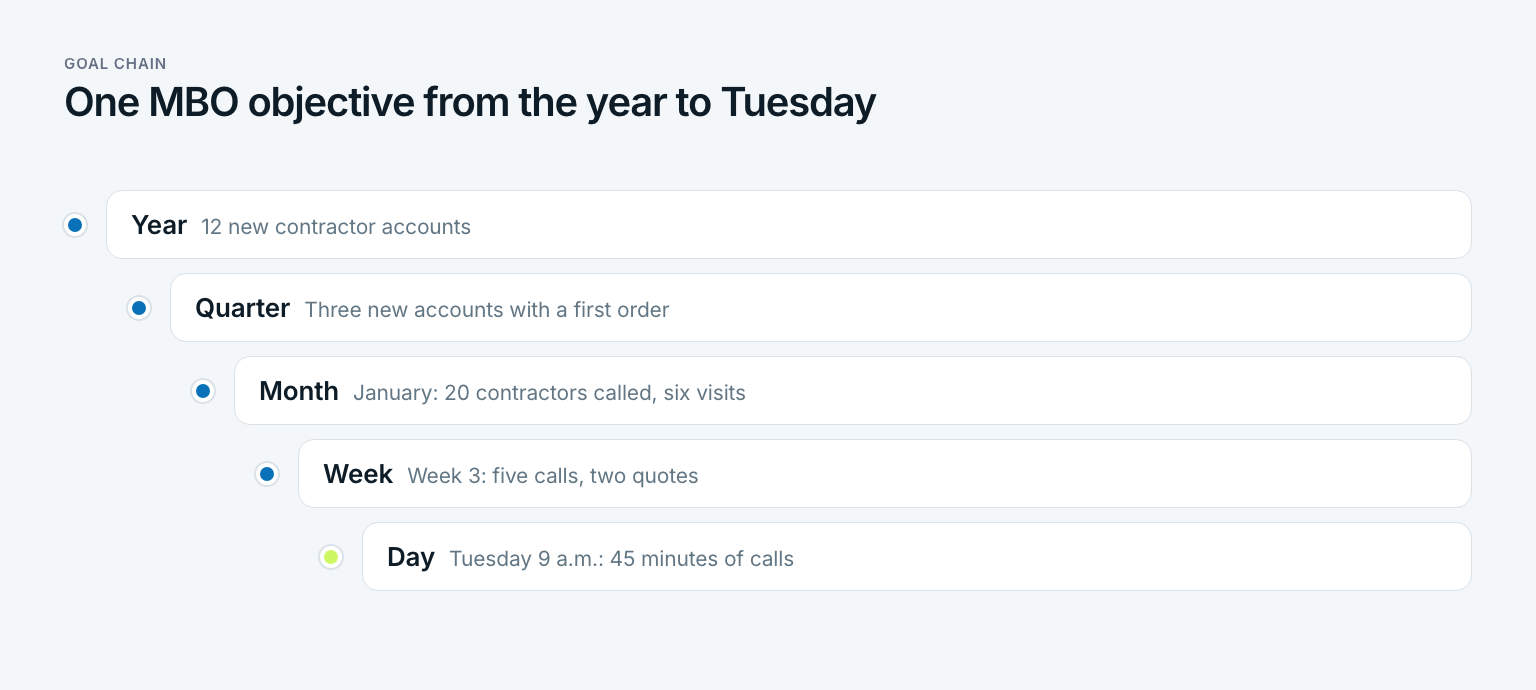
A yearly objective on a goal sheet only becomes work once it is translated into shorter periods. Anyone who leaves that to chance spends November catching up on what should have started in March. Tyler broke his main objective down across five levels.
| Level | Tyler's goal | How he measures it |
|---|---|---|
| Year | 12 new contractor accounts by December | Accounts with at least three orders |
| Quarter | Q1: three new accounts with a first order | Orders in the ERP system |
| Month | January: 20 contractors in central Ohio called, six visits booked | Call list with dates |
| Week | Week 3: five calls, two quotes sent | Friday weekly review |
| Day | Tuesday 9 a.m.: 45 minutes of calls before the phone queue opens | Checked off in the calendar |
The goal chain fixes two MBO weaknesses at once. The rigid year becomes flexible because every quarter gets a fresh interim goal. And the quarterly check-in has something to work with because progress is visible week by week. In Gaapp you enter the yearly objective once and see the quarter, month, week and day beneath it as one chain.
What stays out of the chain matters too. Tyler has no daily goals for quote speed or order accuracy. Those run as metrics Rachel shows every Monday. Only what would not happen without deliberate planning goes into the chain. Winning new accounts does. Sending quotes does not.
MBO objectives examples by role
The pattern is the same everywhere: company objective, derived contribution, measure. These MBO objectives examples show what that looks like across roles:
| Role | Company objective | Agreed MBO objective |
|---|---|---|
| Inside sales | Grow revenue | Send 80 percent of quotes the same business day |
| Account manager | Reduce dependence on large accounts | Win 12 new contractor accounts |
| Warehouse lead | Improve order accuracy | Cut shipping errors from 1.4 to 0.5 percent |
| Accounts receivable | Improve cash flow | Lower days sales outstanding from 47 to 38 |
| HR generalist | Keep skilled staff | First-year turnover under 10 percent |
| Team lead | Develop managers | Hold and document four quarterly check-ins with each report |
| Marketing | Reach new customer groups | 120 qualified leads from contractors per year |
Notice what no row contains: an activity. Nobody agrees to make more calls or send more emails. Whoever agrees on activities is back to giving instructions, just with more paperwork. An objective describes a state at the end of the period. How the person gets there is up to them.
The three mistakes nobody notices
Tying objectives to the bonus is the obvious mistake. Three more barely register because they feel like good MBO:
- Objectives outside the person's control. An objective someone cannot influence measures luck. Tyler can win new accounts. He cannot control company revenue, so it is not on his sheet.
- No checkpoint. Without a fixed quarterly conversation, the objective is not read again until December. By then it is too late to change anything.
- Only numbers, no growth. A sheet that measures only results says nothing about what the person wants to learn. A development objective belongs on it, even with a smaller weight.
All three come from the same habit: MBO gets administered instead of led. What helps? A fixed slot in the calendar where objectives are discussed, not just checked. For Rachel that is the first Tuesday after each quarter ends.
Self-audit: is your MBO still alive?
Five questions to ask before the next round of objectives. Anyone who hesitates on two of them knows where to start:
- Does everyone on my team know the company objectives their own objectives come from?
- Did each person help propose their objectives, or did I just fill in the sheet?
- Can each person actually influence every objective on their sheet?
- Is the next progress review on the calendar with a date?
- Would we agree on the same objectives if no money were attached?
Rachel runs through these before every quarterly check-in. After the first quarter, her team sent 71 percent of quotes the same day, and Tyler had two new accounts instead of three. The conversation about it took 25 minutes and ended with a new plan rather than an excuse. In short: management by objectives works when objectives are discussed more often than they are graded.
Who introduced management by objectives?
Peter F. Drucker introduced the term in 1954 in The Practice of Management, as management by objectives and self-control. George S. Odiorne turned it into a full system with meetings and appraisals in 1965. From there it spread through large companies worldwide.
What are the 7 business objectives and examples?
There is no single official list. A common set is profitability, growth, market share, productivity, customer satisfaction, employee development and social responsibility, for example 8 percent revenue growth or 99.5 percent order accuracy. Drucker himself named eight areas, adding innovation and financial resources.
Why is MBO important?
MBO links each person's work to the goals of the organization and makes performance reviews depend on agreed results instead of impressions. A 1991 review of 70 studies by Rodgers and Hunter found productivity gains in 68 of them. The gains were largest when top management was fully committed.
What is the organizational objective of management?
The organizational objective of management is to set the results the whole organization should reach and to coordinate people and resources toward them. In MBO those organizational objectives come first. Every team and individual objective is then derived from them.
What does MBO mean?
MBO means management by objectives, a management approach in which managers and employees agree on specific objectives and measure performance against them. In sales compensation, MBO also refers to the bonus portion tied to goals other than quota.
What is the difference between MBO and OKR?
MBO usually runs on yearly objectives that are private and often tied to pay. OKRs run quarterly, are visible to the whole team and are deliberately separated from bonuses. Ambitious OKRs count as a success at about 70 percent achievement, while MBO usually expects close to 100 percent.
Last updated: 22 October 2026
Read next
 Leadership & Teams
Leadership Styles: Which One Fits Which Situation
Leadership styles are not personality types: 11 types compared, Lewin, Goleman, situational leadership and five steps to find the style that fits you.
14 min read
 Leadership & Teams
Retrospective: How Teams Learn From Every Sprint
A retrospective is not a blame session: what the word means, five phases, seven retrospective examples and action items that stick, shown on one team.
16 min read
 Leadership & Teams
How to Delegate Tasks: Hand Off Work, Keep Results
Delegation is not dumping work: five levels of delegation, seven steps, a handoff script and what to keep, shown on one marketing team.
15 min read