Mental Toughness: The 4 C's and How to Build It
Mental toughness is not being hard on yourself. What the 4 C's mean, six tested training exercises and a five-step plan with a worked example.

Contents
- 01What is mental toughness? A definition from psychology
- 02Mental toughness vs resilience vs grit
- 03The 4 C's of mental toughness
- 04What the research says, and where it stops
- 05Mental toughness training: six exercises with evidence
- 06Building mental toughness in five steps
- 07A worked example: Alicia and the CPA exam
- 08Mental toughness in the goal chain: year, quarter, month, week, day
- 09Frequently asked questions about mental toughness
Mental toughness is not being hard on yourself. It is the capacity to keep performing the way you planned under pressure, after setbacks and over long stretches, consistently and not just on good days. Psychologists most often describe it with four building blocks, the 4 C's: control, commitment, challenge and confidence. Anyone who wants to build mental toughness does not practice suffering. They train those four blocks, one at a time, with steps they can measure.
You need three things to do that: a clear definition, so you know what you are actually training, a toolkit of exercises that have been tested in studies, and a goal where the training shows up. The worked example is Alicia, 34, a staff accountant at a regional firm studying for the CPA exam at night. Four sections, a passing score of 75. She missed the Financial Accounting and Reporting section with a 71 on her first try. Her practice scores say she knows the material. What she lost was her composure in the first half hour.
What is mental toughness? A definition from psychology
The term comes from sport psychology. Coaches talked about mentally tough athletes for decades without being able to say exactly what they meant. In 2002, Graham Jones, Sheldon Hanton and Declan Connaughton interviewed ten international athletes and built a definition from their answers. Mental toughness, in their words, is a psychological edge that lets you cope better than your opponents with the demands of training and competition and stay determined, focused, confident and in control under pressure.
In 2015, Daniel Gucciardi and colleagues took the concept out of the stadium in the Journal of Personality. They describe mental toughness as a personal capacity to deliver high performance consistently, despite everyday stressors and despite major adversity. The key word is consistently. One great performance under pressure tells you little. Mental toughness shows up when your performance does not collapse on a bad day.
So what does mentally strong look like from the inside? It does not mean feeling no fear. Mentally tough people feel nervous before a big moment like everyone else. The difference lies in what happens next: they read the nerves as information, return to a plan they made earlier and keep acting. That means: mental toughness is less about what you feel and more about what you do while you feel it.
Hardiness: where the idea started
In 1979, Suzanne Kobasa studied executives at a large telephone company who were going through heavy work stress. Some stayed healthy, others got sick more often. The healthy group shared three attitudes: they felt committed to their work, believed they could influence events and saw change as a challenge. Kobasa called this hardiness. That means: the later 4C model of mental toughness is essentially Kobasa’s hardiness plus confidence.
Mental toughness vs resilience vs grit
The three terms get mixed up constantly. That is understandable, because all three are about not giving up. They answer different questions, though. Resilience asks how you recover after something hits you. Grit asks whether you stick with a long-term goal for years. Mental toughness asks whether you hold your performance while the pressure is on.
| Concept | Core question | When it matters | Typical practice |
|---|---|---|---|
| Mental toughness | Do I stay effective under pressure? | During the stressor | Self-talk, if-then plans, reappraising nerves |
| Resilience | Do I bounce back after a setback? | After the stressor | Recovery, social support, meaning making |
| Grit | Do I keep going on one goal for years? | Across years | Deliberate practice, a long-term purpose |
| Self-discipline | Do I do what I planned without feeling like it? | Daily, before the stressor | Routines, fixed times, designing your environment |
Angela Duckworth and colleagues defined grit in 2007 as perseverance and passion for long-term goals. It is about years, not about the hour inside the exam room. Resilience is about recovery after a crisis, and if you are looking for footing after a loss or a layoff, building resilience is the better place to start. Self-discipline is the base everything else is trained on. How to build it as a system rather than an act of will is covered in Self-Discipline: How to Build It Without Willpower. Programs like the 75 Hard challenge are marketed as mental toughness training, but what they mostly demand is endurance over 75 days. This article is about the moment in between: the exam, the hard conversation, mile 20.
For Alicia, the distinction changed her diagnosis. After the failed section she called herself undisciplined. Her study log said otherwise: 160 hours of review, almost no skipped evenings. The problem was not in the weeks before the exam. It was in the first 30 minutes of the exam itself. She had discipline. What she lacked was control under pressure.
The 4 C's of mental toughness
In 2002, Peter Clough, Keith Earle and David Sewell added a fourth building block to Kobasa’s hardiness and turned it into the best known model of mental toughness. They also built the MTQ48, a questionnaire with 48 statements that is now used in sport, education and business. The four C's stand for control, commitment, challenge and confidence.
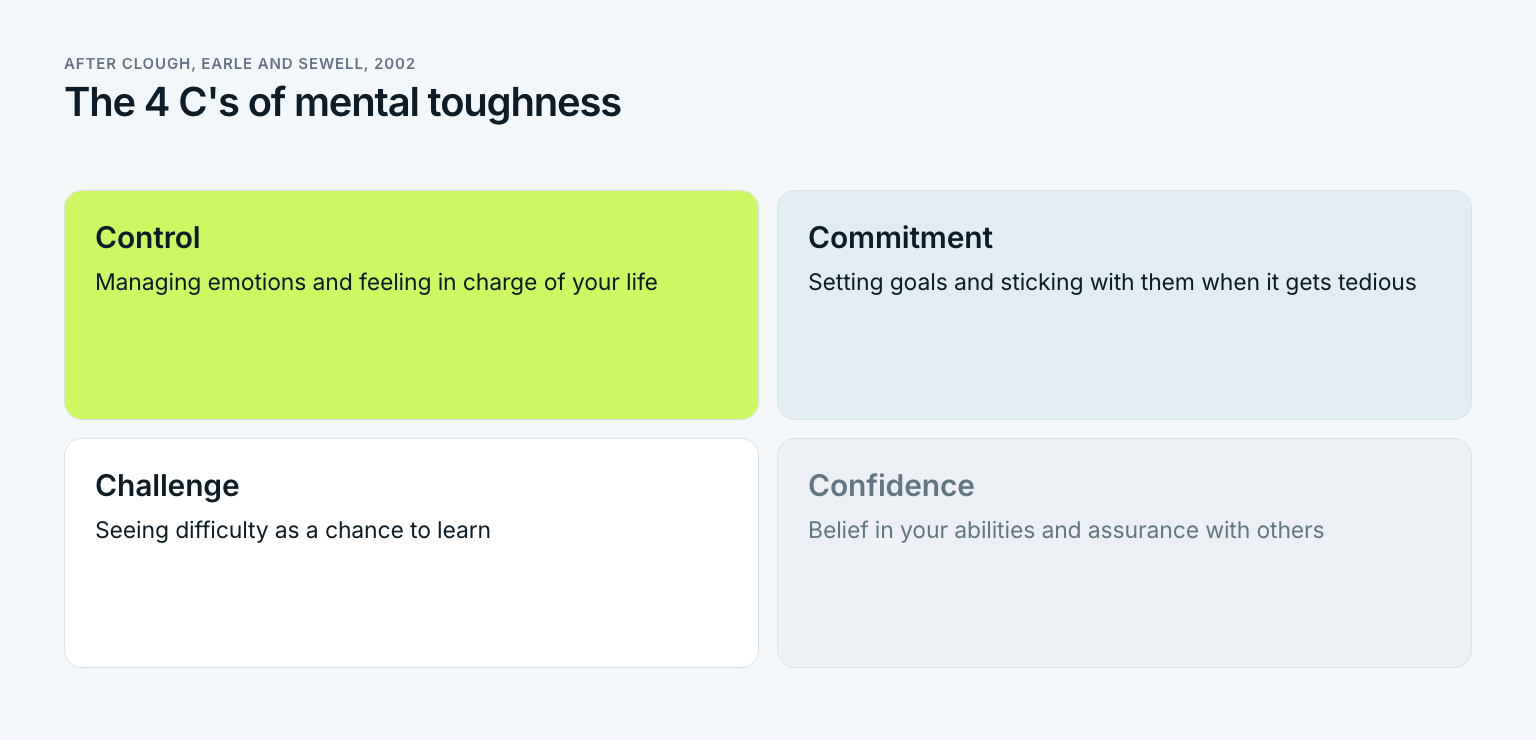
- Control. The sense that you steer your own life, plus the ability to manage emotions such as anxiety or anger. Clough separates life control from emotional control.
- Commitment. The willingness to set goals and keep pursuing them when the work gets tedious.
- Challenge. The tendency to see change and difficulty as a chance to learn rather than a threat.
- Confidence. Belief in your abilities and assurance in dealing with other people. The model splits this one too: confidence in your abilities and interpersonal confidence.
How do you spot a mentally strong person? Not by volume or a show of calm. Mentally tough people stand out through consistency: their performance swings less between good and bad days. After a mistake they talk about the next action, not about blame. They seek out hard tasks instead of avoiding them, and they can name what makes them nervous without being frozen by it. In short: mental toughness often looks unremarkable from the outside.
The fourth block overlaps heavily with self-efficacy, the belief that you can handle a specific task. How that belief grows from Albert Bandura’s four sources is explained in Self-Efficacy: Four Sources and How to Build It. For mental toughness, one sentence is enough here: confidence grows from tasks you have handled, not from encouragement.
After the failed section, Alicia rated herself on a scale from zero to ten, without a questionnaire. Commitment: eight, she had not skipped a week. Challenge: six. Confidence in her technical knowledge: seven, in front of a ticking clock: four. Emotional control: three. The profile was clear. Whoever looks at a profile like that does not need to train everything. They train the two lowest scores and maintain the rest.
What the 7 C's of mental toughness are
Coaching books and training courses circulate lists of seven C's, adding words such as concentration, composure, consistency or character. These lists are memory aids, not a tested model, and they differ from source to source. The best researched model remains the 4C model. Look closer and the MTQ48 actually has six subscales, because control and confidence are each split in two. That means: four blocks are enough, as long as you keep the split inside control and confidence in mind.
What the research says, and where it stops
Mental toughness sounds like a slogan from a locker room poster. The research is solid enough to take it seriously, though. In 2017, Yi Lin, Julian Mutz, Peter Clough and Kostas Papageorgiou published a systematic review of the studies. Across many of them, mental toughness was linked to better performance in school, college and work, to higher well-being and to lower stress, anxiety and depressive symptoms.
Three caveats belong here. First, most studies are cross-sectional. They show a link, but not what is cause and what is effect. Second, they rely on self-report, and people who rate themselves as tough are not necessarily tough when it counts. Third, mental toughness is partly inherited. In a 2009 twin study, Vanessa Horsburgh and colleagues found that a substantial share of the differences between people was genetic and closely tied to personality traits such as emotional stability.
Does that mean training is pointless? No. Heritable does not mean fixed, just as height is heritable and strength is still trainable. People start from different places, but the direction can be changed. Anyone who starts with low emotional control may need longer, yet still moves forward with the right exercises.
One limit matters more than any study. Mental toughness does not mean ignoring warning signs. Whoever answers months of poor sleep, exhaustion or low mood by gritting their teeth is not training. They are overloading. The exercises below are training for healthy people under pressure and no substitute for treatment. If you are in crisis or thinking about suicide, call or text 988 to reach the Suicide and Crisis Lifeline, free and around the clock.
Mental toughness training: six exercises with evidence
How do you build mental toughness in practice? With exercises that each target one of the four blocks. Sport psychologists call them psychological skills. The six below are the best studied. None of them takes more than ten minutes a day.
| Exercise | Mainly trains | Time | Evidence |
|---|---|---|---|
| Cue-word self-talk | Control, confidence | 2 minutes before the task | Hatzigeorgiadis and colleagues, 2011, meta-analysis |
| If-then plan | Commitment, control | 5 minutes once per obstacle | Gollwitzer and Sheeran, 2006, meta-analysis of 94 tests |
| Mental contrasting, WOOP | Commitment, challenge | 5 minutes per goal | Oettingen, many studies since 2000 |
| Reappraising nerves as excitement | Challenge, control | one sentence before the moment | Brooks, 2014 |
| Imagery rehearsal | Confidence | 10 minutes, three times a week | Driskell, Copper and Moran, 1994, meta-analysis |
| Slow exhale breathing | Emotional control | 5 minutes a day | Balban and colleagues, 2023 |
Cue-word self-talk
In 2011, Antonis Hatzigeorgiadis and colleagues pooled the studies on self-talk in sport and found a moderate positive effect. Instructional phrases helped more with precise tasks, motivational ones with strength and endurance. This is not positive thinking. It is a short sentence you choose in advance for one specific moment. Alicia picked: Read the last line first.
If-then plans
Peter Gollwitzer calls them implementation intentions. You decide ahead of time: if situation X happens, then I do Y. Across 94 tests, Gollwitzer and Paschal Sheeran found a medium to large effect on reaching goals in 2006. The plan takes the decision away from the moment of pressure, which is exactly when you have the least capacity to make one.
Mental contrasting with WOOP
Gabriele Oettingen has shown that simply picturing success tends to sap energy. The contrast works better: first the wish and the best outcome, then the inner obstacle, then the plan. The four steps are Wish, Outcome, Obstacle, Plan. WOOP pairs commitment with a sober look at what will get in your way.
Reappraising nerves as excitement
In 2014, Alison Wood Brooks had people say a single sentence before a speech, a math test or a karaoke song. Those who said they were excited performed better than those who tried to calm down. A racing heart is not a sign of failure. It is energy for the task. This reappraisal is the challenge block in one sentence.
Imagery rehearsal
In a 1994 meta-analysis, James Driskell, Carolyn Copper and Aidan Moran showed that mental practice improves performance, though less than physical practice. It works best when you picture the hard situation in detail, the room, the sounds and the moment where it goes wrong, and then rehearse your response.
Slow exhale breathing
In 2023, Melis Yilmaz Balban and colleagues compared short breathing routines with mindfulness meditation in Cell Reports Medicine. Five minutes a day for a month, with an emphasis on a long exhale, improved mood somewhat more than meditation did. The study is small, but the exercise is free and fits into any break between exam sections.

Building mental toughness in five steps
Single exercises help. Building mental toughness means putting them in an order that leads from your profile to the real moment. The five steps follow the 4C model and one simple rule from physical training: increase the load, but in doses.
Map your profile
Rate the four blocks from zero to ten and write down one situation from the last three months for each. Under emotional control Alicia wrote: FAR, first simulation, read it twice, understood nothing, felt my pulse, blanked.
Pick two blocks
Train the two lowest scores, not all four. For Alicia that meant emotional control and confidence against the clock. Commitment and challenge were good enough and stayed as they were.
Assign one exercise per block
Match each block to an exercise from the table and decide when it happens. Alicia chose slow exhales plus a cue sentence for control and imagery of the test center for confidence.
Raise the pressure in doses
Practice first without pressure, then with a little, then with the real thing. Alicia worked through practice sections untimed, then timed, then timed at a noisy coffee shop, and finally in a full four-hour mock exam on a Saturday morning.
Measure after every pressure test
After each session under pressure, write down two numbers: how good the result was and how calm you felt, both from zero to ten. After four weeks you can see whether the exercise works or needs to be swapped.
The order is deliberate. Whoever trains without a profile spreads their time evenly over strengths and weaknesses. Whoever skips the dosing meets real pressure for the first time on exam day. And whoever does not measure mistakes a good feeling for progress. In short: mental toughness grows like strength, through well chosen loads with rest in between.
The most common mistake: confusing hardship with toughness
Many people train mental toughness with cold plunges, fasting days or brutal workout challenges. Those can be fun and can build some confidence. Mostly, though, they train tolerance for discomfort you picked yourself. The exam, the tough performance review or the client who walks away are different: they arrive uninvited. That means: train the situation where you fold, not just any hard situation.
A worked example: Alicia and the CPA exam
Alicia had about five months until her retake of Financial Accounting and Reporting and a year to finish all four sections. Her goal was fixed: all four passed, license application filed by December. Her budget for mental training: ten minutes on study days, plus one practice test under pressure every week.
| Point in time | Practice score in % | Calm from 0 to 10 | What changed |
|---|---|---|---|
| Week 1, untimed | 78 | 6 | Baseline, the knowledge is there |
| Week 3, timed | 63 | 3 | The clock brings back the old pattern |
| Week 7, timed | 70 | 5 | Slow exhales and cue sentence before each simulation |
| Week 11, coffee shop | 73 | 6 | If-then plan for simulations she does not understand |
| Week 16, full mock exam | 77 | 7 | Imagery of the test center the night before |
| Week 21, retake | passed with 79 | 7 | Skipped the first simulation as planned |
The most important row is week 3. With a timer running, Alicia dropped to 63 percent, worse than without one. She could have concluded that she simply chokes under pressure. Instead she noticed that the drop started in the same place every time: at the first task-based simulation she did not understand right away. One stuck simulation dragged down the next three. So she wrote her if-then plan: If I do not understand a simulation after one read, then I flag it, breathe out slowly twice and move to the next one.
What made the difference in the end? Not the score, which climbed slowly. The second column did. Calm went from three to seven, and with it came back the performance she already had in week 1. On retake day she again did not understand the first simulation. She flagged it, breathed out and solved it about an hour later as one of her last tasks. She passed with a 79, and the remaining sections followed by December.
One detail in the log is easy to miss. In those 21 weeks Alicia never spent more than ten minutes a day on mental training. Her content review ran alongside unchanged. Mental toughness cost her almost no extra time. It asked for a different way to use the practice time she already had: under conditions that look like the exam.
Mental toughness in the goal chain: year, quarter, month, week, day
Mental toughness needs an occasion. Without a goal you are training into thin air, and without checkpoints you cannot tell whether it works. The goal chain provides both, because it splits a big goal into time frames where pressure can be dosed and progress becomes visible. How to translate a yearly goal into these levels is covered in How to Achieve Goals.
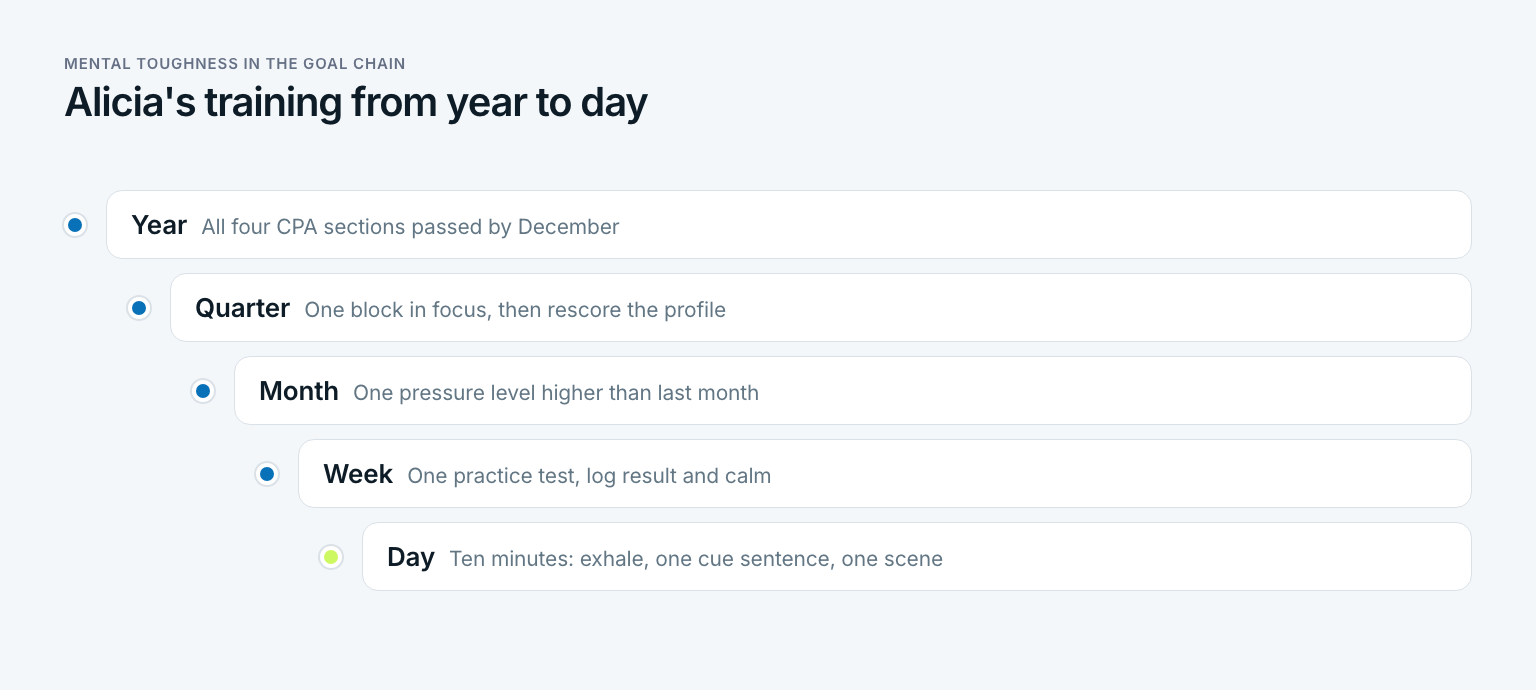
Here is how the method maps onto the five levels:
- Year. A goal with a real pressure moment, such as an exam, a race or a big presentation. For Alicia: all four CPA sections passed by December.
- Quarter. One block in focus. Emotional control in the first quarter, confidence against the clock in the second. At the end of the quarter, you score your profile again.
- Month. One pressure level higher than last month: from untimed to timed, from alone to a full mock exam.
- Week. One pressure test with two numbers, result and calm. Plus a short review of which plan held.
- Day. Ten minutes of practice: five minutes of slow exhales, one cue sentence, one imagined exam scene.
In Gaapp, every level hangs on the one above it, and the progress of a period is the share of goals you completed. For mental toughness that is useful, because a weak practice test then sits next to every completed training day instead of standing alone. How much pressure your everyday life can take before it starts to hurt is a separate question, covered in Stress Management: Three Pillars and One Plan.
Three questions for your next pressure test
- In which situation over the last three months did you perform below your level, and which of the four blocks was missing there?
- Do you have an if-then plan for that situation, or do you decide fresh every time, while the pressure is already on?
- When did you last practice under pressure before it counted?
Anyone who cannot answer one of these questions does not need to get harder. They need a first pressure test with a number attached. In short: mental toughness is not a trait you either have or lack. It is a skill you train against a goal.
Frequently asked questions about mental toughness
What are the 4 C's of mental toughness?
The 4 C's are control, commitment, challenge and confidence. The model comes from Peter Clough, Keith Earle and David Sewell, published in 2002, and builds on Suzanne Kobasa’s concept of hardiness. It is measured with the MTQ48 questionnaire.
How do you spot a mentally strong person?
Mentally strong people are consistent: their performance swings less between good and bad days. After mistakes they talk about the next step instead of blame, and they seek out hard tasks rather than avoid them. They still feel nervous, but the nerves do not stop them from acting.
How do I build mental toughness?
Rate yourself on the four C's and pick the two weakest. Train each with a tested exercise such as cue-word self-talk, if-then plans or imagery rehearsal. Raise the pressure step by step and record your result and your calm after every pressure test.
What are the 7 C's of mental toughness?
There is no single scientific 7 C model. Coaching lists add terms such as concentration, composure, consistency or character to the original four, and the lists vary by source. The best researched framework is the 4C model, which the MTQ48 splits into six subscales.
Is mental toughness genetic?
Partly. Twin studies such as Horsburgh and colleagues in 2009 found a substantial heritable component. Heritable does not mean fixed, though, and mental toughness can still be trained with targeted exercises.
What is the difference between mental toughness and resilience?
Mental toughness is about staying effective during pressure. Resilience is about recovering after a setback or crisis. The two are related, but they are trained in different ways.
Last updated: 22 October 2026
Read next
 Personal Growth
Maslow's Hierarchy of Needs: The 5 Levels Explained
Maslow's hierarchy of needs sorts motivation into five levels. What each level means, what research says today and a needs audit you can run yourself.
14 min read
 Personal Growth
Mindfulness Exercises: 12 for Everyday Life
Mindfulness exercises are not about emptying your mind. 12 techniques for stress and focus, what research shows, and a four-week plan to practice daily.
16 min read
 Personal Growth
Positive Affirmations: 50 Examples You Can Believe
Positive affirmations are not magic words. What research shows, 50 daily affirmations you can believe, and a five-step method with a worked example.
16 min read