Monthly Goals: How to Set Three You Actually Finish
Monthly goals are not mini resolutions: four types, five steps, a four-question test and 30 monthly goal ideas, worked through one real November.

Contents
- 01What monthly goals are, and what they are not
- 02Four types of monthly goals: finish, count, limit, decision
- 03How to set monthly goals in five steps
- 04Monthly goals examples: Dana's goals for November
- 05Monthly goal ideas: 30 examples by life area
- 06How to review monthly goals on the 15th and the last day
- 07Monthly goals in the goal chain: from yearly goal to Tuesday morning
- 08Three mistakes that end monthly goals in week three
- 09Three questions before you write your monthly goals down
- 10Monthly goals: frequently asked questions
Monthly goals are not mini New Year's resolutions. They are two or three results you can check with a plain yes or no on the last day of the month, and each one moves a bigger goal forward, usually a quarterly or yearly goal. A resolution describes who you want to be. A monthly goal describes what is done by the 30th.
To set them well you need three things: a type, a sentence pattern, and a test. The type decides what you check at the end of the month. The sentence pattern turns a wish into a line with a number and a date. The test filters out everything that is not a monthly goal. All of it is worked through with Dana, 41, a freelance graphic designer in Denver with two kids, who wants to swap one-off projects for steady retainer clients by next summer. You also get 30 monthly goals examples by life area and a simple check for the 15th and the last day of the month.
What monthly goals are, and what they are not
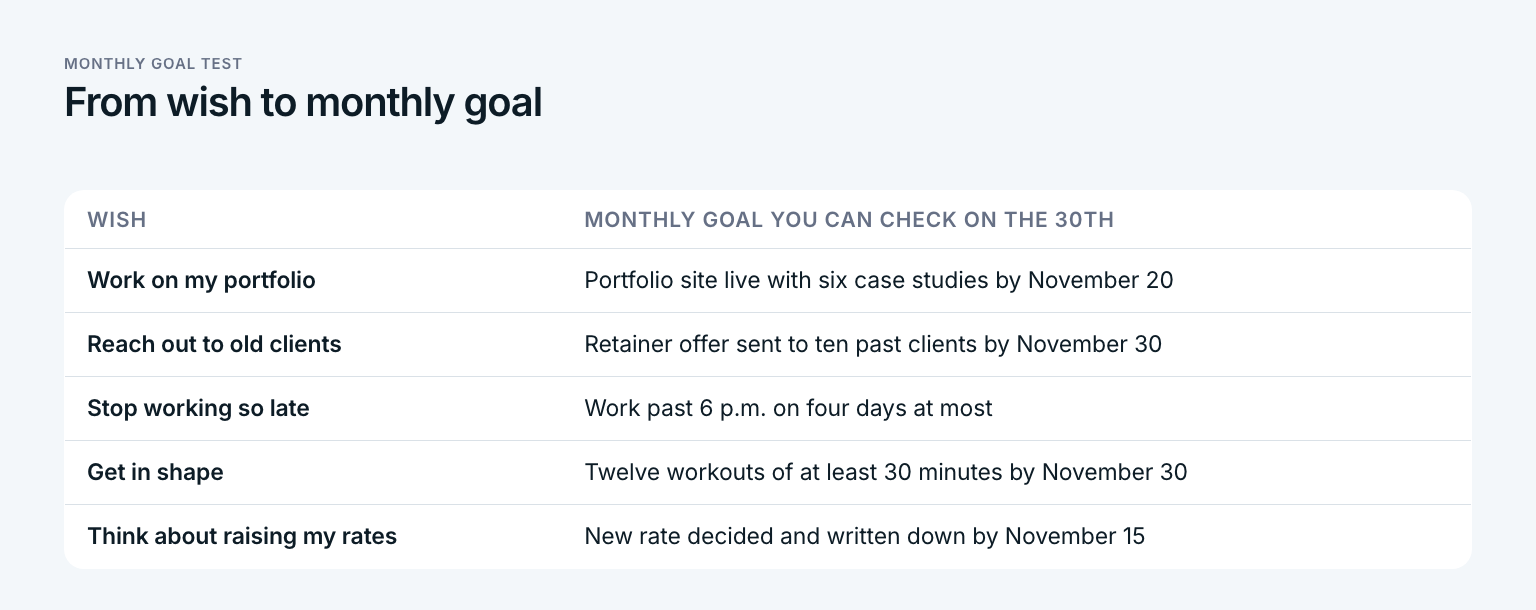
A monthly goal is a state, not an activity. "Work on my portfolio" is an activity that never ends. "Portfolio site live with six case studies by November 20" is a state you can check on November 20. The difference decides whether you can measure something at the end of the month or only have a feeling about it.
Every good monthly goal has three traits. You can check it on the last day, it hangs on a bigger goal, and it fits into the hours the month actually gives you. Without the first, it turns into a resolution. Without the second, it turns into busywork. Without the third, it becomes the goal that shows up on your list every single month.
Anyone who confuses monthly goals with tasks checks off a lot and still goes nowhere. Tasks are the steps. A monthly goal is the result they lead to. "Pick a website template" is a task. "Site live" is the goal. The task list itself is covered in the guide to a to-do list that gets done.
Monthly goal, weekly goal, task
A monthly goal is a result on the last day of the month. A weekly goal is the slice of it that one week delivers. A task is a single action that fits into an hour. Whoever writes all three on the same list loses the yardstick. That is why the monthly goals sit alone at the top of the page.
How many monthly goals you should set
Two or three. A month has about four working weeks. Each monthly goal needs real attention in at least two of them, or it gets crammed into the last week. With three goals the math works. With five it does not. A single goal is fine in a month with a move. In short: the number follows the weeks, not your ambition.
Four types of monthly goals: finish, count, limit, decision
Not every monthly goal looks the same. Some end with a finished result, others with a number. Anyone who only knows the first type ends up forcing health or money goals into project sentences that do not fit. Four types cover nearly everything a month can carry:
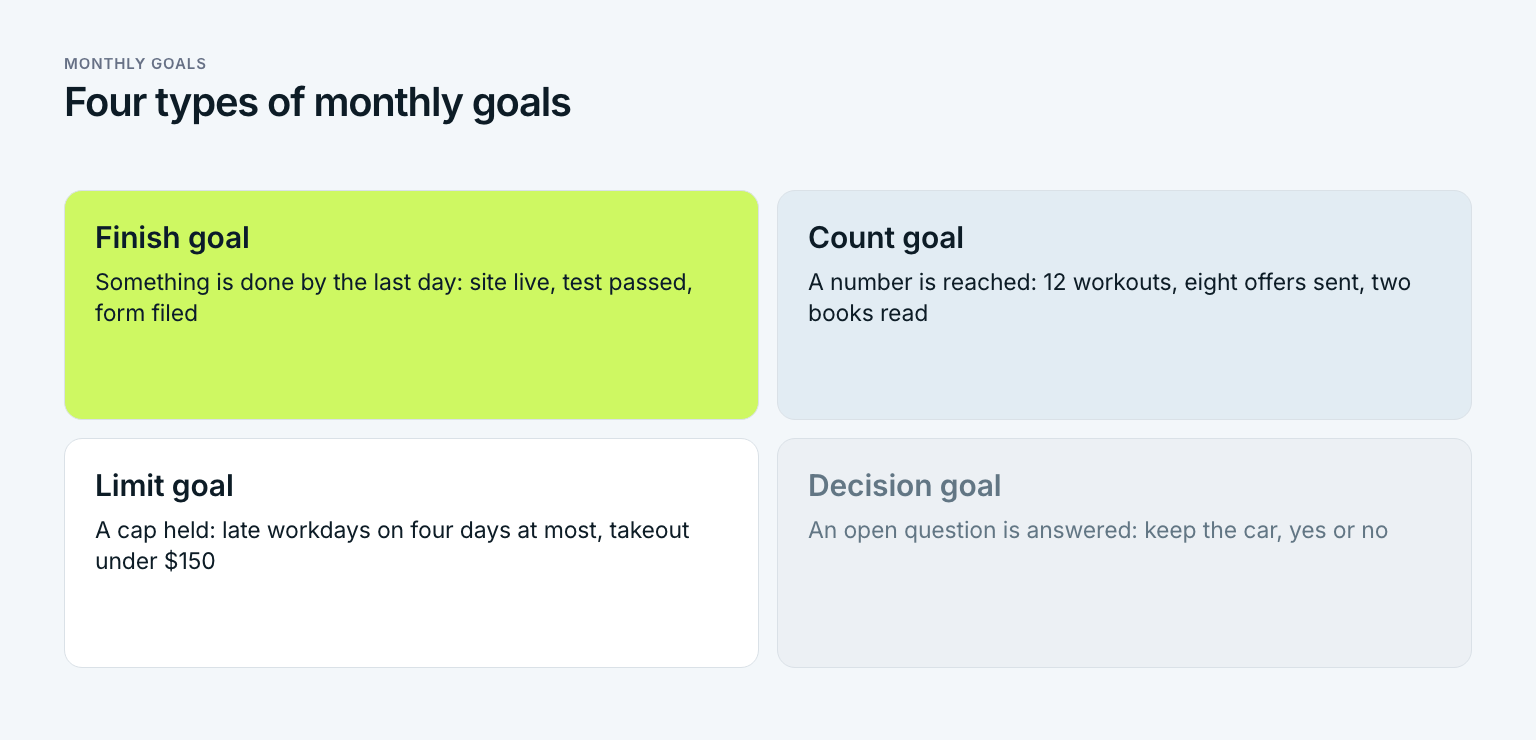
- Finish goal. Something is done by the last day: a site is live, a test is passed, a form is filed. The check is a single yes or no. This type fits projects and anything with an end point.
- Count goal. A number is reached: twelve workouts, eight offers sent, two books read. The check is a tally. This type fits habits you want to see in a month, even though they are never finished.
- Limit goal. A cap held: late workdays on four days at most, takeout under $150. The check is a comparison with the cap. This type fits anything you want less of.
- Decision goal. An open question is answered: keep the car or sell it, raise rates or not. The check is a decision with a date and three reasons. This is the most underrated type, because open questions eat months without ever landing on a list.
A good month mixes the types. Two finish goals and a count goal are a common combination: two results for the big project, one number for health or family. Three finish goals in one month are a warning sign, because each of them can tip over in the last week. That means: the type is not a formality. It sets the risk level of your month.
How to set monthly goals in five steps
Writing your monthly goals takes about 30 minutes and happens before the first of the month. Have your quarterly or yearly goal and a blank page ready. How you later spread the hours across your calendar is a separate question. Here the only job is deciding which sentences end up at the top of the page:
Read the bigger goal, five minutes
Read your quarterly goal, or your yearly goal if you have no quarterly one. Ask: what has to happen this month so the quarter works out? Anyone without a bigger goal should start with their [yearly goals](/en/blog/yearly-goals), because without a direction every monthly goal is just a good intention.
Collect every wish for the month, five minutes
Write down everything you want to get done this month, with no filter. Chores and small stuff belong on the list too. It is supposed to be too long, because only the comparison shows what matters. Seven to ten entries are normal.
Turn each wish into a state, ten minutes
The sentence pattern is: what is done or reached, with which number, by which date. "Get in shape" becomes "twelve workouts of at least 30 minutes by November 30." If a wish cannot be translated, it is a task or a mood, not a monthly goal.
Run the monthly goal test, five minutes
Every candidate has to pass the four questions below. If it fails one, you cut it, move it to another month, or make it smaller. This is where about half the list usually disappears, and that is the point.
Cut to two or three and put them where you see them, five minutes
Pick the goals that move the bigger goal furthest, and mix the types. Write them at the top of your monthly page, in your goal app, or on a sticky note on your monitor. Everything else goes on a later list so nothing is lost.
The sentence pattern in step three is a lean version of the SMART rule. Specific, measurable, and time-bound live in the number and the date. Achievable and relevant are what the test checks. If you want to work through all five criteria one by one, the guide on how to write SMART goals has the full pattern with before and after examples.
Why bother with a number and a date at all? In "A Theory of Goal Setting and Task Performance" from 1990, Edwin Locke and Gary Latham summarized hundreds of goal-setting studies. Their core finding: specific, challenging goals lead to better performance than simply trying to do your best. A monthly goal without a number is exactly that kind of do-your-best goal.
The monthly goal test: four questions for every goal
The test is the heart of the process. Each question checks one of the traits where monthly goals fail in real life:
- Can I answer yes or no on the last day of the month? If you have to think about it, a number or a date is missing.
- Does it move a quarterly or yearly goal forward? If not, it can still matter. But then it goes on the list as a deliberate exception, not out of habit.
- Does it fit into the hours this month gives me? A rough estimate is enough: how many mornings or evenings does it need, and how many do you have? If you are short by more than a quarter, the goal gets smaller.
- Is the result in my hands? "Land the promotion" is someone else's call. "Application for the role submitted by November 20" is yours.
The fourth question gets skipped most often. Goals that depend on others are not forbidden. They just make poor monthly goals, because you can do everything right and still mark a no. In short: write down the part you can deliver, and keep the other person's answer next to it as a hope.
Monthly goals examples: Dana's goals for November
Dana has run her one-woman design studio for eight years, mostly on one-off projects. Every January she starts at zero. Her yearly goal: three retainer clients on a monthly fee by June 30, 2027. Her goal for Q4: a new portfolio site live and a retainer offer sent to the past clients who liked her work most. Next to about 30 hours of client work she keeps Tuesday and Thursday mornings from 9 to 12 as studio time for her own business.
In November that studio time adds up to about 21 hours, not 24. Thanksgiving falls on Thursday, November 26, so that week only has one studio morning. On Saturday, October 31, after the kids are in bed, Dana collects her wishes for November. Seven come together. Then she turns each one into a state and runs it through the test:
| Wish | Turned into a state | Test | Decision |
|---|---|---|---|
| Finish my portfolio | Portfolio site live with six case studies by November 20 | 4 of 4 | Monthly goal 1 |
| Reach out to old clients | Retainer offer sent to ten past clients by November 30 | 4 of 4 | Monthly goal 2 |
| Stop working so late | Work past 6 p.m. on four days at most in November | 3 of 4, no link to the yearly goal | Monthly goal 3, deliberate exception |
| Learn motion design | Three short animations finished for the portfolio | 2 of 4, no hours left, not in Q4 goal | cut |
| Book Thanksgiving flights | not a state, a single action | not a goal | to-do list, Monday, November 2 |
| Start a studio Instagram | Twelve posts published by November 30 | 2 of 4, no hours left | moved to February |
| Save for taxes | $1,500 set aside for estimated taxes by November 30 | 4 of 4 | automatic transfer, not a goal |
Seven wishes, three monthly goals. That looks like a lot of loss. In fact very little is gone. Motion design would not have fit into 21 studio hours. The flights are a task with a date. The Instagram account waits for February, when the site can feed it. And the tax money now moves by itself, through an automatic transfer of 25 percent of every invoice. A goal that an automatic transfer handles does not need one of the three spots.
Goal three is the interesting one. Working fewer late days does not move the retainer goal, so it fails the second test question. Dana keeps it anyway, as a deliberate exception. In October she worked past 6 p.m. on eleven days. Whoever picks an exception on purpose knows on the 30th why it was on the list.
That leaves the third test question, the hours. Dana estimates roughly: twelve hours for the site and the six case studies, four hours for the offer and the ten emails. That is 16 of 21 studio hours, about three quarters. The late-day limit costs no studio time at all. For writing the goals, that rough estimate is enough. It answers one question only: does this fit at all? How she spreads those hours across the weeks is the job of monthly planning.
Monthly goal ideas: 30 examples by life area
The monthly goal ideas below are sorted by life area, and every one follows the sentence pattern. Use them as models for the sentence, not as a list to copy. If you are looking for goals over longer stretches of time, the list of 50 personal goals examples gives you bigger targets you can break down into months.
Career and work
- Application for the internal role submitted by the 20th, with one line for each listed requirement.
- Twelve people in my industry contacted, each with one specific question.
- Decided by the 15th whether I take the project lead, with three reasons written down.
- Work email checked after 7 p.m. on four evenings at most.
- Quarterly presentation finished and rehearsed once in front of a colleague by the 28th.
Learning and skills
- Module three of the online course finished and the quiz passed with at least 80 percent.
- 20 language lessons of 15 minutes each completed.
- One book in my field read, with one page of notes.
- Decided by the end of the month which certification I start next year.
- One small project published: a case study, an article, or a short video.
Health and fitness
- Twelve workouts of at least 30 minutes, each one checked off on the calendar.
- Annual checkup attended, not just scheduled.
- Screens off by 10 p.m. on all but four nights.
- Three miles run without a walking break by the 30th.
- 7,000 steps or more on 20 days.
Money
- $300 moved into the emergency fund by the 5th.
- Takeout and delivery under $150 for the month.
- Every subscription reviewed and at least two canceled.
- Credit card balance paid down by $400 by the 30th.
- Decided by the 20th whether we keep the second car.
Family and relationships
- Four date nights with phones in another room.
- One afternoon alone with each kid.
- Summer vacation booked by the 15th, with the budget set first.
- Family calendar for next quarter set up, with every school break and birthday on it.
- Called my parents every Sunday, four calls in the month.
Home and personal life
- Garage cleared out, three boxes sold or donated.
- Two books read just for fun.
- Four new recipes cooked, one per week.
- Saw three friends I have not seen since summer.
- Two weekends at most with plans on them.
Notice how rarely the words "more" and "better" show up. They are the surest sign of a wish that has not found its sentence yet. Anyone who spots them in their own monthly goal should replace them with a number.
How to review monthly goals on the 15th and the last day
A monthly goal you write down on the 1st and find again on the 30th is a lottery ticket. Two check-ins turn it into a goal: a short check at mid-month and a verdict on the last day.
On the 15th you ask each monthly goal one question: is the finished work ahead of or behind the time that has passed? Half the month is gone. So a finish goal should be about half done, and a count goal should have about half its tally marks. If a goal is clearly behind, you have three options: give it more time, make it smaller, or drop it on purpose. On the 15th, all three are still planning. Here is Dana's check on Sunday, November 15:
| Monthly goal | Target by the 15th | Actual on the 15th | Decision |
|---|---|---|---|
| Site live with six case studies by Nov 20 | three case studies written | four written, template set up | on track, nothing to change |
| Offer sent to ten past clients | offer drafted | offer drafted, none sent, waiting for the site | cut to eight, sending starts Nov 21 |
| Late days, four at most | two at most | three used | no client calls after 4 p.m. for the rest of the month |
Dana shrinks the offer goal on the 15th from ten clients to eight. It feels like giving up. It is the opposite. Eight is a number she can still hit once the site is live. Ten would have become a goal she had quietly written off. Whoever shrinks a goal on the 15th keeps it alive. Whoever waits until the 28th is only grading a failure.
On the last day you give each goal one of three verdicts: done, partly done, or missed. Partly done means the bigger share is finished, but not all of it. For every goal that is not done, you write one sentence about why. That sentence is worth more than the score, because it helps write next month's goals. For an open goal there are exactly three ways forward:
- Carry it over. The goal moves to next month, but only once, and only if the reason is fixed.
- Shrink it. The goal stays, with a number you will actually reach. Ten offers become eight, twelve workouts become nine.
- Drop it. Dropping a goal is not failure. It is a decision that gives you one of your three spots back.
How many goals done make a good month? Two out of three is a good result. Anyone who hits all three every month is probably setting them too low. Anyone who hits only one every month is setting too many or too big. In short: the score is not a report card. It is a dial for setting next month.
Monthly goals in the goal chain: from yearly goal to Tuesday morning
A monthly goal is one link in a chain. Above it hang the quarter and the year, below it the weeks and days. Whoever writes the chain down once sees right away whether a single morning moves the big goal. For Dana's November it looks like this:
- Year. Three retainer clients on a monthly fee by June 30, 2027.
- Quarter. By December 31: portfolio site live, retainer offer sent, two discovery calls held.
- Month. Site live with six case studies by November 20, offer sent to eight past clients by November 30, late days on four days at most.
- Week. November 16 to 22: case studies five and six written, site live on Friday, November 20.
- Day. Tuesday, November 17, 9 to 12: case study five, the bakery rebrand.
The chain also shows why a yearly goal is not simply divided by twelve. Dana's year is a site, an offer, a few sales calls, and three contracts. Those are not twelve equal pieces. Each month gets the piece that is due right now.
Between year and month sits the quarter. It is short enough to create urgency and long enough for a real result. That is why so many people ask for 3 month goals. In "The 12 Week Year" from 2013, Brian Moran and Michael Lennington go one step further and treat twelve weeks as a full planning year of their own. How that works in practice is covered on the page about the 12 week year. For monthly goals it means: three months carry one quarterly goal together, and each month knows which third belongs to it. The guide to quarterly planning shows how to set that quarterly goal.
In a goal app like Gaapp, each monthly goal hangs on its quarterly goal and each weekly goal on its monthly goal. Finished daily goals fill up the progress above them. On the 15th you see not only what is done but also how much of the month has passed.
Three mistakes that end monthly goals in week three
Monthly goals rarely fail on the 1st. They fail quietly, usually in the third week, because of mistakes made while writing them. On the 1st they all feel like ambition.
The most common mistake: dividing the yearly goal by twelve
Anyone who wants to save $6,000 this year writes down $500 a month. It looks logical and ignores that months are different. December with holiday gifts carries less, the month with the tax refund carries more. A monthly goal does not ask what one twelfth of the year is. It asks what this one month can carry.
- Dividing the yearly goal by twelve. Equal slices only fit goals that grow evenly, and few do. Most projects have phases: start, push through, finish. Each phase needs a different monthly goal.
- Monthly goals without a parent. A monthly goal that hangs on no bigger goal is not wrong. But it competes with everything else for the same hours and usually loses to whatever is urgent. Dana's late-day limit is marked as an exception for that reason.
- Quietly pushing missed goals forward. Whoever copies an open goal into next month ends up with one more goal and the same hours. After three months the same goal sits on the list for the third time and reads like an accusation. So the rule is: carry it over once, then shrink it or drop it.
All three mistakes happen while writing the goals, not while doing the work. That means: the half hour before the 1st decides more about your month than your discipline in week three.
Three questions before you write your monthly goals down
Before the two or three sentences land at the top of the page, ask yourself three questions. They take two minutes and catch what the test misses:
- If I only reach one of these goals by the last day, which one should it be?
- Can I answer yes or no for every goal on the 30th without thinking about it?
- Which goal is on my list for the second time, and what am I doing differently now?
Dana answers the first question right away: the portfolio site, because the offer depends on it. So the site gets the first two studio mornings of every week. The third question hits the late days, which were on her October list too. This time they come with a rule. Monthly goals are not a wish list for 30 days. They are the decision about which two or three sentences should end with a yes on the last day.
Monthly goals: frequently asked questions
What are some good goals for a month?
Good goals for a month are results you can check with yes or no on the last day, such as "twelve workouts of at least 30 minutes," "$300 moved into savings by the 5th," or "decided by the 15th whether I take the new role." Pick two or three, mix finish, count, limit, and decision goals, and tie at least two of them to a bigger goal.
What are 10 good goals?
Ten solid goals you can adapt to a month: twelve workouts, an annual checkup attended, $300 saved, two subscriptions canceled, one online course module finished, one book read, four date nights, an afternoon alone with each kid, one room decluttered, and one open question decided. Each one becomes a goal once it has a number and a date.
What are 5 good personal goals?
Five personal goals that work well as monthly goals: move for 30 minutes twelve times, keep screens off by 10 p.m. on most nights, read two books for fun, call a family member every Sunday, and set aside a fixed amount for an emergency fund. They cover health, rest, growth, relationships, and money.
What are some 3 month goals?
Three-month goals are quarterly goals, a bit bigger than monthly ones: a portfolio site live and offers sent, a certification passed, a 5K finished, or $1,500 of debt paid off. Split each one into three monthly goals, one per month, based on what each month can carry rather than equal thirds.
How many monthly goals should I have?
Two or three. A month has about four working weeks, and each goal needs real attention in at least two of them. With five goals you usually end the month with five half-finished results.
What should I do if I miss a monthly goal?
Write one sentence about why first. Then choose one of three moves: carry it over once, shrink it, or drop it. A goal that lands on your list for the third time is usually too big or no longer important.
Last updated: 14 October 2026
Read next
 Planning
Cleaning Schedule: Daily, Weekly and Monthly Tasks
A cleaning schedule is not a Saturday to-do list: daily, weekly and monthly tasks, a printable template and a fair split for families.
15 min read
 Planning
Study Plan: How to Make One You Can Actually Follow
A study plan is not a schedule. Make one in six steps: inventory, hours math, buffer, a sample study schedule and a template, with a worked example.
17 min read
 Planning
Bullet Journal: How to Start One You'll Actually Keep
A bullet journal is not an art project. Learn the bullets, four core modules, migration and a six-step setup, with an example, 12 ideas and a goal chain.
15 min read