Personal Goals: 50 Examples You Can Actually Measure
Personal goals are not a wish list. 50 examples in eight areas, a three-part formula, five steps, a one-card template, and a goal chain to Tuesday.

Contents
- 01What a personal goal is, and what it is not
- 0210 goals examples, rewritten from vague to specific
- 03Personal goals examples: 40 goals in eight areas of life
- 04How to find your personal goals in five steps
- 05Worked example: Priya's three personal goals for 2027
- 06The three mistakes that keep personal goals on paper
- 07Personal goals in a goal chain: from 2027 to Tuesday morning
- 08A personal goal template that fits on one card
- 09Frequently asked questions about personal goals
Personal goals are not a wish list. A personal goal is a result you choose for yourself, written with a number and a date, like “On December 31, 2027, my credit card balance is $0.” The personal goals examples below show how “get healthier” or “save more” turns into a sentence like that. A wish says what would be nice. A goal says how you will know it happened.
You need three things: a formula, a list to borrow from, and a way into your week. The formula has three parts, a result, a number, and a date. The list holds 50 examples, ten common goals rewritten from vague to specific and 40 more across eight areas of life. The way into your week is a goal chain. Everything is worked through with one person: Priya, 34, an ER nurse in Columbus, Ohio, who writes down 17 things she wants on a Sunday in October and keeps three.
What a personal goal is, and what it is not
A personal goal belongs to you. Nobody assigned it, not your manager, not your doctor, not your family group chat. It can sit in your private life or at work. What makes it personal is who chose it. What makes it a goal is that it has three parts: a result someone else could see, a number that measures it, and a date. Drop any one of them and you are back to a good intention.
The word gets used in five different ways, and each one plans for a different horizon. Which one are you actually writing?
| Term | Who sets it | Time frame | Example |
|---|---|---|---|
| Short-term personal goal | you | up to twelve months | “By June 30, 2027, I do ten push-ups in a row.” |
| Long-term personal goal | you | one to five years | “By 2030, we have saved a 20 percent down payment for a house.” |
| Professional goal | you, often agreed with your manager | one review cycle | “By June 30, I present our quarterly numbers without notes.” |
| Life goal | you | five to twenty years | “At 50, I work four days a week.” |
| New Year's resolution | you, on January 1 | open-ended | “Get in shape this year.” |
Personal goals sit in the middle. They are more concrete than life goals, which describe a decade, and more binding than a resolution, which describes a mood. That means: Most personal goals are twelve-month goals you give yourself. That is exactly why they are so easy to drop. Nobody checks in on them in March. A twelve-month goal is a short-term goal, and it earns its place only when a longer one stands behind it, as the guide to short-term and long-term goals shows.
When an interviewer asks “What is your personal goal?”
In a job interview, the question is rarely about your marathon. It asks for a development goal, a skill you want to build in the next year that also helps the role. Anyone who answers with one skill, a number, and a date sounds prepared, and keeps the private goals private. The same rule applies to being goal oriented on a resume: a number and a date prove it, the bare phrase does not.
10 goals examples, rewritten from vague to specific
Goal lists are good for ideas. They just do not decide anything. Anyone who copies “be healthier” from a list has no way of knowing in December whether it worked. The goal was never wrong. It was never finished.
The formula for a personal goal
A result, a number, and a date, written in the present tense as if the date has arrived: “On December 31, 2027, my credit card balance is $0. Today it is $7,800.” The number has two values, today and on the deadline. Almost every list leaves out today's value. Without it you cannot tell whether a goal is ambitious or already half done.
Edwin Locke and Gary Latham summarized decades of research on this in 1990, in A Theory of Goal Setting and Task Performance. Their central finding: specific, challenging goals lead to better performance than being told to do your best. Here are the ten goals people write most often, in the vague version and in the version you can check.
| Vague goal | Specific personal goal | What was missing |
|---|---|---|
| Get in shape | By June 30, 2027, I run a 5K without stopping. Today I stop after four minutes. | a result and today's number |
| Save money | On December 31, 2027, my emergency fund holds $6,000. Today it holds $900. | a number, a date, a starting point |
| Read more | In 2027, I finish twelve books, one a month. In 2026 I finished three. | a number and a starting point |
| Spend less time on my phone | From March 1, my daily screen time stays under 90 minutes. Today it is 3 hours 40. | a number and a date |
| Be a better parent | By December 31, each of my kids has had twelve one-on-one afternoons with me. | something you can count |
| Be more confident | By June 30, I have brought a prepared idea to six team meetings. Today I stay quiet. | a behavior instead of a feeling |
| Eat healthier | Starting February 1, I bring lunch from home four days a week. | a habit with a frequency |
| Get out of debt | By September 30, my $2,400 car repair loan is paid off at $300 a month. | a number and a payment |
| Learn something new | By May 31, I finish a twelve-week pottery class and take home a set of four mugs. | a finish line you can see |
| Travel more | By October 31, I have taken two trips of at least three nights to places I have never been. | a count and a definition |
Look at the sixth row. Confidence cannot be counted, but a behavior can. Whoever has a feeling as a goal translates it into what they would do if the feeling were already there. In short: A personal goal describes what someone could see, not what you feel.
The formula is related to SMART, just shorter. If you want to check all five criteria one by one, the page with SMART goals examples walks through them. For personal goals, one test usually does the job: Could a stranger answer yes or no on the deadline?
Personal goals examples: 40 goals in eight areas of life
The 40 examples below are already written in the formula. Do not copy any of them unchanged. Swap in your own number and your own date, and cross out every one that leaves you cold. Each is meant as a twelve-month goal, and the numbers assume someone starting at zero or close to it.
Health and fitness
- Starting in February, I average 8,000 steps a day, checked every Sunday. Today it is 4,500.
- Starting in March, I sleep seven hours on at least five nights a week, tracked by my watch.
- By June 30, I do ten full push-ups in a row. Today I do none.
- Starting in March, we eat a home-cooked dinner on five weeknights, marked on the fridge calendar.
- By March 1, I have booked a physical, a dental cleaning, and an eye exam for this year.
Relationships and family
- Starting in January, we have one phone-free dinner as a couple every Wednesday, at least 40 in the year.
- By December 31, we have had twelve date nights, one a month, with the sitter booked a month ahead.
- Starting in February, I call my mom every Sunday. Today it is about once a month.
- By October 31, I have reconnected with three old friends and seen each of them at least twice.
- By December 31, I have hosted four dinners, one per quarter, for people I want to know better.
Money
- On December 31, my credit card balance is $0. Today it is $7,800.
- By December 31, I have $3,000 in a sinking fund for car repairs and holidays.
- Starting in February, $200 goes into my Roth IRA on the first of every month.
- By March 31, I know my fixed monthly costs to the dollar and have canceled two subscriptions.
- By December 31, tutoring brings in $400 a month on the side. Today it brings in nothing.
Career and work
- By June 30, I present our quarterly numbers to leadership in ten minutes without notes.
- By September 30, I have passed the certification exam that my next role requires.
- By December 31, I have had a 30-minute coffee with twelve people outside my team, one a month.
- Starting in February, I block two mornings a week for focused work, at least 80 blocks in the year.
- By March 31, I have asked for a raise with a one-page summary of last year's results.
Learning and skills
- By December 31, I hold a 15-minute conversation in Spanish without switching to English.
- By June 30, I play three full songs on the guitar. Today I know four chords.
- By September 30, I type 70 words per minute. Today I type 40.
- By August 31, I cook ten dinners without a recipe. Today I cook three.
- By October 31, I have built a working budget spreadsheet from scratch after a free online course.
Mind and habits
- By March 31, I wait one day before saying yes to any new request, and I log every no.
- Starting in February, I am on time for 95 percent of my appointments, counted in my calendar.
- By June 30, I have done a ten-minute weekly review on twelve Fridays in a row.
- Starting in January, my phone stays in the kitchen after 9 p.m. on six nights out of seven.
- By December 31, I have written a one-line journal entry on 300 days.
Home and environment
- By April 30, the garage is clear enough to park the car inside.
- By June 30, I have donated or sold 200 things I no longer use, counted on a list.
- Starting in March, the kitchen is clean before bed on six nights out of seven.
- By September 30, we have grown and eaten tomatoes, basil, and peppers from the balcony.
- By December 31, the three repairs on the house list are done, starting with the leaking shower.
Fun and adventure
- By August 31, I have hiked three trails of at least 10 miles each.
- By October 31, I have taken one solo trip of at least four days.
- Starting in April, I take one photo a week and print a photo book with 40 of them in December.
- By December 31, I have visited five state parks I have never been to.
- By July 31, I can stand on a paddleboard for 30 minutes without falling in.
Notice anything? Not one example uses “more,” “better,” or “often” without a number. Every one has a day on which you can answer yes or no. Anyone who borrows from this list takes the shape and fills in their own content. That means: The list is a quarry, not a substitute for your own decision.
How to find your personal goals in five steps
Most people do not have too few goals. They have too many half-goals, scattered across notes apps, old resolutions, and the back of their mind. The job is not to invent new ones. The job is to sort and cut the ones you already have. It takes 45 minutes, a sheet of paper, and a pen. Anyone who prefers to start wide can write a 100 goals list and pick three from it each year.
Write everything down, ten minutes
List every want that comes to mind, without judging: health, relationships, money, work, learning, habits, home, fun. Ten to 20 entries is normal. The list can be embarrassing, because nobody else will read it.
Ask three questions, ten minutes
For each entry, ask: Would I still want this if nobody ever found out? Would it change what my normal week looks like? What am I willing to give up for it? Whatever gets three honest answers stays.
Cut to three, five minutes
Cross out until no more than three remain, ideally from different areas of life. The rest goes on a parking list with a date to look again, not in the trash.
Write each one as a sentence, ten minutes
Turn each of the three into a result, a number, and a date. Measure today's number instead of guessing it: account balance, screen time, a timed test, your calendar.
Put the first step on the calendar, ten minutes
For each goal, decide what happens this week, small enough that it will happen. Give it a day and a time. A goal with nothing scheduled this week is still a wish.
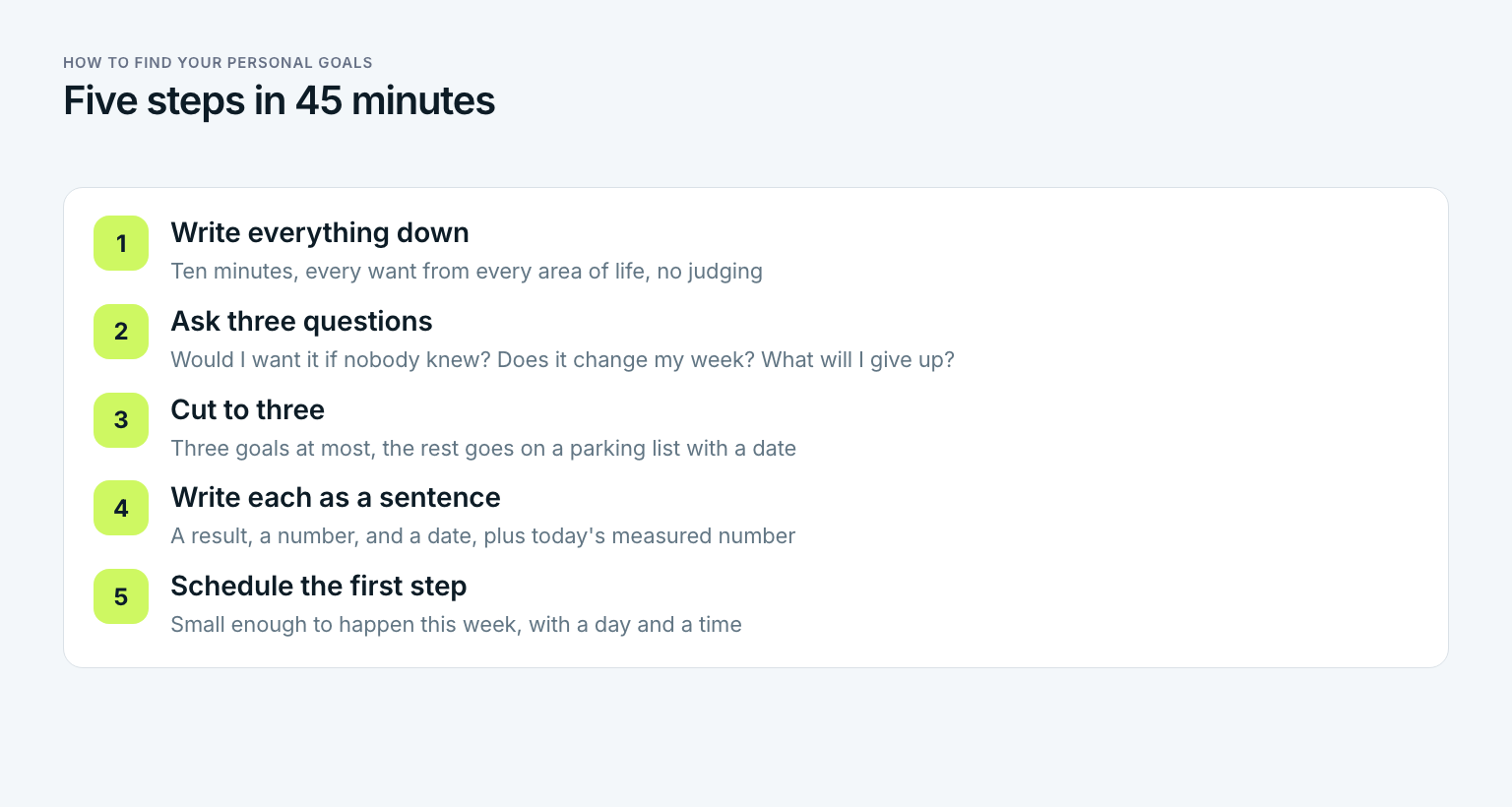
Step three hurts the most. Why three? Three goals fit into a week. Five only fit on a sheet of paper. The longer argument is in why three goals are enough, and the full method with goal types and if-then plans is in the guide to goal setting.
You also do not need to wait for January. Hengchen Dai, Katherine Milkman, and Jason Riis showed in 2014, in Management Science, that people start new goals more often after temporal landmarks: a new week, a new month, a birthday. January is one landmark among many. Whoever reads this on a Thursday in October has a perfectly good one coming on Monday.
Worked example: Priya's three personal goals for 2027
Priya is 34 and works as an ER nurse in Columbus, Ohio, three 12-hour shifts a week on a rotating schedule. Her husband Sam teaches middle school. After a shift she is wiped out, so her real free time is about eight hours a week, spread across her days off. On a Sunday in October she writes down 17 things she wants.
After the three questions, five survive. She cuts two because they mostly sound good, a marathon and a podcast. She parks one, a kitchen remodel, because it will not fit the budget until the card is paid off. Three remain, one each for money, learning, and health.
| Area | October wish | Personal goal | Today |
|---|---|---|---|
| Money | stop feeling broke | On December 31, 2027, my credit card balance is $0. | $7,800 at 22 percent APR |
| Learning | speak Spanish with patients | By December 31, 2027, I hold a 15-minute conversation in Spanish without switching to English. | two sentences, about 150 words |
| Health | get stronger | By June 30, 2027, I do ten full push-ups in a row. | none, knee push-ups only |
The numbers work out. Without interest, $650 a month would clear the card in twelve months. At 22 percent APR it takes about $730, which is why the card stays in the drawer all year. For Spanish, she needs roughly 1,000 words and a lot of speaking practice, so three 20-minute sessions on days off plus one 30-minute call with an online tutor each week. For the push-ups, three 15-minute sessions a week, starting against the kitchen counter and moving lower every few weeks.
Together the three goals cost about two and a half hours a week. That is less than a third of her free time, and that is on purpose. Whoever plans every free hour has no slack for the week with a double shift. Is three goals too few? On paper, maybe. In December 2027, probably not.
The three mistakes that keep personal goals on paper
Personal goals rarely fail for lack of willpower. They fail because of sentences that look harmless when you write them. Three of these show up in almost every list of examples, good ones included.
The most common mistake: a feeling as a goal
“Be happier,” “be calmer,” and “be more confident” are good directions and bad goals. A feeling cannot be checked on a deadline, so nobody ever decides whether it was reached. Whoever wants a feeling writes down the behavior they would show if the feeling were already there, and counts that behavior.
- The feeling goal. The test is simple: Could a stranger answer yes or no on the deadline? If not, a behavior or a number is missing. Priya's “speak Spanish with patients” became a 15-minute conversation for exactly that reason.
- The borrowed goal. A coworker's marathon, a savings target from a finance podcast, a morning routine from a video. Borrowed goals sound convincing and still do not make it through February. The first question catches them: Would you still want it if nobody ever found out?
- The goal without a price. Every goal costs time, and that time comes from somewhere. Priya's Spanish sessions cost three mornings of scrolling and one Saturday sleep-in. Anyone who does not name the price up front pays it in March by quitting.
All three mistakes have something in common. None of them shows up while you write. They show up weeks later, when the goal quietly disappears. Without the check, every personal goal turns into a resolution with an expiration date. That means: Five minutes of questions now save you three months of disappointment.
Personal goals in a goal chain: from 2027 to Tuesday morning
A yearly goal is too big for a week. Nobody holds a 15-minute Spanish conversation in January, and nobody pays off $7,800 on a Tuesday. For a personal goal to reach your actual days, it gets broken into five levels: year, quarter, month, week, day. Each level answers the same question at a smaller scale: What has to be true by then for the level above to hold?
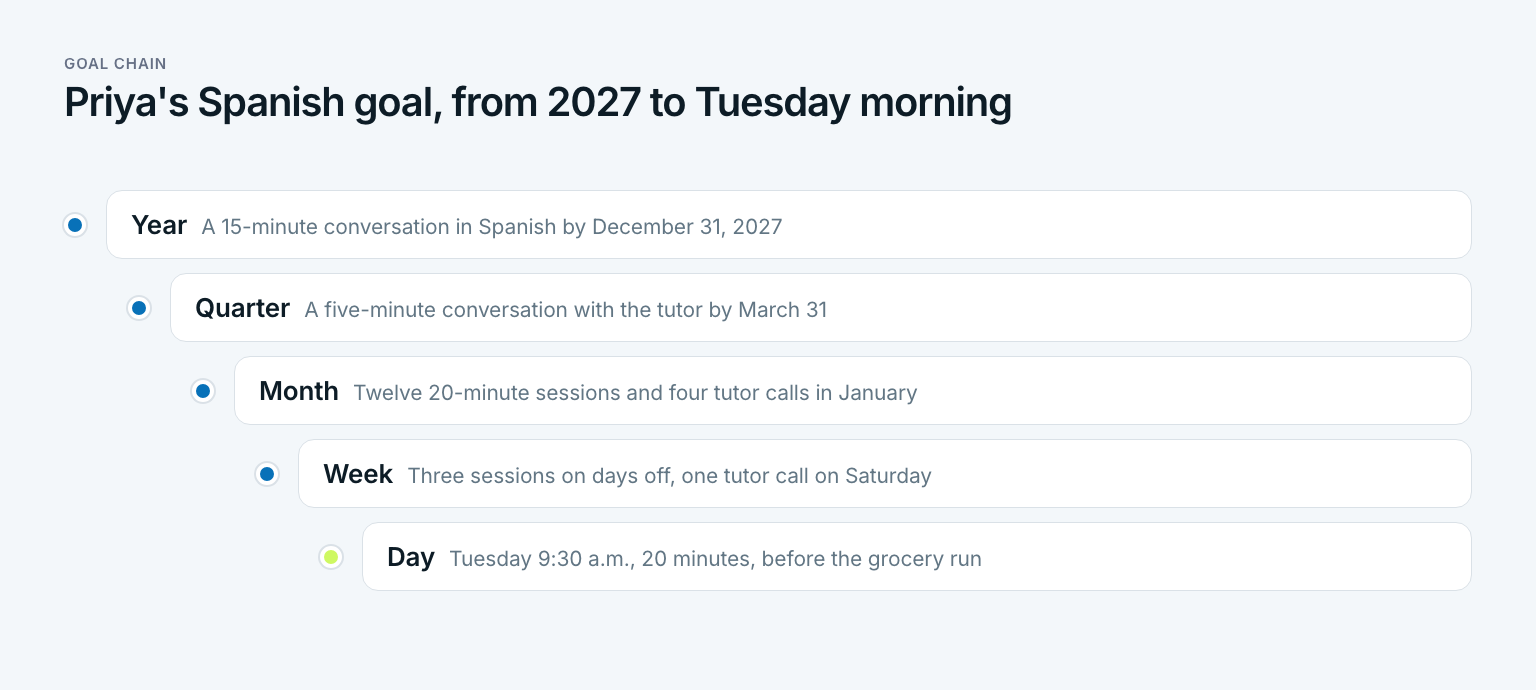
| Level | Spanish | Credit card | Push-ups |
|---|---|---|---|
| Year 2027 | 15-minute conversation by December 31 | $0 balance by December 31 | ten in a row by June 30 |
| First quarter | five-minute conversation with the tutor by March 31 | about $6,000 left by March 31 | three in a row by March 31 |
| January | twelve 20-minute sessions and four tutor calls | $730 paid on January 3 | twelve sessions at the counter |
| Second week of January | three sessions on days off, tutor call Saturday 10 a.m. | autopay set for the 3rd of each month | three sessions of 15 minutes |
| Tuesday | 9:30 a.m., 20 minutes, before the grocery run | nothing, autopay runs | 7 p.m., 15 minutes, counter push-ups |
The table shows two things. First, not every goal needs something every day. The money goal runs on its own after one hour of setup. Second, the week is the level where a goal lives or dies. Whoever compares the week to the monthly goal every Friday notices in February that something is off, not in December. For the full method of breaking goals down, see how to turn yearly goals into daily steps.
Gaapp is built around exactly this chain: the yearly goal on top, the quarter, month, and week underneath, and next to each level the progress compared with the time that has passed. Priya will see in early April whether three push-ups in March were enough or whether the June goal is wobbling.
A personal goal template that fits on one card
A template does not need to look good. It needs to fit on an index card and stay visible every week, on the fridge, in your calendar, or as the first goal in an app. Five fields are enough:
- Area: health, relationships, money, career, learning, habits, home, or fun.
- Goal sentence: a result, a number, and a date in the present tense, like “On December 31, 2027, my credit card balance is $0.”
- Today's number: measured, not guessed.
- Price: what you give up for it, in hours per week.
- First weekly step: what happens this week, with a day and a time.
Priya's card for Spanish reads like this. Area: learning. Goal: By December 31, 2027, I hold a 15-minute conversation in Spanish without switching to English. Today: two sentences, about 150 words. Price: three mornings of scrolling and one Saturday sleep-in a week. First weekly step: Saturday at 10 a.m., first 30-minute call with the tutor.
Three questions before you write it down
Before the card goes on the fridge, ask three questions. Can you answer yes or no on the deadline? Would you pursue it even if nobody knew? Is the first weekly step already on your calendar? Three yeses, and the card goes up. One no, and the goal gets ten more minutes.
In short: Personal goals are not a list you write once in January, they are three sentences that get a slot in your calendar every week.
Frequently asked questions about personal goals
What are the 10 examples of goals?
Ten common personal goals are getting fit, saving money, paying off debt, reading more, sleeping better, spending time with family, learning a skill, cutting screen time, growing at work, and traveling. Each one becomes a real goal only when you add a result, a number, and a date, for example “By June 30, I run a 5K without stopping.” The table above rewrites ten of them that way.
What is your personal goal?
A personal goal is a result you choose for yourself, apart from anything your employer or anyone else sets for you. In a job interview, the question usually asks for a development goal that fits the role, so answer with one skill, a number, and a date. In your own life, it is the one to three results you want most in the next twelve months.
What are 5 good goals?
Five good goals cover different areas so they do not compete for the same hours: one each for health, money, relationships, learning, and work. For example: run a 5K by June, build a $6,000 emergency fund, have twelve date nights, hold a Spanish conversation by December, and present without notes by summer. Five is the upper limit, three is easier to keep.
What are 20 goals I can set in my life?
Pick from the eight areas above: health, relationships, money, career, learning, habits, home, and fun. The 40 examples give you five per area to start from. Twenty is a good brainstorm but not a good plan, so after listing them, keep three for this year and park the rest with a date.
How many personal goals should I have at once?
Three at a time works for most people, ideally from different areas of life. More goals do not mean more progress, they mean less time for each one. Everything else goes on a parking list with a date to revisit.
What is the difference between personal goals and life goals?
Life goals describe who you want to be in five to twenty years. Personal goals are usually twelve-month results that move you toward one of them. A life goal like “debt-free by 45” becomes the personal goal “credit card at $0 by December 31.”
Last updated: 19 October 2026
Read next
 Goal Setting
Intrinsic Motivation: What Drives You From the Inside
Intrinsic motivation is not a personality trait. Meaning, 12 examples, the three needs behind it and five steps to build it, with a worked example.
17 min read
 Goal Setting
Financial Goals: How to Turn Wishes Into a Plan
Financial goals are not wishes with a dollar sign. Short and long term examples, SMART savings goals and a five step plan, worked through one year.
17 min read
 Goal Setting
WOOP Method: Four Steps From Wish to If-Then Plan
The WOOP method is not positive thinking. What WOOP stands for, the research, if-then plans, eight goal examples and a five-minute guide.
18 min read