Morning Pages: How to Do Them and What to Write
Morning pages are not a diary: three longhand pages each morning. The rules, a real example, prompts, what research says, and how to tie them to goals.

Contents
- 01What it means to do morning pages
- 02The rules of morning pages, and where you have room
- 03How to do morning pages: your first week in five steps
- 04Morning pages example: one real page and prompts for blank mornings
- 05How are morning pages different from journaling?
- 06Do morning pages really help? What the evidence says
- 07The three mistakes that make people quit
- 08Your morning pages journal: paper, notebook, or app
- 09Morning pages in the goal chain: from the year to Tuesday morning
- 10Three questions to ask your pages after 30 days
Morning pages are not a diary, and they are not a writing exercise. Morning pages are three pages of longhand, stream-of-consciousness writing that you do first thing after waking up, with no topic, no pauses, and no editing. The practice comes from Julia Cameron's 1992 book The Artist's Way. It is not meant to record your life. It is meant to clear your head before the day fills it.
All you need is a notebook, a pen, and roughly 20 to 40 minutes before anything else happens. The worked example is Dana, 41, a high school chemistry teacher in Columbus, Ohio, who has had a half-finished novel in a drawer for three years. Along the way you get the rules and where they bend, a first week in five steps, a real morning pages example, prompts for blank mornings, an honest look at the research, and a way to turn three messy pages into a step toward a yearly goal.
What it means to do morning pages
Doing morning pages means writing three full pages by hand every morning, before your phone, your email, or your first conversation. You write whatever is in your head, in whatever order it arrives. You do not reread the pages for the first several weeks, and you never show them to anyone. That is the whole method. Everything else is detail.
The point is not the writing. Most of what lands on the page is clutter: the email you owe, the argument from last night, the grocery list, the vague dread about a meeting. Anyone who dumps that clutter onto paper at 6 a.m. does not have to carry it around until 6 p.m. In short: morning pages are a drain, not a document.
Julia Cameron's morning pages: where the practice comes from
Julia Cameron is a writer, filmmaker, and teacher of creative work. In The Artist's Way she lays out a 12-week course for people who feel creatively blocked. The course rests on two tools: morning pages, done daily, and the artist date, a weekly block of time you spend alone doing something that feeds your curiosity. Of the two, morning pages traveled furthest. Plenty of people write them today without ever having opened the book.
The Censor
Cameron calls the voice that judges every idea before it is finished the Censor. It tells you the idea is silly, the sentence is clumsy, and the project is too big. Morning pages are not designed to defeat that voice. They are designed to outrun it: whoever writes three pages without stopping has no time to vet each sentence. That means: the pages do not train your writing. They train you to keep going while being judged.
That was exactly Dana's problem. She wrote on Sunday afternoons, reread the last chapter first, decided it was bad, and closed the laptop. In three years she had added about 6,000 words. Her issue was not time. Her issue was the voice that edited every sentence before she had written the next one. Does that sound familiar?
The rules of morning pages, and where you have room
The rules are short, and each one exists for a reason. Whoever knows the reason can decide where to bend and where to hold the line. The table sums up what Cameron asks for and how much room you realistically have.
| Rule | What it means | Why it matters | Room to bend |
|---|---|---|---|
| Three pages | About three letter-size pages, no time limit | The first pages are clutter, the interesting part often shows up on page three | Little, one page is a different tool |
| Longhand | Pen and paper, not a keyboard | Slower, no deleting, no formatting | Some, typing works but changes the feel |
| First thing | Before your phone, email, or talking to anyone | Your head has not been claimed by the day yet | Some, after the first coffee is fine |
| No stopping | The pen keeps moving, even when you are stuck | The Censor never gets a gap | Little, this is the core |
| No rereading | Put the pages away for the first weeks | If you know you will read it, you write for a reader | Later, with a clear purpose |
| Private | Nobody else reads them | Honesty needs safety | None |
| Daily | Including the days you do not feel like it | The effect comes from repetition | A missed day is not a reset |
Why three pages and not one? Because page one is almost always logistics and page two is often repetition. Only once the obvious material is used up do you start writing sentences you did not plan. One page calms you down. Three pages can surprise you.
The most important rule is the least glamorous one: no stopping. Three handwritten pages come to roughly 750 words, which takes most people 20 to 40 minutes. Anyone who pauses to think about what to write next ends up at 50 minutes with a text that has been edited after all. In short: speed beats content.
Why mornings, and why by hand
The timing is not ritual for its own sake. Right after waking, you have not read a message, had a conversation, or made a decision. Your mind is full but not yet sorted. That unsorted state is the raw material. An hour later the day has already organized it, on its terms rather than yours.
Handwriting has a practical reason. On paper you cannot delete, rearrange, or quickly check a spelling. Each of those small moves is an invitation to the Censor. There is no study that compares typing and handwriting for morning pages specifically, so the case is about method, not measurement. It makes sense to anyone who has rewritten the same email five times.
Dana tested both. In week two she typed her pages on two mornings and was done in 15 minutes. When she checked, she had deleted two whole paragraphs. She went back to the notebook. That does not make typing wrong. It means you should know what you give up.
How to do morning pages: your first week in five steps
The first week decides whether the pages become a habit or a chore. Here is how Dana set hers up. The five steps work for almost anyone without changes.
Set out the notebook the night before
Put the notebook and pen where you will pass them first thing, on the kitchen counter or next to the coffee maker. Leave your phone in another room. Dana moved her alarm from 6:10 a.m. to 5:40 a.m. because she expected to need 30 minutes.
Start with whatever sentence is there
Write the sentence that is already in your head, even if it is: I have no idea what to write. Dana's first line on day one was: I am tired and this feels pointless. It was enough to get going.
Keep the pen moving
When nothing comes, write the last word again until a new thought shows up. Do not correct, do not cross out, do not worry about spelling. Dana needed 41 minutes on day one and 29 by day five.
Stop at the bottom of page three and close the notebook
When page three is full, you are done, even mid-sentence. Do not flip back, do not skim what you wrote. The notebook goes back to its spot.
After seven days, count instead of reading
At the end of the week, look at only two numbers: how many days you wrote and how long it took on average. Dana got six out of seven days and 33 minutes on average. The content stays closed.
A missed day is not a failure. Dana slept through her alarm on Saturday and simply picked it up again on Sunday. Whoever writes off the whole week after one skipped morning turns a habit into a test. That is exactly the mindset the pages are meant to wear down.
Morning pages example: one real page and prompts for blank mornings
What do you write in morning pages? Whatever is there. That sounds vague, and for many people it is the hardest part. Anyone used to writing for an audience goes looking for a topic. Morning pages do not have one.
Here is part of page three from Dana's twelfth morning, word for word and unedited: “Radiator is ticking again. Need to email the district about the lab budget. Do not want to do the 10 a.m. assembly. Why do I say yes to every committee. In the novel Ruth keeps explaining herself in chapter 14 and it reads like a lab report. What if she just does not answer. What if she leaves the room. That might actually work. Okay. Coffee is cold.”
Most of that is noise. One line is an idea Dana had not found in three years of Sunday afternoons. That is how morning pages work: they do not sort, they flush. Most pages are everyday life, and precisely because everyday life is allowed onto the paper, something occasionally slips through that the Censor would otherwise have caught.
For mornings when nothing comes after three lines, prompts help. They are not topics, just a push. Pick one, keep writing, and let go of it as soon as the pen is moving:
- Right now I am thinking about …
- What bugged me yesterday was …
- Today I really do not want to …
- I have not dared to …
- If nobody were watching, I would …
- What I actually meant to say was …
- My body feels like …
- Last night I dreamed that …
- The thing I keep putting off is …
- If I am honest, …
Anyone who starts with the same prompt every morning quietly builds a topic. Rotate them, or drop them once the pages run on their own. For Dana that happened after about ten days.

How are morning pages different from journaling?
Morning pages are a form of journaling, but one with very tight rules. Most journaling has a question, a purpose, or a regular slot in the evening. Morning pages have only a quantity and a time of day. For an overview of the other formats and how to start one, see the guide to journaling. Here the focus is on what morning pages do differently.
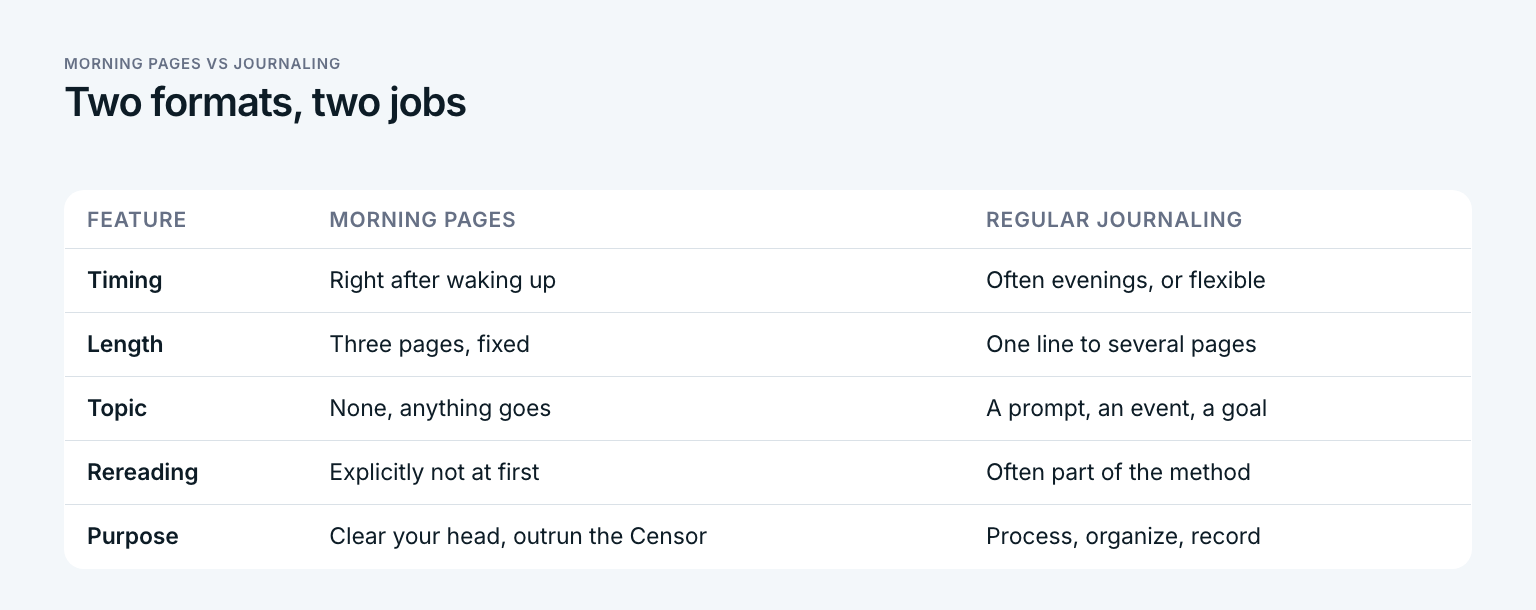
The difference is not a detail. A journal with a prompt directs your attention, and that is often exactly what you want. Morning pages deliberately do not direct anything. Whoever has to answer a question first thing in the morning has already invited the Censor in. That means: the two do not compete. Plenty of people write pages in the morning and three lines with a question at night, and neither takes anything from the other. If you prefer to plan in short bullets at night, pair the pages with a bullet journal for tasks and events.
Do morning pages really help? What the evidence says
There is no controlled study that tests morning pages themselves against a comparison group. What exists is research on related forms of free writing. It is useful, but it needs careful reading.
The best-known work comes from James Pennebaker. In a 1986 study with Sandra Beall, college students wrote for 15 minutes on four consecutive days about a stressful experience. Over the following months they visited the campus health center less often than a control group that wrote about trivial topics. In 2001, Kitty Klein and Adriel Boals found that expressive writing over several weeks can improve working memory, and they linked the gain to fewer intrusive thoughts. That fits Cameron's claim: unload the clutter, and you have more room to think.
The caveat matters just as much. In a 2006 meta-analysis of 146 studies on expressive writing, Joanne Frattaroli found a small average effect. Expressive writing is also a different format: shorter, over a few days, about one hard topic. Morning pages are daily, longer, and topic-free. So what is left? In short: the research supports the idea, it does not prove the method.
When writing makes things heavier
Right after writing about something painful, many people feel worse for a while, which Pennebaker already observed. The psychologist Susan Nolen-Hoeksema also showed that passively circling around negative feelings tends to deepen low mood rather than lift it. Whoever notices the pages running the same loop every morning should change the format, not write longer. One alternative is a short mindfulness exercise that notices thoughts without following them further. Morning pages are not therapy. If you have been struggling for a while, talk to your doctor or a licensed therapist, and if you are in crisis, call or text 988 to reach the Suicide and Crisis Lifeline, any time of day.
Dana did not measure anything after four weeks. She counted. In 30 days she had written pages on 25 mornings and worked on the novel 14 times, more than in the previous three months combined. That is not proof. It is the number that mattered to her.
The three mistakes that make people quit
Most people do not stop because the pages do nothing. They stop because they turned the pages into something else. Three mistakes show up again and again.
Mistake one: turning the pages into a to-do list
Whoever plans the day on paper every morning instead of writing what is there has built a daily planner with extra steps. That is not wrong, it is just a different tool. Planning has better formats, and the pages lose their purpose along the way. Jot down a task when it appears, then keep writing.
Mistake two: rereading and judging
Anyone who reads in the evening what they wrote that morning will write for a reader the next day. The Censor is back, just a few hours late. That is why Cameron advises not reading the pages at all in the first weeks. If you read them later, read with a purpose, more on that in the goal chain below.
Mistake three: treating length as performance
Three pages are a measure, not a contest. If you only manage one page on a 15-minute morning, you did not fail, you wrote a page. If you cut down to one page every day, though, you lose the moment on page three when the clutter runs out. The pattern matters, not the single day.
The most common mistake: trying to write well
Almost everyone who quits morning pages started, at some point, to write good sentences. They rephrase, cross out, and hunt for the right word. It feels like progress and it is the opposite. The pages only work if they are allowed to be ugly. A fast sentence with a typo is worth more than a polished one you spent two minutes on.
Your morning pages journal: paper, notebook, or app
A morning pages journal does not need to be special. Cameron's only requirement is enough room for three full pages a day, so a large spiral notebook with letter-size pages works better than a pocket journal, where three pages run out in five minutes. Dana uses cheap composition books and gets through one roughly every 30 days.
The most common objection is the most honest one: there is no free half hour in the morning. Whoever packs lunches at 6:30 a.m. does not have 30 quiet minutes. Does the method have to go, then? Before you drop it, look at the versions that keep the core. Each one costs something, and it helps to know what:
- Digital, 750 words: In 2009, Buster Benson built the website 750 Words, which turns three pages into a word count. Typing is faster, but the keyboard invites deleting. If you type, switch off spell check and do not scroll up.
- Later in the morning: Write the pages on the train or in the first quiet 15 minutes before work. Your head is fuller by then, but the method is the same.
- One page on weekdays, three on weekends: You lose the page-three moment during the week, but the habit stays alive until you have more time.
What does not work is writing at night under the same name. In the evening your head is full of the day, and the pages turn into a review. That is a good format, just a different one. If you are rebuilding your mornings anyway, the guides to a morning routine and the Miracle Morning show two setups in which writing already has a fixed slot.
Morning pages in the goal chain: from the year to Tuesday morning
Morning pages are not a goal tool. They do produce raw material for goals, though, and it gets lost if it stays in the notebook. The bridge is simple and does not break the no-rereading rule: when a thought that is an action shows up while you write, draw an arrow in the margin. Nothing else. On Friday you do not read the pages, only the lines with an arrow.
After 30 days, Dana had 37 arrows. Most were logistics: email the district, call the dentist. Eight were about the novel. Those eight became her goal chain:
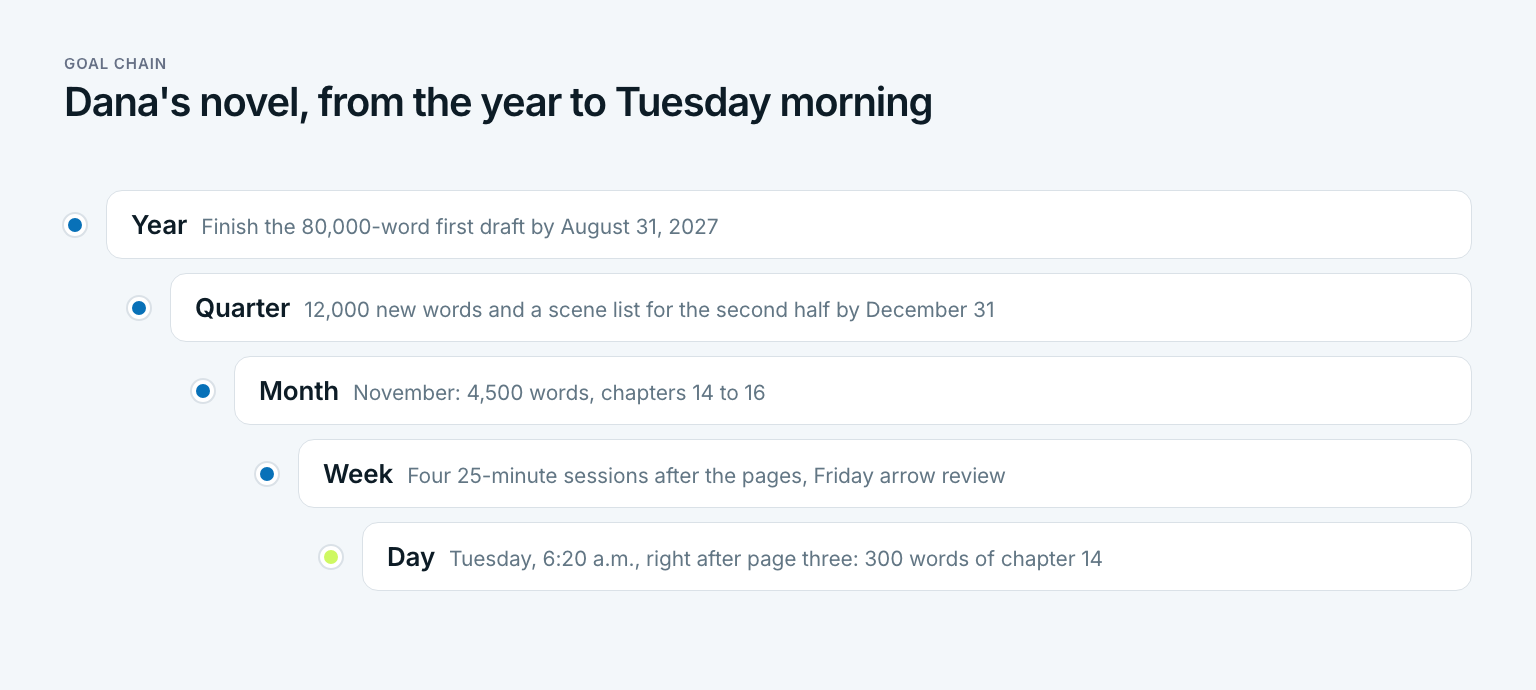
The trick is the timing. Dana writes fiction right after page three, while the Censor is still quiet. Peter Gollwitzer described in 1999 that plans in the form “if situation X, then action Y” get carried out more often than general intentions, and a 2006 meta-analysis with Paschal Sheeran confirmed it. Her plan reads: when page three is full, I open the manuscript. For how to break a yearly goal down into a week, see the guide to weekly goals. Gaapp maps exactly this chain, from the yearly goal down to the one thing on Tuesday morning.
Three questions to ask your pages after 30 days
After a month, take a short look, not at the content but at the pattern. Three questions are enough:
- Am I writing, or am I composing? If you keep pausing mid-page, the Censor is back. Spend one week writing deliberately faster.
- Are the pages going in circles? If the same topic dominates ten mornings out of twelve, it probably needs a decision or a conversation, not more pages.
- What happened to the arrows? Count how many arrows turned into an action that week. Zero means the bridge between pages and daily life is missing.
Dana got stuck on the second question. On nine mornings the pages circled back to the committees she keeps joining. The pages had not solved anything, but they had made it visible. She stepped down from one committee the following week. That means: morning pages rarely give you answers, but they show you which question you are avoiding.
Morning pages are not a diary but a drain, and anyone who accepts that gets a clearer head and, now and then, an idea the Censor would otherwise have swallowed.
What does it mean to do morning pages?
It means writing three pages by hand every morning right after waking up, before your phone or email. You write whatever is in your head, without a topic and without stopping. You do not reread the pages for the first weeks and you do not show them to anyone.
Do morning pages really help?
There is no controlled study of morning pages themselves. Research on expressive writing, such as the work of James Pennebaker, shows small positive effects, for example on working memory. Many people report a clearer head, but that is not a promise of healing.
What do I write in morning pages?
Whatever is there: thoughts, worries, plans, dreams, errands. If nothing comes, write exactly that until a new thought shows up. Prompts like “Right now I am thinking about …” help on blank mornings.
How are morning pages different from journaling?
Morning pages are a tightly defined form of journaling: a fixed time in the morning, a fixed length of three pages, no topic, and no rereading at first. Regular journaling often works with prompts, a clear purpose, and rereading as part of the method.
Can I do morning pages on a computer?
Yes, but it changes the experience. Typing is faster and invites deleting and correcting, which is exactly what the pages are meant to avoid. If you type, aim for about 750 words and switch off spell check.
How long do morning pages take?
Most people need 20 to 40 minutes for three handwritten pages. The first days often take longer, and after two or three weeks the time settles. There is no time limit, the page count is the rule.
Last updated: 22 October 2026
Read next
 Personal Growth
Maslow's Hierarchy of Needs: The 5 Levels Explained
Maslow's hierarchy of needs sorts motivation into five levels. What each level means, what research says today and a needs audit you can run yourself.
14 min read
 Personal Growth
Mindfulness Exercises: 12 for Everyday Life
Mindfulness exercises are not about emptying your mind. 12 techniques for stress and focus, what research shows, and a four-week plan to practice daily.
16 min read
 Personal Growth
Positive Affirmations: 50 Examples You Can Believe
Positive affirmations are not magic words. What research shows, 50 daily affirmations you can believe, and a five-step method with a worked example.
16 min read