Psychological Safety: How to Build It on Your Team
Psychological safety is not about being nice: Edmondson's definition, the 4 stages, seven survey questions and six steps for your team.

Contents
- 01What Is Psychological Safety? Edmondson's Definition
- 02What Psychological Safety Is Not: Three Myths
- 03Why Team Psychological Safety Drives Performance
- 04The 4 Stages of Psychological Safety
- 05How to Measure Psychological Safety: Seven Questions
- 06How to Build Psychological Safety in the Workplace: Six Steps
- 07Warning Signs That Safety Is Slipping
- 08Psychological Safety in the Workplace: What Leaders Can and Cannot Do
- 09From Yearly Goal to Daily Standup
- 10Self-Check: Three Questions for Your Friday
Psychological safety is not a feel-good policy. Psychological safety is a shared belief within a team that it is safe to ask questions, admit mistakes and raise concerns without being embarrassed or punished. Amy Edmondson of Harvard Business School defined it that way in 1999. Anyone who works on a team like that speaks up sooner when something is going wrong. That is exactly why less goes wrong there.
This guide follows Priya, 36, an engineering manager at a health insurance software company in Denver. She leads six engineers who ship the claims portal. Her team looked healthy on paper: friendly standups, few complaints, on-time releases. Then a config change took the portal down for four hours on a Monday, and the postmortem revealed that a junior engineer had spotted the risk two weeks earlier and said nothing. Along the way you get Edmondson's definition, the 4 stages of psychological safety, seven survey questions, six steps you can copy and a plan from yearly goal to daily standup.
What Is Psychological Safety? Edmondson's Definition
Edmondson describes psychological safety as a shared belief that the team is safe for interpersonal risk taking. Interpersonal risks are small moments with big consequences: a question that might sound naive, a mistake you would rather hide, a disagreement with your boss. Anyone who expects those moments to be used against them stays quiet. That means: psychological safety is not one person's feeling. It is a climate the whole team shares.
The idea is older than Edmondson's study. Edgar Schein and Warren Bennis used the term in 1965 in their work on organizational change. William Kahn applied it to individuals in a 1990 paper in the Academy of Management Journal: you are psychologically safe when you can bring your full self to work without fearing damage to your image, status or career. Edmondson then lifted the concept to the team level and gave it a way to be measured.
Her 1999 study looked at 51 work teams in a manufacturing company. Teams with higher psychological safety showed more learning behavior. They asked for feedback, discussed errors and tried new approaches more often, and that learning behavior was linked to better performance. In short: for Edmondson, safety is not the goal in itself. It is what allows a team to learn from what goes wrong.
Key term: interpersonal risk
Edmondson names four fears behind it: looking ignorant, incompetent, negative or disruptive. Anyone who feels those fears on a team weighs every comment and, when in doubt, keeps the most important one to themselves. On Priya's team, that comment was a single Slack message nobody sent: “This config flag looks risky.”
What Psychological Safety Is Not: Three Myths
The phrase gets used a lot and misunderstood almost as often. Three myths come up in nearly every leadership workshop. They sound reasonable. They just lead in the wrong direction:
- “Psychological safety means being nice.” Kindness helps. It can also mean nobody pushes back because no one wants to spoil the mood. Edmondson is clear that psychological safety exists to make candor possible.
- “Psychological safety lowers the bar.” The opposite is true. Safety and performance standards are two separate dimensions. A team needs both to learn and deliver.
- “Psychological safety is the same as trust.” Related, but not identical. Trust is about how you see one specific person. Psychological safety is about how you expect the group to treat you when you take a risk.
Priya had mistaken the first myth for a strength. Her standups were warm, and conflict was rare. What she missed was the price of that calm. Anyone who wanted to raise something uncomfortable waited for a better moment, and the better moment never came. Is a team where nobody disagrees really safe? Usually it is just quiet.
A fourth myth concerns accountability. Psychological safety does not mean mistakes have no consequences. Anyone who knowingly ignores a security policy still faces the result. The difference is elsewhere. A psychologically safe team never punishes someone for reporting a mistake. If anything, it treats hiding one as the real problem.
Why Team Psychological Safety Drives Performance
The best-known evidence comes from Google. Starting in 2012, its Project Aristotle studied more than 180 teams to find out what made some of them effective. In 2015 Google reported that who was on a team mattered less than how the team worked together. Of five factors, psychological safety came first, ahead of dependability, structure and clarity, meaning and impact.
Edmondson's own path to the topic began with a puzzle. In a hospital study published in 1996, the better-led nursing units reported more medication errors, not fewer. The explanation was that they did not make more errors. They reported more of them. Anyone who does not fear blame also reports the mistake nobody else would have noticed.
Priya found the same pattern in her own numbers. Her team had filed only two incident reports in the previous quarter, which had looked like a sign of quality. For a team shipping weekly to 40,000 users, it was more likely a sign of silence. That means: a low error count on paper can also mean that nobody is writing errors down.
A 2017 meta-analysis by M. Lance Frazier and colleagues in Personnel Psychology pulled the research together. Across the studies it reviewed, psychological safety was linked to more information sharing, more learning behavior and better performance. It is still not a cure-all. It does not replace clear goals, training or good planning. What it does is make sure a team uses the information it already has. The idea is old: in Maslow's hierarchy of needs, safety comes right after the physical basics, and a person who feels threatened spends energy on protection instead of curiosity.
The 4 Stages of Psychological Safety
Timothy R. Clark described the 4 stages of psychological safety in a 2020 book. The stages build on each other, so a person rarely reaches the fourth without the first three. They are useful when you want to understand where one individual stands, not just the team on average.
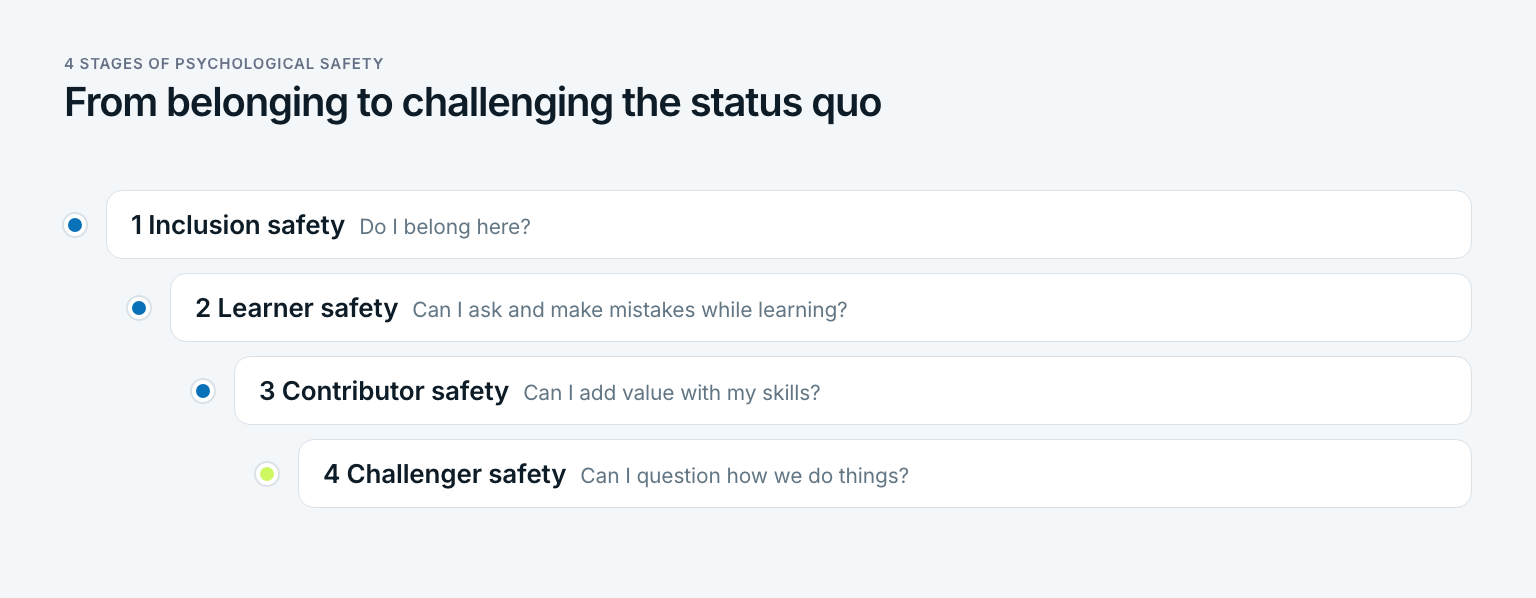
| Stage | The question behind it | On Priya's team |
|---|---|---|
| 1 Inclusion safety | Do I belong here? | The two contractors were never invited to sprint planning |
| 2 Learner safety | Can I ask and make mistakes while learning? | The newest engineer avoided asking how the deploy pipeline worked |
| 3 Contributor safety | Can I add value with my skills? | Senior engineers shipped great work, but only inside their own tickets |
| 4 Challenger safety | Can I question how we do things? | Nobody questioned the habit of skipping config reviews on Fridays |
The junior engineer who spotted the risky flag was stuck at stage two. She was still learning the system and did not want to look like she was guessing. Challenging a senior colleague's config change would have required stage four. That gap between where she was and where the situation needed her to be is where the outage came from.
Safety and standards: the four zones
Edmondson adds a second lens. She sorts teams by two questions: How safe do people feel? And how high are the performance standards? The answers produce four zones:
| Zone | Safety | Standards | What it feels like |
|---|---|---|---|
| Learning zone | high | high | People argue about the work, flag problems early and want to improve |
| Anxiety zone | low | high | People work hard, hide problems and cover themselves |
| Comfort zone | high | low | People get along well, but nobody stretches |
| Apathy zone | low | low | People do the minimum and stay out of everything |
Priya rated her team in the comfort zone. Her predecessor had left behind the anxiety zone, with tight deadlines and public blame after every bug. Both lead to the same result. The most important information never makes it into the room. Anyone who works on only one axis moves the team into the neighboring zone, not into the learning zone.

How to Measure Psychological Safety: Seven Questions
Team psychological safety can be measured, and it takes very little effort. Edmondson's 1999 study used seven statements, each rated on a scale from 1 to 7. Three are negatively worded and scored in reverse. Paraphrased, they read like this:
| No. | Statement, paraphrased | Scoring |
|---|---|---|
| 1 | If you make a mistake on this team, it is often held against you. | reverse |
| 2 | Members of this team are able to bring up problems and tough issues. | normal |
| 3 | People on this team sometimes reject others for being different. | reverse |
| 4 | It is safe to take a risk on this team. | normal |
| 5 | It is difficult to ask other members of this team for help. | reverse |
| 6 | No one on this team would deliberately act in a way that undermines my efforts. | normal |
| 7 | Working with members of this team, my unique skills and talents are valued and used. | normal |
Priya ran the seven statements as an anonymous form with no name field and no team breakdown. Seven of eight people answered, including the two contractors. The average came out at 4.3 out of 7. The weakest item was number one, mistakes held against you, at 3.4. The strongest was number six at 5.9. People did not suspect each other of bad intent. They simply remembered the old blame culture.
Three tips for your own survey. First, anonymous has to mean anonymous, so skip any breakdown that would identify people on a small team. Second, the number is a starting point, not a grade. Third, repeat the survey in the same format after three months, or you will never know whether anything changed. Anyone who runs a survey and never discusses the results with the team has turned a measurement into another disappointment.
How to Build Psychological Safety in the Workplace: Six Steps
In “The Fearless Organization”, Edmondson describes three jobs for leaders: set the stage, invite participation and respond productively. Priya turned them into six steps for her team. None of them takes long. Together they change what gets said in standup.
Frame the work, 10 minutes
Tell the team out loud why every signal matters. Priya said in the next retro: “We deploy to 40,000 people every week. At that pace, things will break. I want to hear about every risk before a customer does.”
Show your own uncertainty, 2 minutes
Admit what you do not know. Priya told the team she had approved the config change herself without reading the flag description. A leader who admits mistakes lowers the cost of admitting them for everyone else.
Ask specific questions, 5 minutes a day
Almost nobody answers “Any questions?” A specific question works better: “What almost bit us yesterday?” Priya asked it at the end of every standup and then waited a full ten seconds.
Respond well to the first report, right away
The first person who speaks up is testing the waters for everyone. Thank them specifically, ask for details and say what happens next. When the junior engineer flagged a second risky flag, Priya pinned her message in the team channel with a thank-you.
Run blameless reviews, 30 minutes a week
Set a fixed slot to review incidents and near misses without looking for someone to blame. The guiding question is: What about our process made this mistake easy? Google's 2016 book on site reliability engineering describes the same idea as a blameless postmortem culture.
Close the loop visibly, 5 minutes a week
Nothing kills candor faster than reports that disappear. Priya kept a shared list of every flagged risk with an owner and a date. After six weeks, eight of eleven items were marked done.
Step four matters most and breaks most easily. Edmondson calls it responding productively: express appreciation, destigmatize failure and sanction only clear violations. One irritated sentence can undo weeks of work. Anyone who greets the first uncomfortable report with a sigh will not get a second one.
Many of these conversations happen one on one, not in the group. The one-on-one meeting questions are a good place to start. When you need to give critical feedback without damaging safety, follow the structure in how to give feedback to employees: describe the behavior, name the impact and agree on what happens next.
Warning Signs That Safety Is Slipping
Psychological safety rarely disappears with a bang. It erodes quietly. Priya wrote down these signals so she would notice early if her team started sliding back:
- Meetings get shorter. What looks like efficiency often means nobody is contributing.
- Problems surface late. Anyone who learns on Thursday about a bug found on Monday has a reporting problem, not a bug problem.
- The same two voices. When only the most senior people talk in retros, the others are not short on ideas.
- Jokes about past mistakes. A nickname for the person who once broke production sounds harmless. It is a warning to everyone else.
- Feedback only in private. When criticism reaches you only in direct messages, nobody feels safe saying it in front of the team.
The most common mistake: asking for candor, then shooting the messenger
Many managers say “my door is always open” and then react with irritation when someone walks through it. Priya caught herself doing it. In week three, an engineer questioned the new on-call rotation, and Priya answered on reflex: “We already decided that.” In the next sprint retrospective, nobody raised anything. A leader who asks for honesty and then brushes off the first honest person teaches the team the opposite of what they say.
Priya walked it back the next day. She told the team her response had been wrong and asked the engineer to explain the concern again. It took two minutes. Two new risks came up in the same meeting. Mistakes on the leadership side are part of learning too, as long as they are corrected in the open.
Psychological Safety in the Workplace: What Leaders Can and Cannot Do
Psychological safety in the workplace is built mostly inside the immediate team. Company culture sets the frame, but whether it is safe to report a mistake is something each person learns from their direct manager. That is good news. You do not need to wait for a company-wide culture program to change things on your team.
Leadership also has limits. Psychological safety is a team climate, not therapy and not a substitute for health support. The U.S. Surgeon General's 2022 Framework for Workplace Mental Health and Well-Being lists psychological safety as part of protection from harm, next to things like workload and fair treatment. Those are related topics with their own tools, and a manager is not the right person to handle all of them alone.
Anyone who notices a team member under heavy strain for a long time should take it seriously and point them to an employee assistance program, HR or a professional rather than trying to treat it themselves. If you or someone on your team is in crisis, call or text 988 to reach the Suicide and Crisis Lifeline in the US.
What about poor psychological safety? It rarely looks dramatic. It looks like silence in meetings, surprises at the end of a sprint and good people leaving without saying why. Improving it does not start with perks or offsites. It starts with how the next reported mistake is handled.
From Yearly Goal to Daily Standup
Psychological safety sounds like something you cannot plan. That is only half true. You cannot order a climate into existence. You can plan the habits that create it. Priya broke her plan down across all five levels like any other goal.
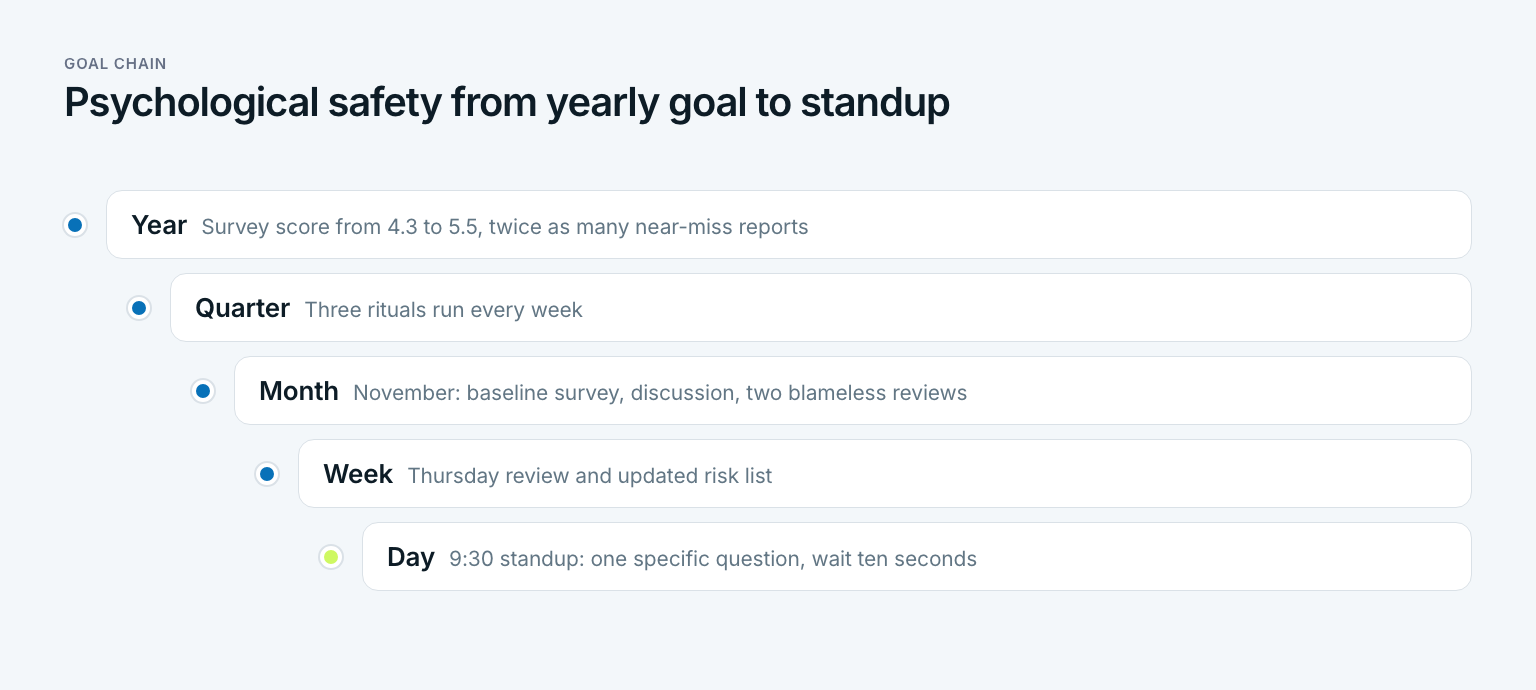
| Level | Priya's goal | How she measures it |
|---|---|---|
| Year | By fall 2027, the team scores at least 5.5 out of 7 on the seven-question survey and files twice as many near-miss reports as in 2026 | Anonymous survey every three months, incident log |
| Quarter | Three rituals run every week: the standup question, the Thursday blameless review and the shared risk list | Number of weeks with all three |
| Month: November | Baseline survey done, results discussed with the team, two blameless reviews held | Retro notes |
| Week | Thursday review covers at least one case, risk list updated | Dated list in the team channel |
| Day | At the 9:30 standup, ask one specific question and wait ten seconds | A check in her daily notes |
The yearly goal has two numbers on purpose. The survey score shows how safe people feel. The report count shows whether that feeling changes behavior. Anyone who measures only the feeling can confuse a good mood with the learning zone. Anyone who counts only reports risks people filing trivial ones to hit a quota.
Psychological safety is also never one person's goal. It grows where a team shares goals and talks honestly about the path there. The guide to team goals shows how to set those together. The article on goals for managers shows how to write your own version as a leadership goal. In Gaapp, Priya entered the yearly goal once and now sees every Friday whether the week's rituals actually happened.
After three months her team scored 4.9. Near-miss reports went from two in the previous quarter to nine. The yearly goal was not reached yet. But the direction was right, and for the first time it was visible.
Self-Check: Three Questions for Your Friday
Psychological safety shifts with every reaction you show. A short look at the end of each week is worth it. Anyone who cannot answer one of these questions has found their next step:
- When did someone tell me something this week that I did not want to hear, and how did I respond?
- Who on the team said nothing at all this week, and what might be behind that?
- Which flagged risk from the last few weeks is still open, and does the person who raised it know why?
Priya answers the three questions every Friday afternoon in five minutes and writes the answers next to her weekly goals. After a quarter she can see not only whether the rituals happened but also how she reacted. In short: psychological safety is not a state a team reaches. It is a promise a leader keeps again every day.
How do you improve psychological safety in the workplace?
Start with how you respond to the next person who reports a mistake or disagrees with you. Thank them, ask for details and close the loop visibly. Add one specific question to every standup and a regular blameless review, then measure the climate again after three months.
What does poor psychological safety look like?
It usually looks quiet rather than dramatic: short meetings, the same two voices in every discussion and problems that surface only at the last minute. People keep risks to themselves because raising them once cost them something. Low error counts can be a symptom rather than a sign of quality.
What are the 4 stages of psychological safety?
Timothy R. Clark describes four stages that build on each other: inclusion safety, learner safety, contributor safety and challenger safety. Only at the fourth stage do people feel safe questioning the status quo. The model helps you see where an individual stands, not just the team average.
Who came up with psychological safety?
Edgar Schein and Warren Bennis used the term in 1965, and William Kahn applied it to individuals in 1990. Amy Edmondson of Harvard Business School defined team psychological safety in 1999 and created the seven-item survey most teams still use.
How do you measure team psychological safety?
The most common tool is Edmondson's survey with seven statements rated from 1 to 7, three of them scored in reverse. Keep it truly anonymous and repeat it in the same format after about three months. Discuss the results with the team, or the survey itself becomes a trust problem.
Is psychological safety the same as being nice?
No. Psychological safety exists so people can disagree, admit mistakes and challenge ideas openly. A team that is only nice often ends up in the comfort zone, where nobody pushes back. Edmondson pairs high safety with high standards.
Last updated: 22 October 2026
Read next
 Leadership & Teams
Leadership Styles: Which One Fits Which Situation
Leadership styles are not personality types: 11 types compared, Lewin, Goleman, situational leadership and five steps to find the style that fits you.
14 min read
 Leadership & Teams
Retrospective: How Teams Learn From Every Sprint
A retrospective is not a blame session: what the word means, five phases, seven retrospective examples and action items that stick, shown on one team.
16 min read
 Leadership & Teams
How to Delegate Tasks: Hand Off Work, Keep Results
Delegation is not dumping work: five levels of delegation, seven steps, a handoff script and what to keep, shown on one marketing team.
15 min read