Self Love: What It Means and How to Practice It
Self love is not a constant high. It is the tone you use after a mistake. What it means, the research on self-compassion, five steps and six practices.

Contents
- 01What self love means, in plain words
- 02Self love vs self-esteem, self care and narcissism
- 03Why self-compassion beats high self-esteem
- 04What causes a lack of self love
- 05Do you have to love yourself first?
- 06Learning to love yourself in five steps
- 07How to practice self love: six exercises for ordinary days
- 08Rachel's self love plan from year to day
- 09Three mistakes that keep self love from sticking
- 10Three questions before you start
Self love is not feeling amazing about yourself all the time. Self love is the way you treat yourself, especially when something goes wrong: with the same honesty, kindness and loyalty you would give someone you care about. That makes it learnable, because it depends less on how you feel and more on habits of thought you can practice.
Anyone who only likes themselves when things go well doesn't have self love. They have a contract with conditions. Most guides start with affirmations in the mirror. This one starts with the tone you use on yourself after a mistake. It follows Rachel, 31, a junior architect in Chicago who replays every comment from a design review at 2 a.m. You get a clear line between self love, self-esteem and self care, what the research on self-compassion actually shows, five steps, six practices and a plan that runs from the year down to a single Tuesday.
What self love means, in plain words
The shortest definition: self love is goodwill toward yourself that does not depend on performance. You don't have to think you're great. You just have to want things to go well for you, even on days when you have nothing to show for yourself. That is less romantic than the word suggests. It is also far more useful.
The idea is old. In Book IX of the Nicomachean Ethics, Aristotle distinguished two kinds of self-lovers: people who grab as much money, honor and pleasure as they can, and people who take care of what is best in them. Only the second kind earned his praise. In 1755, Jean-Jacques Rousseau separated amour de soi, a natural concern for your own well-being, from amour-propre, the hunger for status that constantly measures itself against others. That split is still the core of the matter. Self love needs no comparison. Vanity lives on it.
What self love is not
Three misunderstandings keep coming back, and each one sends you in the wrong direction:
- Not a permanent high. You don't have to wake up every morning feeling beautiful, smart and lovable. Self love holds even on days when you don't like yourself at all.
- Not a free pass. Loving yourself doesn't mean dropping your standards. Self love changes the tone on the way to a goal, not the goal itself.
- Not a project with a finish line. There is no day when you are done. There are only weeks when the kind voice wins more often than the harsh one.
What is self-love called?
The closest synonyms are self-acceptance, self-regard and self-compassion. The ancient Greeks used the word philautia, which could mean healthy self-respect or plain selfishness, depending on who was using it. Psychologists today mostly study self-compassion, because it can be measured and trained. That is the part of self love this guide focuses on.
Self love vs self-esteem, self care and narcissism
Four terms tend to get lumped together. None of them is wrong. Each answers a different question. Self-esteem is a verdict, self care is action, self love is the tone, and narcissism is a facade.
| Term | The question behind it | How you spot it | Rachel's example |
|---|---|---|---|
| Self love | How do I treat myself when I fail? | The tone of your inner voice after a mistake | After a wrong dimension on a drawing: annoying, it happens, I'll fix it before lunch |
| Self-esteem | How much am I worth, all things considered? | Your overall judgment of yourself, often tied to results | She feels like a good architect as long as the partners praise her work |
| Self care | What do I need to stay healthy and functional? | Fixed actions on your calendar | Climbing gym every Wednesday at 6 p.m., no matter what is due |
| Narcissism | Am I admired enough? | An inflated self-image that needs constant validation | She would blame the error on the intern to look good |
The distinction matters in practice. If your verdict on yourself is shaky, you work on self-esteem, through evidence and kept promises. If you are exhausted, you need self care first, meaning sleep and free evenings. If you tear yourself apart after every mistake even though your record is fine, you need self love. That is Rachel's situation exactly. Her team likes her and her work is solid, yet a single critical comment keeps her awake until 2 a.m. This blog has separate guides on how to improve self-esteem and self care ideas. This one is about tone.
Is self love selfish?
From the outside it can look that way, because you stop apologizing for everything. The difference is who pays the bill. Selfishness takes something away from other people. Self love takes nothing from anyone. It simply stops punishing you. Narcissism, for its part, is not too much self love. It is a self-image that collapses without outside admiration.
Why self-compassion beats high self-esteem
Psychologist Kristin Neff introduced self-compassion in 2003 in the journal Self and Identity as an alternative to chasing high self-esteem. She breaks it into three parts, each with an opposite you probably know well:
- Self-kindness instead of self-judgment. You talk to yourself after a mistake the way you would talk to a good friend: honestly, without contempt.
- Common humanity instead of isolation. You know that failing is part of being human and does not prove that something is uniquely wrong with you.
- Mindfulness instead of over-identification. You notice the pain without drowning in it or pushing it away. Short mindfulness exercises train exactly this skill.
Why not just raise your self-esteem? Because high self-esteem often comes with conditions. In 2004, Jennifer Crocker and Lora Park described in Psychological Bulletin how costly the pursuit of self-esteem can be. If you define yourself by success, every failure feels like an attack on who you are, so you start avoiding anything that could go wrong. In 2009, Kristin Neff and Roos Vonk compared both attitudes in more than 2,000 adults in the Netherlands. Self-compassion went along with a steadier sense of self-worth that depended less on success and comparison. Narcissism was linked to high self-esteem, not to self-compassion.
The most important finding addresses the fear that self love makes you lazy. In 2012, Juliana Breines and Serena Chen had college students fail a hard vocabulary test. Those who were then guided to take a compassionate view of their failure studied longer for a retest than those who only got a self-esteem boost. Anyone who is kind to themselves finds it easier to look straight at their own mistakes. In short: self-compassion doesn't lower your standards. It lowers your fear.
There is also evidence on well-being. In a 2012 meta-analysis, Angus MacBeth and Andrew Gumley found a large association: people who report more self-compassion report less depression, anxiety and stress. That is a correlation, not proof of cause and effect. So self love is not a treatment. It is an attitude that makes hard stretches easier to get through.
What causes a lack of self love
A lack of self love rarely feels like self-hatred. Usually it sounds reasonable, almost like ambition. Three sentences give it away:
- “I should have known better.” You judge yourself in hindsight by information you didn't have at the time.
- “Everyone else manages.” You compare your insides with other people's outsides.
- “I can rest once everything is done.” Kindness toward yourself becomes a reward that never comes due.
Where does this come from? The causes vary, and not all of them can be traced. Often it is an environment where affection depended on achievement, with lots of criticism and little comfort. British psychologist Paul Gilbert describes three systems we use to regulate emotion in his 2009 book The Compassionate Mind: threat, drive and soothing. In many people the third one is barely trained. Whoever never learned to calm themselves reaches for the only tool they know after a mistake: pressure.
Rachel only saw this once she started counting. For one week she made a tally mark on her phone for every harsh thought about herself. By Sunday there were 56 marks, an average of eight a day, and up to 14 on days with a design review. The number embarrassed her. It was also the first honest measurement she had. How many marks would you get?
Do you have to love yourself first?
You have probably heard that you can't love anyone else until you love yourself first. The saying has a grain of truth and a big flaw. The truth: someone who constantly needs reassurance puts a heavy load on any relationship. The flaw: the saying turns self love into an entry ticket, as if people who struggle with it were not allowed to love or be loved.
Erich Fromm saw it differently. In The Art of Loving, published in 1956, he argued that love for yourself and love for others are not in competition and do not come in sequence. They grow together. He also held that the selfish person does not love themselves too much but too little. That means: you don't have to finish loving yourself before you are allowed a relationship. You can practice both at once, and relationships where you are treated kindly are one of the places where you learn to treat yourself kindly.
Fromm also answered the question of whether love can be learned at all. He called it an art that requires knowledge and practice, like any other. That is good news for anyone who did not grow up with a kind inner voice.

Learning to love yourself in five steps
Learning to love yourself works the way any mental habit does: through repetition in small, recurring situations. The five steps take you from counting to a fixed routine. They don't replace therapy. They are training for ordinary days.
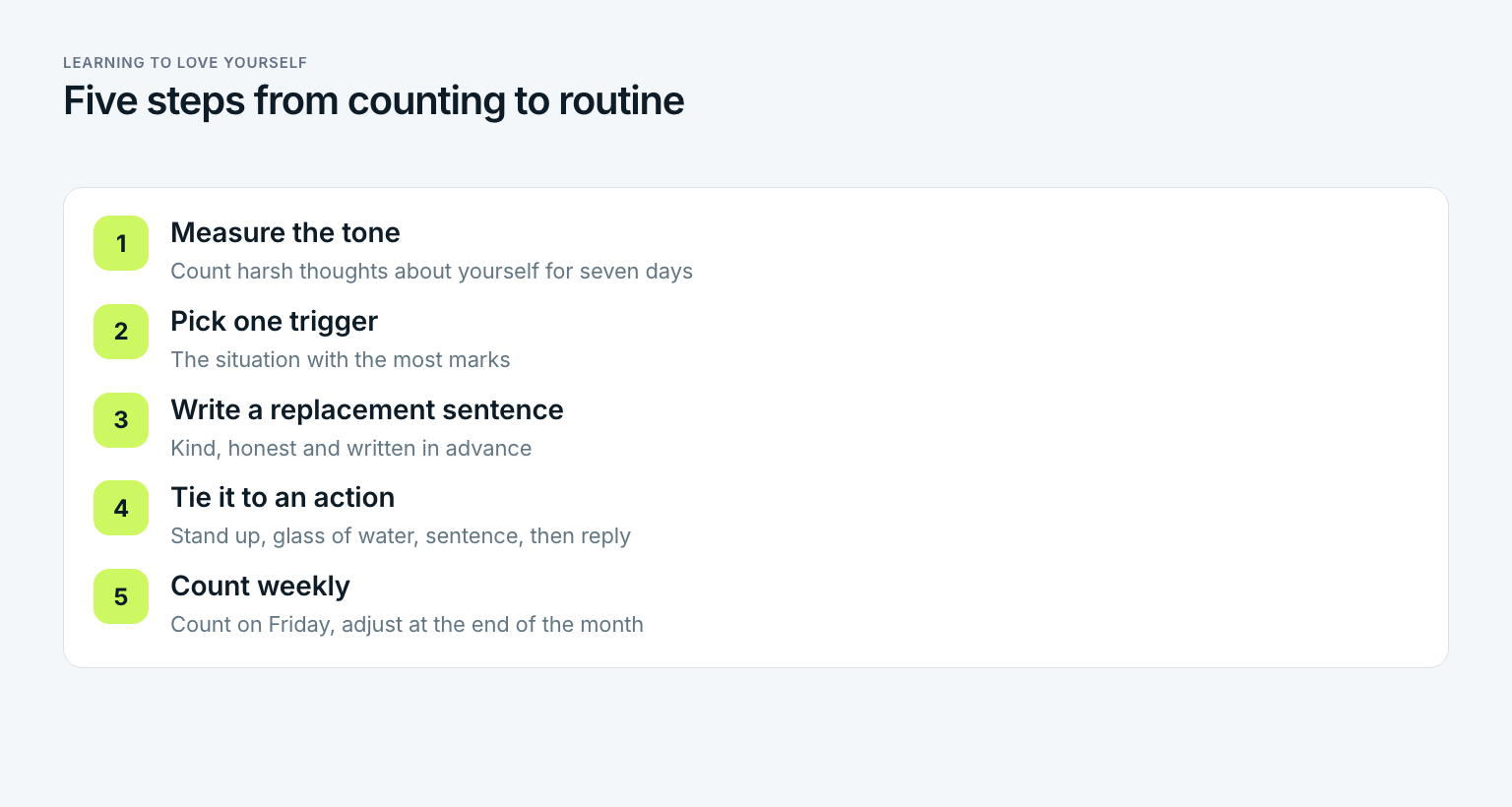
Measure the tone before you change it
Keep a tally of harsh thoughts about yourself for seven days. Don't argue with them, just count. Rachel got 56 marks in one week. Without that number she would not have known three weeks later whether anything had moved.
Pick one trigger
Look at when most of the marks happen. For Rachel it was design reviews and the half hour before sleep. Pick exactly one situation, not all of them. Whoever tries to be kinder everywhere at once ends up kinder nowhere.
Write a replacement sentence in advance
Decide ahead of time what you will say to yourself in that situation, based on Neff's three parts. Rachel's sentence: This stings. Every architect gets redlined. What would I tell Maya from my studio right now? The sentence doesn't have to be pretty. It has to be believable.
Tie the sentence to a fixed action
A good intention fades. A link holds. Rachel decided that after every review she walks to the kitchen, fills a glass of water and says the sentence once before opening her laptop again. The action is the anchor. The sentence is the practice.
Count weekly, adjust monthly
On Friday, count the week's marks and note how often the replacement sentence worked. At the end of the month, ask whether the sentence still fits. After eight weeks Rachel was down to about three marks a day. The critic was not gone. It was quieter and shorter.
The tally looks trivial, but it is the part most people skip. Without counting, self love stays a feeling you think about. With counting, it becomes a habit you can improve. To fold observations like these into a short weekly review, see the guide to self-reflection.
How to practice self love: six exercises for ordinary days
The following practices are short, and most of them come from research on self-compassion. You don't need all six. Pick the one that fits your trigger and do it for four weeks.
The self-compassion break
Kristin Neff developed this exercise, and it takes about a minute. In a difficult moment you say three sentences to yourself, one for each part of self-compassion: This is a moment of suffering. Suffering is part of life. May I be kind to myself. If the words feel too solemn, use your own. The order is what matters: notice, put it in context, be kind.
A letter from a friend
Write about something you feel ashamed of, from the point of view of someone who likes you and knows your flaws. What would they tell you? Rachel wrote about her fear of being found out as the least talented person in the studio. The letter was half a page. She reread it every time a deadline slipped. If you already write regularly, the guide to journaling gives you a format this letter fits into.
Talk to yourself by name
Ethan Kross and colleagues found in 2014, in the Journal of Personality and Social Psychology, that people under stress think more calmly and clearly when they reflect on themselves in the third person or by first name. Instead of “Why did I mess this up?” you ask: “What does Rachel need right now?” The small distance turns the judge back into an advisor.
The friend test
Before you keep running a harsh thought about yourself, check it with one question: Would I say this to a friend in the same situation? If not, rephrase it the way you would say it to them. The sentence can stay honest. Only the contempt goes.
One no per week
Self love also shows in what you allow. Plan one deliberate no each week to a request you would otherwise have accepted out of guilt. In her first month Rachel turned down two weekend favors and a side project, and said yes to a design competition because she actually wanted it. That is not withdrawal. It is a decision.
The evening question
Every evening, answer one question in writing: Where was I kind to myself today, and where could I have been? One sentence is enough. The question trains your attention on the moments your inner critic usually wins without a fight. After a month you have about 30 lines that show you where the work is.
Rachel's self love plan from year to day
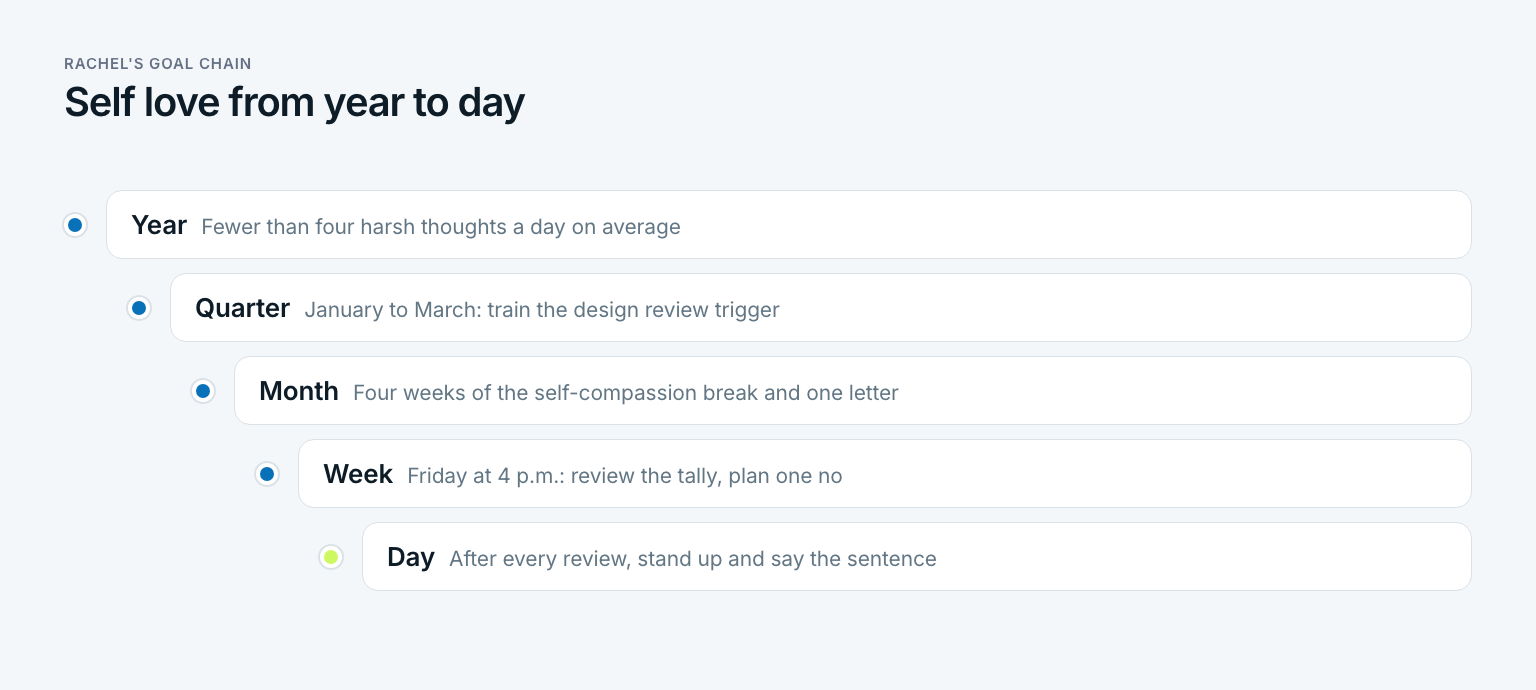
Self love is not a goal you can check off. What you can plan is the practice. That sounds dry, but it is the difference between a resolution and a habit. Rachel translated her self love into five levels, from one sentence for the year to one minute a day:
- Year: I talk to myself after mistakes the way I talk to my team. Measure: fewer than four harsh thoughts a day on average.
- Quarter: From January to March, train the design review trigger with the replacement sentence and the glass of water.
- Month: In February, four weeks of the self-compassion break plus one letter about deadlines.
- Week: Friday at 4 p.m., ten minutes to review the tally and plan one no for next week.
- Day: After every review, stand up and say the sentence once.
Here is what Rachel's tally looked like over the first eight weeks. The numbers are hers, not a benchmark for you:
| Week | Harsh thoughts | Per day | What changed |
|---|---|---|---|
| 1 | 56 | 8 | Counting only, nothing changed |
| 2 | 52 | 7 | Picked the design review trigger, wrote the sentence |
| 4 | 40 | 6 | Glass of water after every review, held on three of five days |
| 6 | 30 | 4 | Wrote the deadline letter and reread it twice |
| 8 | 21 | 3 | The sentence mostly shows up on its own, added the evening question |
The interesting part is not the curve but week four. That was when Rachel first noticed she could get back to work faster after a critical review. The marks went down, and so did the time she spent ruminating. If you only go by feeling, you miss progress like this, because it arrives slowly.
The yearly goal is deliberately measurable. A sentence like “I want to love myself more” can never be finished and never be checked. “Fewer than four harsh thoughts a day” can. The week is the most important level, because that is where the practice either survives or quietly dies. Anyone who plans self love this way treats it as a skill rather than a mood, and skills grow with repetition. It connects directly to self-efficacy: every week you hold is evidence that you can change. In Gaapp you link the five levels and see on Friday whether the chain held. For the general principle of breaking big intentions into small steps, see how to achieve goals.
Three mistakes that keep self love from sticking
The most common mistake: making self love a reward
Many people plan to like themselves once they lose ten pounds, get the promotion or finally get organized. That sounds like motivation. It is exactly the kind of condition Crocker and Park called costly. Anyone who ties kindness toward themselves to a result goes without it in the weeks they need it most. The fix: kindness comes first, the goal comes second, and both can stand side by side.
Mistake two: confusing self love with letting yourself off the hook
Self love doesn't mean nothing matters. Whoever waves off every mistake with “it's fine” avoids discomfort but learns nothing. The Breines and Chen study points the other way: compassion makes it easier to look at a mistake, not to ignore it. Rachel didn't downplay the wrong dimension. She fixed it, told the project lead and added a second check to her workflow. She only skipped the trial against herself.
Mistake three: handling everything alone
The second part of self-compassion is common humanity, and it is the one most people skip. If you only argue with your mistakes inside your own head, you eventually believe you are the only one who makes them. A conversation with a senior colleague who made the same error five years ago can do more than ten exercises. Self love is an attitude toward yourself, but it doesn't grow in a vacuum.
When self love is not enough
Self love practices are meant for ordinary days, not for a crisis. If you have felt worthless for weeks or are thinking about harming yourself, talk to your doctor or a therapist, or call or text 988, the Suicide and Crisis Lifeline in the US, free and open around the clock. More discipline in your practice is not the answer in a phase like that. Asking for help is not weakness. It may be the clearest form of self love there is.
Three questions before you start
Before you start your first tally, answer three questions honestly:
- In which situation am I hardest on myself, and how often does it happen each week?
- What would I say to a good friend in exactly that situation?
- Which fixed action can I tie that sentence to, starting tomorrow?
If you can answer those three, you already have your plan for the first four weeks. In the end, self love is not a feeling you wait for. It is a tone you practice.
What does self-love mean?
Self love means goodwill toward yourself that does not depend on performance. In practice, you treat yourself after a mistake the way you would treat someone you care about: honestly, but without contempt. It does not mean thinking you are great all the time.
What causes a lack of self-love?
Common causes include growing up where affection depended on achievement, a lot of criticism with little comfort, and a sense of worth that hinges on success. Psychologist Paul Gilbert describes it as an undertrained soothing system: without a learned way to calm yourself, pressure becomes the default response to mistakes. If the pattern runs deep, a therapist can help you trace it.
How long does it take to love yourself?
There is no fixed timeline, and it is never fully finished. Measurable change within a few weeks is realistic: in a randomized trial by Neff and Germer in 2013, participants in an eight-week Mindful Self-Compassion program gained clearly more self-compassion than a waitlist group. Counting your harsh thoughts each week lets you see your own progress.
What is self-love called?
Close synonyms include self-acceptance, self-regard and self-compassion. The ancient Greek term is philautia, and Aristotle distinguished a healthy and a selfish form of it. In psychology, self-compassion is the most widely studied form of self love.
Do you have to love yourself first before you can love someone else?
No. Erich Fromm argued in The Art of Loving that love for yourself and love for others grow together rather than one after the other. Working on self love helps relationships, but it is not an entry ticket you need before you are allowed to love.
Is self love selfish?
No. Selfishness takes something from other people, while self love only stops you from punishing yourself. Fromm even saw the selfish person as someone who loves themselves too little, not too much.
Last updated: 22 October 2026
Read next
 Personal Growth
Maslow's Hierarchy of Needs: The 5 Levels Explained
Maslow's hierarchy of needs sorts motivation into five levels. What each level means, what research says today and a needs audit you can run yourself.
14 min read
 Personal Growth
Mindfulness Exercises: 12 for Everyday Life
Mindfulness exercises are not about emptying your mind. 12 techniques for stress and focus, what research shows, and a four-week plan to practice daily.
16 min read
 Personal Growth
Positive Affirmations: 50 Examples You Can Believe
Positive affirmations are not magic words. What research shows, 50 daily affirmations you can believe, and a five-step method with a worked example.
16 min read