Productivity Tips: 25 Ways to Do More of What Matters
Productivity tips are not about more checkmarks: 25 tips in five areas, a four-week plan and a worked example from a busy week.

Contents
- 01What productivity means: output that counts, not hours logged
- 02Planning: productivity tips for deciding what to do
- 03Focus: how to be more productive inside the hour
- 04Energy: how to increase productivity without adding hours
- 05Tools: the productivity hacks worth keeping
- 06Boundaries: protect the time you planned
- 07Where to start: a four-week productivity plan
- 08Productivity in the goal chain: from yearly goal to this morning
- 09Three mistakes that cancel out every tip
- 10Productivity tips: frequently asked questions
Productivity tips are not a race to check off more boxes. Being productive means finishing more of the work that moves a goal in the same hours, and less of the work that only keeps you busy. That is why the 25 tips below start with a yardstick and only then get to tactics. They are grouped into five areas: planning, focus, energy, tools and boundaries.
Each tip is short. Where a full method exists, like the Eisenhower Matrix or the Pomodoro Technique, you get the core idea and a pointer to the complete guide instead of a rerun. Everything is tested on one person: Dana, 29, a staff accountant at a regional firm who is studying for the CPA exam on top of a 45-hour work week.
What productivity means: output that counts, not hours logged
Productivity is the ratio of output to input. On a factory floor you count units per hour. Knowledge work has no units, which is why the word gets slippery. Peter Drucker drew the line in The Effective Executive in 1967: efficiency is doing things right, effectiveness is doing the right things. Anyone who only gets more efficient finishes the wrong tasks faster.
Apps, to-do lists and morning routines are useful. They just don't measure anything. The number of boxes you checked does not tell you whether a day was productive. One question does: did the goal move? That means: learning how to be more productive starts with a goal you can hold a week up against.
What Dana's week really looked like
Dana's goal is clear. She wants to pass all four sections of the CPA exam within the next twelve months, starting with Financial Accounting and Reporting, or FAR, in December. Her study plan calls for 15 hours a week. In the first week of October she tracked where her time outside the office actually went:
| Where Dana's evenings and weekend went | Hours | Moved the exam goal? |
|---|---|---|
| Study sessions, mostly after 9 p.m. | 6 h | Yes |
| Phone and social media, from her own screen time report | 9 h | No |
| Answering work email from home | 4 h | No |
| Errands, laundry, meal prep | 6 h | No, but necessary |
| Rebuilding her study app and color-coding notes | 2 h | No |
| Total | 27 h | 6 of 15 planned study hours |
Dana did not have a time problem. She had 27 hours outside work and gave six of them to the exam. At that pace she would sit for FAR in spring, not December. The obvious fix is to study harder, sleep less and push later into the night. That is the wrong reflex. Dana does not need more hours. She needs different ones. In short: her bottleneck is not effort but the shape of her week.
The 25 tips work at five points. Each area answers a different question, and only one or two of them will be your real bottleneck:
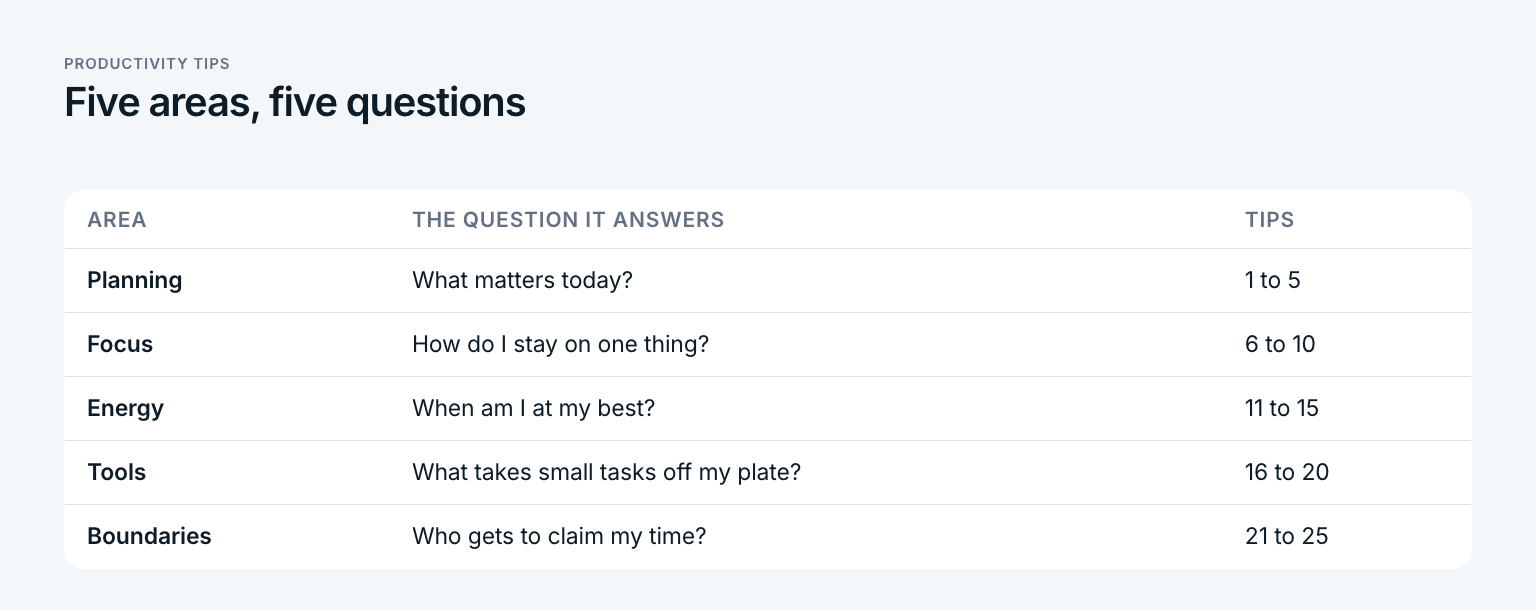
Planning: productivity tips for deciding what to do
Planning is not the goal. It decides which task gets the best hour of your day. Most lost time is lost right here, before the work even starts.
1. Start the week with one weekly goal
A to-do list collects everything that shows up. A weekly goal states what must be done by Friday. Write it on Monday in one sentence with a number: “Finish FAR chapters 5 and 6 and 150 practice questions.” Every task that week gets measured against it.
2. Plan tomorrow tonight
Ten minutes the evening before saves the half hour you would otherwise spend sorting yourself out in the morning. Pick one daily goal, give it a start time and put the remaining tasks in order. The guide on how to plan your day walks through it step by step.
3. Sort urgent from important
Urgent things are loud. Important things wait quietly. The Eisenhower Matrix puts every task into one of four boxes and shows you what to do, what to hand off and what to drop. Dana finds that most of her evening email is urgent for someone else and important to no one.
4. Find the 20 percent that carries the result
Not every task carries equal weight. The Pareto principle assumes a small share of the work produces most of the result. For Dana that share is practice questions, not rewriting notes in three colors. Ask of every list: which two items would save the week if only they got done?
5. Cap the daily list
A list with 20 items is a wish, not a plan. The 1-3-5 rule allows one big task, three medium ones and five small ones per day. The Ivy Lee method is stricter: six tasks in fixed order, worked from the top down. Both force you to decide before the day starts instead of in the middle of it.
Focus: how to be more productive inside the hour
A good plan still fails when the day breaks into fifteen-minute pieces. Focus is the ability to stay on one thing until it is done. You can train it. Mostly, though, you have to protect it.
6. Do the hardest task first
What doesn't happen in the morning often doesn't happen at all. Eat the frog means the most unpleasant important task comes before the inbox. For Dana that is a block of practice questions, not the dishes and not her phone. The rule comes from Brian Tracy's book of 21 principles, and an Eat That Frog summary in plain words explains each of them.
7. Give every important task a start time
A task without a time competes with everything else. With time blocking, each important task gets a fixed block on the calendar, as binding as a meeting. Dana moved her study sessions from 9 p.m. to 6 a.m. on four weekdays, before the office and before her phone fills up.
8. Protect one block for deep work
Hard work needs long stretches without interruption. Cal Newport calls this deep work in his 2016 book of the same name: focused effort, free of distraction, that produces something new. The guide to deep work shows how to schedule those hours and defend them. When the challenge sits just above your skill, such a block can turn into what Mihaly Csikszentmihalyi called a flow state.
9. Work in a rhythm
Some tasks are too heavy for two straight hours. The Pomodoro Technique splits them into 25 minutes of work and a five-minute break. If 25 minutes feels too short, try longer cycles, such as 50 minutes on and ten off. The number matters less than the fact that the break is fixed.
10. Do one thing at a time
Multitasking feels fast and is slow. Joshua Rubinstein, David Meyer and Jeffrey Evans showed in 2001 that every switch between two tasks costs time to reorient, and the cost grows with the complexity of the tasks. Close every window that does not belong to the task in front of you. One tab is enough. Whoever runs many things in parallel can cap them with personal kanban, a board with a fixed limit on work in progress.
Energy: how to increase productivity without adding hours
Time is fixed. Energy moves. The same hour can produce very different results at 7 a.m. and at 10 p.m. Whoever knows that plans not only tasks but also the state in which to do them.
11. Match hard work to your best hour
Everyone has hours when thinking comes easier. Watch yourself for one week and note when reading, writing or calculating goes best. That is where the focus block belongs, not the inbox. Dana assumed she was a night person. Her practice scores said otherwise: she got more questions right before work than after 9 p.m.
12. Take real breaks
A break on your phone is not a break. It is a different screen. Stand up, walk a few steps, look out a window. Anyone who walks away for ten minutes after 90 minutes of work usually comes back clearer than someone who pushes through.
13. Treat sleep as part of the plan
No tip makes up for a short night. Running on too little sleep makes you plan worse, get distracted faster and decide in a hurry. So set not only a start time for work but also a time for bed. Dana's move to morning study only worked once she was asleep by 10:30.
14. Move between blocks
Between two focus blocks, movement often helps more than another coffee. A walk around the block, stairs instead of the elevator, a phone call on your feet. Dana reviews flashcards on a 20-minute walk at lunch instead of at her desk.
15. Close the day on purpose
An open day keeps running in your head. Newport recommends a fixed shutdown ritual: write down open items, sketch tomorrow, then call it done. Five minutes is enough. That means: whoever closes the day at night does not start from zero in the morning.
Tools: the productivity hacks worth keeping
Productivity hacks have a bad reputation, and some of them earn it. A hack is fine as long as it removes friction. It becomes a hobby once setting it up takes longer than the work it saves. Dana spent two hours in one week color-coding notes. The five tips below need a rule, not a new app.
16. Capture everything in one place
Ideas on sticky notes, tasks in email, deadlines in your head: things get lost, and your mind holds on to everything so nothing slips. In Getting Things Done, David Allen calls the fix an inbox. Everything that comes in lands in one place and gets sorted later. How to build a full system around that inbox, with tasks, calendar, and filing, is the topic of how to be more organized.
17. Do two-minute tasks right away
Anything that takes less than two minutes costs more time on a list than in the doing. This rule also comes from Allen. Dana answers quick texts and confirms appointments on the spot, but only outside her study blocks.
18. Batch similar work
Email, calls, approvals: small tasks eat less time when they arrive in a batch. Set two or three fixed windows a day for your inbox and messages. Dana now checks work email from home once, at 7 p.m. for 15 minutes, and that alone cut four hours a week to one.
19. Turn repeated work into a template
Anything you have written three times deserves a template. A weekly status note, the answer to the question your clients ask most, a meeting agenda. Each template saves only a little. It saves it every single week. Dana built one study-session template: chapter, number of questions, score.
20. Use one system, not five
One calendar, one task list, one place for goals. Anyone who keeps tasks in three apps spends the time reconciling them. The best system is the one you open every day. Before you add a new tool, ask yourself: which old one goes?
Boundaries: protect the time you planned
The best plan fails when anyone can rewrite it. Boundaries are not rude. They are the condition for being able to say yes and then deliver.
21. Turn off notifications
Every notification is a small interruption someone else scheduled for you. Turn off every one that is not time-critical. Anything truly urgent will come as a call. Dana's phone now spends her study blocks in another room, and her screen time dropped from nine hours a week to four.
22. Give every meeting a goal, or skip it
A meeting without an agenda is a conversation with a calendar invite. The same goes for the calls that eat your evenings. Dana's weekly study group used to run two hours. With a one-line goal and a hard stop, it now takes 45 minutes.
23. Say no with a counteroffer
A no is easier to say when it includes an alternative: “Not Saturday morning, but I'm free from 2 p.m.” The relationship stays intact, and so does the focus block. Whoever never says no ends up working on someone else's goals.
24. Set shorter deadlines
Work expands to fill the time available for its completion. Cyril Northcote Parkinson wrote that in The Economist in 1955, and it became known as Parkinson's law. So give a task a little less time than it would take on its own. A Thursday deadline instead of Friday often does the job.
25. Measure every week instead of guessing
Your gut on Friday is not a reliable judge of whether the week was productive. Ten minutes of weekly review is: what moved the goal, what got left behind, what matters next week? Without that measurement you will never know which of the other 24 tips works for you.
Where to start: a four-week productivity plan
Twenty-five tips at once are a productivity problem of their own. So where do you start? With the area where your bottleneck sits. This table helps you find it:
| If this sounds like you | Bottleneck | Start with |
|---|---|---|
| Exhausted at night, but the important thing is still undone | Planning | Tips 1, 3 and 5 |
| Lots of things started, few finished | Focus | Tips 6, 7 and 10 |
| Nothing works after 2 p.m. | Energy | Tips 11, 12 and 13 |
| Small tasks eat your best hours | Tools | Tips 16, 17 and 18 |
| Other people run your calendar | Boundaries | Tips 21, 22 and 23 |
| No idea whether anything is moving | Measurement | Tip 25 |
Dana's table showed two bottlenecks: energy and boundaries. So she did not change everything at once. She added one piece per week. Here is the plan you can copy:
Week 1: track
For one week, write down where your hours go, as roughly as Dana's table. Mark every line yes, partly or no. By Friday you know how many hours actually moved your goal.
Week 2: set two focus blocks
Put two 90-minute blocks into your strongest hours and give each one a task that moves the goal. Email and messages stay closed during that time. Change nothing else this week.
Week 3: draw one boundary
Take the biggest time leak from week one and set a rule against it: inbox windows, an agenda for every meeting, or notifications off. Tell the people around you what changes and why.
Week 4: plan tomorrow tonight
Every evening, spend ten minutes planning the next day: one daily goal, one start time, one order. The focus blocks from week two are fixed and do not move.
After that: compare and keep
Track week four the same way and put it next to week one. Keep what raised your goal hours and drop the rest. Take on the next area only in the following month.
Dana's comparison after four weeks: 13 study hours in week four instead of six, with the same job and the same 45 hours at the office. Phone time fell from nine hours to four, work email from home from four hours to one. Her score on FAR practice sets rose from about 62 to 74 percent. That means: the December exam date is back on her calendar.
What if you run a team?
A lot of advice on how to increase productivity is written about employees, not about you. The logic is the same, one level up. Whoever wants a more productive team starts with clarity, not control: one team goal per quarter, protected focus hours with no internal meetings, and a short review on Friday. A team gets more done when its time is guarded as carefully as your own.
Productivity in the goal chain: from yearly goal to this morning
Tips make you faster. The goal chain tells you where to go. Without it you optimize hours without knowing whether they add up to anything bigger. Why would Dana sit down at 6 a.m. on a Tuesday to work through chapter 5? Her chain gives the answer:
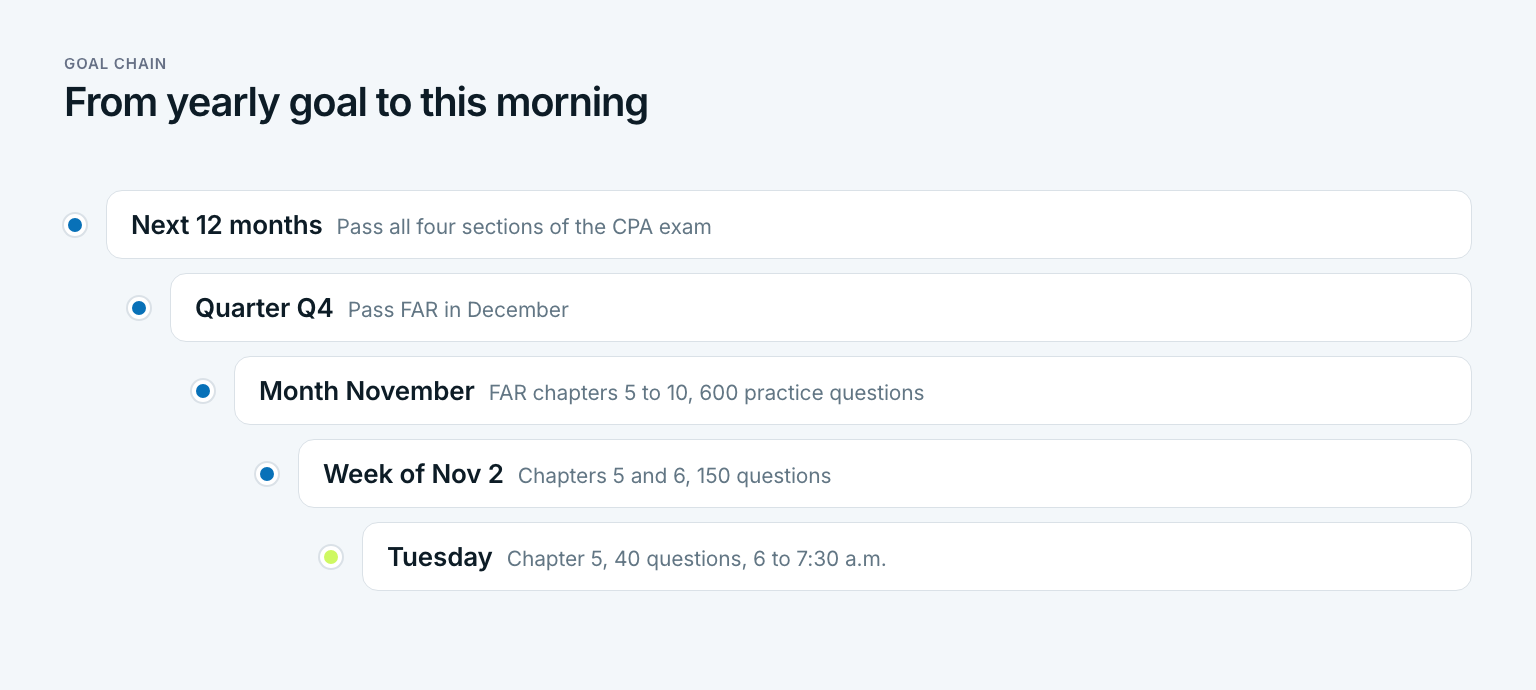
Each level answers a question for the next one. The yearly goal says why the exam matters. The quarter turns it into a date. The month sets the numbers, the week takes its share and the day sets the start time. Whoever has written the chain down once does not have to decide in the morning where the focus block begins.
The tips sit at fixed points in that chain. Pareto and Eisenhower decide what goes into the month at all. The weekly goal and weekly review belong to the week, planning the day and the focus block to the day. In Gaapp you set up that chain once and see on Friday whether the week moved the month. For the full picture of tracking goals across every level, read the guide on how to achieve goals.
Three mistakes that cancel out every tip
Productivity tips rarely fail because of the tip. They fail because of how they are used. Three patterns show up again and again:
- Everything at once. Anyone who adds ten new rules on Monday has none left by Wednesday. Habits take weeks, not days. One tip per week is slower and lasts longer.
- Efficiency without direction. Answering email faster is good. It is just not progress when the email has nothing to do with the goal. Direction first, then speed.
- No measurement. Without a comparison between week one and week four, every tip stays an opinion. With a comparison, it becomes a decision.
The most common mistake: more hours instead of different hours
When people feel unproductive, they usually add hours: start earlier, catch up at night. That works for about a week. Then the energy runs out, and the extra hours are just as fragmented as the old ones. Dana did not add a single hour. She moved her study time from the worst part of her day to the best.
Before you try the first tip, answer three questions next Friday:
- How many hours this week went directly into my goal?
- Which interruption cost the most time, and what rule will I set against it?
- Which single tip will I try next week?
Whoever answers those three questions every week does not need 25 tips at once. In short: productivity is not doing more. It is doing more of what counts.
Productivity tips: frequently asked questions
What is the 3-3-3 rule for productivity?
The 3-3-3 rule splits a workday into three parts: three hours on your most important project, three shorter urgent tasks, and three maintenance tasks such as email or errands. It is usually credited to the writer Oliver Burkeman. Its strength is the cap: once the three hours of deep work are done, the day counts as a success.
What are the top 10 productivity strategies?
Ten strategies show up in nearly every serious list: set a weekly goal, plan the day the night before, sort urgent from important, focus on the 20 percent that matters, do the hardest task first, time block your calendar, protect deep work, batch small tasks, turn off notifications and review your week. Which one helps most depends on your bottleneck, not on how popular it is.
What is the 1/3/5 rule of productivity?
The 1-3-5 rule limits your daily list to nine items: one big task, three medium ones and five small ones. It keeps a to-do list honest because the big task cannot hide among the small ones. Write the list the evening before and put the big task in your best hour.
What are five ways to improve productivity?
Start with a measurable goal, give important tasks a fixed time on your calendar, work in focused blocks with notifications off, batch email and small tasks into set windows, and review each week in ten minutes. Add them one per week rather than all at once. That way you can see which one actually changed your numbers.
Why am I busy but not productive?
Busy measures activity, productive measures progress toward a goal. Most busy weeks are full of urgent tasks that serve other people's priorities. Track one week of your time, mark which hours moved your goal, and you will usually find the gap in meetings, messages or switching between tasks.
How long do productivity tips take to work?
Single rules like turning off notifications work the same day. Habits like a morning focus block take several weeks before they feel automatic. So measure after four weeks, not after four days.
Last updated: 19 October 2026
Read next
 Productivity
Feynman Technique: Four Steps to Real Understanding
The Feynman technique is not a memorization trick: four steps, a worked example from a stats class, a one-page template, and what research says.
16 min read
 Productivity
Zettelkasten: How to Turn Notes Into Your Own Ideas
A Zettelkasten is not an archive: Luhmann's method, the three note types, a five-step setup and an Obsidian template, with a worked example.
15 min read
 Productivity
Second Brain: How to Build One You Actually Use
A second brain is not a note archive: Tiago Forte's CODE steps, the PARA method with an example, a five-step setup and the mistakes that sink it.
15 min read