How to Wake Up Early: A Four-Week Plan That Sticks
Waking up early is not a willpower test. A four-week step plan, a bedtime calculator and tips on how to wake up early without losing sleep.

Contents
- 01What waking up early actually means
- 02Is waking up early good for you? What the research says
- 03What really happened in Priya's first two weeks
- 04How much sleep you need: count back from the alarm
- 05How to wake up early without losing sleep: five steps
- 06Tips on how to wake up early in the morning when the alarm rings
- 07Three mistakes that end early rising after two weeks
- 08Waking up early in the goal chain: what the extra hour is for
- 09Three questions before you move your alarm
- 10Frequently asked questions about waking up early
Learning how to wake up early is not a test of willpower. It is a scheduling problem with two ends: you move your alarm back in steps of 15 minutes every three to four days, you move your bedtime back by the same amount, and you keep the new wake time on all seven days, weekends included. Light in the morning and dim light at night help your body clock follow. Anyone who only moves the alarm is trading sleep for an hour they will spend tired.
What you do with that hour is a separate question. If you want to build the first minutes of the day around a goal, the guide to a morning routine covers it, and the review of the Miracle Morning looks at Hal Elrod's SAVERS. This article is about the step before both: how to shift the wake time itself without losing sleep. Everything is worked through with Priya, who wants to study before work and needs to be up at 5:45 a.m. to do it.
What waking up early actually means
There is no official hour at which waking up counts as early. A baker's alarm goes off at 3 a.m., and for a college student 8 a.m. can feel brutal. A more useful definition: waking up early means being awake before your obligations start, with enough room to do something of your own first.
Three things it is not. It is not a moral virtue, even though early risers get more praise than night owls. It does not create time, because the day still has 24 hours and every minute you gain in the morning comes out of the evening. And it is not a 5 a.m. requirement. The 5 a.m. ideal owes a lot to Robin Sharma's 2018 book The 5 AM Club. That hour works for some people. For many, it is an hour too early.
Chronotype: your body's own clock
Your chronotype is the time your body prefers to sleep and wake when nothing interferes. Morning types, often called larks, get sleepy early in the evening. Evening types, the owls, come alive late. Most people sit somewhere in between. Chronotype is partly inherited and shifts with age. That means: an owl can learn to get up early too. It just takes a longer run-up and stricter evenings than it takes a lark.
Is waking up early good for you? What the research says
Waking up early is fine for your health as long as your sleep does not get shorter. That is the short answer. The longer one starts with how much of your wake time you control in the first place.
Part of it is genetic. In 2019, Samuel Jones and colleagues analyzed genetic data from 697,828 people in Nature Communications and found 351 locations in the genome linked to being a self-described morning person. Part of it is age. Till Roenneberg and colleagues showed in Current Biology in 2004 that people are at their latest around age 20 and drift earlier after that. Whoever could not get out of bed at 19 may still turn out to be a lark at 45.
Most of the rest is habit and light. Roenneberg coined the term social jetlag for it. Marc Wittmann, Roenneberg and colleagues described it in 2006 as the gap between your sleep timing on workdays and on free days. Anyone who gets up at 6 a.m. during the week and sleeps until 9 a.m. on Saturday flies to another time zone every weekend and back again on Monday. Is it any surprise that Monday morning feels like a red-eye flight?
Regularity matters more than most people think. In a 2024 study in the journal Sleep, Daniel Windred and colleagues looked at about 60,000 UK Biobank participants whose sleep was measured with a wrist sensor. A regular sleep schedule was more strongly linked to lower mortality risk than sleep duration alone. That is an association, not proof. It still supports a simple rule: a consistent wake time matters more than an early one.
What about the claim that early risers get more done? Christoph Randler found in a 2009 survey of university students that morning types were more likely to describe themselves as proactive. Again, that is a correlation. Proactive people may simply choose to get up early, not the other way around. In short: waking up early will not make you healthier or more successful on its own. Waking up early on a regular schedule with enough sleep will not hurt you either, and it gives you a window nobody else is claiming.
What really happened in Priya's first two weeks
Priya is 32 and works as a staff accountant. Her workday starts at 8:30 a.m., and her commute takes 35 minutes. She wants to pass the first section of the CPA exam in March. After work she is too drained to study, and her evenings already belong to dinner, her partner Sam and a podcast in bed. Her alarm has gone off at 7:15 a.m. for years. Lights out is usually around 12:15 a.m.
One Sunday she decides to start the next morning at 5:45 a.m. and study for an hour before work. She keeps her bedtime as it is. After two weeks she counts:
| Period | Days | Up at 5:45 a.m. | Study sessions | What got in the way |
|---|---|---|---|---|
| Week 1, Monday to Friday | 5 | 4 | 3 | Hit snooze twice from Wednesday on, Thursday session cut to 25 minutes |
| Week 1, weekend | 2 | 0 | 0 | Slept until 9:30 a.m. to catch up |
| Week 2, Monday to Friday | 5 | 1 | 1 | Wide awake until 1 a.m. on Sunday night, could not get up Monday |
| Week 2, weekend | 2 | 0 | 0 | Slept in again |
| Total | 14 | 5 | 4 | 36 percent of mornings at 5:45 a.m. |
Five out of 14 mornings. Without counting, Priya would have concluded that she is just not a morning person. With the count in front of her, she sees two causes that have nothing to do with character. First, she got at most five and a half hours of sleep a night in week one, because 12:15 a.m. to 5:45 a.m. leaves no more. Second, sleeping in on the weekend pushed her body clock back, so the second Monday started with social jetlag.
That means: Priya does not lack discipline or willpower. She cut an hour and a half of sleep from every weeknight and expected her body not to notice. How much sleep she actually needs is the first number to settle before she touches the alarm again.
How much sleep you need: count back from the alarm
Most adults need at least seven hours of sleep a night. That is the joint recommendation of the American Academy of Sleep Medicine and the Sleep Research Society, published by Nathaniel Watson and colleagues in 2015. The National Sleep Foundation recommended seven to nine hours for adults aged 18 to 64 the same year. Your personal number sits somewhere in that range.
The easiest way to find it is on vacation. Whoever wakes up after roughly the same number of hours on day four or five without an alarm has found their need. For Priya it is about seven and a half hours. She also needs around 15 minutes to fall asleep. The math is then simple: wake time minus sleep need minus time to fall asleep equals lights out.
| Wake time | Lights out for 7 hours | Lights out for 7.5 hours | Lights out for 8 hours |
|---|---|---|---|
| 5:00 a.m. | 9:45 p.m. | 9:15 p.m. | 8:45 p.m. |
| 5:45 a.m. | 10:30 p.m. | 10:00 p.m. | 9:30 p.m. |
| 6:00 a.m. | 10:45 p.m. | 10:15 p.m. | 9:45 p.m. |
| 6:30 a.m. | 11:15 p.m. | 10:45 p.m. | 10:15 p.m. |
For Priya that means an alarm at 5:45 a.m. and lights out at 10 p.m. That is more than two hours earlier than she is used to. No wonder the overnight jump failed. Many online sleep calculators also work with 90-minute sleep cycles. Cycle length varies from person to person and from night to night, though. Treat the table as a starting point and adjust after a week if you still wake up groggy.
Is 11 p.m. to 6 a.m. enough sleep?
Seven hours in bed from 11 p.m. to 6 a.m. gives you a little less than seven hours of actual sleep, because falling asleep and brief awakenings take some of it. For many adults that sits right at the lower edge of the recommendation. Anyone who needs eight hours will feel it by Thursday. If you can move lights out to 10:30 p.m., you buy a buffer that makes the 6 a.m. alarm much easier to keep.
The 4 a.m. rule and the 5 a.m. club
Getting up at 4 a.m. or 5 a.m. to work before the world wakes up is a popular idea online. It is a lifestyle choice, not a finding from sleep research. The arithmetic is unforgiving: a 4 a.m. alarm with seven hours of sleep means lights out around 8:45 p.m. Who among parents, shift workers or anyone with an evening social life can keep that on all seven days? The healthiest wake time is the one you can hold every day without dropping below seven hours.
How to wake up early without losing sleep: five steps
Waking up earlier works like any other habit: small steps, a fixed anchor and a reason. The plan below moves your wake time 15 minutes every four days. That gives your body time to adjust, and your evening moves with it.
Set the target time and the reason
Write down the new wake time and, next to it, what the extra time is for. Without a reason, the blanket wins at 5:45 a.m. Priya writes: 5:45 a.m., one hour of CPA study five days a week, first exam section in March.
Count back to your bedtime
Subtract your sleep need and the time it takes to fall asleep. The result is not a suggestion. It is the real appointment in the plan. Priya puts lights out at 10 p.m. in her calendar with a reminder at 9:30 p.m.
Shift in 15-minute steps
Move the alarm 15 minutes earlier every three to four days and go to bed 15 minutes earlier too. From 7:15 a.m. to 5:45 a.m. is 90 minutes, which makes six steps. At four days per step, Priya reaches her target on day 21.
Bright mornings, dim evenings
Bright light right after waking moves your body clock earlier, and bright light late in the evening pushes it later. Open the blinds, turn on the lights and step outside for ten minutes if you can. From 9 p.m. on, Priya dims the lights and charges her phone in the kitchen.
Keep the wake time all seven days
On weekends, the same alarm or at most 30 minutes later. Anyone who needs to catch up on sleep should go to bed earlier on Friday rather than sleep in on Saturday. That keeps Monday a normal day.
Step four rests on a striking experiment. In 2013, Kenneth Wright and colleagues sent volunteers camping in the Colorado Rockies for a week with no electric light, only sunlight and campfires. Their body clocks shifted about two hours earlier in that week, and the gap between early and late types shrank sharply. The study appeared in Current Biology. You do not have to go camping. Whoever seeks daylight in the morning and dims the lights at night is pulling the same lever.
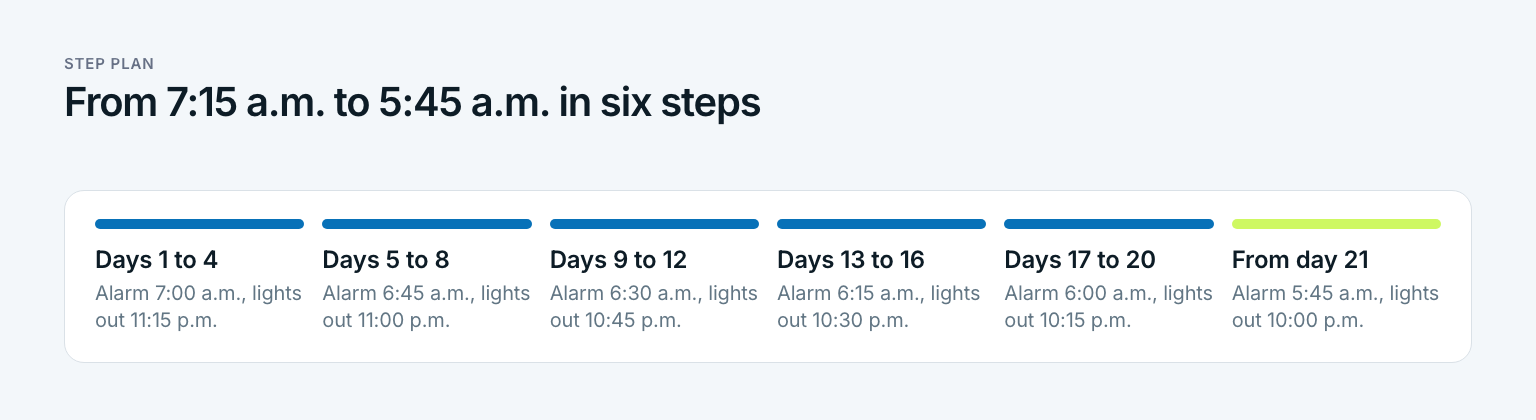
Why not just jump? Because a 90-minute jump feels like flying east across one and a half time zones. You can do it, but the first days are rough, and those are exactly the days when you decide whether to keep going. The step plan is slower, but it holds. Priya needs three weeks to reach 5:45 a.m. Her first attempt lasted eight days.
Tips on how to wake up early in the morning when the alarm rings
The plan decides the weeks. The first two minutes decide each single morning. What helps when the alarm goes off at 5:45 a.m. and every part of you says no?
Start by giving your body some credit. The fog right after waking has a name: sleep inertia. Patricia Tassi and Alain Muzet described it in a 2000 review as a normal transition state that usually fades within about half an hour. That means: how you feel in the first minutes says nothing about how the morning will go. So make no decisions lying down.
- Put the alarm out of reach. If it sits on the dresser across the room, you have to stand up to turn it off. The hardest part is then already done.
- Decide the first action the night before. Priya leaves her laptop open on the kitchen table with the practice questions already loaded. At 5:45 a.m. she does not choose anything, she just sits down. The guide to an evening routine shows how the night before sets up the morning.
- Light and water first. Lights on, a glass of water from the kitchen. Both pull you out of sleep inertia without any thinking.
- No phone for the first ten minutes. Anyone who reads messages first is mentally at work and still in bed at 6 a.m.
- Keep caffeine away from the evening. Christopher Drake and colleagues showed in 2013 that caffeine taken even six hours before bed can cut sleep by more than an hour. The 4 p.m. latte costs you the next morning.
And the snooze button? Fairness first. Tina Sundelin and colleagues studied habitual snoozers in 2023 in the Journal of Sleep Research. Thirty minutes of snoozing did not hurt their performance on thinking tests. So snoozing is not poison. It is just built for something other than getting up early: it stretches the night in pieces instead of ending it. If you like to snooze, set the alarm for the time you actually want to get up and take those 30 minutes as real, unbroken sleep.
How to force yourself to wake up early
You cannot force it for long. Force works for a week, then the sleep debt wins. What does work is making the decision earlier: the bedtime in the calendar, the alarm across the room, the first action prepared the night before. Whoever has made all three decisions by 9 p.m. only has to follow them at 5:45 a.m.
Three mistakes that end early rising after two weeks
Most attempts to get up earlier die in week two or three. Rarely in the morning itself, usually in the evening or on the weekend before. Do you recognize yourself in any of these three?
The most common mistake: moving the alarm but not the evening
Anyone who gets up an hour earlier and still goes to bed at the same time sleeps an hour less. That lasts a few days and then it breaks, usually on a Thursday or on the Monday after a weekend. Waking up early is an evening appointment first. Only when lights out sits where the math says it should does the alarm stand a chance.
- Sleeping in on weekends. Two mornings until 9:30 a.m. push your body clock back, and Monday starts with social jetlag. Better: the same wake time, and if you are tired, an earlier night on Friday or a short nap on Saturday.
- Time without a purpose. Whoever gets up at 5:45 a.m. and then scrolls the news at the kitchen counter has traded sleep for screen time. After a few days your brain fairly asks what the point is.
- All or nothing. A missed morning is not a relapse. It becomes one when you give up the bedtime the next evening. The rule: never miss twice in a row.
One note before moving on: if you spend enough time in bed and still feel tired for weeks, struggle to fall asleep or wake up often at night, talk to a doctor. Ongoing tiredness can point to a sleep disorder that no step plan will fix.
Waking up early in the goal chain: what the extra hour is for
Waking up early is a means, not a goal. The extra hour only pays off when it is clear what it is for. For some that is a run, for others it is three handwritten pages, as in morning pages by Julia Cameron. Each morning needs an answer to one question: what is on today? The goal chain provides it. Your yearly goal becomes a quarterly goal, the quarterly goal a monthly goal, then a weekly goal and a daily goal. The daily goal is what happens at 5:45 a.m.
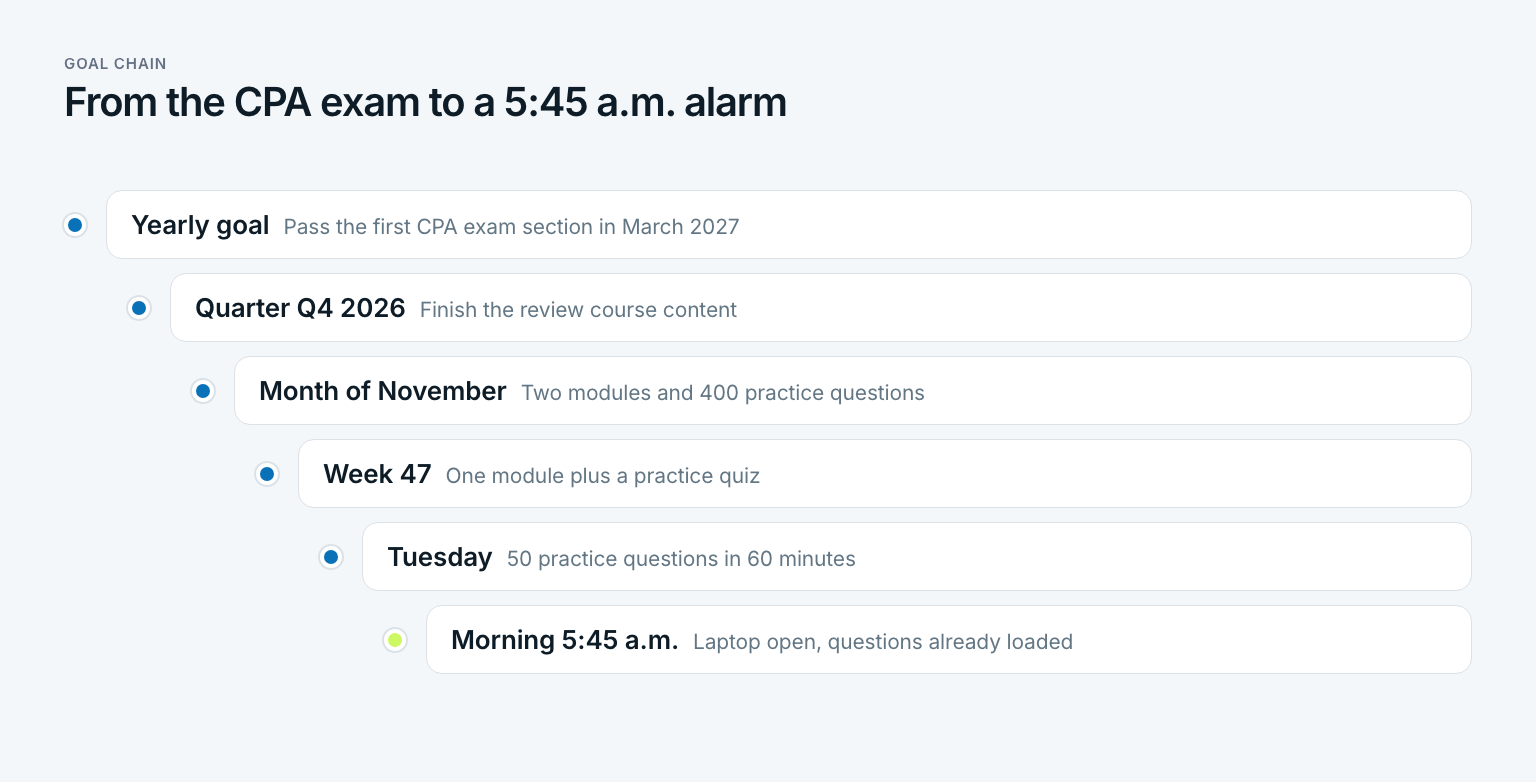
For Priya it looks like this. Yearly goal: pass the first section of the CPA exam in March 2027. Quarter Q4 2026: finish the review course content. Month of November: two modules and 400 practice questions. Week 47: one module plus a practice quiz. Tuesday: 50 practice questions in 60 minutes. The alarm is no longer self-improvement. It is the smallest piece of a plan that ends in an exam room in March.
In Gaapp, every daily goal hangs on a weekly goal, and every weekly goal on a monthly goal. For Priya that means on Friday she sees not just how often she got up at 5:45 a.m., but whether those mornings moved the module forward. If you want to break a yearly goal into daily steps like these, the guide on how to turn yearly goals into daily steps shows the method.
Six weeks in, Priya counts again, this time the two weeks after reaching her target. She was up by 6 a.m. on 13 of 14 days, weekends included. All ten planned study sessions happened, and she worked through 480 practice questions. Once she slept until 7:30 a.m. after a friend's wedding and turned the lights out at 10 p.m. the next evening anyway. Is the new wake time a habit yet? Not quite. Phillippa Lally and colleagues found in 2009 that new behaviors took 66 days on average to become automatic, with a wide range. The article on how long it takes to form a habit has the details. Until the exam, the plan stays as it is.
Three questions before you move your alarm
Before you change the alarm tonight, answer three questions:
- What exactly is the extra time for, and which goal does it feed?
- What time does lights out need to be for your new wake time, and what would have to go from your evenings?
- Can you keep that wake time on Saturday and Sunday without your partner, kids or friends paying for it?
Anyone who cannot answer the first question gains an hour but no progress. Anyone who stalls on the second should start with the evening, not the morning. Anyone who answers no to the third is better off with a later target they can hold all week. In short: waking up early does not start with the alarm in the morning. It starts with lights out the night before.
Frequently asked questions about waking up early
How can I force myself to wake up early?
Force rarely lasts more than a week, because the sleep debt wins. Make the decisions the night before instead: lights out in your calendar, the alarm across the room and your first action prepared. Then move your wake time in 15-minute steps every three to four days.
What is the 4am rule?
The 4am rule is a productivity idea from social media: get up at 4 a.m. to work on your own goals before anyone else is awake. It is not a finding from sleep research. With seven hours of sleep it means lights out around 8:45 p.m., which few people can keep on all seven days.
What is the 10 5 3 2 1 rule for sleep?
It is a rule of thumb that circulates online in several versions, not a clinical guideline. Most versions count back from bedtime: no caffeine in the last ten hours, no heavy food or alcohol in the last three, no work in the last two and no screens in the last hour. The caffeine part is the best supported, since caffeine six hours before bed cut sleep by more than an hour in a 2013 study by Drake and colleagues.
Is 11pm to 6am enough sleep?
Seven hours in bed gives you a little under seven hours of actual sleep, which sits at the lower edge of the recommendation for adults. For many people that works, but anyone who needs eight hours will feel it by midweek. Moving lights out to 10:30 p.m. adds a useful buffer.
How long does it take to start waking up early?
With 15-minute steps every three to four days, you can move your wake time 90 minutes earlier in about three weeks. Feeling natural takes longer. In a 2009 study by Lally and colleagues, new habits took 66 days on average to become automatic.
Can a night owl become a morning person?
Yes, within limits. Chronotype is partly inherited, but light, a fixed wake time and an earlier bedtime can shift your body clock earlier. Owls usually need more patience and stricter evenings than larks to get there.
Last updated: 22 October 2026
Read next
 Habits
75 Hard: Rules, Risks and a Version You Can Finish
75 Hard is not a fitness program. The full rules, four health risks, 75 Soft compared and a custom version built around a real goal.
15 min read
 Habits
Digital Detox: A 7-Day Plan to Reduce Screen Time
A digital detox isn't a weekend offline. What the research shows, how to measure and reduce screen time, plus a 7-day plan with a worked example.
15 min read
 Habits
Delayed Gratification: Meaning, Examples, How to Build It
Delayed gratification isn't self-denial, it's a trade: what the marshmallow test really showed, everyday examples, five proven strategies and a plan.
15 min read